
Types of Quantitative Measurements Chapter 1 Section 2

- Slides: 7
Types of Quantitative Measurements Chapter 1, Section 2
What are the different types of measurements you can use to collect data? n n Length Mass Temperature Weight n n n Time Volume Density
Compare the Different Types of Measurements 1. Length a. The distance from one point to another point. b. Base (SI) unit is the meter (m) c. Tool is the metric ruler.
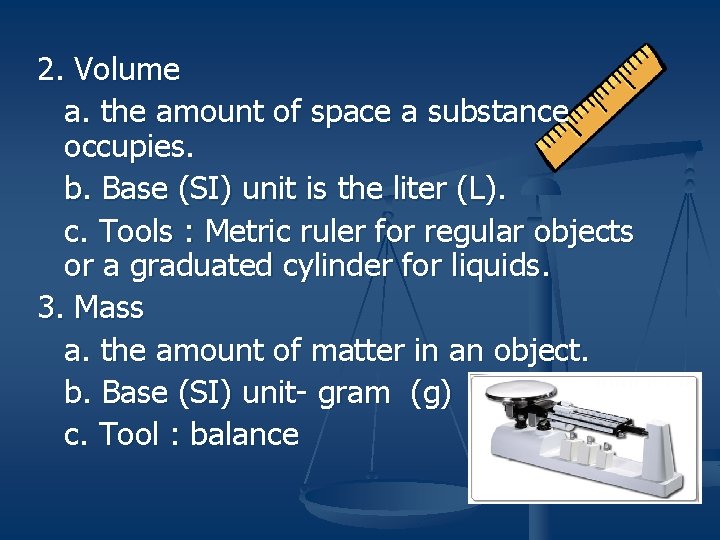
2. Volume a. the amount of space a substance occupies. b. Base (SI) unit is the liter (L). c. Tools : Metric ruler for regular objects or a graduated cylinder for liquids. 3. Mass a. the amount of matter in an object. b. Base (SI) unit- gram (g) c. Tool : balance
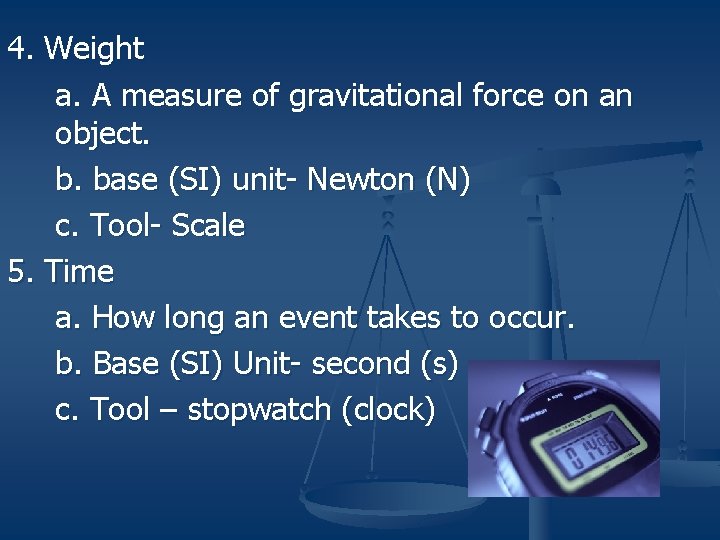
4. Weight a. A measure of gravitational force on an object. b. base (SI) unit- Newton (N) c. Tool- Scale 5. Time a. How long an event takes to occur. b. Base (SI) Unit- second (s) c. Tool – stopwatch (clock)
6. Temperature a. The amount of kinetic energy a substance has. b. base (SI) unit- Celsius (C) c. Tool- thermometer 7. Density a. How compacted the matter is in a substance. b. Base (SI) Units- gram/ml, gram/cm 3 c. Density is a calculated unit. d. D = Mass / Volume or D=M/V
Practice (We Do) n n n Think- Pair- Share. Think- Identify the measurement and tool for each situation. Pair- Discuss with your partner your responses. Share- Confirm a correct response and correct those you may have wrong. Paste in your notebook on the next page.