
TYPES OF PUFF PASTRY KSHS 2 200 TYPES
- Slides: 12
TYPES OF PUFF PASTRY KSHS 2, 200
TYPES OF PUFF PASTRY There are three recognised types of puff pastry based on the amount of total fat present. These are: Ø full puff Ø three quarter puff Ø half puff These relate to the proportion of total fat weight to flour weight, i. e. if a batch was based on 3 Kg of flour a three quarter puff would contain 2250 gms of total fat and so on.
PROCESSING • Flour, cake margarine, salt and relaxants if used are mixed together. The water is then added and a dough formed. The dough needs to be thoroughly mixed to develop a good gluten structure. After mixing the dough is cut into appropriate batch weights, rounded up and allowed to rest prior to laminating. It is important to have materials at the correct temperature - cold water would be used for the puff pastry dough with the layering fat used at room temperature. The ambient temperature within pastry manufacturing areas should also be maintained at around 18°C.
Purpose of Lamination Ø The main purpose with all methods is to build up continuous layers of fat and dough, so it is important to ensure that the fat is evenly distributed in the initial stage and that subsequent folding is done evenly and with care. TYPES OF TURNS There are two types of folds used in puff pastry manufacture. These are referred to as: Ø Half turn A half turn is where the paste is sheeted to a rectangle and folded into 3. Ø Book turn This is when the paste is sheeted to a rectangle. The ends are folded to the centre and then one side is folded over the other.
VARIETIES OF PUFF PASTRY PRODUCTS Savoury puff pastry products Ø Sausage rolls Ø Meat pies Ø Chicken pies They are carefully egg washed before baking. NUMBER OF FOLDS The greater the number of folds, the greater the number of layers, which markedly effects the finished volume/lift during baking. A paste with around 4 half turns will produce a puff with coarse open layers which will break apart easily. As the number of turns increases the lift becomes less erratic and more controlled with a much finer structure. In excess of 6 half turns volume begins to be lost as layers start to merge together.
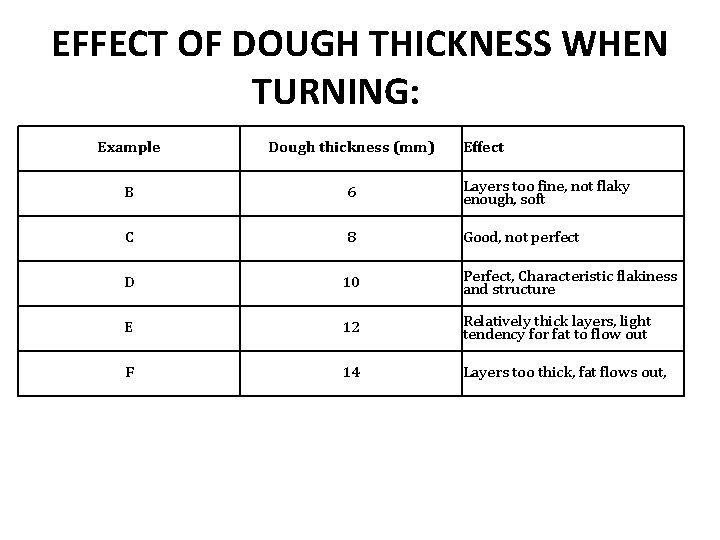
EFFECT OF DOUGH THICKNESS WHEN TURNING: Example Dough thickness (mm) Effect B 6 Layers too fine, not flaky enough, soft C 8 Good, not perfect D 10 Perfect, Characteristic flakiness and structure E 12 Relatively thick layers, light tendency for fat to flow out F 14 Layers too thick, fat flows out,
Ø The ideal number of folds and in turn the number of layers, will be dependant on the product being produced. Where stability without crumbliness is required and flakiness without volume then the number of layers/turns would be high - possibly in excess of 6 half turns, for such items as vanilla sheets. Docking or pricking the dough with a docker or fork can also be used if restricted lift is required. This would be done on vanilla sheets/strips and the centres of vol-au-vents etc. Ø Where more flakiness is required then fewer turns may be employed perhaps for sausage rolls etc. Having said that most puff pastry items will benefit from puff with 6 half turns using the French method and 5 -6 half turns using the English method.
THEORY OF AERATION Ø The aeration/lift in puff pastry is brought about by water in the dough turning to steam during baking. Ø This becomes trapped between the impervious fat layers causing them to lift apart. There will also be some expansion of air cells trapped in the dough. Ø Eventually the pastry fat will melt into the dough, the protein (gluten) in the flour will coagulate, starches in the flour will gelatinise and the structure will become rigid.
Use of Trimmings Ø It is necessary to reuse as much of the trimmings as possible to prevent wastage. Trimmings may be incorporated into fresh batches at the mixing stage at a set percentage. Ø Only uncontaminated trimmings should be used and these should be stored under refrigerated conditions and used within 24 hours. Ø In some cases trimmings are laminated into fresh bundles of puff during the early stages of turning.
INTERNSHIP Practical tasks: Ø Have a look at the types of puff pastry being produced in your bakery. Ø Ask about the materials being used for puff pastry. Ø Ask why different folding methods are used for some products and why some products have different number of turns to others. INTERNSHIP THEORY Ø Explain to your work mates what you have learned about: Ø The selection of ingredients for puff pastry. Ø The 3 methods of layering puff pastry. Ø The effects of numbers of turns on baked product. Ø The difference between ‘half' turns and ‘book' turns. Ø The need to rest puff between turns and before baking
QUESTIONS – PUFF PASTRY Q 1. Which of the following statements is correct? • A half puff is one made using half turn • A half puff has as many turns as full turn • A half puff is one in which the fat contents is half the flour weight Q 2. Which of the following statements is correct with reference to pastry fat? • Puff pastry fat is a firm plastic fat • Puff pastry fat is responsible of paste flavour • Puff pastry fat is low melting point fat Q 3. The optimum number and type of turns will be • Produced by using book turns • Depend on the product being produced • Produced by giving 4 half turns
Q 4. Which of the following statement is correct in relation to flour? • The type of flour required for puff pastry needs to be strong • The type of flour required for puff pastry needs to be weak • The type of flour required for puff pastry needs to have a protein content of 8% Q 5. Trimmings should be incorporated in to the puff pastry at what stage? • Into the fresh batch at the mixing stage, at a set percentage • At the final turn • When adding the fat Q 6. It is essential to rest puff pastry products prior to baking to prevent • Shrinkage and distortion • Excessive volume • Early colouration during baking