
Types of Product Costing Systems Process Costing Joborder
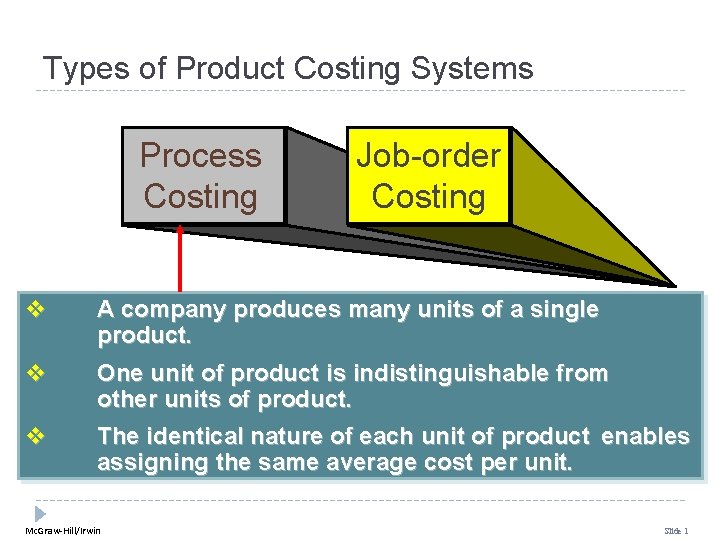
Types of Product Costing Systems Process Costing Job-order Costing v A company produces many units of a single product. v One unit of product is indistinguishable from other units of product. v The identical nature of each unit of product enables assigning the same average cost per unit. Mc. Graw-Hill/Irwin Slide 1
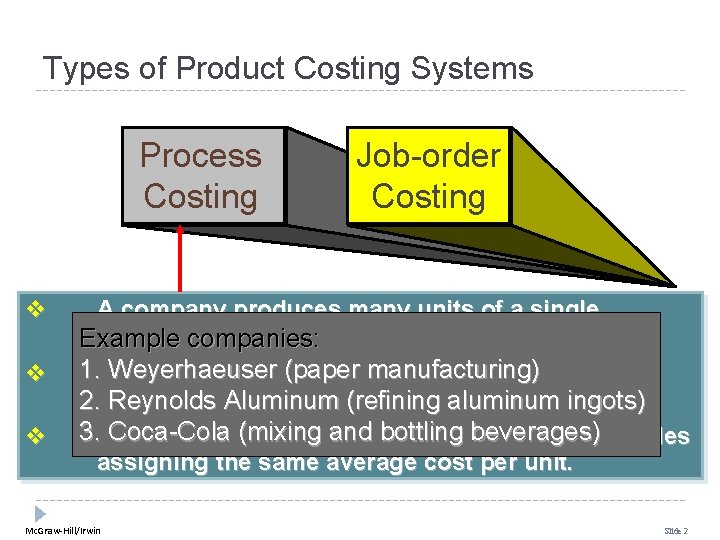
Types of Product Costing Systems Process Costing Job-order Costing v A company produces many units of a single product. companies: Example v 1. One Weyerhaeuser (paper manufacturing) from unit of product is indistinguishable units Aluminum of product. (refining aluminum ingots) 2. other Reynolds 3. The Coca-Cola bottling identical(mixing nature and of each unit beverages) of product enables v assigning the same average cost per unit. Mc. Graw-Hill/Irwin Slide 2
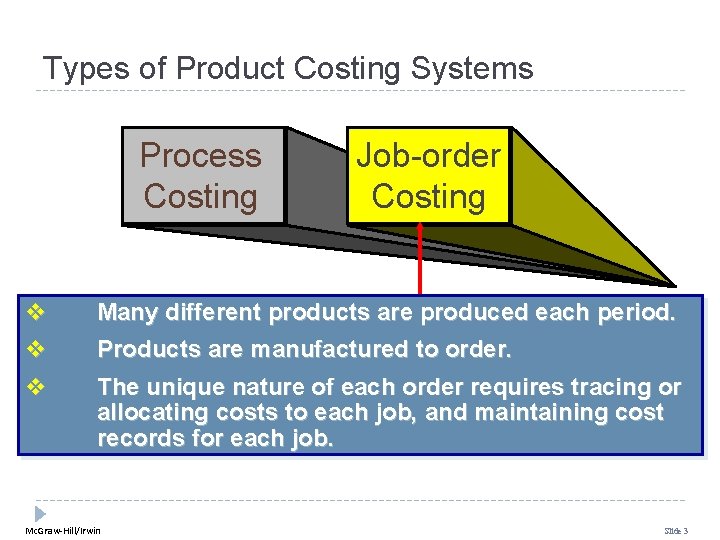
Types of Product Costing Systems Process Costing Job-order Costing v v Many different products are produced each period. v The unique nature of each order requires tracing or allocating costs to each job, and maintaining cost records for each job. Products are manufactured to order. Mc. Graw-Hill/Irwin Slide 3

Types of Product Costing Systems Process Costing v v v Job-order Costing Many different products are produced each period. Example companies: are manufactured to order. 1. Products Boeing (aircraft manufacturing) unique nature of each order requires tracing or 2. The Bechtel International (large scale construction) costs to each job, and maintaining cost 3. allocating Walt Disney Studios (movie production) records for each job. Mc. Graw-Hill/Irwin Slide 4
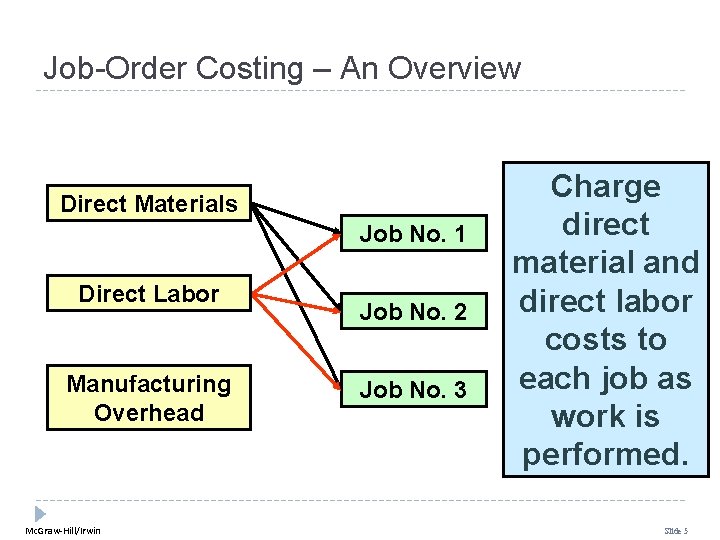
Job-Order Costing – An Overview Direct Materials Job No. 1 Direct Labor Manufacturing Overhead Mc. Graw-Hill/Irwin Job No. 2 Job No. 3 Charge direct material and direct labor costs to each job as work is performed. Slide 5

Indirect Manufacturing Costs Direct Materials Job No. 1 Direct Labor Manufacturing Overhead Mc. Graw-Hill/Irwin Job No. 2 Job No. 3 Manufacturing Overhead, including indirect materials and indirect labor, are allocated to all jobs rather than directly traced to each job. Slide 6
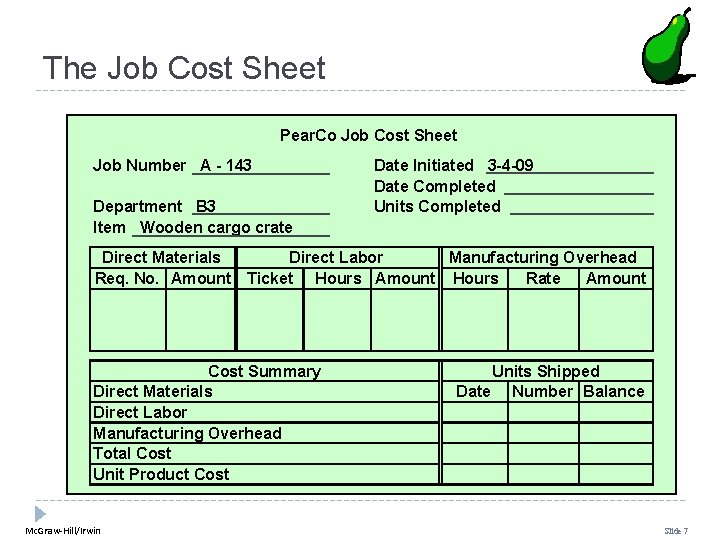
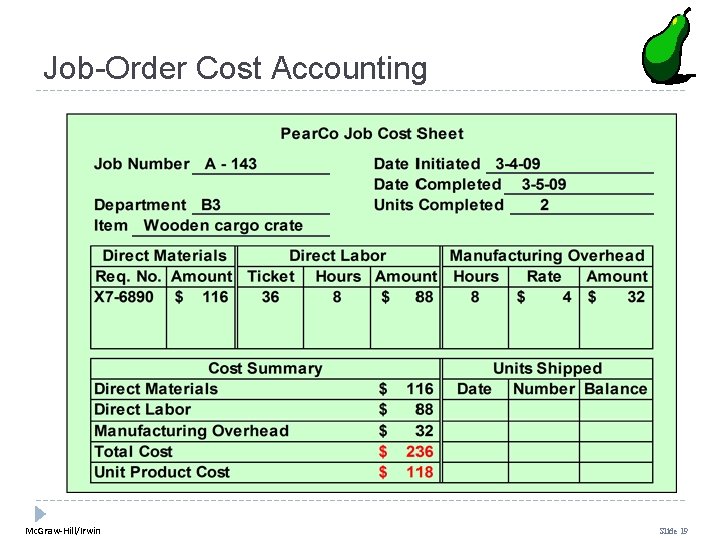
The Job Cost Sheet Pear. Co Job Cost Sheet Job Number A - 143 Department B 3 Item Wooden cargo crate Date Initiated 3 -4 -09 Date Completed Units Completed Direct Materials Direct Labor Manufacturing Overhead Req. No. Amount Ticket Hours Amount Hours Rate Amount Cost Summary Direct Materials Direct Labor Manufacturing Overhead Total Cost Unit Product Cost Mc. Graw-Hill/Irwin Units Shipped Date Number Balance Slide 7
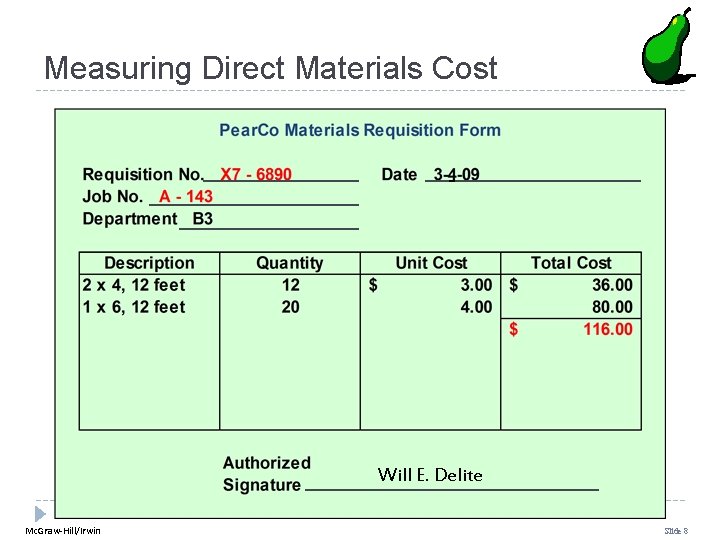
Measuring Direct Materials Cost Will E. Delite Mc. Graw-Hill/Irwin Slide 8
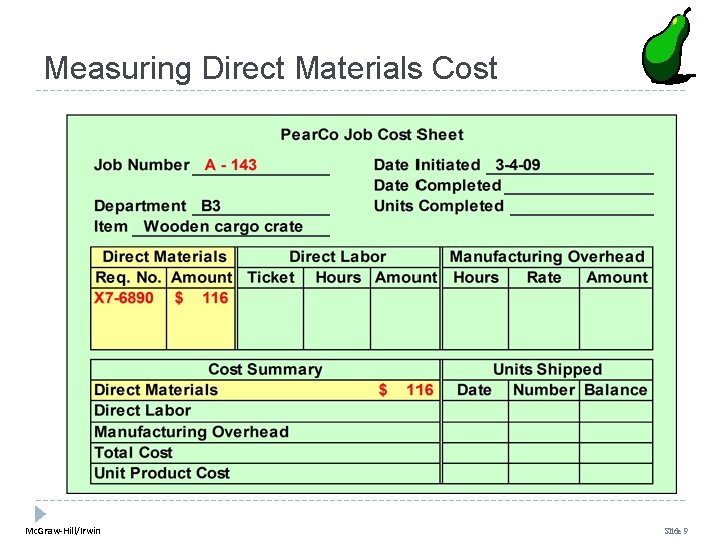
Measuring Direct Materials Cost Mc. Graw-Hill/Irwin Slide 9
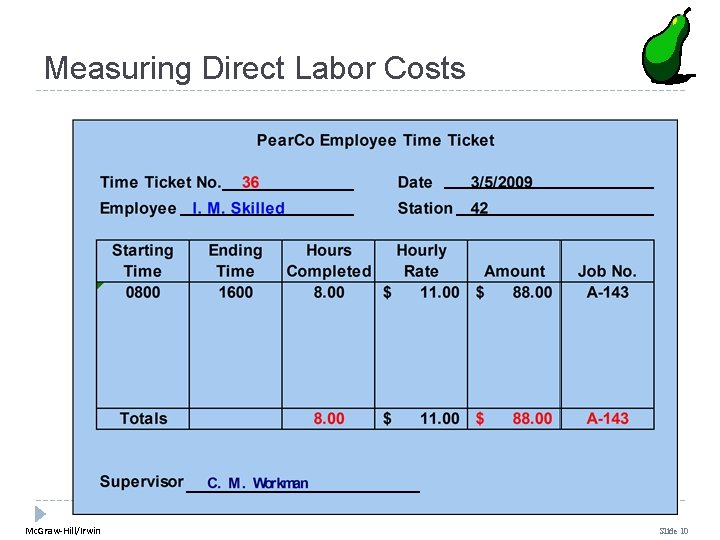
Measuring Direct Labor Costs Mc. Graw-Hill/Irwin Slide 10
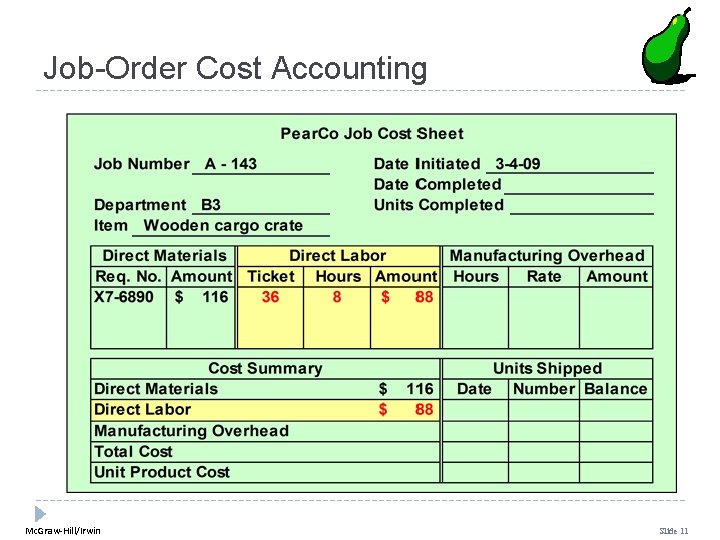
Job-Order Cost Accounting Mc. Graw-Hill/Irwin Slide 11
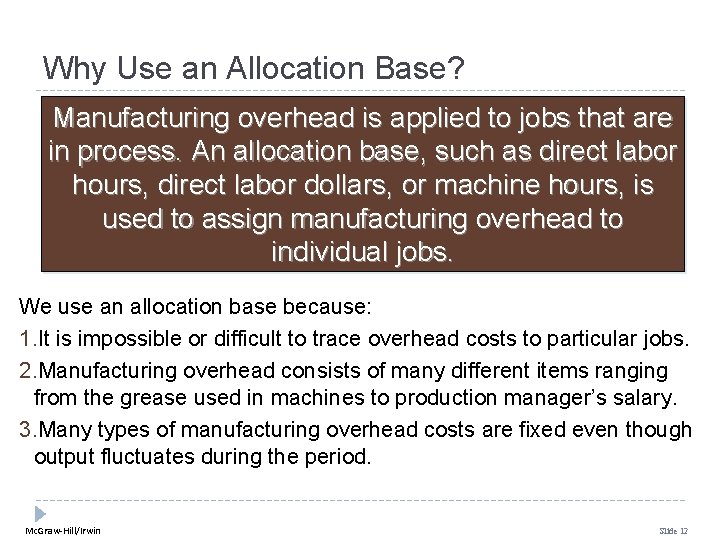
Why Use an Allocation Base? Manufacturing overhead is applied to jobs that are in process. An allocation base, such as direct labor hours, direct labor dollars, or machine hours, is used to assign manufacturing overhead to individual jobs. We use an allocation base because: 1. It is impossible or difficult to trace overhead costs to particular jobs. 2. Manufacturing overhead consists of many different items ranging from the grease used in machines to production manager’s salary. 3. Many types of manufacturing overhead costs are fixed even though output fluctuates during the period. Mc. Graw-Hill/Irwin Slide 12
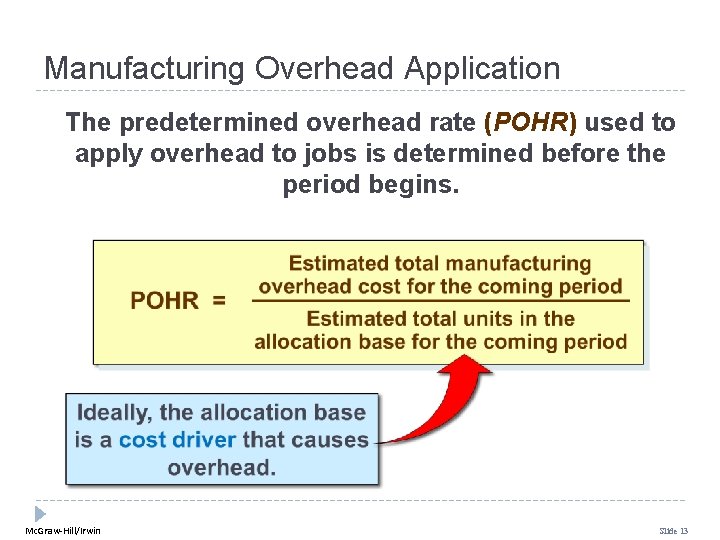
Manufacturing Overhead Application The predetermined overhead rate (POHR) used to apply overhead to jobs is determined before the period begins. Mc. Graw-Hill/Irwin Slide 13
The Need for a POHR Using a predetermined rate makes it possible to estimate total job costs sooner. Actual overhead for the period is not known until the end of the period. Mc. Graw-Hill/Irwin Slide 14
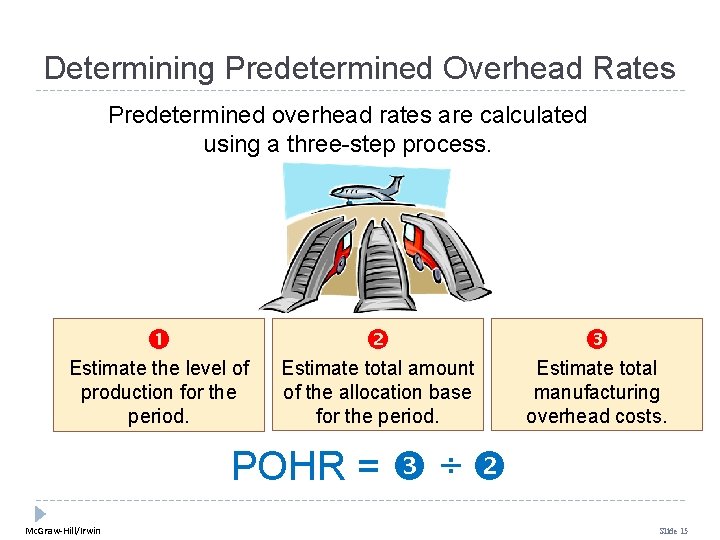
Determining Predetermined Overhead Rates Predetermined overhead rates are calculated using a three-step process. Estimate the level of production for the period. Estimate total amount of the allocation base for the period. Estimate total manufacturing overhead costs. POHR = ÷ Mc. Graw-Hill/Irwin Slide 15
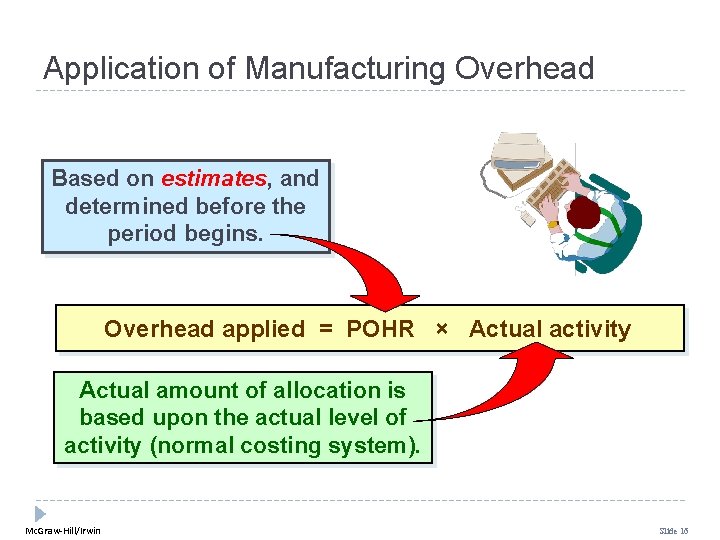
Application of Manufacturing Overhead Based on estimates, and determined before the period begins. Overhead applied = POHR × Actual activity Actual amount of allocation is based upon the actual level of activity (normal costing system). Mc. Graw-Hill/Irwin Slide 16
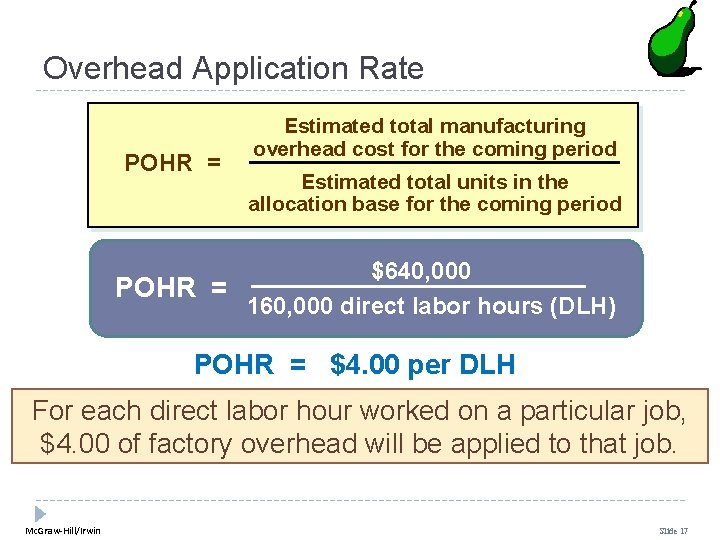
Overhead Application Rate POHR = Estimated total manufacturing overhead cost for the coming period Estimated total units in the allocation base for the coming period $640, 000 POHR = 160, 000 direct labor hours (DLH) POHR = $4. 00 per DLH For each direct labor hour worked on a particular job, $4. 00 of factory overhead will be applied to that job. Mc. Graw-Hill/Irwin Slide 17
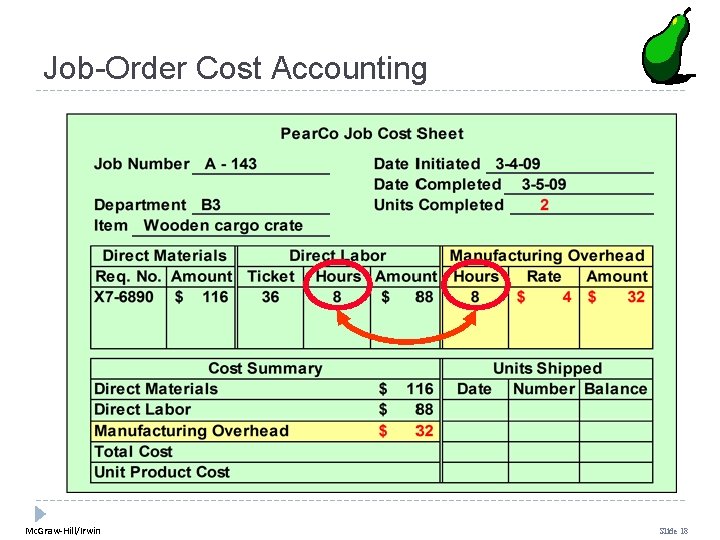
Job-Order Cost Accounting Mc. Graw-Hill/Irwin Slide 18
Job-Order Cost Accounting Mc. Graw-Hill/Irwin Slide 19
Interpreting the Average Unit Cost The average unit cost should not be interpreted as the costs that would actually be incurred if an additional unit was produced. Fixed overhead would not change if another unit was produced, so the incremental cost of another unit is something less than $118. Mc. Graw-Hill/Irwin Slide 20
- Slides: 20