
Types of Movements at Synovial Joints Groups of

- Slides: 14
Types of Movements at Synovial Joints
Groups of Movements Gliding Angular Rotation Special Movements
Gliding A simple movement in which relatively flat bone surfaces move back-and-forth and side -to-side relative to one another. Limited in range by the articular capsule and ligaments of the joint Occurs in Planar Jonits (carpals, tarsals, sternoclavicular)
Angular Movements There is an increase or decrease in the angle between articulating bones n Flexion, Extensions, Abduction, Adduction
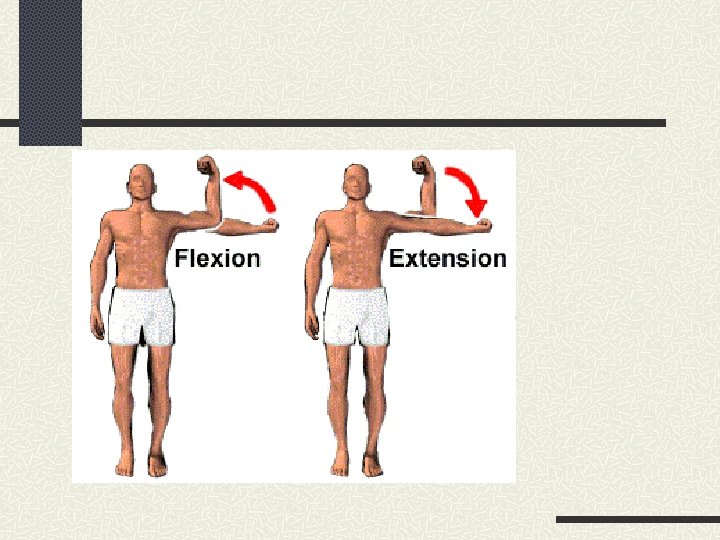
Flexion/Extension Flexion - A decrease in the angle between articulating bones Extension – An increase in the angle between articulating bones Found in hinge, pivot, condyloid, saddle and ball-and-socket joints HYPEREXTENSION – extension beyond anatomical position
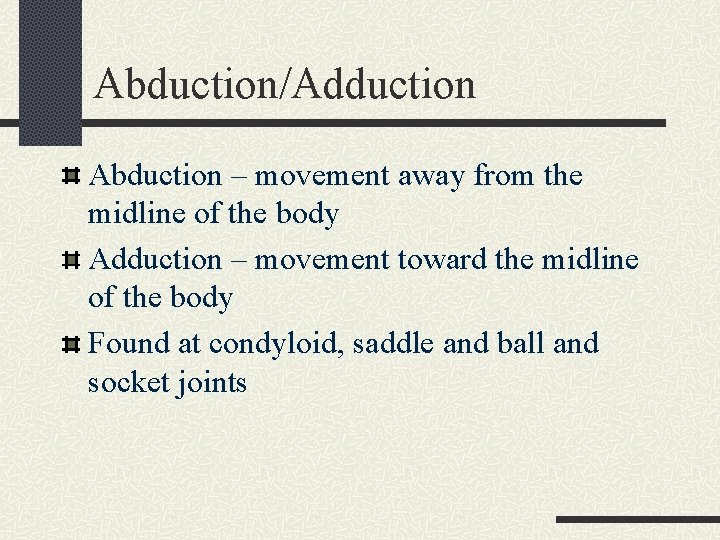
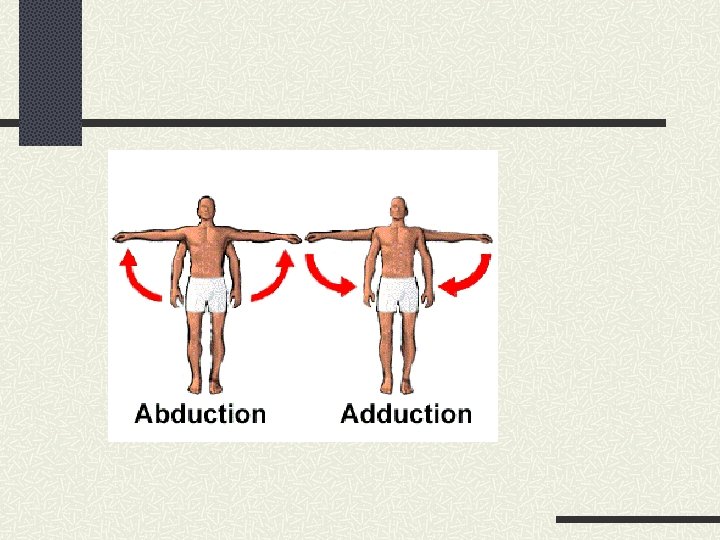
Abduction/Adduction Abduction – movement away from the midline of the body Adduction – movement toward the midline of the body Found at condyloid, saddle and ball and socket joints
Circumduction Movement of the distal end of a body part in a circle Found at ball-and-socket joints
Rotation A bone revolves around its own longitudinal axis Found at pivot and ball and socket joints
Special Movements Occur only at certain joints Include elevation, depression, protraction, retraction, inversion, eversion, dorsiflection, plantar flexion, supination and pronation
Elevation - upward movement of a body part (closing your mouth) Depression – downward movement of a body part (opening your mouth) Protraction – movement of a body part forward (mandible or clavicles) Retraction – returning a protracted part to anatomical position
Inversion – movement of the soles medially so they face each other Eversion – movement of the soles laterally so they are away from eachother Dorsiflexion – Bending the feet upward (like standing on your heals) Plantar Flexion – Bending the feet down (like standing on your toes)
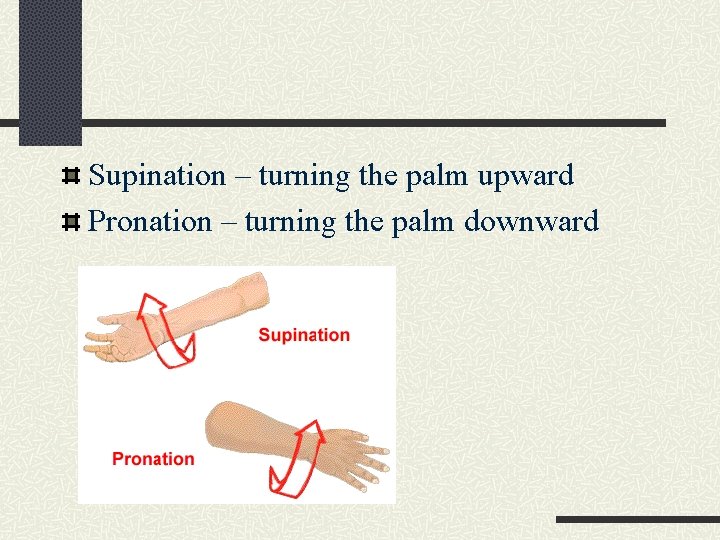
Supination – turning the palm upward Pronation – turning the palm downward