
Types of Microscopy Type Probe Technique Best Resolution
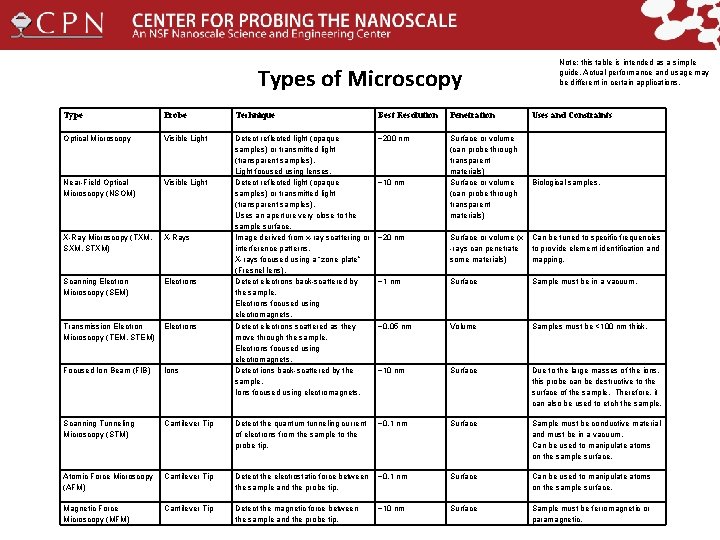
Types of Microscopy Type Probe Technique Best Resolution Penetration Optical Microscopy Visible Light ~200 nm Near-Field Optical Microscopy (NSOM) Visible Light Surface or volume (can probe through transparent materials) X-Ray Microscopy (TXM, STXM) X-Rays Scanning Electron Microscopy (SEM) Electrons Transmission Electron Microscopy (TEM, STEM) Electrons Focused Ion Beam (FIB) Ions Detect reflected light (opaque samples) or transmitted light (transparent samples). Light focused using lenses. Detect reflected light (opaque samples) or transmitted light (transparent samples). Uses an aperture very close to the sample surface. Image derived from x-ray scattering or interference patterns. X-rays focused using a “zone plate” (Fresnel lens). Detect electrons back-scattered by the sample. Electrons focused using electromagnets. Detect electrons scattered as they move through the sample. Electrons focused using electromagnets. Detect ions back-scattered by the sample. Ions focused using electromagnets. Scanning Tunneling Microscopy (STM) Cantilever Tip Atomic Force Microscopy (AFM) Magnetic Force Microscopy (MFM) ~10 nm Note: this table is intended as a simple guide. Actual performance and usage may be different in certain applications. Uses and Constraints Biological samples. ~20 nm Surface or volume (x Can be tuned to specific frequencies -rays can penetrate to provide element identification and some materials) mapping. ~1 nm Surface Sample must be in a vacuum. ~0. 05 nm Volume Samples must be <100 nm thick. ~10 nm Surface Due to the large masses of the ions, this probe can be destructive to the surface of the sample. Therefore, it can also be used to etch the sample. Detect the quantum tunneling current of electrons from the sample to the probe tip. ~0. 1 nm Surface Sample must be conductive material and must be in a vacuum. Can be used to manipulate atoms on the sample surface. Cantilever Tip Detect the electrostatic force between the sample and the probe tip. ~0. 1 nm Surface Can be used to manipulate atoms on the sample surface. Cantilever Tip Detect the magnetic force between the sample and the probe tip. ~10 nm Surface Sample must be ferromagnetic or paramagnetic.
- Slides: 1