
Types of Memory n Real memory l Main
- Slides: 20
Types of Memory n Real memory l Main memory n Virtual memory l Memory on disk l Allows for effective multiprogramming and relieves the user of tight constraints of main memory 1 Rutgers University, CS 416, Spring 2008 . 1
Virtual Memory n Virtual memory – separation of user logical memory from physical memory. l Only part of the program needs to be in memory for execution l Logical address space can therefore be much larger than physical address space l Allows address spaces to be shared by several processes l Allows for more efficient process creation n Virtual memory can be implemented via: l Demand paging l Demand segmentation Rutgers University, CS 416, Spring 2008 . 2
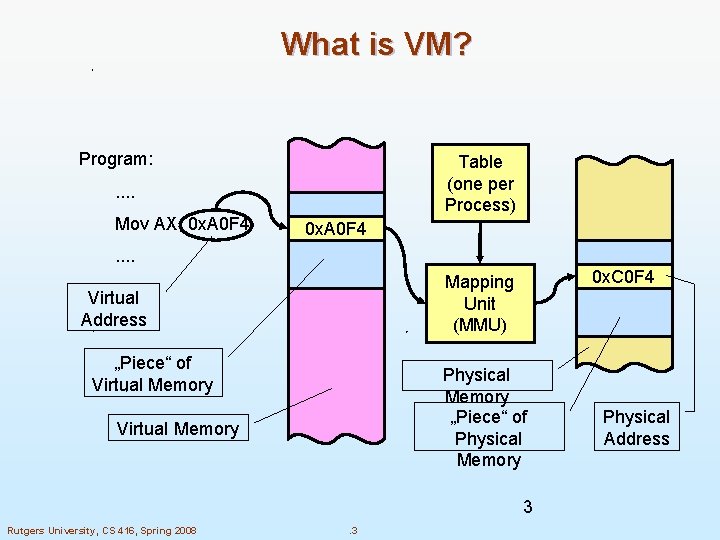
What is VM? Program: Table (one per Process) . . Mov AX, 0 x. A 0 F 4 . . 0 x. C 0 F 4 Mapping Unit (MMU) Virtual Address „Piece“ of Virtual Memory Physical Memory „Piece“ of Physical Memory Virtual Memory 3 Rutgers University, CS 416, Spring 2008 . 3 Physical Address
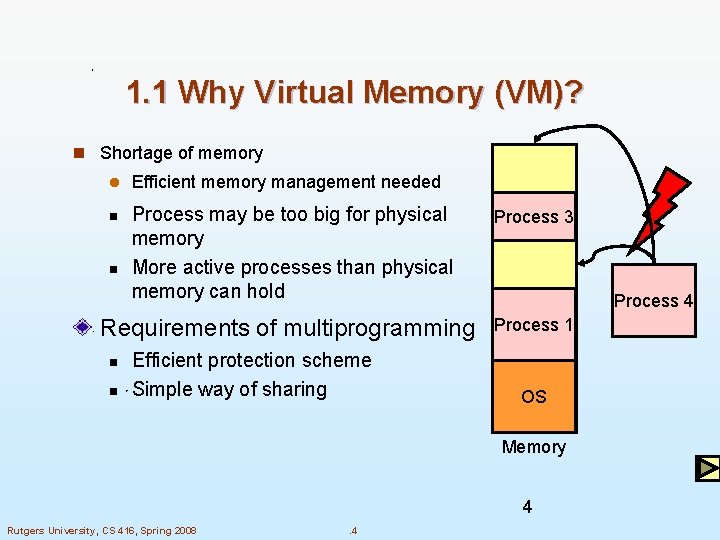
1. 1 Why Virtual Memory (VM)? n Shortage of memory l Efficient memory management needed Process may be too big for physical memory More active processes than physical memory can hold Process 3 Requirements of multiprogramming Process 1 n n Efficient protection scheme Simple way of sharing Process 2 Process 4 OS Memory 4 Rutgers University, CS 416, Spring 2008 . 4
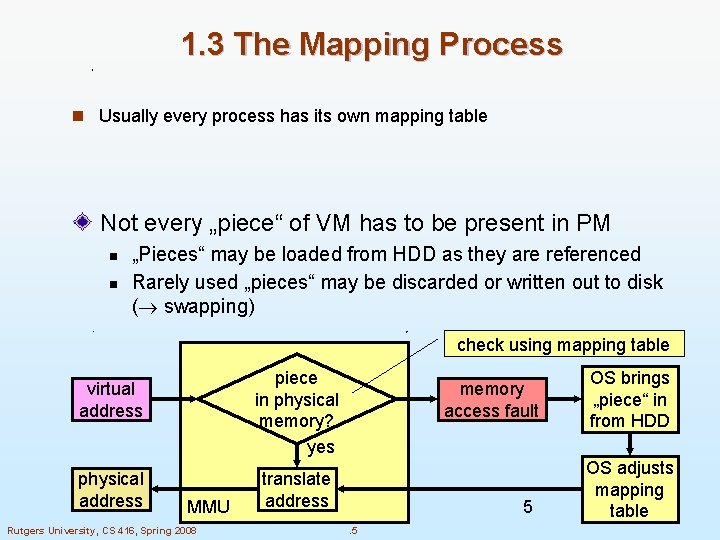
1. 3 The Mapping Process n Usually every process has its own mapping table Not every „piece“ of VM has to be present in PM n n „Pieces“ may be loaded from HDD as they are referenced Rarely used „pieces“ may be discarded or written out to disk ( swapping) check using mapping table piece in physical memory? yes virtual address physical address MMU Rutgers University, CS 416, Spring 2008 memory access fault translate address 5. 5 OS brings „piece“ in from HDD OS adjusts mapping table
Demand Paging n Bring a page into memory only when it is needed l Less I/O needed l Less memory needed l Faster response l More users n Page is needed reference to it l invalid reference abort l not-in-memory bring to memory Rutgers University, CS 416, Spring 2008 . 6
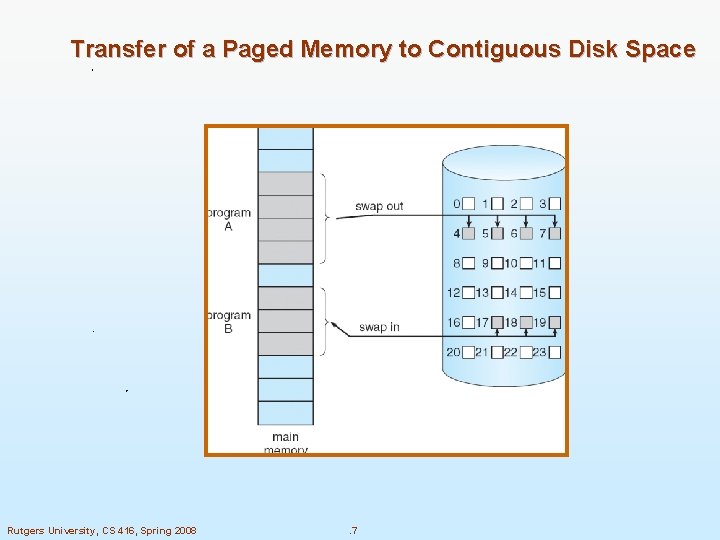
Transfer of a Paged Memory to Contiguous Disk Space Rutgers University, CS 416, Spring 2008 . 7
What is a process n We typically mean that a process is a running program n A better definition is that a process is the state of a running program n Now we have a really good definition of the state of a running program l A program counter l A page table l Register values Rutgers University, CS 416, Spring 2008 . 8
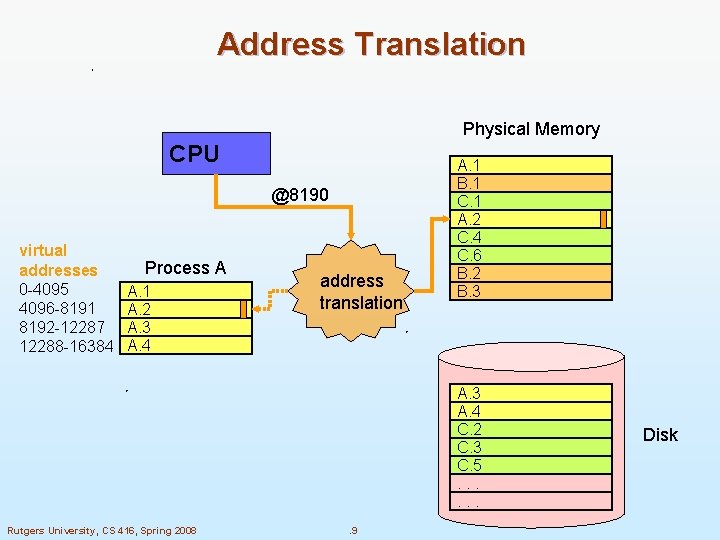
Address Translation Physical Memory CPU @8190 virtual addresses 0 -4095 4096 -8191 8192 -12287 12288 -16384 Process A A. 1 A. 2 A. 3 A. 4 address translation A. 1 B. 1 C. 1 A. 2 C. 4 C. 6 B. 2 B. 3 A. 4 C. 2 C. 3 C. 5. . . Rutgers University, CS 416, Spring 2008 . 9 Disk
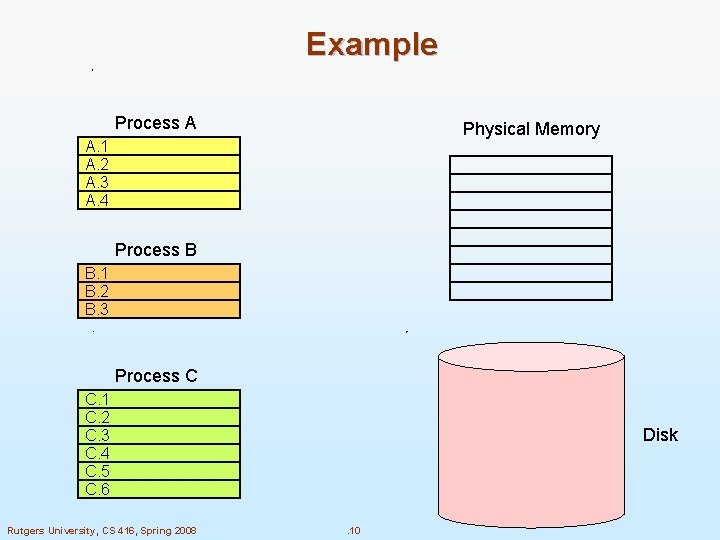
Example Process A Physical Memory A. 1 A. 2 A. 3 A. 4 Process B B. 1 B. 2 B. 3 Process C C. 1 C. 2 C. 3 C. 4 C. 5 C. 6 Rutgers University, CS 416, Spring 2008 Disk . 10
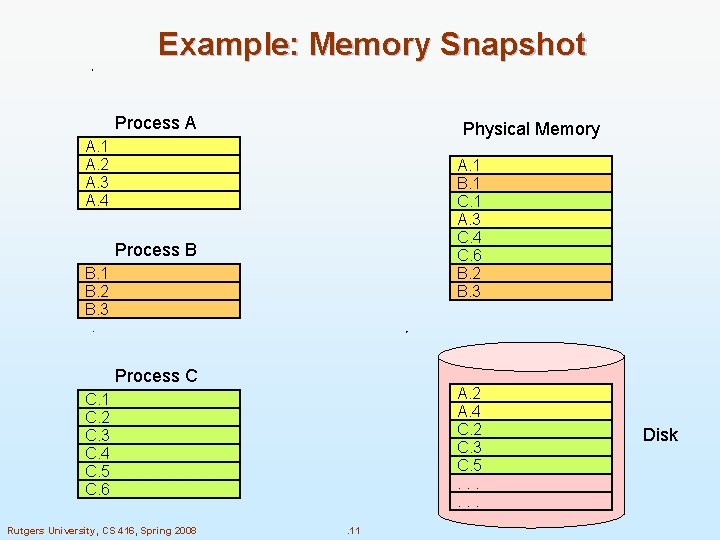
Example: Memory Snapshot Process A Physical Memory A. 1 A. 2 A. 3 A. 4 A. 1 B. 1 C. 1 A. 3 C. 4 C. 6 B. 2 B. 3 Process B B. 1 B. 2 B. 3 Process C A. 2 A. 4 C. 2 C. 3 C. 5. . . C. 1 C. 2 C. 3 C. 4 C. 5 C. 6 Rutgers University, CS 416, Spring 2008 . 11 Disk
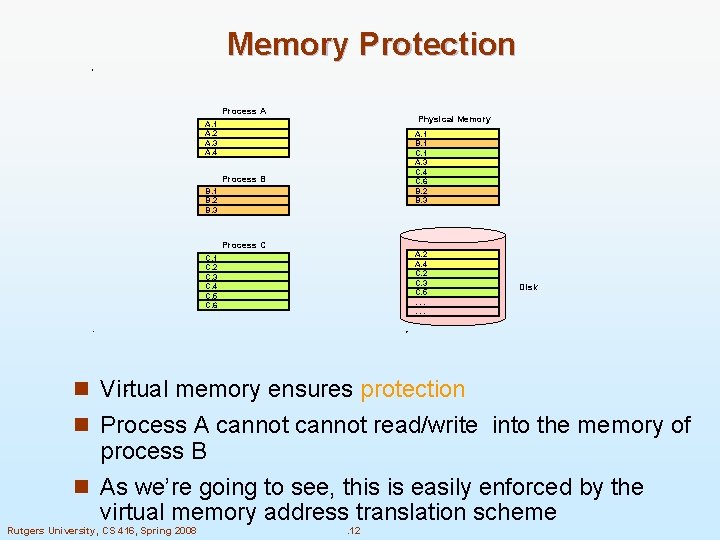
Memory Protection Process A Physical Memory A. 1 A. 2 A. 3 A. 4 A. 1 B. 1 C. 1 A. 3 C. 4 C. 6 B. 2 B. 3 Process B B. 1 B. 2 B. 3 Process C A. 2 A. 4 C. 2 C. 3 C. 5. . . C. 1 C. 2 C. 3 C. 4 C. 5 C. 6 Disk n Virtual memory ensures protection n Process A cannot read/write into the memory of process B n As we’re going to see, this is easily enforced by the virtual memory address translation scheme Rutgers University, CS 416, Spring 2008 . 12
Paging n Each process has its own page table n Each page table entry contains the frame number of the corresponding page in main memory n A bit is needed to indicate whether the page is in main memory or not 13 Rutgers University, CS 416, Spring 2008 . 13
Page Tables n The entire page table may take up too much main memory n Page tables are also stored in virtual memory n When a process is running, part of its page table is in main memory 14 Rutgers University, CS 416, Spring 2008 . 14
Page Size n Smaller page size, less amount of internal fragmentation n Smaller page size, more pages required per process n More pages per process means larger page tables n Larger page tables means large portion of page tables in virtual memory 15 Rutgers University, CS 416, Spring 2008 . 15
Page Faults n A miss in the page table is called a page fault n When the “valid” bit is not set to 1, then the page must be brought in from disk, possibly replacing another page in memory Rutgers University, CS 416, Spring 2008 . 16
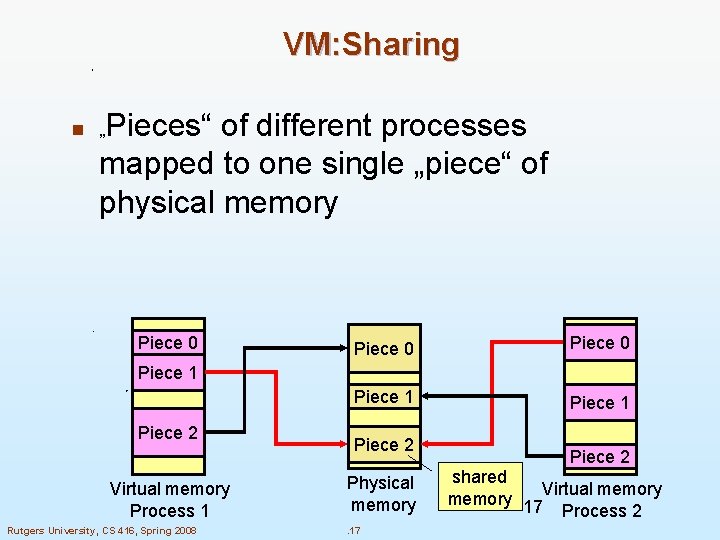
VM: Sharing Pieces“ of different processes mapped to one single „piece“ of physical memory n „ Piece 0 Piece 1 Piece 2 Virtual memory Process 1 Rutgers University, CS 416, Spring 2008 Piece 2 Physical memory. 17 Piece 2 shared Virtual memory 17 Process 2
VM: Advantages n VM supports l Swapping 4 Rarely used „pieces“ can be discarded or swapped out 4 „Piece“ can be swapped back in to any free piece of physical memory large enough, mapping unit translates addresses l Protection l Sharing 4 Common data or code may be shared to save memory n Code can be placed anywhere in physical memory without relocation (adresses are mapped!) 18 Rutgers University, CS 416, Spring 2008 . 18
VM: Disadvantages n Memory requirements (mapping tables) n Longer memory access times (mapping table lookup) 19 Rutgers University, CS 416, Spring 2008 . 19
Instruction and Data Memory n One way to remove the conflict is to treat memory accesses differently Memory accesses for instructions l Memory accesses for data l n Can be done by having Instruction Memory (IM) l Data Memory (DM) l Rutgers University, CS 416, Spring 2008 . 20