
Types of Matter Section 3 2 Composition of
- Slides: 17
Types of Matter Section 3. 2
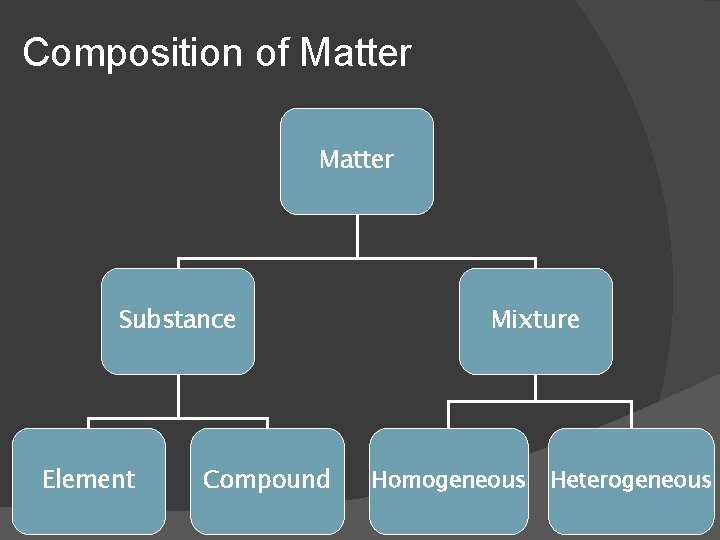
Composition of Matter Substance Element Compound Mixture Homogeneous Heterogeneous
Elements Element – a pure substance, that cannot be broken down 90 occur naturally; the rest are synthetic cannot be broken down through physical or chemical means Atom smallest whole part of an element represented by symbols Hydrogen – H most are solids, several are gases, 2 are liquids (Bromine – Br and Mercury - Hg) most are metals
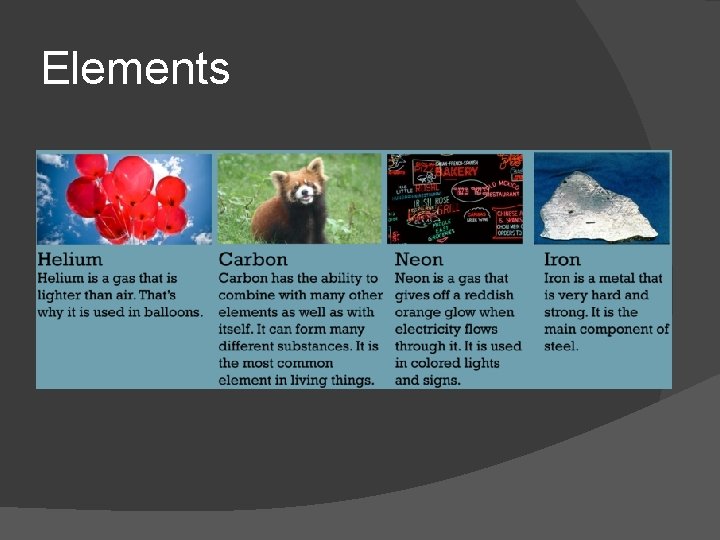
Elements
Pure Substance pure substance a type of matter with a fixed composition • A pure substance can be either an element or a compound. • element • all the atoms in a substance have the same identity (simplest pure substance)
Compounds composed of atoms joined chemically; always in the same ratio molecule smallest whole part of a compound formula represents the atoms and ratios with symbols and subscripts Mg(OH)2 Na. Cl compounds are created by chemical means and separated by chemical means http: //studyjams. scholastic. com/studyjams/ science/matter/elements-and-compounds. htm
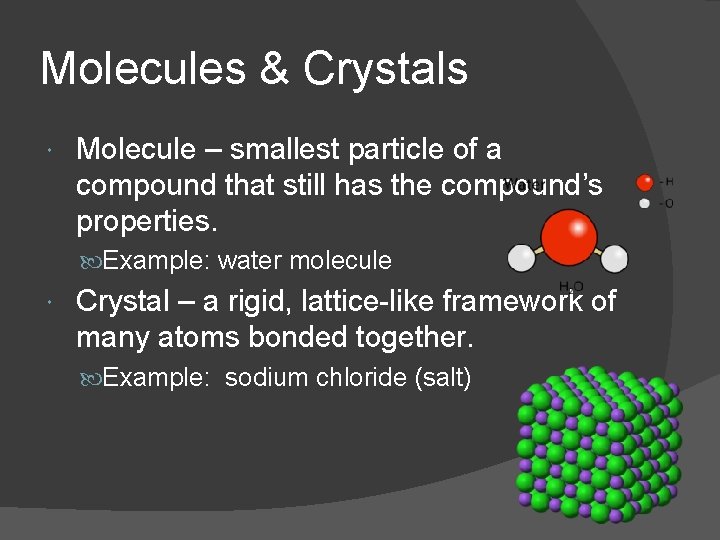
Molecules & Crystals Molecule – smallest particle of a compound that still has the compound’s properties. Example: water molecule Crystal – a rigid, lattice-like framework of many atoms bonded together. Example: sodium chloride (salt)
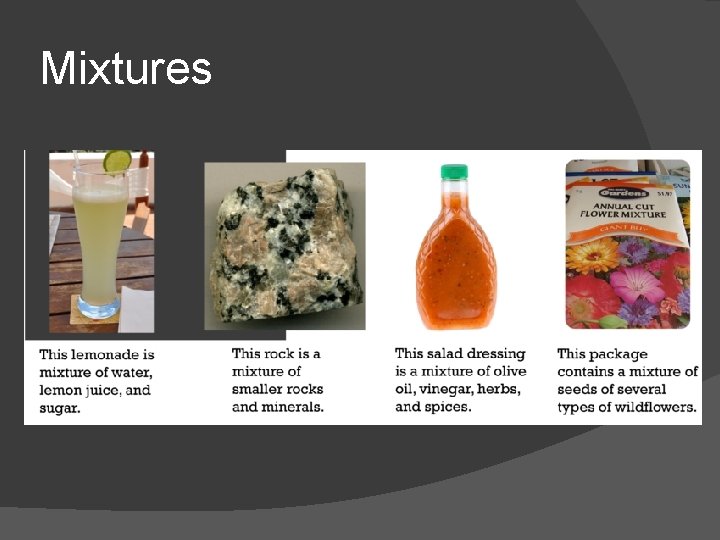
Mixtures Mixture – a combination of two or more substances in any proportion. contain physical combinations of atoms or molecules of different substances each part of a mixture keeps its own set of properties can be separated physically compositions may vary
Mixtures
Heterogeneous Mixture a mixture in which different materials can be distinguished easily materials do not dissolve settle on standing Examples: pizza, salad dressing, chocolate chip ice cream, trail mix
Homogeneous Mixture contains two or more gaseous, liquid, or solid substances blended evenly throughout https: //www. brainpop. com/science/matteran dchemistry/compoundsandmixtures/ solution a homogeneous mixture of particles so small that they cannot be seen with a microscope and will never settle to the bottom of their container remain constantly and uniformly mixed
Solution – a homogeneous mixture with tiny particles Example: salt water Particles are too small to settle or be filtered out of the mixture
Suspensions a heterogeneous mixture with large particles containing a liquid in which visible particles settle Example: Muddy Pond Water, salad dressing
Colloid A homogeneous mixture with medium-sized particles. a type of mixture with particles that are larger than those in solutions but not heavy enough to settle out example: milk
Detecting Colloids distinguish through its appearance you can tell for certain if a liquid is a colloid by passing a beam of light through it A light beam is invisible as it passes through a solution, but can be seen readily as it passes through a colloid. This occurs because the particles in the colloid are large enough to scatter light, but those in the solution are not. called the Tyndall effect
Separating Mixtures The parts of the mixtures keep their identity and characteristics. Use physical properties to separate them. Example: density, size, boiling point https: //youtu. be/j. Wdu_RVy 5_A
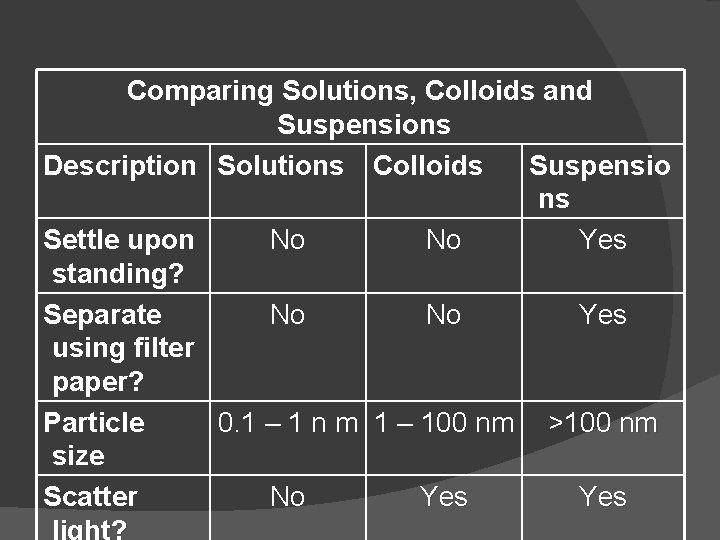
Comparing Solutions, Colloids and Suspensions Description Solutions Colloids Suspensio ns Settle upon No No Yes standing? Separate No No Yes using filter paper? Particle 0. 1 – 1 n m 1 – 100 nm >100 nm size Scatter No Yes light?