
Types of Market Failures A market fails when
- Slides: 78
Types of Market Failures • A market fails when any of the requirements for a competitive market ceases to exist. • The five main causes of market failures are: o Not enough competition o Not enough information o Resources that cannot, or will not, move o Too few public goods o Externalities or spillovers uncompensated side effects that either benefit or harm a third party Examples: increased routes at airport
Dealing with Spillovers • Spillovers distort the decisions made by consumers and producers, making the economy less efficient. • The government often attempts to control harmful spillovers by making them illegal, setting standards for them, or taxing them. • The government sometimes subsidizes positive spillovers. • Cost-benefit analysis can be used to evaluate the costs and benefits of several competing projects. • Government involvement is necessary to deal with both positive and negative spillovers.
Ensuring Competition • The government can help maintain competitive markets by breaking up monopolies, expanding laws against them, or regulating their activities. • The Sherman Act of 1890 was the first American law against monopolies. • In 1914, the Clayton Antitrust Act outlawed price discrimination, and the Federal Trade Commission Act set up the Federal Trade Commission to help stop unfair business practices. • Some monopolies, such as public utilities, are beneficial and should not be broken up.
Competition, Consumer Protection, and Regulation • Transparency and public disclosure help ensure that consumers have adequate information to make decisions. • The Consumer Financial Protection Bureau (CFPB) was established in 2011 to oversee and guide the financial lending industry. • Federal regulatory agencies include the National Weather Service, the National Highway Traffic Safety Administration, the Food and Drug Administration, and many others. • Zoning ordinances are examples of government regulations at the local level.
Modified Free Enterprise • The U. S. economy is now a modified free enterprise economy because of increased government intervention in economic matters. • Almost everything people do and buy is affected by one or more federal agencies. • Over the years, government’s role in the economy has evolved from consumer protection issues to promotion of economic competition and efficiency.
MACROECONOMICS United States Fiscal Policy & International Trade
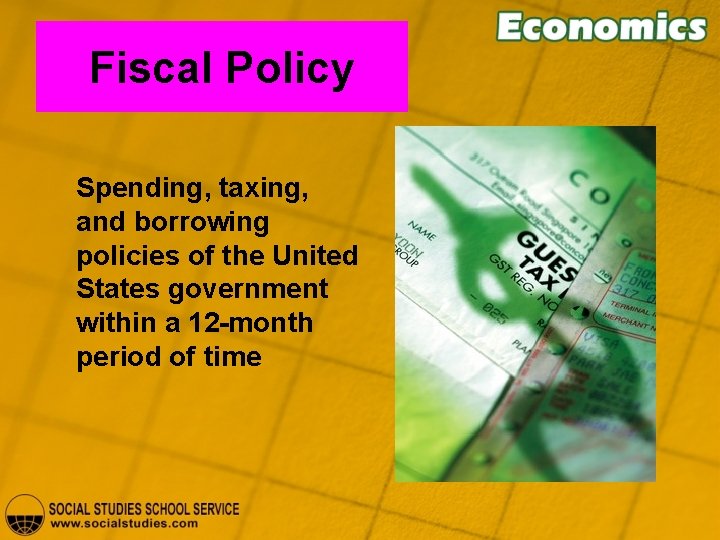
Fiscal Policy Spending, taxing, and borrowing policies of the United States government within a 12 -month period of time
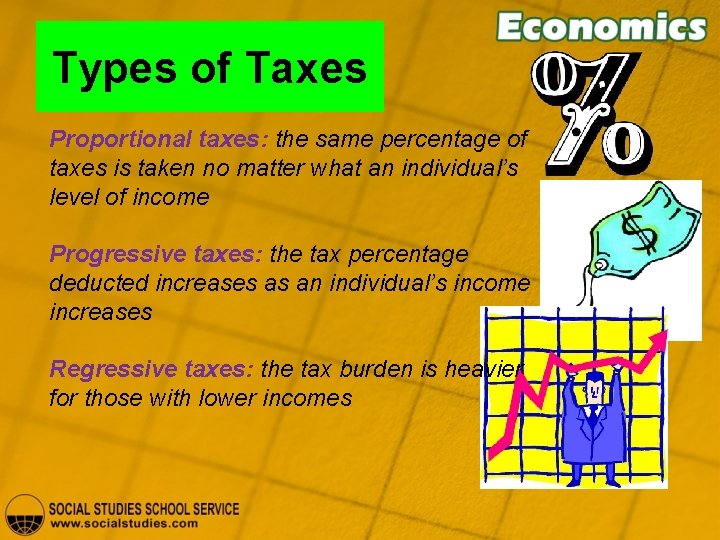
Types of Taxes Proportional taxes: the same percentage of taxes is taken no matter what an individual’s level of income Progressive taxes: the tax percentage deducted increases as an individual’s income increases Regressive taxes: the tax burden is heavier for those with lower incomes
How does the government collect taxes? • Individual Income Tax • Corporate Income Tax • Social Security Tax • Excise Tax • Estate & Gift Tax • Customs Duties
Supply-Side Economics • • Say’s Law, law of markets Laissez-faire Reduce government regulations Supply-side economics
Fiscal Policy Problems 1. To invest or not to invest? 2. What budget areas get cut?
Demand-Side Economics • • John M. Keynes Government involvement 1. Government spending 2. More production 3. Lower unemployment 4. Newly employed spend, create more demand for production • Employment Act of 1946
Five Tools of Fiscal Policy 1. 2. 3. 4. 5. Marginal Tax Rates Tax Incentives Government Spending Public Transfer Payments Progressive Income Taxes
Marginal Tax Rates 1. Lowering taxes: increases individual and business spending power, unemployment rates decrease 2. Raising taxes: decreases individual and business spending power, limiting inflation
Tax Incentives Tax breaks given to businesses in the hope that they will invest in new capital goods Government Spending 1. Decrease in spending: slows down business activity and reduces inflation 2. Increase in spending: reduces unemployment and increases business activity
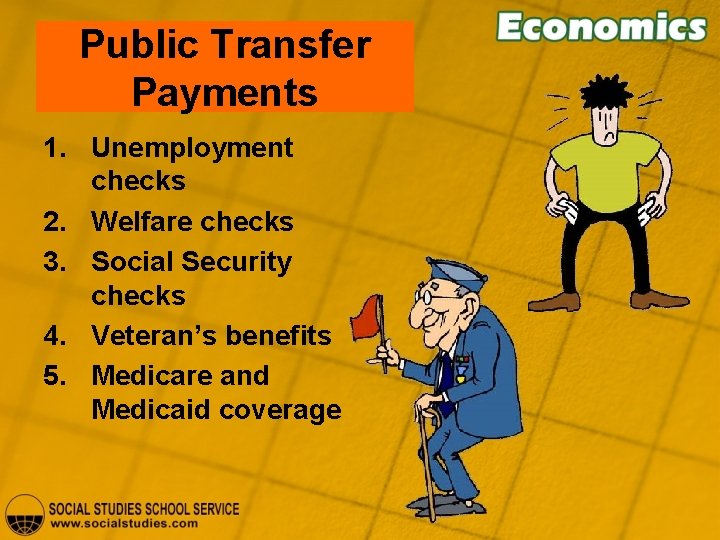
Public Transfer Payments 1. Unemployment checks 2. Welfare checks 3. Social Security checks 4. Veteran’s benefits 5. Medicare and Medicaid coverage
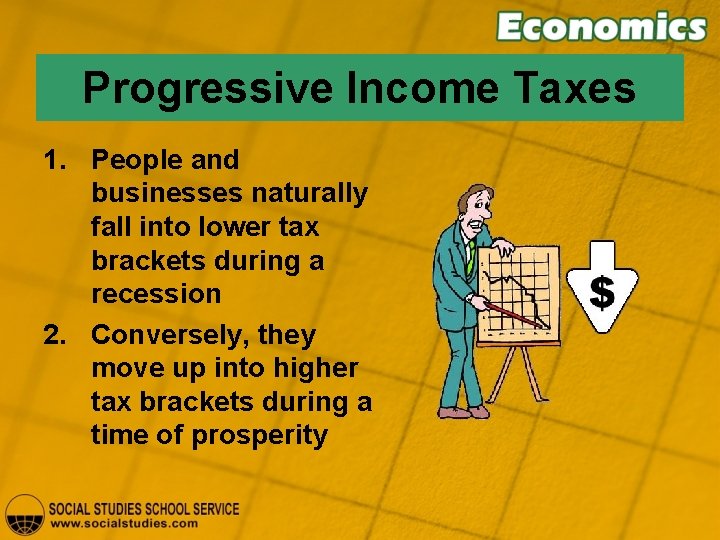
Progressive Income Taxes 1. People and businesses naturally fall into lower tax brackets during a recession 2. Conversely, they move up into higher tax brackets during a time of prosperity
Limitations of Fiscal Policy 1. 2. 3. Timing and Unpredictability: Difficult to predict what the economy will do Political Pressure: Voters will remove elected officials if they feel the economy is not proceeding down a positive path Lack of Coordination: Government agencies cannot always work together quickly enough to get an economic policy in place
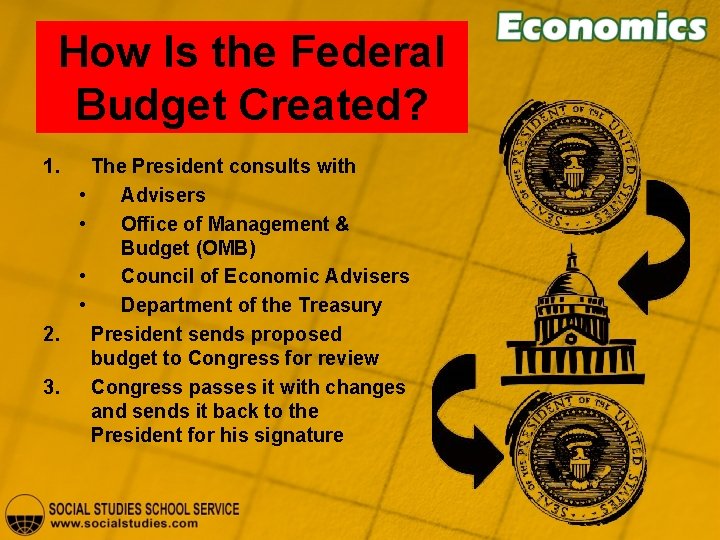
How Is the Federal Budget Created? 1. The President consults with • Advisers • Office of Management & Budget (OMB) • Council of Economic Advisers • Department of the Treasury 2. President sends proposed budget to Congress for review 3. Congress passes it with changes and sends it back to the President for his signature
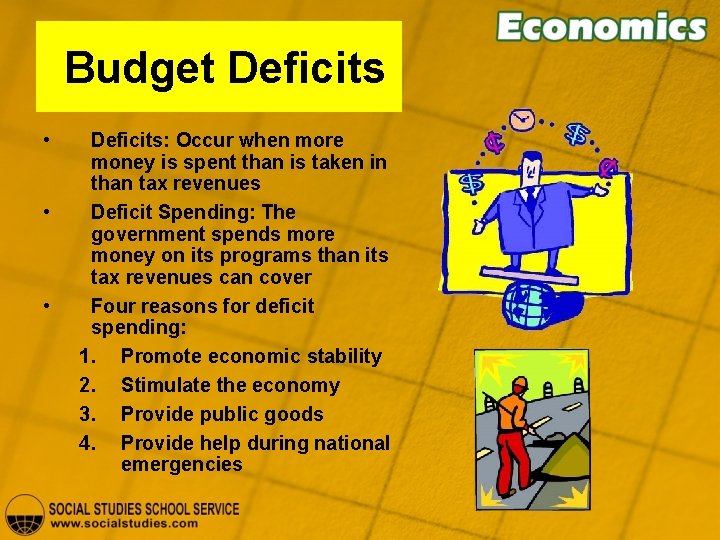
Budget Deficits • • • Deficits: Occur when more money is spent than is taken in than tax revenues Deficit Spending: The government spends more money on its programs than its tax revenues can cover Four reasons for deficit spending: 1. Promote economic stability 2. Stimulate the economy 3. Provide public goods 4. Provide help during national emergencies
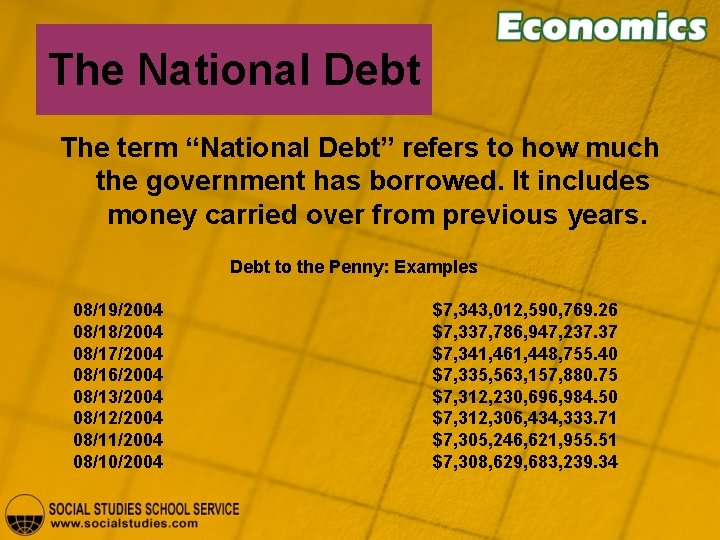
The National Debt The term “National Debt” refers to how much the government has borrowed. It includes money carried over from previous years. Debt to the Penny: Examples 08/19/2004 08/18/2004 08/17/2004 08/16/2004 08/13/2004 08/12/2004 08/11/2004 08/10/2004 $7, 343, 012, 590, 769. 26 $7, 337, 786, 947, 237. 37 $7, 341, 461, 448, 755. 40 $7, 335, 563, 157, 880. 75 $7, 312, 230, 696, 984. 50 $7, 312, 306, 434, 333. 71 $7, 305, 246, 621, 955. 51 $7, 308, 629, 683, 239. 34
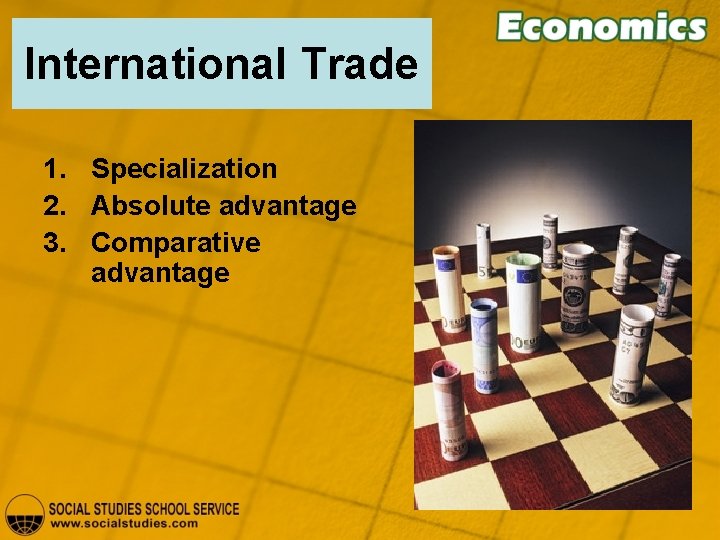
International Trade 1. Specialization 2. Absolute advantage 3. Comparative advantage
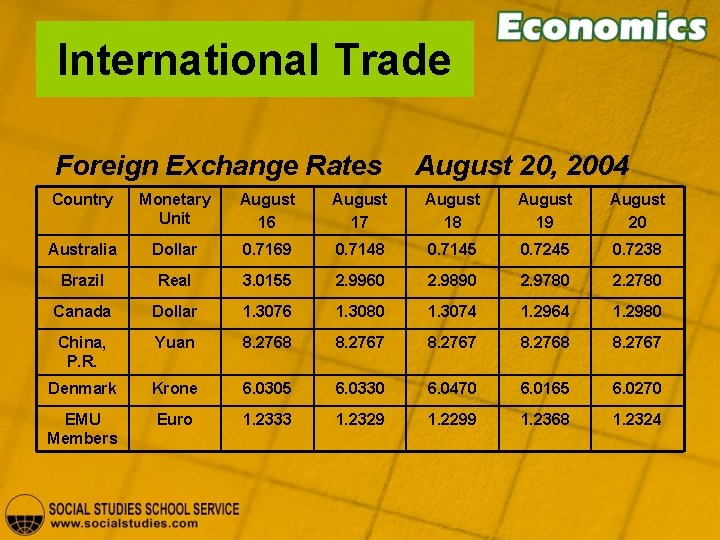
International Trade Foreign Exchange Rates August 20, 2004 Country Monetary Unit August 16 August 17 August 18 August 19 August 20 Australia Dollar 0. 7169 0. 7148 0. 7145 0. 7238 Brazil Real 3. 0155 2. 9960 2. 9890 2. 9780 2. 2780 Canada Dollar 1. 3076 1. 3080 1. 3074 1. 2964 1. 2980 China, P. R. Yuan 8. 2768 8. 2767 Denmark Krone 6. 0305 6. 0330 6. 0470 6. 0165 6. 0270 EMU Members Euro 1. 2333 1. 2329 1. 2299 1. 2368 1. 2324
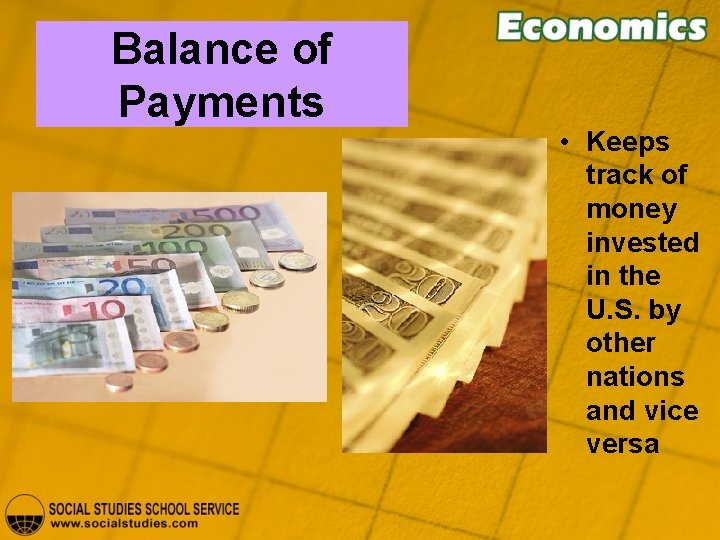
Balance of Payments • Keeps track of money invested in the U. S. by other nations and vice versa
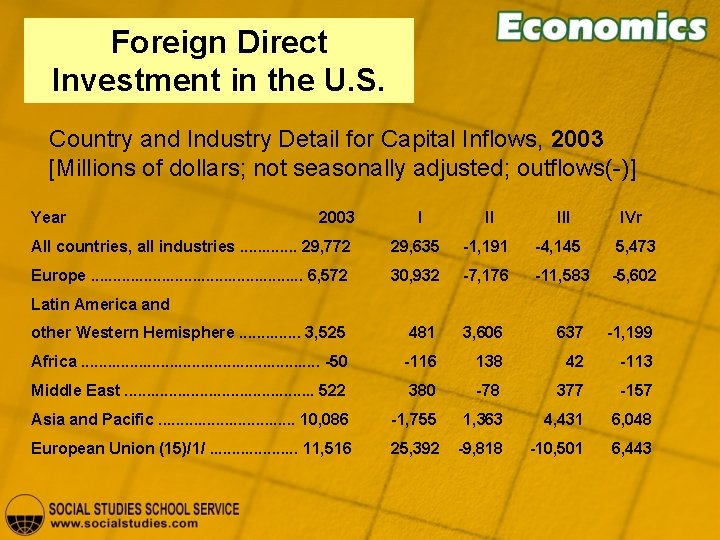
Foreign Direct Investment in the U. S. Country and Industry Detail for Capital Inflows, 2003 [Millions of dollars; not seasonally adjusted; outflows(-)] Year 2003 I II IVr All countries, all industries. . . 29, 772 29, 635 -1, 191 -4, 145 5, 473 Europe. . . 6, 572 30, 932 -7, 176 -11, 583 -5, 602 Latin America and other Western Hemisphere. . . 3, 525 481 3, 606 637 -1, 199 Africa. . . . -50 -116 138 42 -113 Middle East. . . 522 380 -78 377 -157 Asia and Pacific. . . . 10, 086 -1, 755 1, 363 4, 431 6, 048 European Union (15)/1/. . . . . 11, 516 25, 392 -9, 818 -10, 501 6, 443
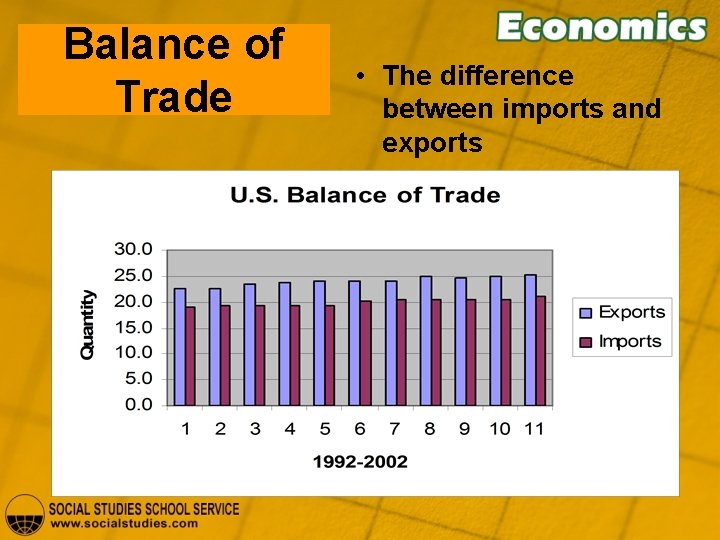
Balance of Trade • The difference between imports and exports
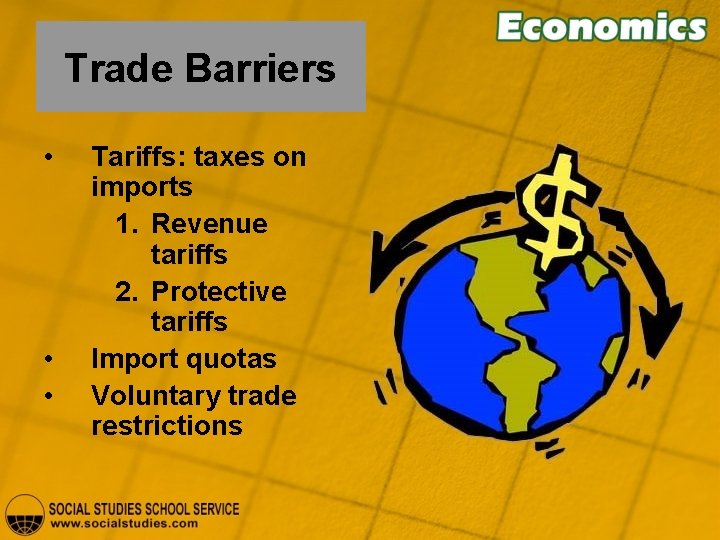
Trade Barriers • • • Tariffs: taxes on imports 1. Revenue tariffs 2. Protective tariffs Import quotas Voluntary trade restrictions
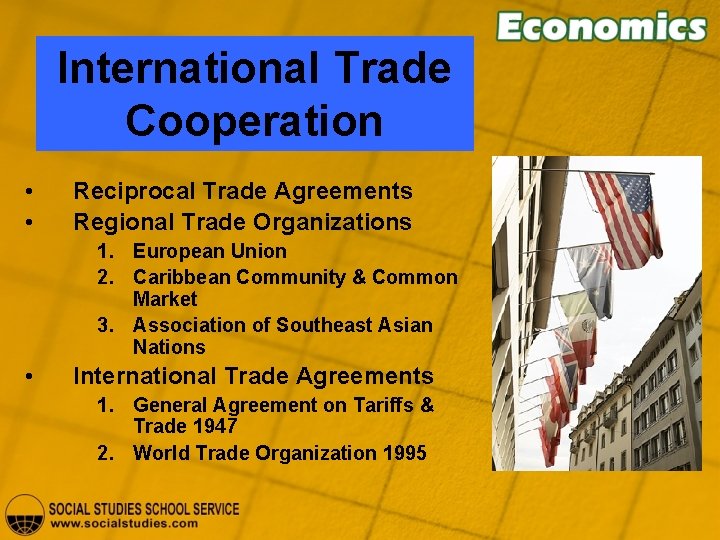
International Trade Cooperation • • Reciprocal Trade Agreements Regional Trade Organizations 1. European Union 2. Caribbean Community & Common Market 3. Association of Southeast Asian Nations • International Trade Agreements 1. General Agreement on Tariffs & Trade 1947 2. World Trade Organization 1995
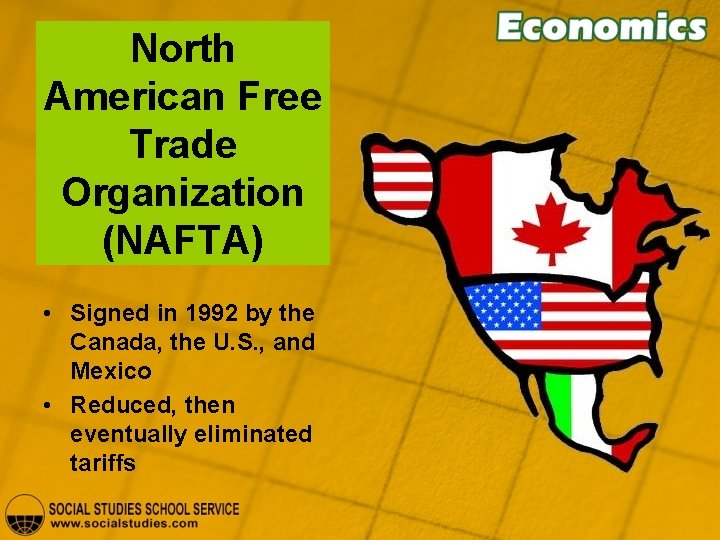
North American Free Trade Organization (NAFTA) • Signed in 1992 by the Canada, the U. S. , and Mexico • Reduced, then eventually eliminated tariffs
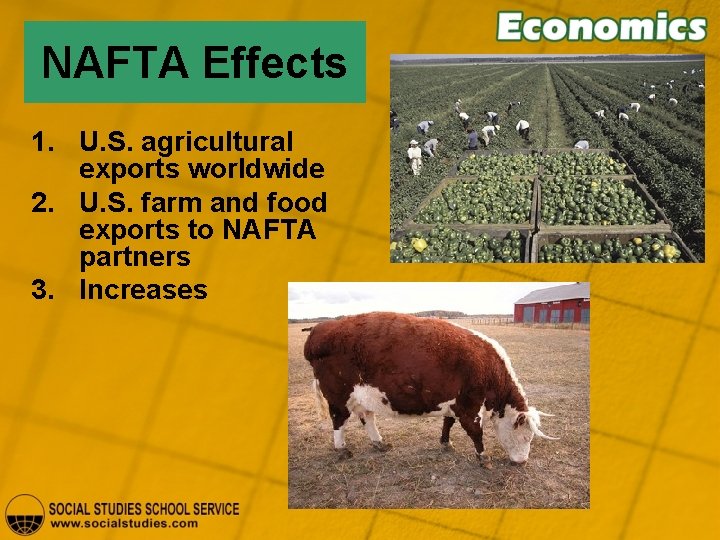
NAFTA Effects 1. U. S. agricultural exports worldwide 2. U. S. farm and food exports to NAFTA partners 3. Increases
MICROECONOMICS Demand Supply through Market Structures
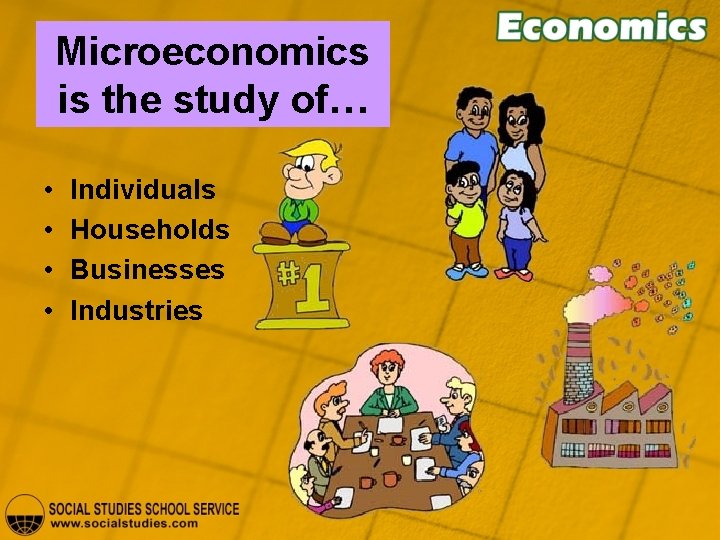
Microeconomics is the study of… • • Individuals Households Businesses Industries
Microeconomics revolves around two very important concepts: • Demand • Supply
Demand • The desire and ability to purchase a good or a service • Demand represents the consumer’s point of view
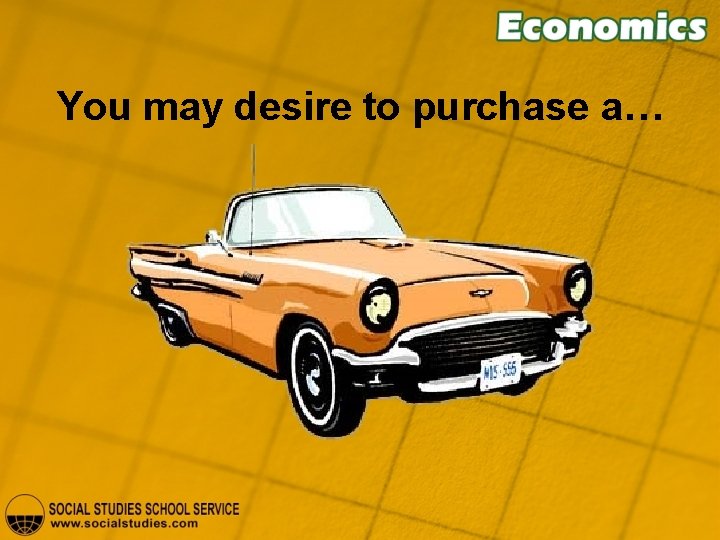
You may desire to purchase a…
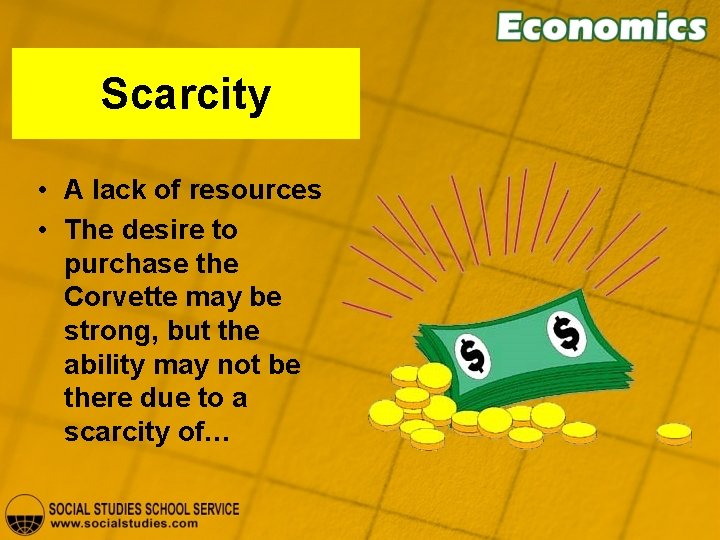
Scarcity • A lack of resources • The desire to purchase the Corvette may be strong, but the ability may not be there due to a scarcity of…
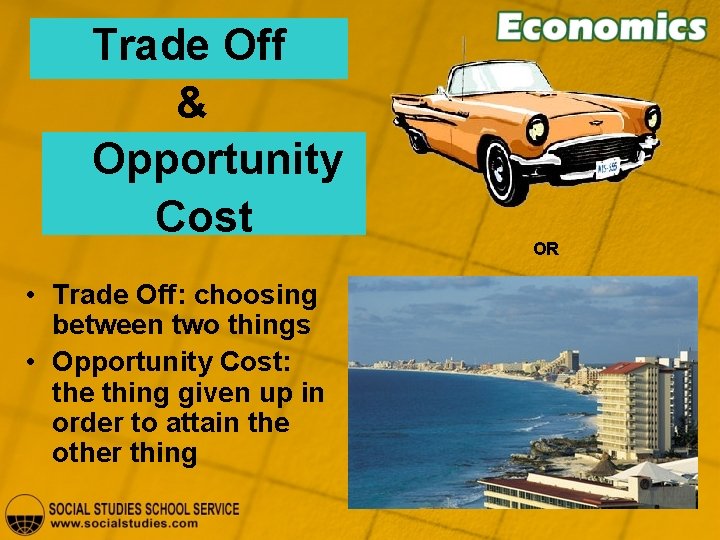
Trade Off & Opportunity Cost • Trade Off: choosing between two things • Opportunity Cost: the thing given up in order to attain the other thing OR
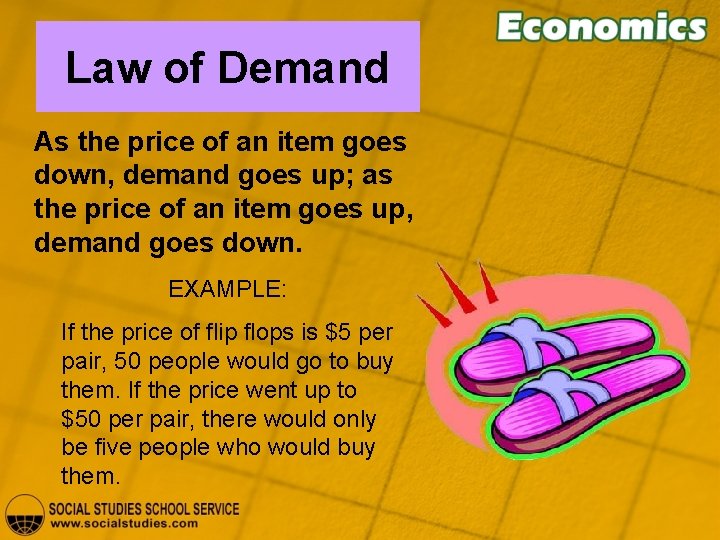
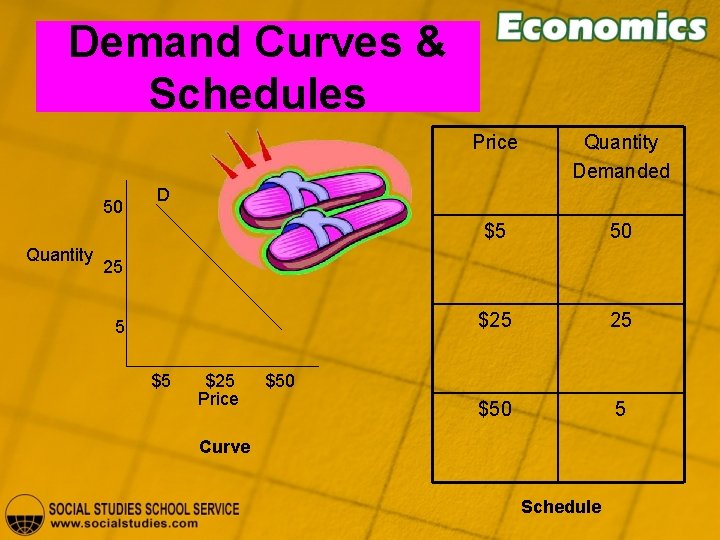
Law of Demand As the price of an item goes down, demand goes up; as the price of an item goes up, demand goes down. EXAMPLE: If the price of flip flops is $5 per pair, 50 people would go to buy them. If the price went up to $50 per pair, there would only be five people who would buy them.
Demand Curves & Schedules 50 Quantity Price Quantity Demanded $5 50 $25 25 $50 5 D 25 5 $5 $25 Price $50 Curve Schedule
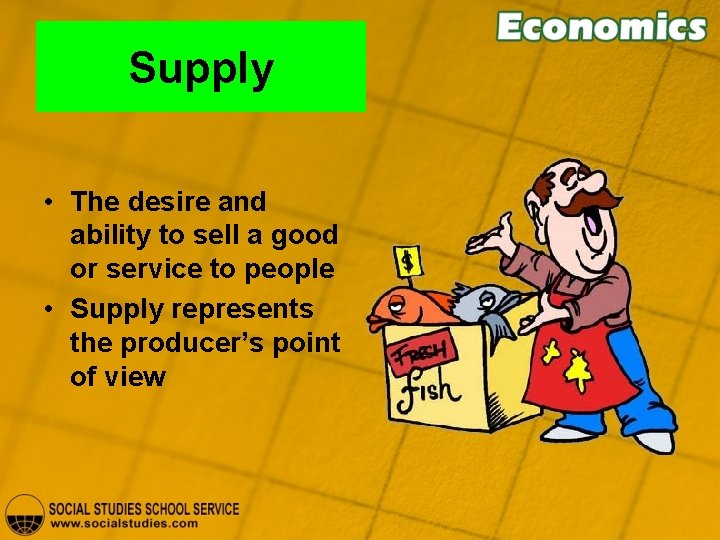
Supply • The desire and ability to sell a good or service to people • Supply represents the producer’s point of view
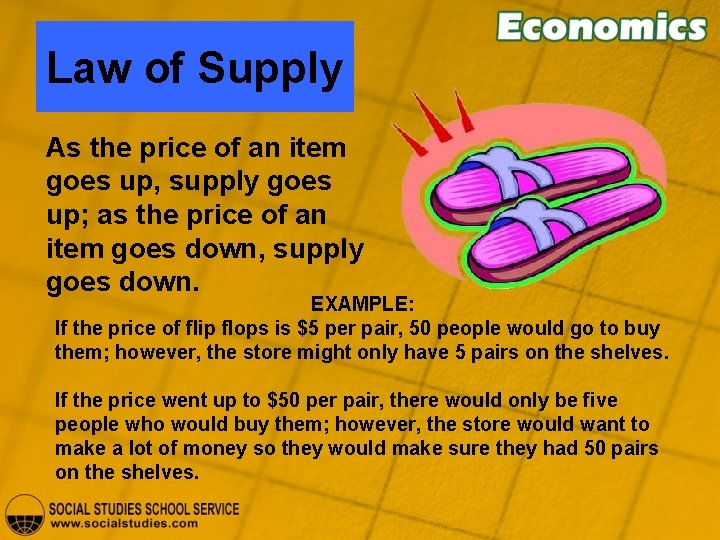
Law of Supply As the price of an item goes up, supply goes up; as the price of an item goes down, supply goes down. EXAMPLE: If the price of flip flops is $5 per pair, 50 people would go to buy them; however, the store might only have 5 pairs on the shelves. If the price went up to $50 per pair, there would only be five people who would buy them; however, the store would want to make a lot of money so they would make sure they had 50 pairs on the shelves.
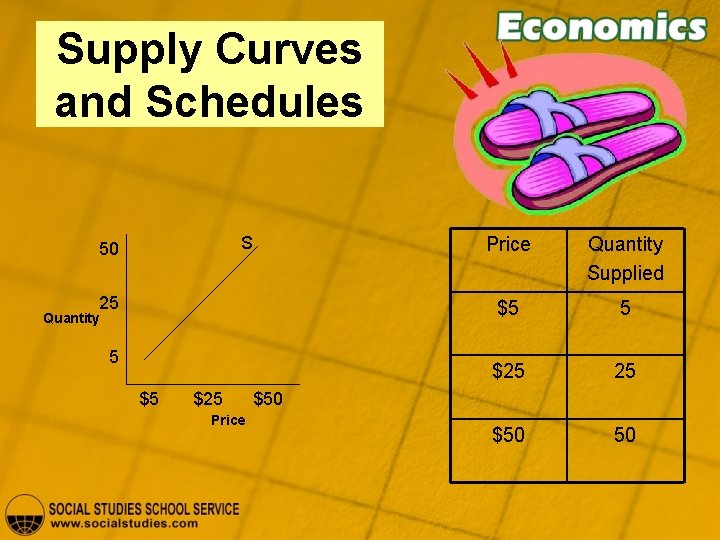
Supply Curves and Schedules S 50 25 Quantity 5 $5 $25 Price Quantity Supplied $5 5 $25 25 $50 50 $50
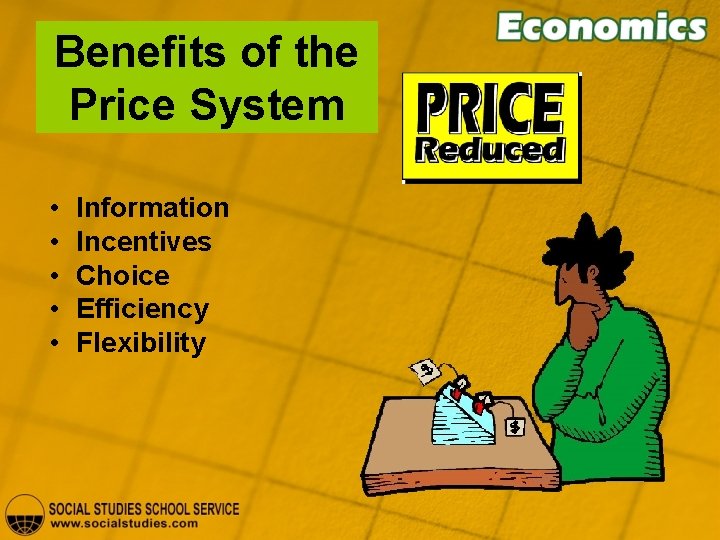
Benefits of the Price System • • • Information Incentives Choice Efficiency Flexibility
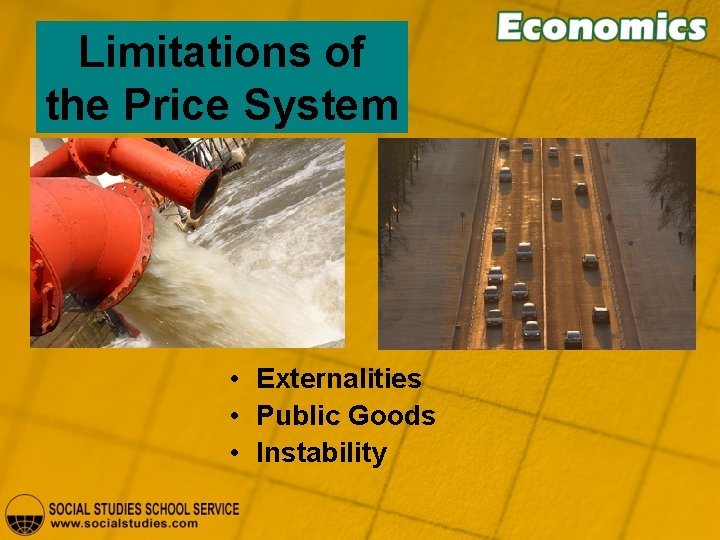
Limitations of the Price System • Externalities • Public Goods • Instability
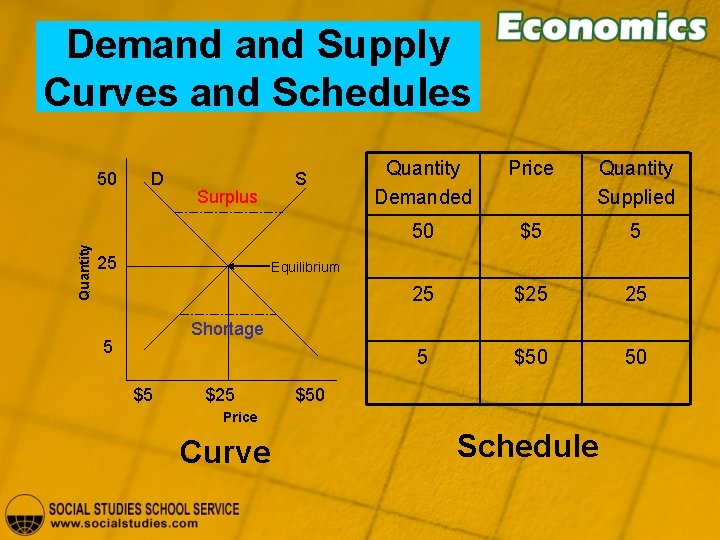
Demand Supply Curves and Schedules Quantity 50 D Surplus 25 S Quantity Demanded Price Quantity Supplied 50 $5 5 25 $25 25 5 $50 50 Equilibrium Shortage 5 $5 $25 $50 Price Curve Schedule
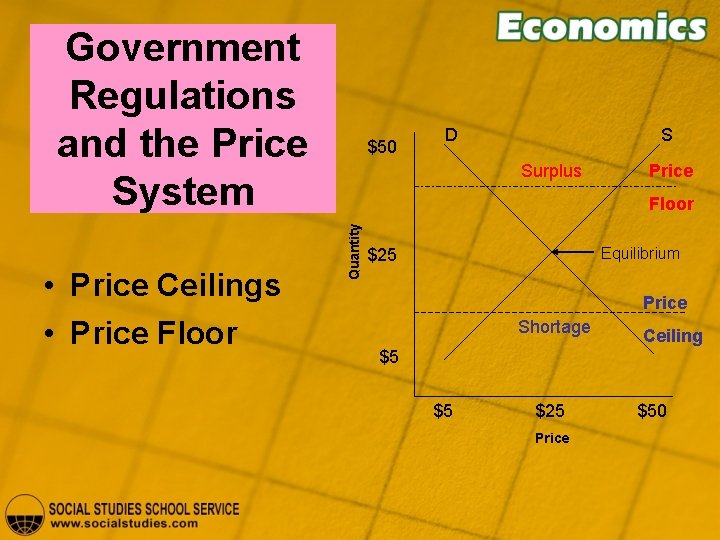
Government Regulations and the Price System D S Surplus Price Floor Quantity • Price Ceilings • Price Floor $50 Equilibrium $25 Price Shortage Ceiling $5 $5 $25 Price $50
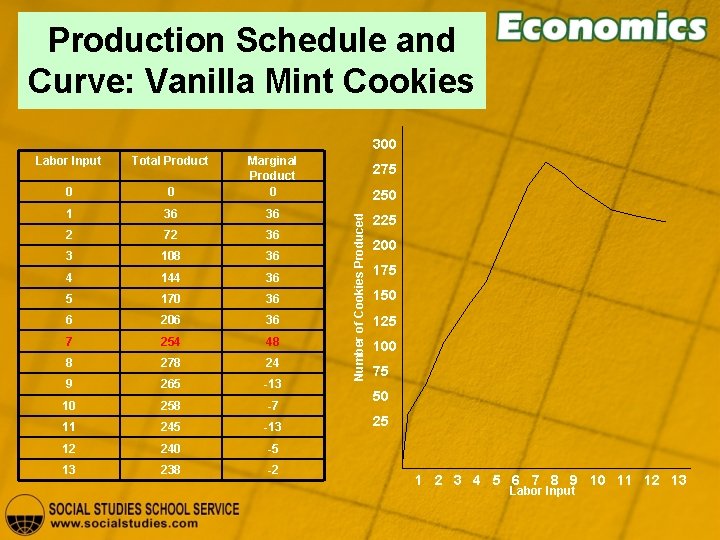
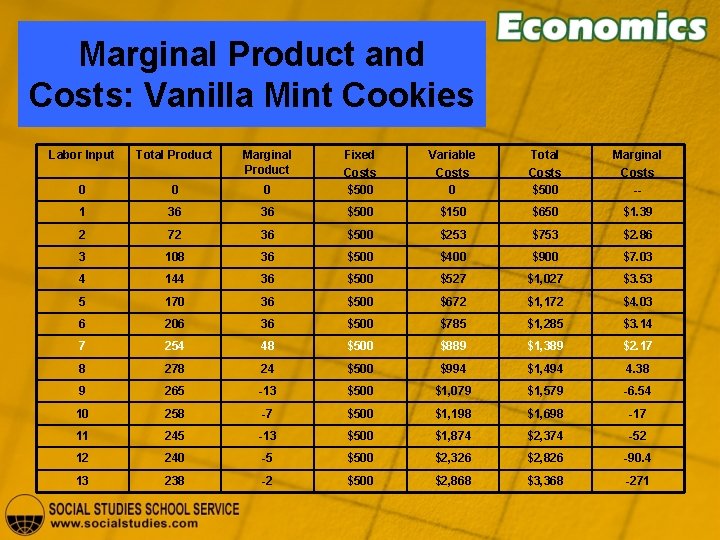
Productivity • The amount of goods and services produced per unit of input • Productivity has an impact on what producers can supply at various prices
Production Schedule and Curve: Vanilla Mint Cookies 300 Total Product 0 0 Marginal Product 0 1 36 36 2 72 36 3 108 36 4 144 36 5 170 36 6 206 36 7 254 48 8 278 24 9 265 -13 10 258 -7 11 245 -13 12 240 -5 13 238 -2 275 250 Number of Cookies Produced Labor Input 225 200 175 150 125 100 75 50 25 1 2 3 4 5 6 7 8 9 10 11 12 13 Labor Input
Marginal Product and Costs: Vanilla Mint Cookies Labor Input Total Product Marginal Product 0 Fixed Costs $500 Variable Costs 0 Total Costs $500 Marginal Costs -- 0 0 1 36 36 $500 $150 $650 $1. 39 2 72 36 $500 $253 $753 $2. 86 3 108 36 $500 $400 $900 $7. 03 4 144 36 $500 $527 $1, 027 $3. 53 5 170 36 $500 $672 $1, 172 $4. 03 6 206 36 $500 $785 $1, 285 $3. 14 7 254 48 $500 $889 $1, 389 $2. 17 8 278 24 $500 $994 $1, 494 4. 38 9 265 -13 $500 $1, 079 $1, 579 -6. 54 10 258 -7 $500 $1, 198 $1, 698 -17 11 245 -13 $500 $1, 874 $2, 374 -52 12 240 -5 $500 $2, 326 $2, 826 -90. 4 13 238 -2 $500 $2, 868 $3, 368 -271
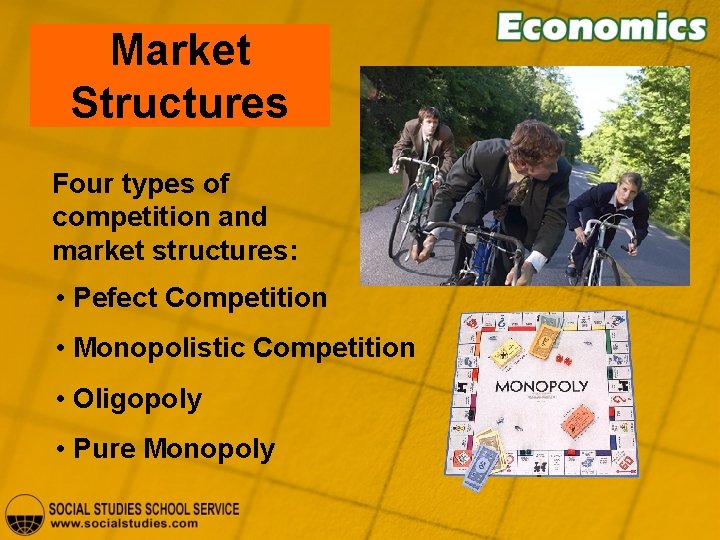
Market Structures Four types of competition and market structures: • Pefect Competition • Monopolistic Competition • Oligopoly • Pure Monopoly
Perfect Competition 1. 2. 3. 4. Characteristics of a market that has perfect competition: Many buyers and sellers All the products are identical There are no price regulations in the market Sellers/Producers can enter and exit the market very easily
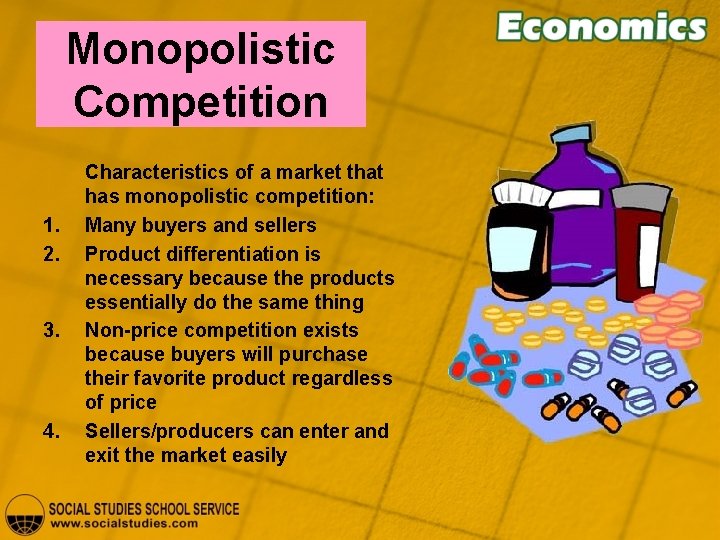
Monopolistic Competition 1. 2. 3. 4. Characteristics of a market that has monopolistic competition: Many buyers and sellers Product differentiation is necessary because the products essentially do the same thing Non-price competition exists because buyers will purchase their favorite product regardless of price Sellers/producers can enter and exit the market easily
Oligopoly 1. 2. 3. 4. Characteristics of a market that has an oligopoly: There are only a few sellers/producers Products can be identical or very similar The market is very difficult for other producers to enter into Non-price competition exists among buyers of the products
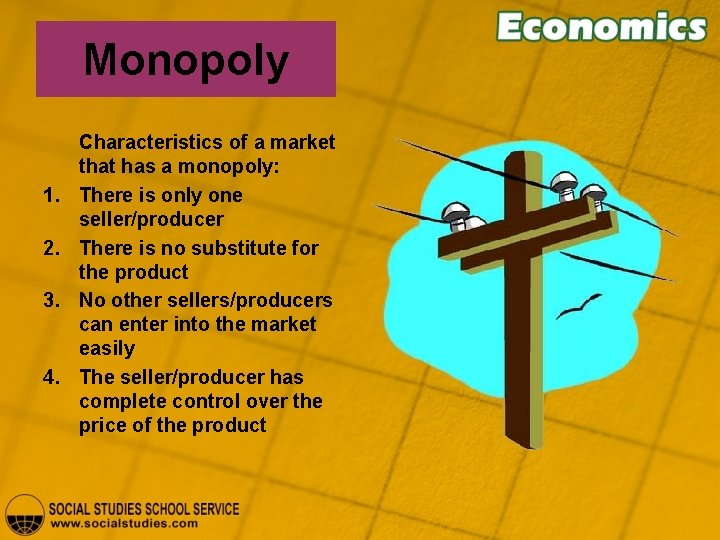
Monopoly 1. 2. 3. 4. Characteristics of a market that has a monopoly: There is only one seller/producer There is no substitute for the product No other sellers/producers can enter into the market easily The seller/producer has complete control over the price of the product
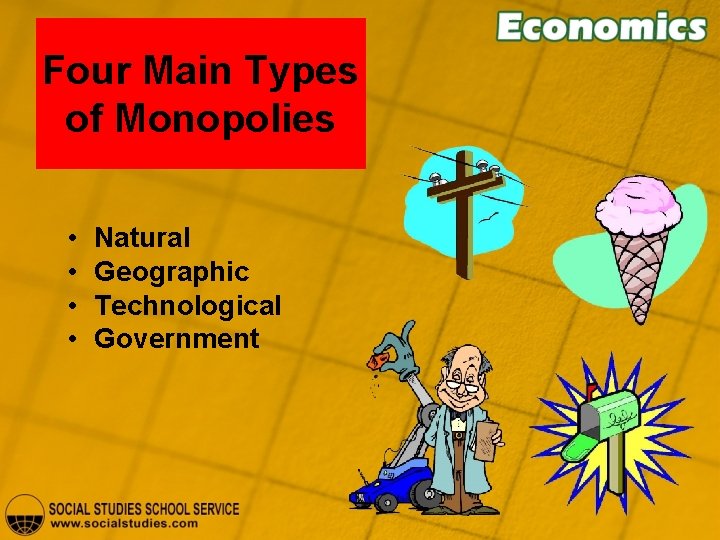
Four Main Types of Monopolies • • Natural Geographic Technological Government
MICROECONOMICS Part II Businesses, Unions, Saving, and Investing
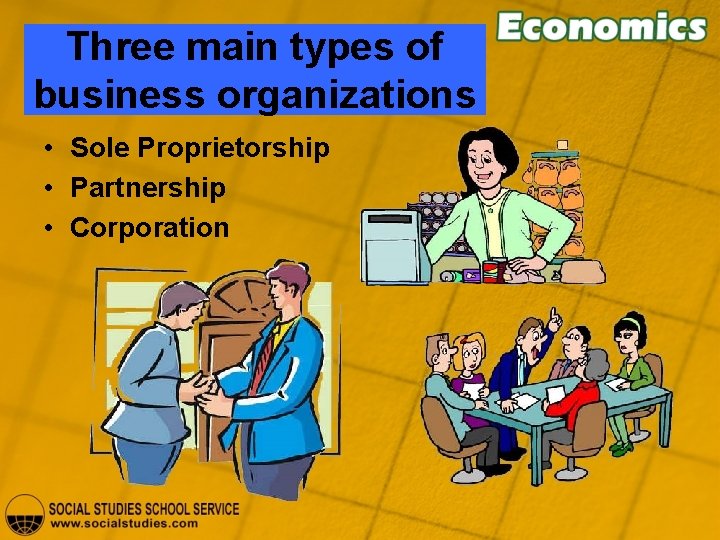
Three main types of business organizations • Sole Proprietorship • Partnership • Corporation
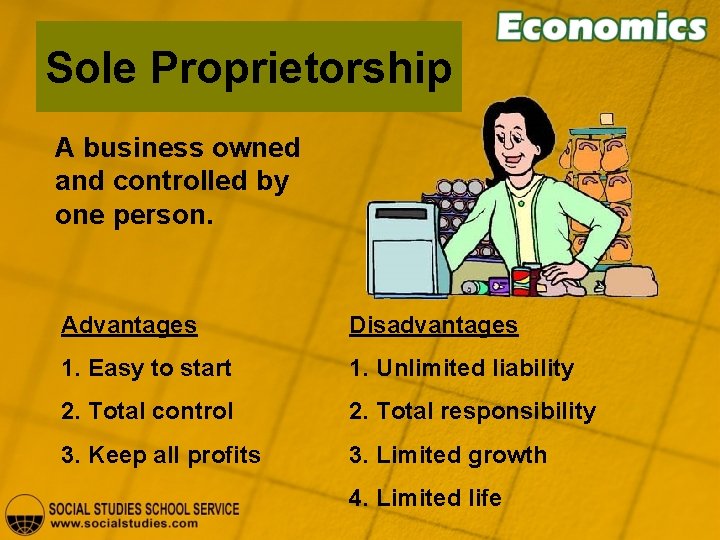
Sole Proprietorship A business owned and controlled by one person. Advantages Disadvantages 1. Easy to start 1. Unlimited liability 2. Total control 2. Total responsibility 3. Keep all profits 3. Limited growth 4. Limited life
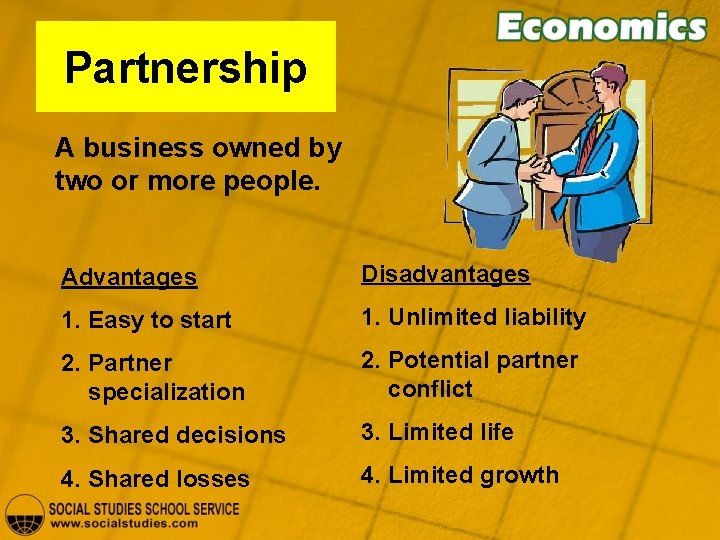
Partnership A business owned by two or more people. Advantages Disadvantages 1. Easy to start 1. Unlimited liability 2. Partner specialization 2. Potential partner conflict 3. Shared decisions 3. Limited life 4. Shared losses 4. Limited growth
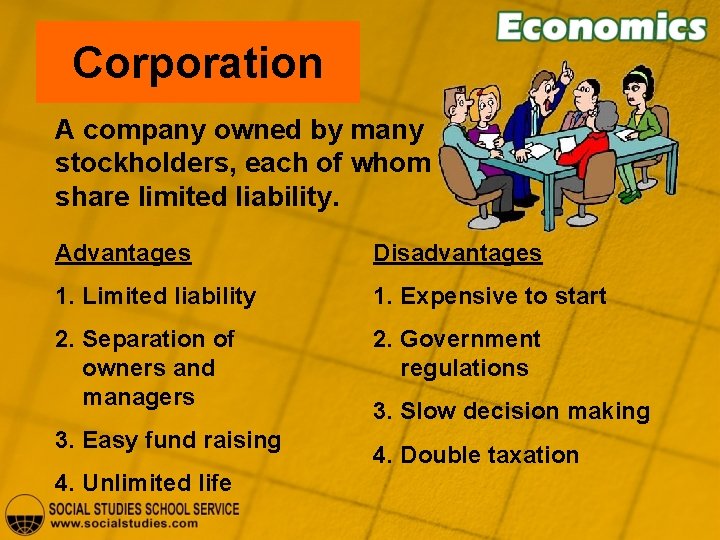
Corporation A company owned by many stockholders, each of whom share limited liability. Advantages Disadvantages 1. Limited liability 1. Expensive to start 2. Separation of owners and managers 2. Government regulations 3. Easy fund raising 4. Unlimited life 3. Slow decision making 4. Double taxation
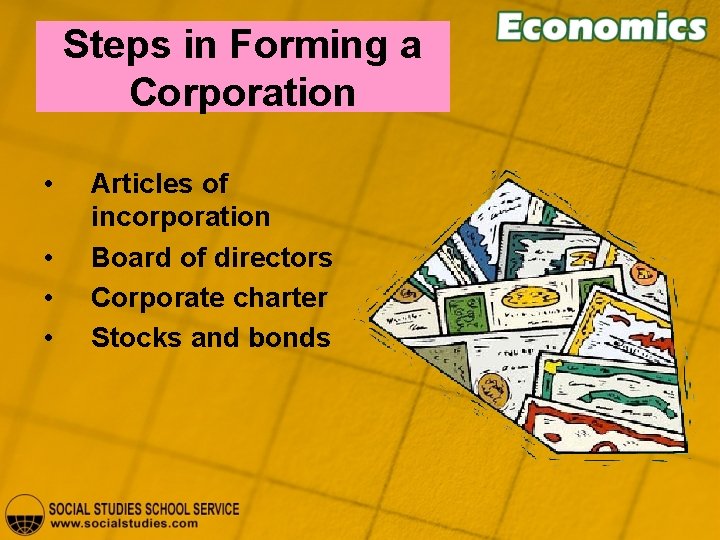
Steps in Forming a Corporation • • Articles of incorporation Board of directors Corporate charter Stocks and bonds
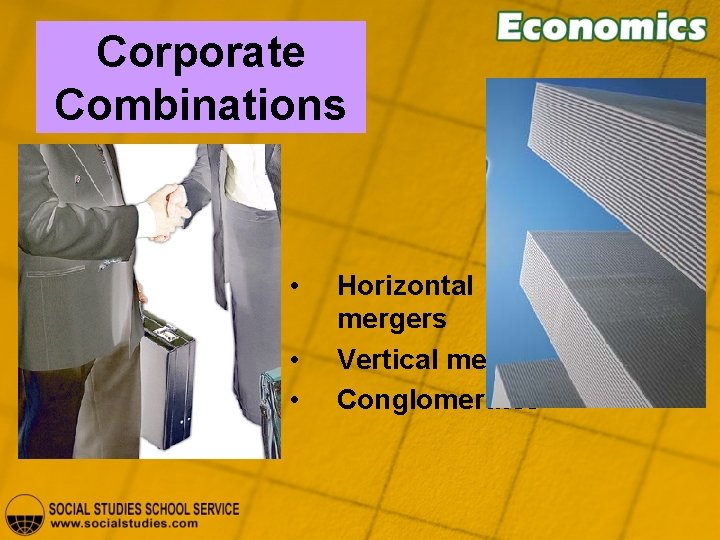
Corporate Combinations • • • Horizontal mergers Vertical mergers Conglomerates
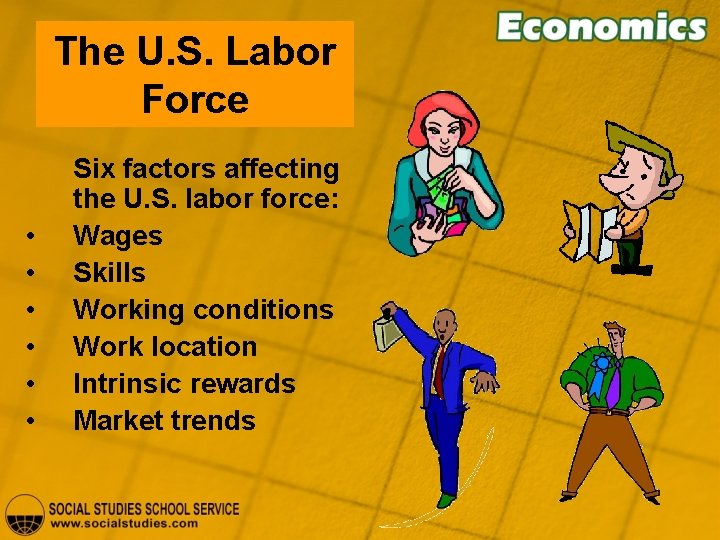
The U. S. Labor Force • • • Six factors affecting the U. S. labor force: Wages Skills Working conditions Work location Intrinsic rewards Market trends
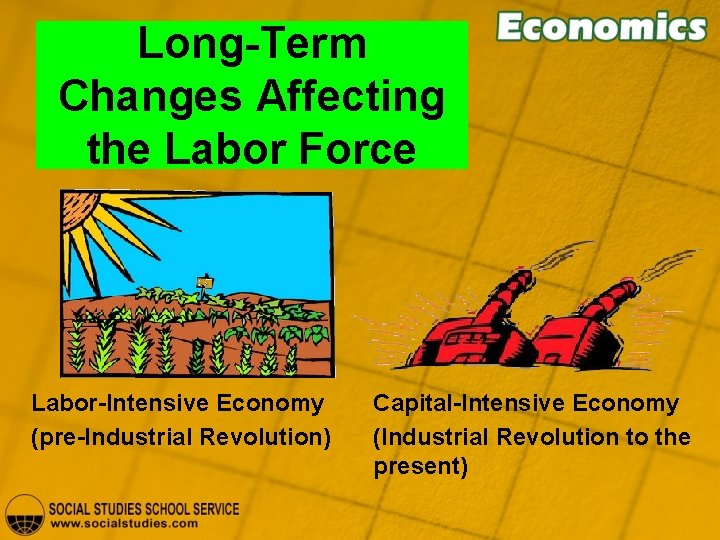
Long-Term Changes Affecting the Labor Force Labor-Intensive Economy (pre-Industrial Revolution) Capital-Intensive Economy (Industrial Revolution to the present)
History of Labor Unions • Knights of Labor • American Federation of Labor (AFL) • Congress of Industrial Organizations (CIO) • AFL-CIO
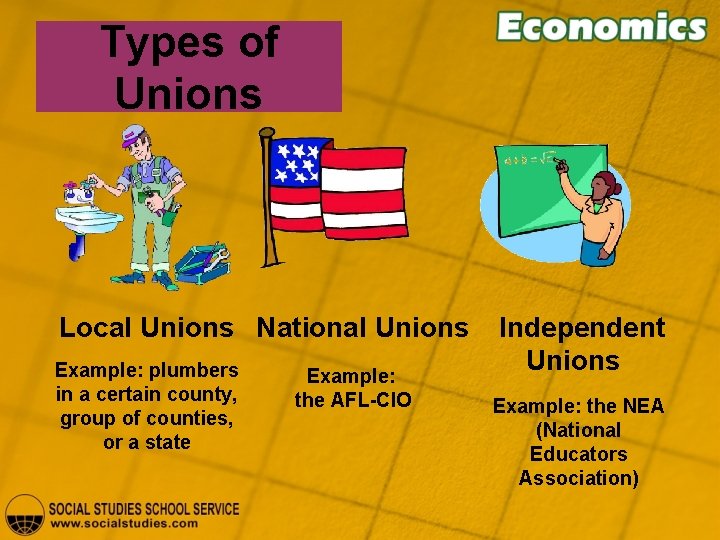
Types of Unions Local Unions National Unions Example: plumbers in a certain county, group of counties, or a state Example: the AFL-CIO Independent Unions Example: the NEA (National Educators Association)
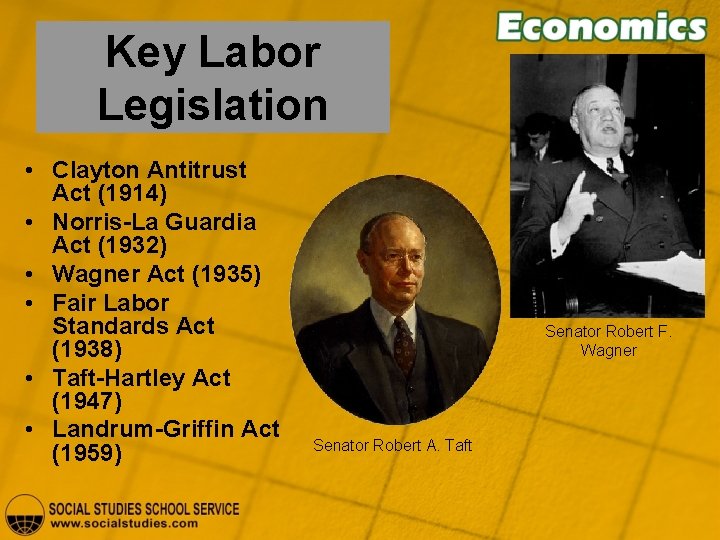
Key Labor Legislation • Clayton Antitrust Act (1914) • Norris-La Guardia Act (1932) • Wagner Act (1935) • Fair Labor Standards Act (1938) • Taft-Hartley Act (1947) • Landrum-Griffin Act (1959) Senator Robert F. Wagner Senator Robert A. Taft
Union Bargaining Contract Issues • Wages and fringe benefits • Working conditions • Job security • Union security • Grievance procedures
Negotiating Techniques • Collective bargaining • Mediation • Arbitration
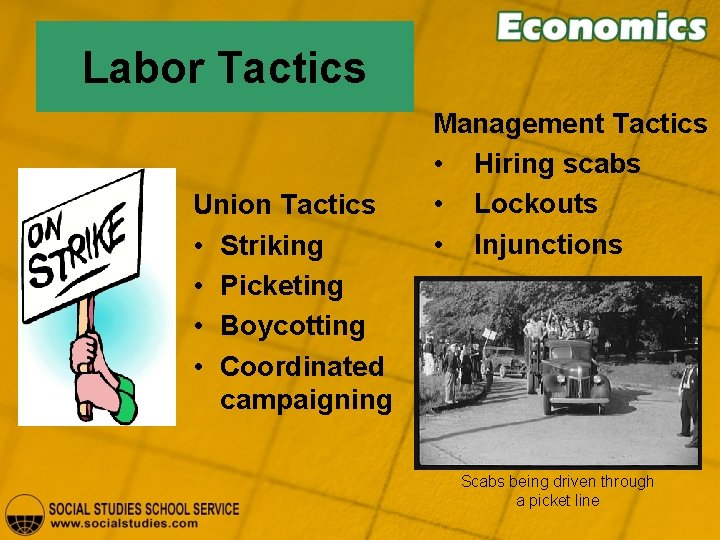
Labor Tactics Union Tactics • Striking • Picketing • Boycotting • Coordinated campaigning Management Tactics • Hiring scabs • Lockouts • Injunctions Scabs being driven through a picket line
Saving • Savings accounts • Money-market accounts • Time deposits - Certificates of deposit - Savings bonds
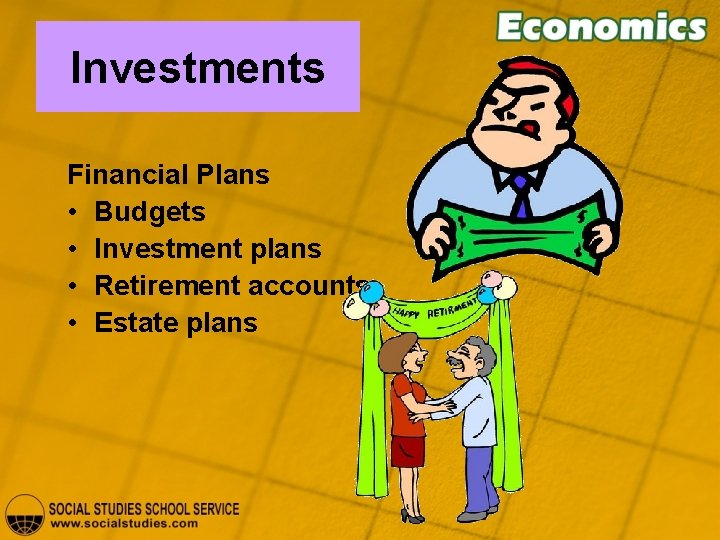
Investments Financial Plans • Budgets • Investment plans • Retirement accounts • Estate plans
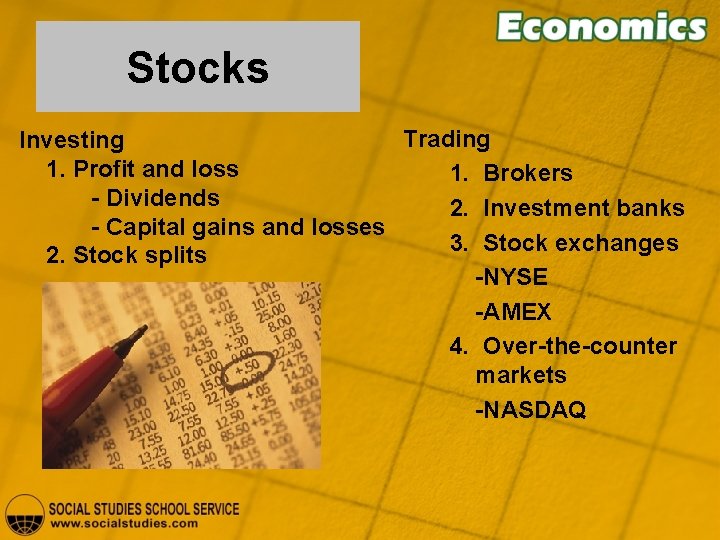
Stocks Trading Investing 1. Profit and loss 1. Brokers - Dividends 2. Investment banks - Capital gains and losses 3. Stock exchanges 2. Stock splits -NYSE -AMEX 4. Over-the-counter markets -NASDAQ
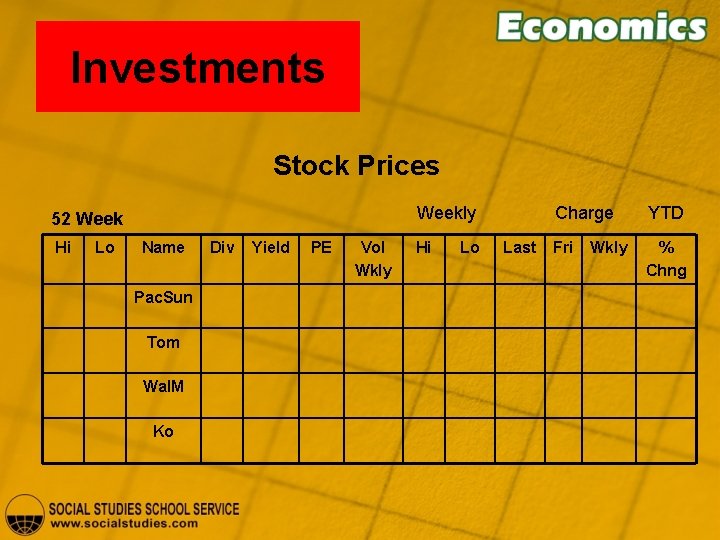
Investments Stock Prices Weekly 52 Week Hi Lo Name Pac. Sun Tom Wal. M Ko Div Yield PE Vol Wkly Hi Lo Last Charge YTD Fri % Chng Wkly
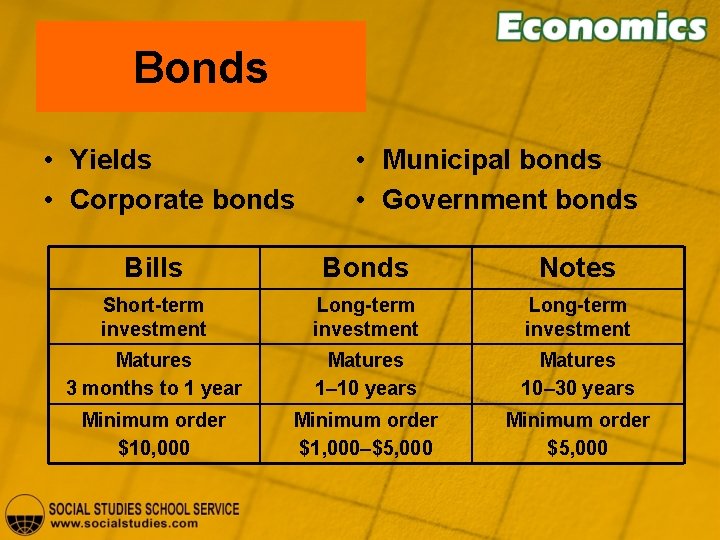
Bonds • Yields • Corporate bonds • Municipal bonds • Government bonds Bills Bonds Notes Short-term investment Long-term investment Matures 3 months to 1 year Matures 1– 10 years Matures 10– 30 years Minimum order $10, 000 Minimum order $1, 000–$5, 000 Minimum order $5, 000
Credit • Credit bureau - Credit rating • Credit terms - Finance charges - Annual Percentage Rate (APR) • Credit abuse - Bankruptcy
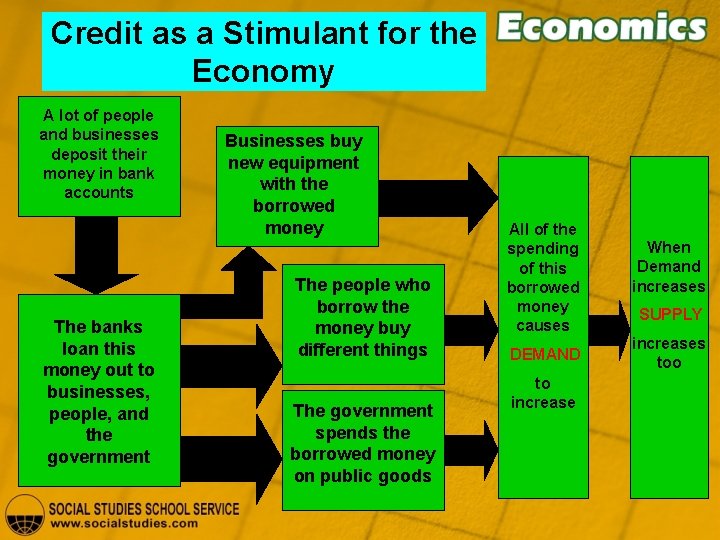
Credit as a Stimulant for the Economy A lot of people and businesses deposit their money in bank accounts The banks loan this money out to businesses, people, and the government Businesses buy new equipment with the borrowed money The people who borrow the money buy different things The government spends the borrowed money on public goods All of the spending of this borrowed money causes DEMAND to increase When Demand increases SUPPLY increases too