
Types of intonation 1 The HighFall The first
- Slides: 6
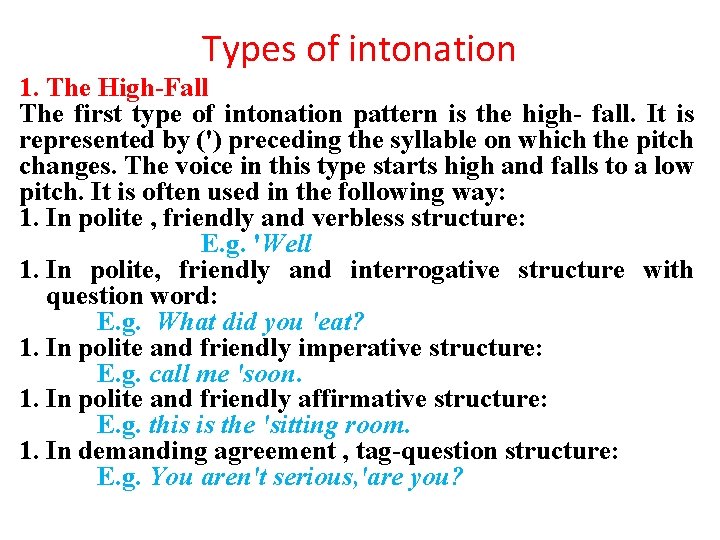
Types of intonation 1. The High-Fall The first type of intonation pattern is the high- fall. It is represented by (') preceding the syllable on which the pitch changes. The voice in this type starts high and falls to a low pitch. It is often used in the following way: 1. In polite , friendly and verbless structure: E. g. 'Well 1. In polite, friendly and interrogative structure with question word: E. g. What did you 'eat? 1. In polite and friendly imperative structure: E. g. call me 'soon. 1. In polite and friendly affirmative structure: E. g. this is the 'sitting room. 1. In demanding agreement , tag-question structure: E. g. You aren't serious, 'are you?
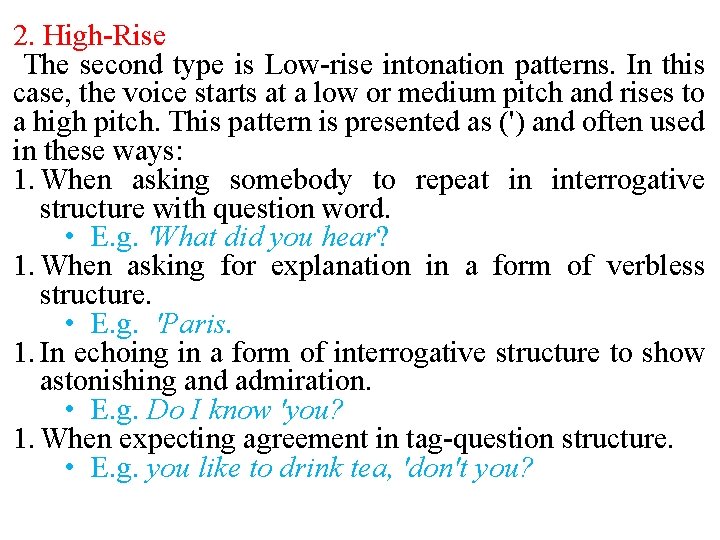
2. High-Rise The second type is Low-rise intonation patterns. In this case, the voice starts at a low or medium pitch and rises to a high pitch. This pattern is presented as (') and often used in these ways: 1. When asking somebody to repeat in interrogative structure with question word. • E. g. 'What did you hear? 1. When asking for explanation in a form of verbless structure. • E. g. 'Paris. 1. In echoing in a form of interrogative structure to show astonishing and admiration. • E. g. Do I know 'you? 1. When expecting agreement in tag-question structure. • E. g. you like to drink tea, 'don't you?
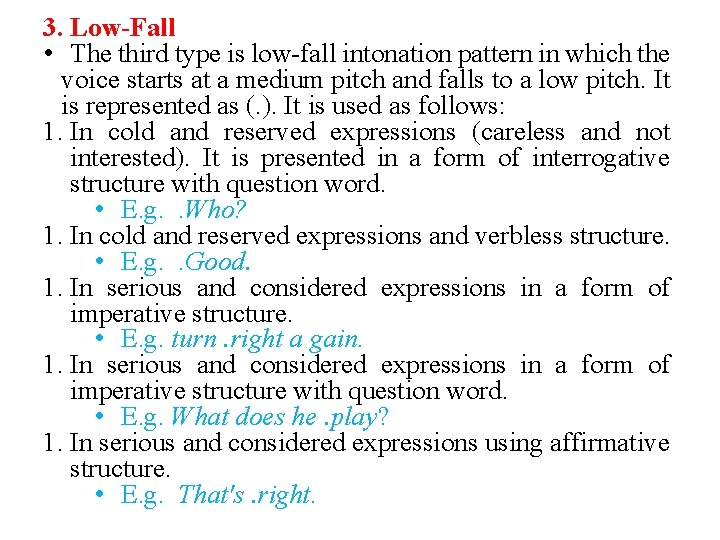
3. Low-Fall • The third type is low-fall intonation pattern in which the voice starts at a medium pitch and falls to a low pitch. It is represented as (. ). It is used as follows: 1. In cold and reserved expressions (careless and not interested). It is presented in a form of interrogative structure with question word. • E. g. . Who? 1. In cold and reserved expressions and verbless structure. • E. g. . Good. 1. In serious and considered expressions in a form of imperative structure. • E. g. turn. right a gain. 1. In serious and considered expressions in a form of imperative structure with question word. • E. g. What does he. play? 1. In serious and considered expressions using affirmative structure. • E. g. That's. right.
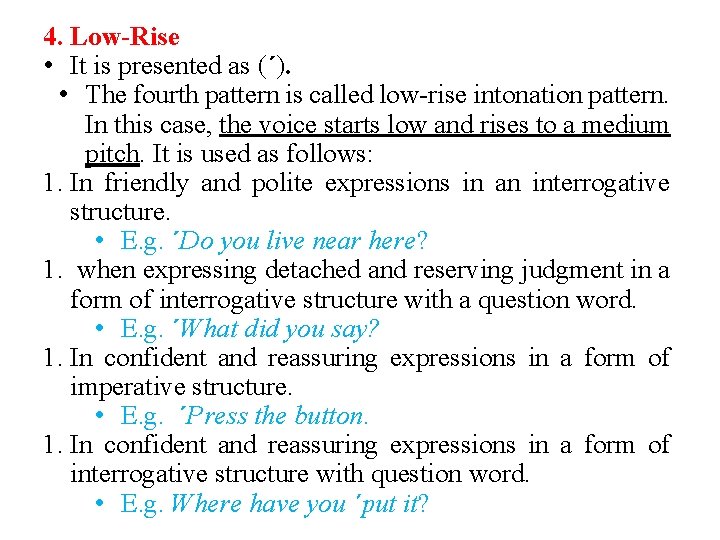
4. Low-Rise • It is presented as (´). • The fourth pattern is called low-rise intonation pattern. In this case, the voice starts low and rises to a medium pitch. It is used as follows: 1. In friendly and polite expressions in an interrogative structure. • E. g. ´Do you live near here? 1. when expressing detached and reserving judgment in a form of interrogative structure with a question word. • E. g. ´What did you say? 1. In confident and reassuring expressions in a form of imperative structure. • E. g. ´Press the button. 1. In confident and reassuring expressions in a form of interrogative structure with question word. • E. g. Where have you ´put it?
5. Fall-Rise • The fifth type is Fall-Rise intonation in which the voice starts high, then falls, then rises. It is presented as (ˇ) and the following are the common usages of this type. . . 1. It is used in expressing partial agreement in a form of affirmative structure. • E. g. He is flying to ˇLondon. 1. When warning in a form of imperative structure. • E. g. Mind the ˇgap.
6. Rise- Fall • This is the last type of intonation according to Kharma and Hajjaj (1989). In this type, the voice starts in a medium pitch or low pitch, then rises and then falls. It is presented as (ˆ). Here are the common usages of this intonation pattern. 1. When expressing impressions in a form of verbless structure. • E. g. ˆFantastic. 1. When expressing impressions in a form of affirmative structure. • E. g. It was ˆlovely