
Types of Industry Primary Extractive Secondary Manufacturing Tertiary


- Slides: 58
Types of Industry • Primary – Extractive • Secondary – Manufacturing • Tertiary – Service • Quaternary – Technology, Storage, Recovery
Primary Industry • Years ago, most jobs in Canada related to natural resources. • industries included mining, fishing, farming, forestry and oil. • Canadians in primary industries work directly with natural resources. • Products are extracted directly from the earth.
Secondary Industries • build, construct, and manufacture products from raw materials. • secondary industry also known as the manufacturing industry. • Canadians have an international reputation for many of the products that they manufacture, such as airplanes, cars, and paper.
Tertiary Industries • Provision of services to others. • ranging from doctors and lawyers to actors and chefs. • See page 355 for a long list. • Do these exist in your community? • Public Sector – government owned (teachers, hospitals, etc. . ) • Private Sector – owned by individuals (mechanics, insurance agents, massage…)
Quaternary Industries • involve the creation of knowledge, ideas, and technology • intellectual services that are the basis of research and development • Some see quaternary industry as a part of tertiary industry, but, it is very different. • Quaternary industry makes use of knowledge and ideas to create solutions to problems.
Natural Resources for the future
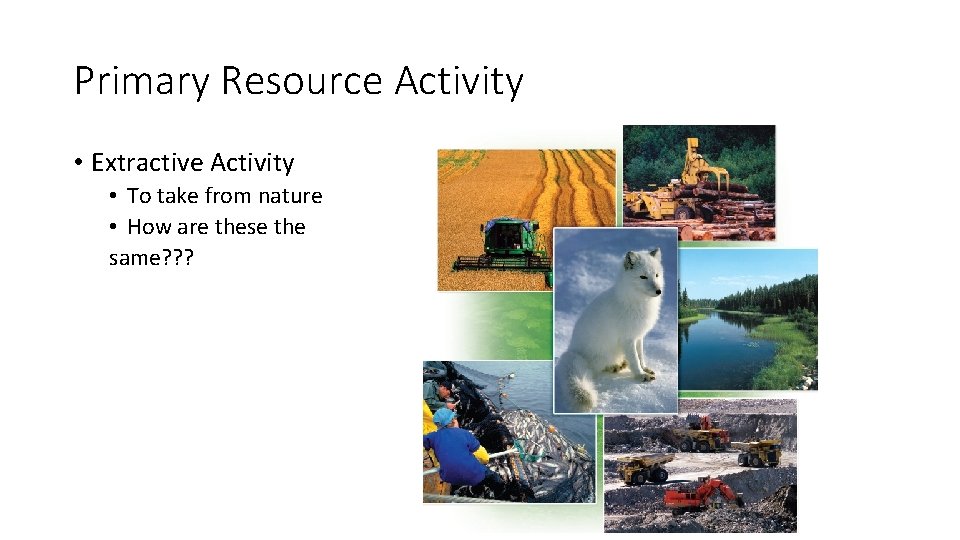
Primary Resource Activity • Extractive Activity • To take from nature • How are these the same? ? ?
• “Canada must become the world’s smartest natural resource developer, user, and exporter; the most environmentally friendly; the most socially responsible; the most productive and competitive. ” • People visit Canada every year to experience the solitude and grandeur of the great outdoors. • The nature of our consumer society has encouraged us to scour Canada’s landscapes for the raw materials that we need to support our way of life. Extracting resources and sales of consumer goods provide jobs for Canadians.
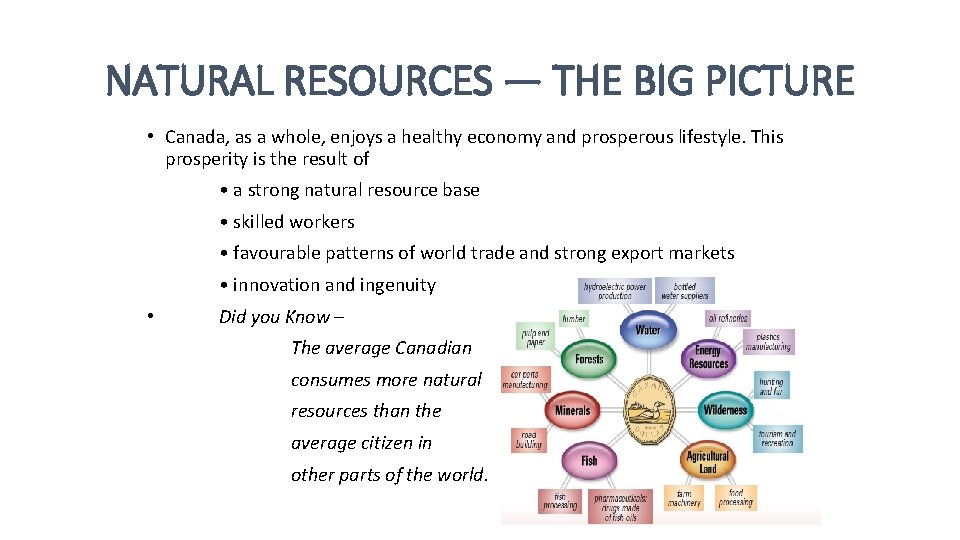
NATURAL RESOURCES — THE BIG PICTURE • Canada, as a whole, enjoys a healthy economy and prosperous lifestyle. This prosperity is the result of • a strong natural resource base • skilled workers • favourable patterns of world trade and strong export markets • innovation and ingenuity • Did you Know – The average Canadian consumes more natural resources than the average citizen in other parts of the world.
Resources at a Glance • Natural resource is anything found in nature that can be used by people. It becomes a resource when: • 1. people have a need or want for it • 2. it is profitable to extract and develop and • 3. technology exists to extract.
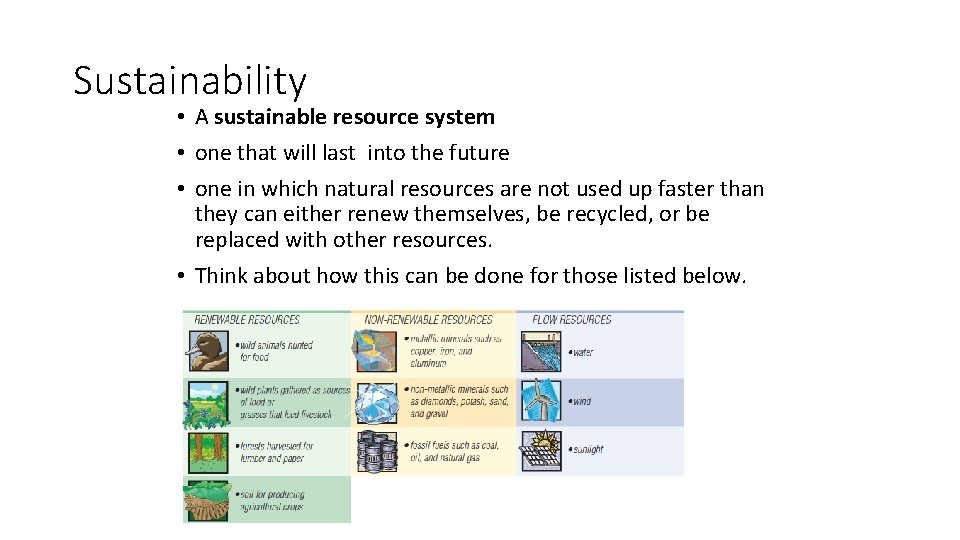
3 types: • Renewable resources, such as forests, can grow again after people harvest them. • Non-renewable resources, such as minerals like gold and oil, are present on Earth in limited amounts, and when they are used they are gone forever. • Flow resources, such as water and wind, are neither renewable nor non-renewable. They must be used where and when they occur. For example, wind energy to produce electricity can only be used in a place where the wind blows continually
Sustainability • A sustainable resource system • one that will last into the future • one in which natural resources are not used up faster than they can either renew themselves, be recycled, or be replaced with other resources. • Think about how this can be done for those listed below.
Consuming Resources: Needs and Wants • When shopping, you are automatically consuming natural resources. • Every product you buy comes from the natural resources of the Earth. • Have you considered: • How many televisions, cars, or pairs of jeans or shoes does one person need to be comfortable? • Do you have enough things to meet your basic needs? • Are there more things that you want that you don’t already have?
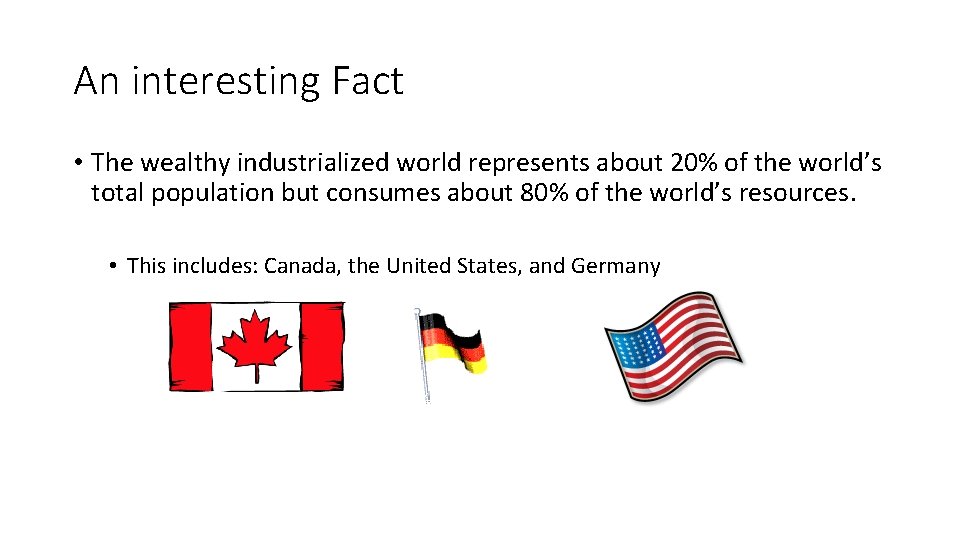
An interesting Fact • The wealthy industrialized world represents about 20% of the world’s total population but consumes about 80% of the world’s resources. • This includes: Canada, the United States, and Germany
What’s in a Word. • • • extract: to remove a resource from the Earth develop: to extract a resource and prepare it for market manage: to provide direction and guidance on how to use a resource conserve: to use a resource so the supply will last for future generations preserve: to maintain a resource in its existing state protect: to look after; to save from harm degrade: to lower the quality of a resource sustain: to conserve resources so that they survive for future generations traditional: describes a way of using a resource that has been handed down from generation to generation
Questions • Page 241 • Answer #1, 2, and 4.
AN ECONOMIC PERSPECTIVE • Extracting natural resources brings money into the economy by providing jobs for more than a million Canadians in resource-related industries and through our exports of raw materials to other countries. • Exports are sales of our products or services to another country. In turn, the companies that profit from the export of our natural resources pay royalties and income taxes to the federal or provincial government, which benefit our country as a whole.
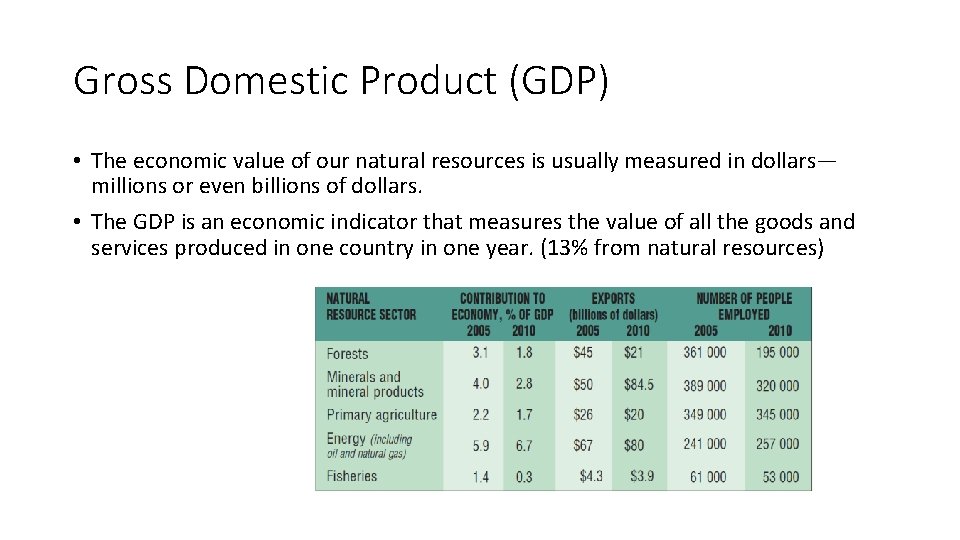
Gross Domestic Product (GDP) • The economic value of our natural resources is usually measured in dollars— millions or even billions of dollars. • The GDP is an economic indicator that measures the value of all the goods and services produced in one country in one year. (13% from natural resources)
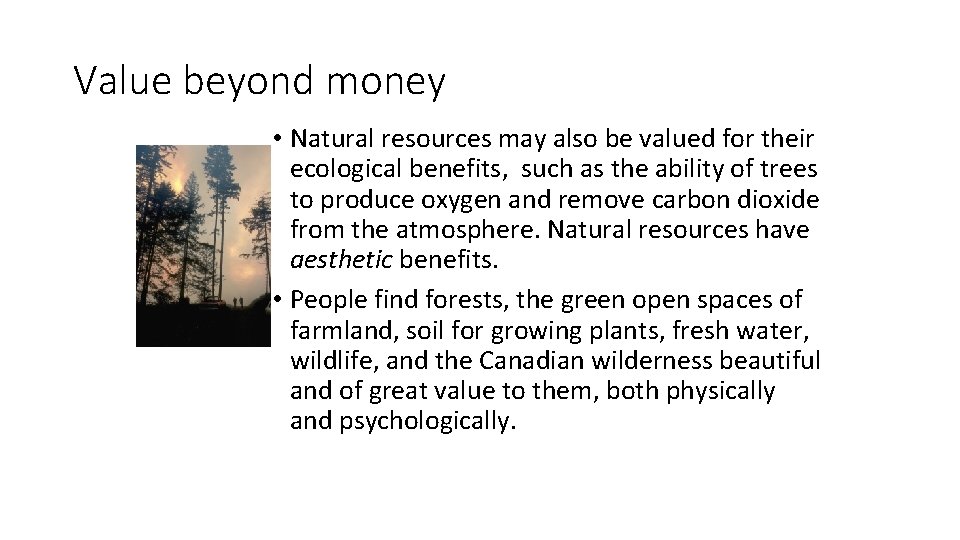
Value beyond money • Natural resources may also be valued for their ecological benefits, such as the ability of trees to produce oxygen and remove carbon dioxide from the atmosphere. Natural resources have aesthetic benefits. • People find forests, the green open spaces of farmland, soil for growing plants, fresh water, wildlife, and the Canadian wilderness beautiful and of great value to them, both physically and psychologically.
Trade off and Systems Thinking • When we take natural resources out of the Earth, there is damage to the environment and to natural systems. It can’t be helped—it is inevitable. Nevertheless, we continue to use natural resources because of the trade-off—we need the raw materials and we need the jobs they provide. Natural resources keep the economy strong. In responding to the challenges of this trade-off, people have become more concerned with protecting and conserving resources. How do we use resources in a sustainable way – Systems Thinking.
What`s so different today compared to the past. • Trends taking place in the world today that have an effect on natural resources in Canada include the following: • Consumption of natural resources is increasing in Canada and around the world as developing countries, in particular countries with large populations such as China, India, and Brazil, become more industrialized. • Competition for selling natural resources is increasing on a global scale as more natural resources are being produced by developing countries, for example, gold in China. • Control of natural resources is increasingly concentrated in the hands of large international companies. • People are becoming more concerned about the condition of the natural environment. - Canada needs to address the rights and title to land of Aboriginal peoples. - Human ingenuity has resulted in the development of new technology that the way resources are both extracted and protected. is changing
Transnational Corporations • Most natural resource development is controlled by large international companies. • Vale, based in Brazil, employs 126 000 people in 38 countries with 50 000 more working in ongoing projects. Vale is the world leader in iron ore production and one of the largest nickel producers in the world. It operates Voisey’s Bay nickel and copper mining in Labrador and processing facilities in Long Harbour, Newfoundland, as well as other mines in Canada. • When a transnational corporation extracts a resource in a small community, the community benefits economically because it gains jobs. Some corporations contribute in other ways to the community by building roads or helping to pay for arenas or other buildings. But some do not.
Sustainable Development • We must consider, how we go about • maintaining a strong economy • considering the needs of people in their communities • protecting the natural environment One way that the government has responded to this challenge is to pass laws to reduce harm to the natural environment.
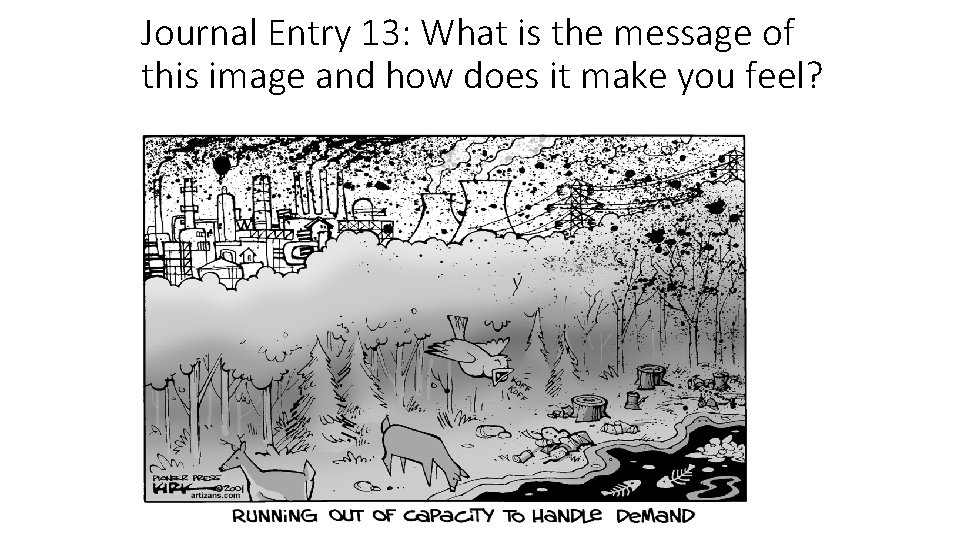
Journal Entry 13: What is the message of this image and how does it make you feel?
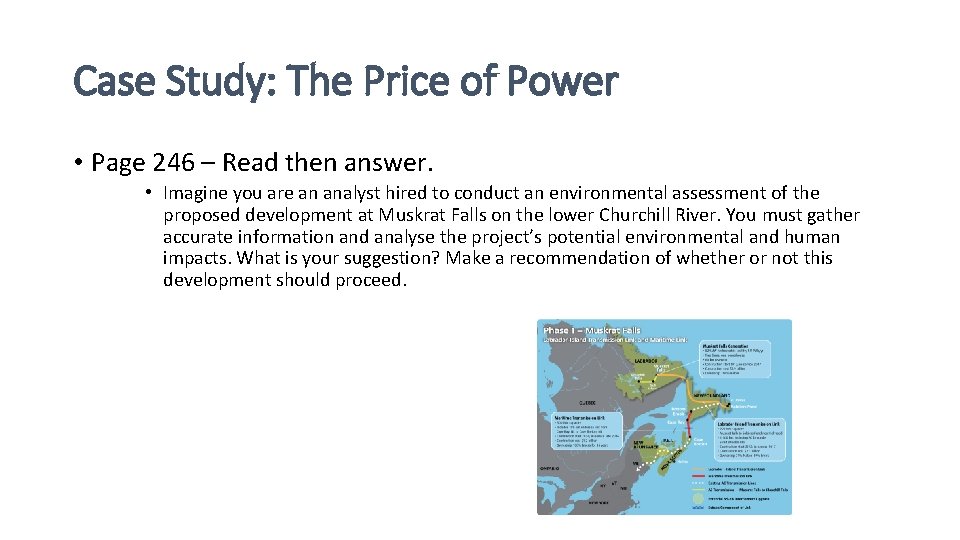
Case Study: The Price of Power • Page 246 – Read then answer. • Imagine you are an analyst hired to conduct an environmental assessment of the proposed development at Muskrat Falls on the lower Churchill River. You must gather accurate information and analyse the project’s potential environmental and human impacts. What is your suggestion? Make a recommendation of whether or not this development should proceed.
Aboriginal Peoples and Natural Resources • Many natural resources are located on land to which Aboriginal peoples have claim or hold title. • Innu Nation of Labrador will have substantial annual revenues that will ensure long-term economic stability. In addition, the Innu Nation will have access to training and employment opportunities. This comes with the Agreement with Lower Churchill. • A company called Nova. Gold began developing a gold, copper, and silver mine on Tahltan First Nation land in British Columbia - An agreement between the Tahltan and Nova. Gold includes a $1 million yearly payment and royalties to the Tahltan First Nation, who play a role in monitoring the project’s environmental effects.
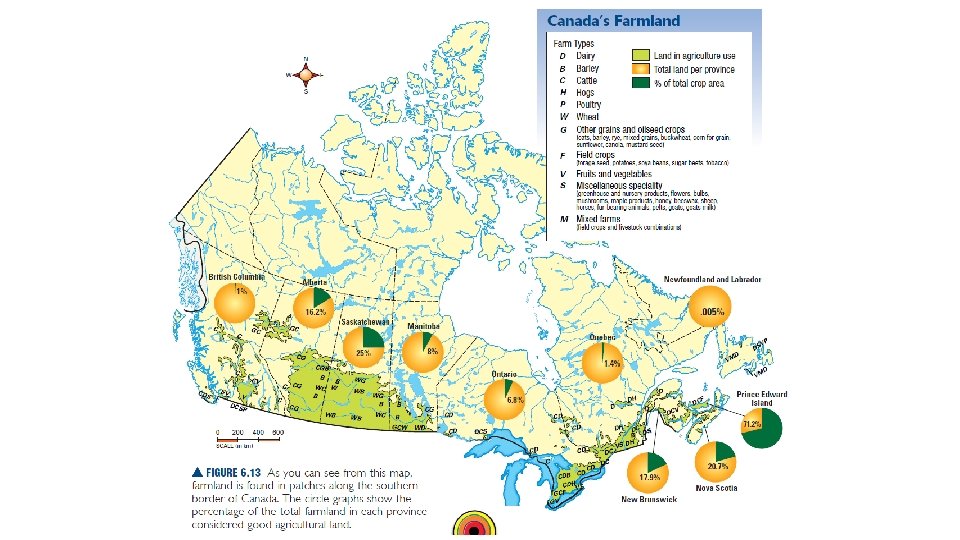
AGRICULTURE —AN ESSENTIAL PRIMARY INDUSTRY • Agriculture generates 1. 7% of Canada’s gross domestic product (GDP) and provides jobs, directly and indirectly, to approximately one in 86 Canadians. • Doesn’t seem like much - Agriculture supports many rural communities and provides Canadians with a safe, abundant food supply. • Agricultural land is often considered a renewable resource because, if it is properly cared for, crops may grow on it year after year. • only about seven per cent of the total land area of Canada is arable, or suitable for growing crops.
Deciding What to Grow —Factors Affecting Agriculture • Climate, landforms, and soil conditions are the most important natural factors affecting farming. • Other factors include: Ø demands by consumers for certain products transportation facilities that are available Ø closeness to market, where food products are bought and sold Ø competition that you may have from other lower-cost growers Ø changing prices for food on world markets
Challenges Farmers Face • natural hazards such as early frosts, drought, floods, and animal diseases such as mad cow disease (BSE) in beef or avian flu in poultry • high costs for fuel and equipment • low crop prices • competition from more heavily subsidized farmers in other countries • competition from large, industrialized factory farms
Canadian Farming Problem • The governments of the United States and the countries of the European Union pay farmers a subsidy to help them grow some farm products. A subsidy is money given to farmers by the government to offset some of their costs, such as expensive machinery or high fuel prices. A subsidy paid to farmers in other countries helps them keep the price of their products low, and may put Canadian farmers at a disadvantage.
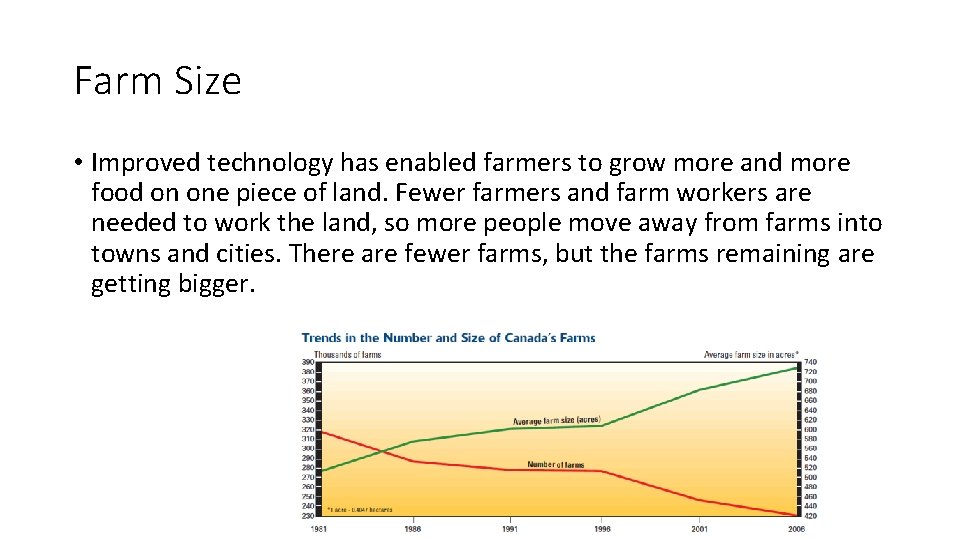
Trends in Agriculture These trends affect the economy, the natural environment, and our communities, and they include the following: Øchanging consumer demands Øchanging technology Øfewer farmers but larger farms Øincreasing control of agriculture by transnational corporations Øan increase in industrial agriculture, known as factory farming
Changing Technology • During the 1960 s and 1970 s, many new technological developments in high-tech farm machinery, chemicals, and high-yield seeds increased the production of food dramatically. • Pesticides have been used throughout farming history to improve production – however the impact of such as been debated heavily recently – Biological Amplification. • Pesticide use has been reduce and even banned in some countries.
Farm Size • Improved technology has enabled farmers to grow more and more food on one piece of land. Fewer farmers and farm workers are needed to work the land, so more people move away from farms into towns and cities. There are fewer farms, but the farms remaining are getting bigger.
Agribusiness and Factory Farms • Transnational corporations (agribusinesses) buy the food from the farmer or grow the food themselves, process it, and distribute it to grocery stores—squeezing out the farmer and the grocery store so that they receive a very small percentage of the profit in the food system. • The pressures of the market and changing technology have caused a gradual shift from small family farms to large industrialized operations often called factory farms. Large pig barns and beef feedlots house thousands of animals in a small, contained space. Animals living in such conditions are more susceptible to diseases, so they are often fed antibiotics as well as growth hormones to make them put on weight.
SUSTAINABLE AGRICULTURE • meets Canadians’ needs for food so we don’t have to rely on food imported from other countries • makes efficient use of fossil fuels to run farm machinery • protects surface and ground water, as well as air and soil quality • reduces the use of chemicals, such as synthetic fertilizers and pesticides • provides jobs and a profitable industry • supports small farms and urban agriculture • encourages positive contact between farmers and consumers
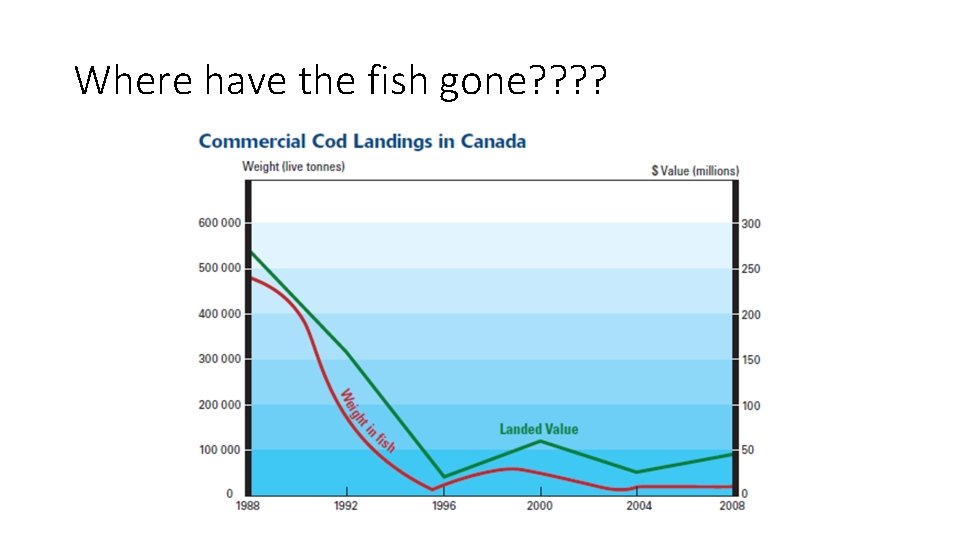
The Fishery • Fishing is one of the last remaining ways to harvest wild food. • With such an abundance of fish and seafood, it is hard to believe that Canada’s fisheries are in a state of crisis. • In 1992, the Atlantic cod fishery in Canada collapsed. In response, the federal government placed a moratorium on the cod fishery in Newfoundland Labrador.
Employment in the fishery • The fishery in Newfoundland Labrador employs more than 20 000 people, mostly in rural areas. Total production in 2010 was valued at $942 million, an increase of almost 14% over 2009. • East coast salmon are disappearing quickly, however. Today, about 350 000 (compare to 1. 5 Million in the 70’s) wild salmon return each year to spawn in rivers flowing into Nova Scotia’s Bay of Fundy. The same is true for the east coast salmon fishery.
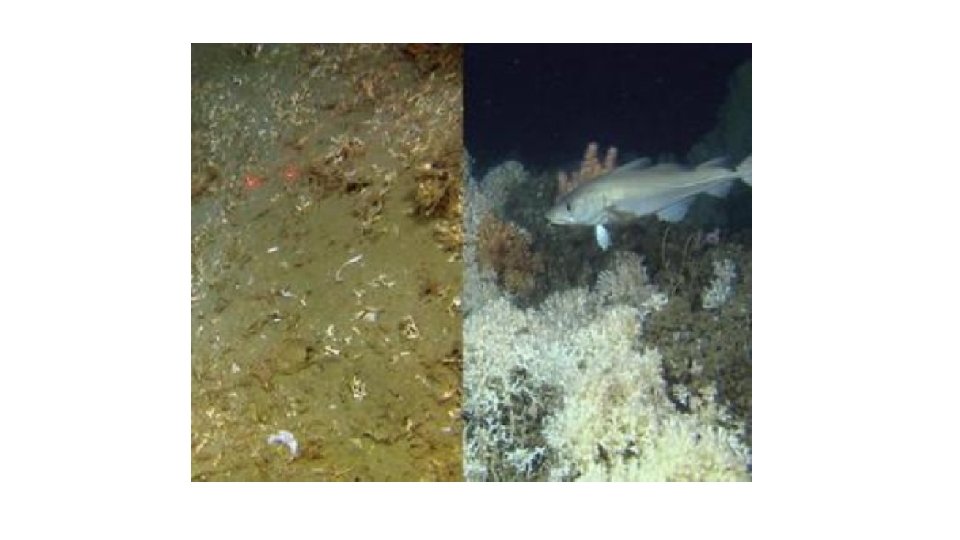
Where have the fish gone? ?
Impact of declining fisheries • Fisher people have moved on to different species (rise in crab, lobster, whelk, cucumber etc… over the past 20 years). • As fish stocks decline, fishers have expanded their reach into deeper water, stopped fishing (retrained or moved away), or expanded into fish farming, known as aquaculture.
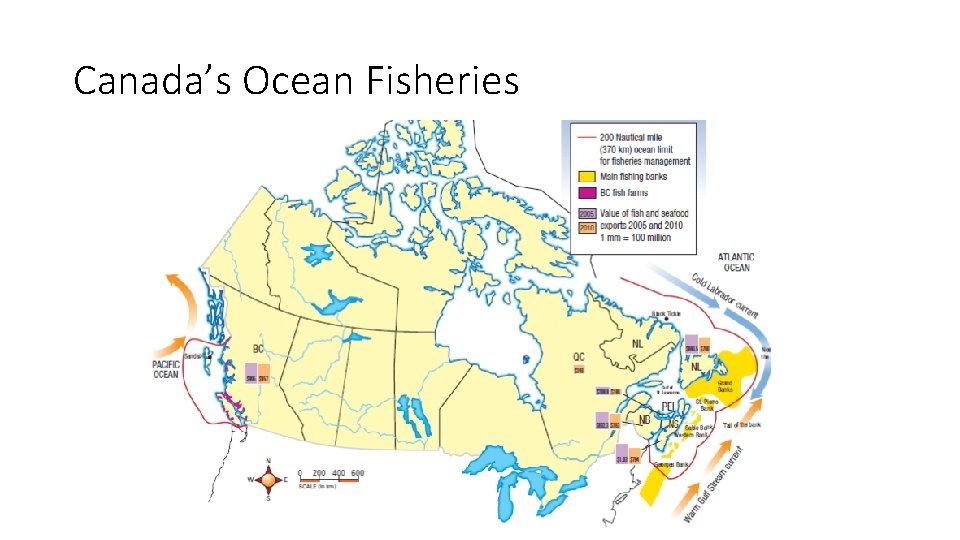
Canada’s Ocean Fisheries
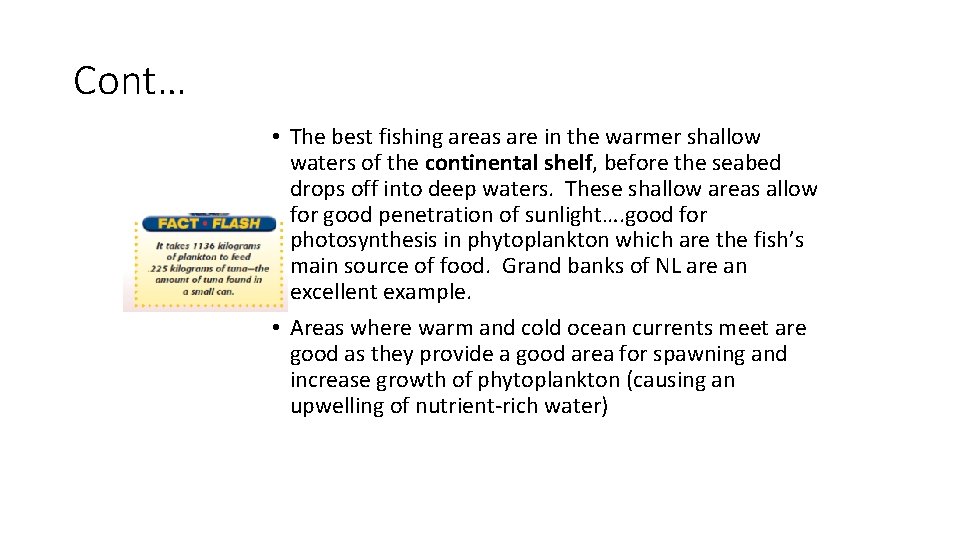
Cont… • The best fishing areas are in the warmer shallow waters of the continental shelf, before the seabed drops off into deep waters. These shallow areas allow for good penetration of sunlight…. good for photosynthesis in phytoplankton which are the fish’s main source of food. Grand banks of NL are an excellent example. • Areas where warm and cold ocean currents meet are good as they provide a good area for spawning and increase growth of phytoplankton (causing an upwelling of nutrient-rich water)
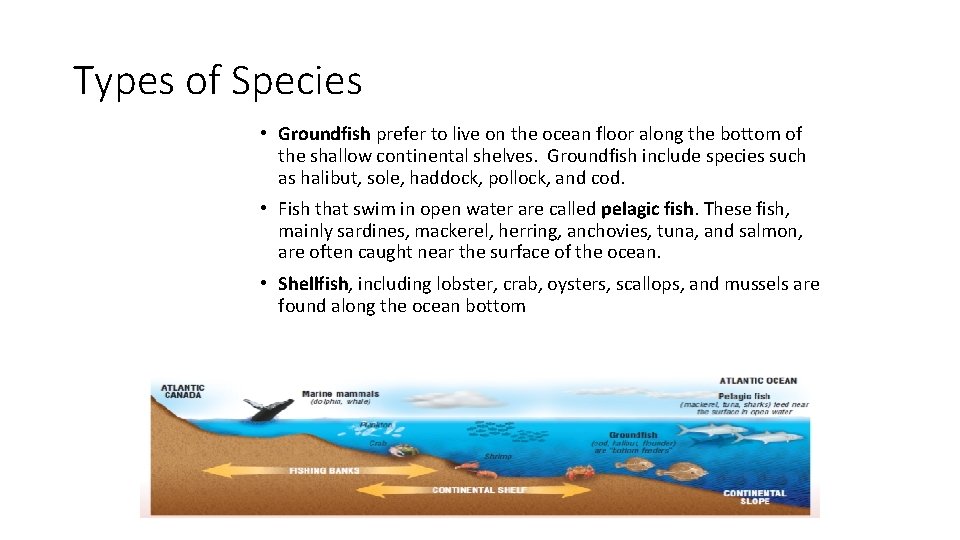
Types of Species • Groundfish prefer to live on the ocean floor along the bottom of the shallow continental shelves. Groundfish include species such as halibut, sole, haddock, pollock, and cod. • Fish that swim in open water are called pelagic fish. These fish, mainly sardines, mackerel, herring, anchovies, tuna, and salmon, are often caught near the surface of the ocean. • Shellfish, including lobster, crab, oysters, scallops, and mussels are found along the ocean bottom
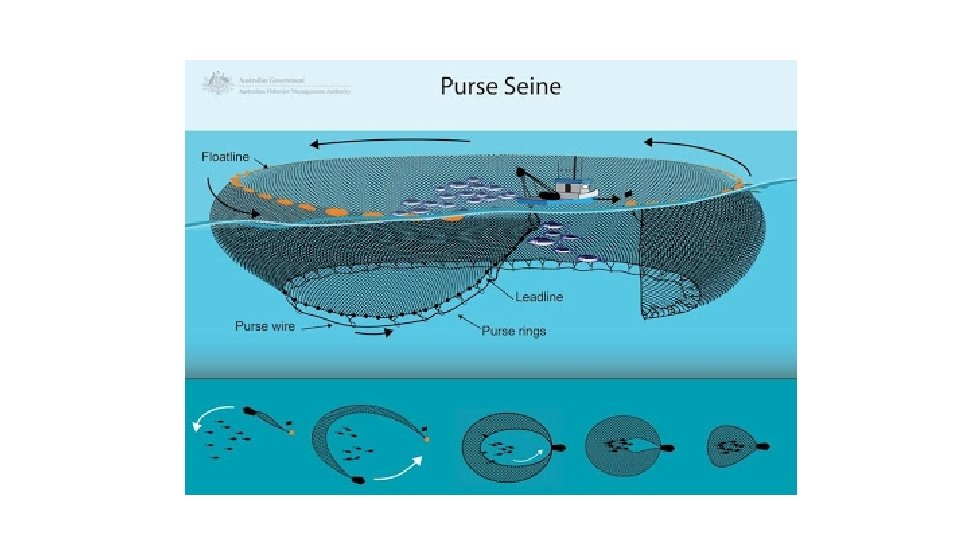
Types of gear used • Purse Seine - A large net that hangs vertically in the water by attaching weights along the bottom edge and floats along the top. • Otter trawl - Trawling, or dragging, is a commercial fishing method in which a trawl vessel (trawler or dragger) drags a cone-shaped net with a rectangular opening through the water to trap fish. • Longlining - Longlining is a hook and line fishery in which long lengths of baited hooks are laid on the ocean floor to catch mainly groundfish • Gill net - A gillnet is a long, horizontal mesh sheet with floats along the upper edge. It is set perpendicular to the path of the fish and designed so that incoming fish can get their heads but not their bodies through the mesh; thus the term gillnet. • weir: a device used to trap fish made of a net supported by wooden stakes
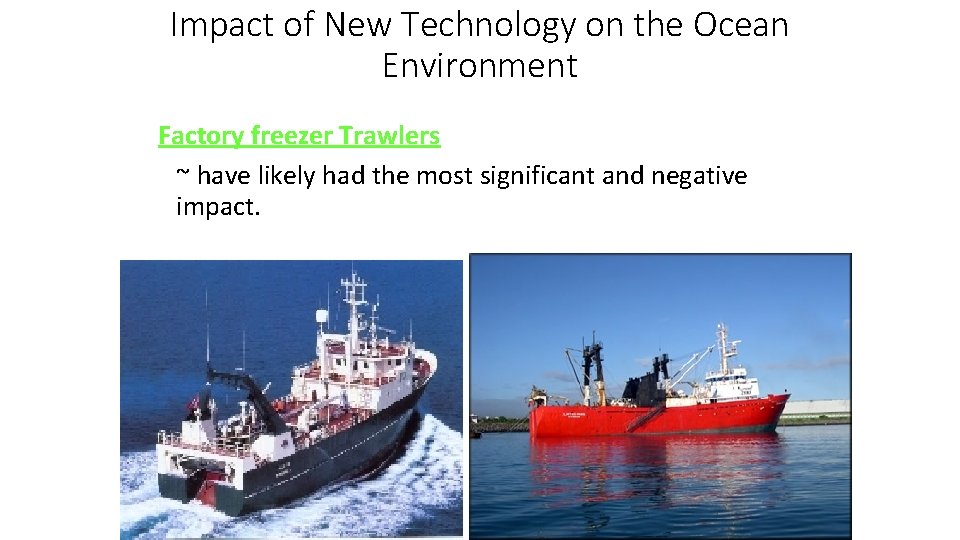
Impact of New Technology on the Ocean Environment Factory freezer Trawlers ~ have likely had the most significant and negative impact.
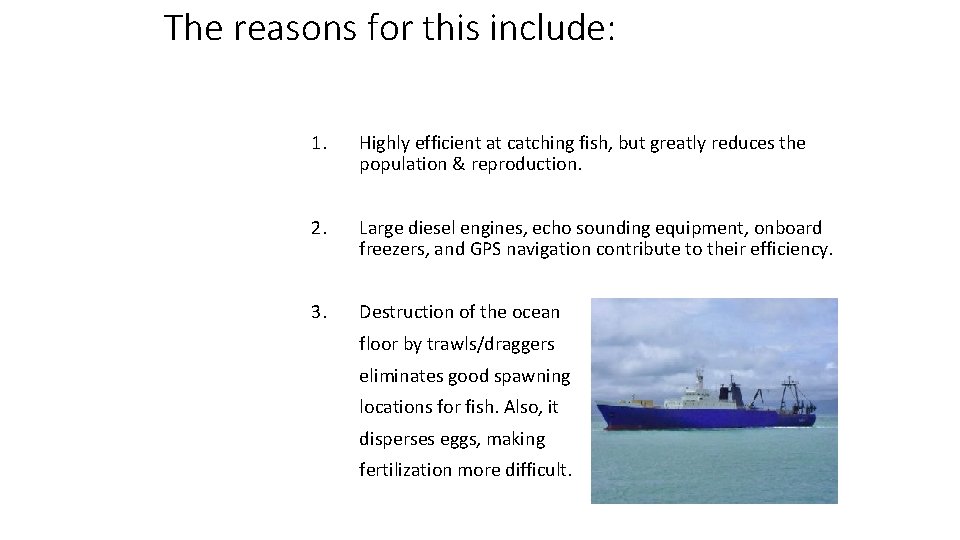
The reasons for this include: 1. Highly efficient at catching fish, but greatly reduces the population & reproduction. 2. Large diesel engines, echo sounding equipment, onboard freezers, and GPS navigation contribute to their efficiency. 3. Destruction of the ocean floor by trawls/draggers eliminates good spawning locations for fish. Also, it disperses eggs, making fertilization more difficult.
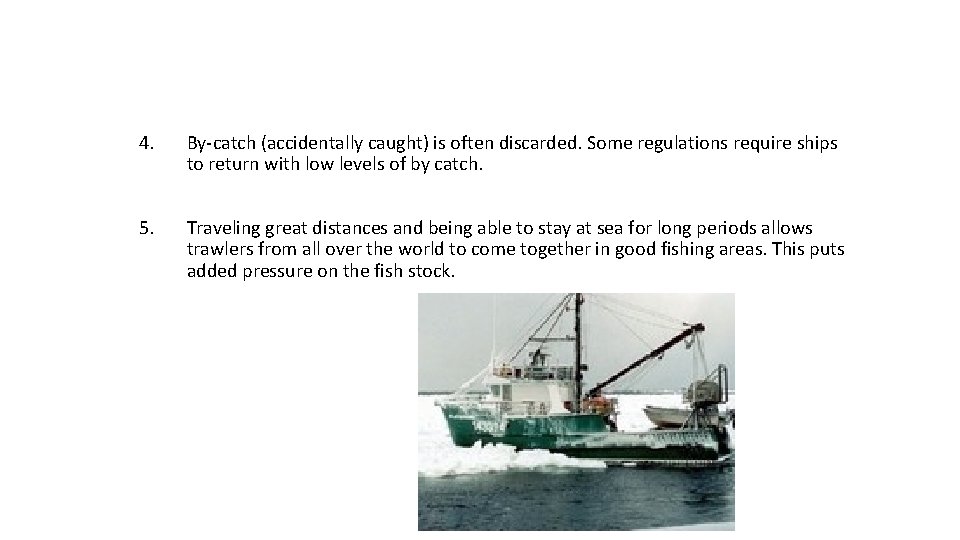
4. By-catch (accidentally caught) is often discarded. Some regulations require ships to return with low levels of by catch. 5. Traveling great distances and being able to stay at sea for long periods allows trawlers from all over the world to come together in good fishing areas. This puts added pressure on the fish stock.
Sustainable Fishery Definition: Using a resources such as the ocean species in a way that will ensure they • will not become extinct, but • will be protected to increase • for the benefit of future generations.
Strategies for a Sustainable Fishery • Have knowledge about sustaining the fishery. • Human attitudes must change. • People need to understand the long-term wellbeing of the resource. • Decrease consumption and world’s population. • Extend legal jurisdictions. • Try to prevent foreign fishing. • Other…Can YOU identify any? ? ? ? ? • technology, catch techniques, pollution, aquaculture.
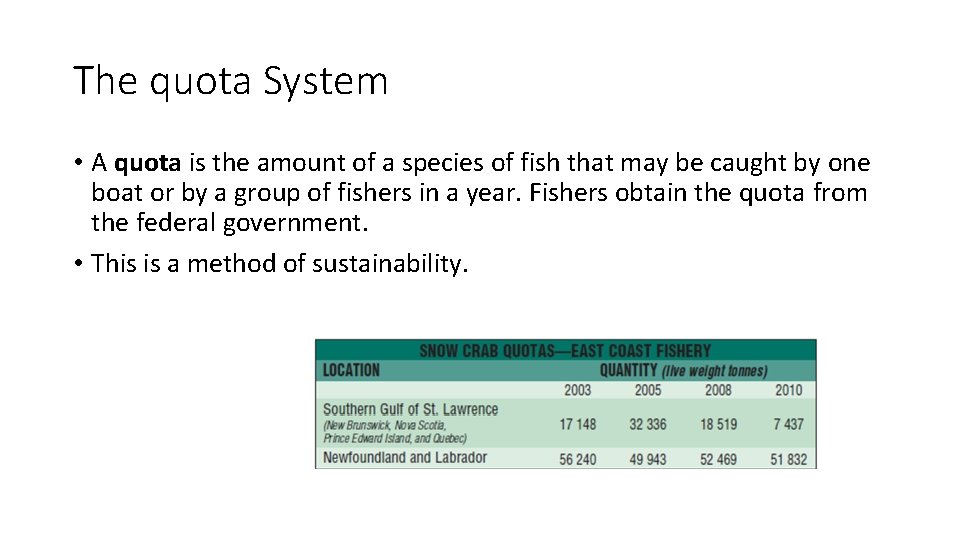
The quota System • A quota is the amount of a species of fish that may be caught by one boat or by a group of fishers in a year. Fishers obtain the quota from the federal government. • This is a method of sustainability.
Depletion of cod stocks • Fish is a renewable resource, and that renewable resources must be managed properly. • Fish can be harvested forever if the number caught each year does not exceed the number reaching maturity in that year.
Depletion of the Cod Stock Why the collapse? Five major conditions responsible for the collapse: 1. 2. 3. 4. 5. Overfishing Improved Fishing Technology (GPS) Uncontrolled Foreign Fishing Destructive Fishing Practices Changes in Natural Conditions
Aquaculture It is also known as fish farming and involves the raising of marine life in a controlled environment. Hence, this activity breeds and raises fish in tanks, ponds, and reservoirs. • Since the fish are fed regularly and are safe from natural predators, they mature rapidly and successfully.
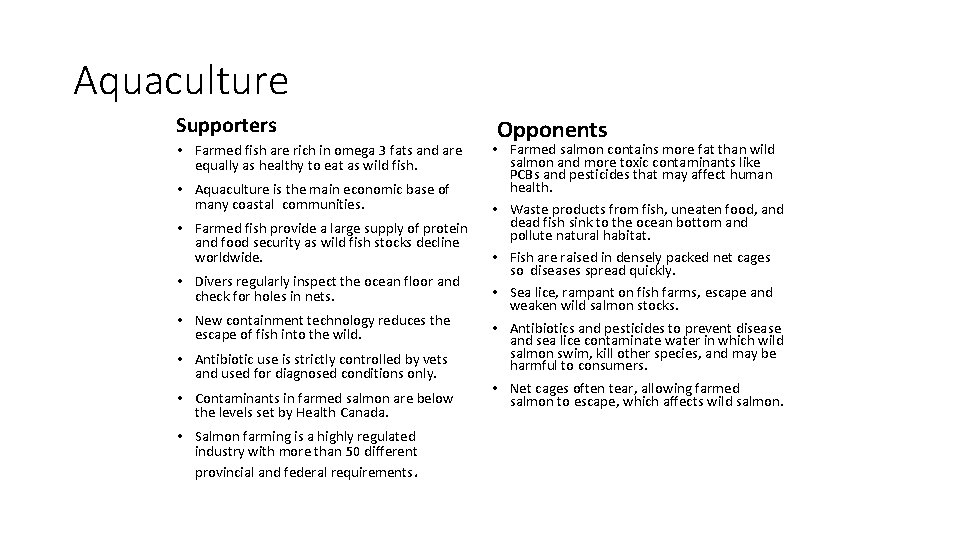
Aquaculture Supporters • Farmed fish are rich in omega 3 fats and are equally as healthy to eat as wild fish. • Aquaculture is the main economic base of many coastal communities. • Farmed fish provide a large supply of protein and food security as wild fish stocks decline worldwide. • Divers regularly inspect the ocean floor and check for holes in nets. • New containment technology reduces the escape of fish into the wild. • Antibiotic use is strictly controlled by vets and used for diagnosed conditions only. • Contaminants in farmed salmon are below the levels set by Health Canada. • Salmon farming is a highly regulated industry with more than 50 different provincial and federal requirements. Opponents • Farmed salmon contains more fat than wild salmon and more toxic contaminants like PCBs and pesticides that may affect human health. • Waste products from fish, uneaten food, and dead fish sink to the ocean bottom and pollute natural habitat. • Fish are raised in densely packed net cages so diseases spread quickly. • Sea lice, rampant on fish farms, escape and weaken wild salmon stocks. • Antibiotics and pesticides to prevent disease and sea lice contaminate water in which wild salmon swim, kill other species, and may be harmful to consumers. • Net cages often tear, allowing farmed salmon to escape, which affects wild salmon.
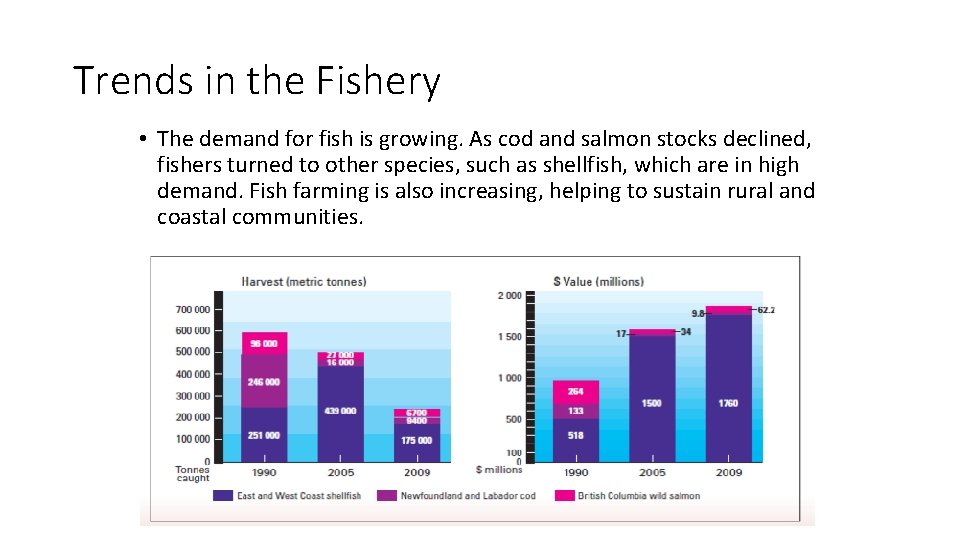
Trends in the Fishery • The demand for fish is growing. As cod and salmon stocks declined, fishers turned to other species, such as shellfish, which are in high demand. Fish farming is also increasing, helping to sustain rural and coastal communities.