
Types of Guidance 1 2 Learning Objectives To
Types of Guidance 1. 2. Learning Objectives: To be able to name and describe 3 types of guidance. To be able to explain how each style is most effectively used.
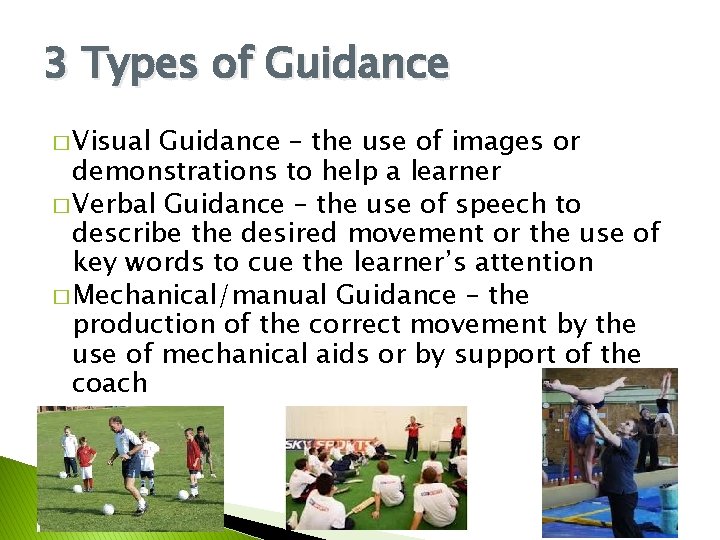
3 Types of Guidance � Visual Guidance – the use of images or demonstrations to help a learner � Verbal Guidance – the use of speech to describe the desired movement or the use of key words to cue the learner’s attention � Mechanical/manual Guidance – the production of the correct movement by the use of mechanical aids or by support of the coach
Visual Guidance Visual guidance can be done through demonstrations, still images (posters etc), or moving images (video, slow motion etc) To ensure effective visual guidance: � The demonstration must be accurate � The learner’s attention should be drawn to key points (cueing) � The learner must be able to see all essential parts � The skill should be attainable/achievable � Allow time for mental rehearsal � Combine with verbal guidance
Advantages and Disadvantages of Visual Guidance � Provides a clear idea of the movement pattern / technique /analysis of technique � Helps develop a mental image � Important for safety / to prevent injury through incorrect technique � Suitable for learners in the cognitive / associative stages of learning � Specific cues can be highlighted � Suitable for large groups � Can motivate by using a significant other / role model, � Can be used in conjunction with verbal guidance � May be less effective with highly complex skills
Verbal Guidance Verbal guidance is often used alongside visual. The key points about the effective use of verbal guidance are: � It is most often used with visual guidance, especially for beginners � It is useful when drawing attention to key points (cueing) � It must be kept brief (to avoid confusion) � It can be used during a movement for more advanced performers � It must be kept clear and precise
Advantages and Disadvantages of Verbal Guidance � Most effective in conjunction with visual guidance; � More effective with advanced performers in the autonomous phase. � Good for the conveying of detailed & technical knowledge in the autonomous phase e. g. strategies & tactics; � Good to use with learners in early stages of leaning to direct them to the important cues in visual guidance. � Amount of information has to be limited; in complex skills it is difficult to be concise and the learners get bored.
Mechanical/Manual Guidance The key points for the use of manual guidance are: � It gives ‘kinaesthetic feel’ to the performer � It is useful for individuals, but not large groups � Helpful at the early stages of learning a difficult or dangerous skill � It is useful when correcting an element of a movement. Manual guidance should be stopped as early as possible to avoid the performer becoming reliant on it.
Advantages and Disadvantages of Mechanical/Manual Guidance � Useful in the early stages of learning to allow the learner to gain the kinaesthetic sense of the movement; is of limited use to the experienced performer. � Gives confidence and ensures safety, particularly in skills with a danger element. � Needs to be removed as soon as possible so that the leaner does not become dependent on it � Difficult to do with a large group.
Exam Question You have been asked to teach a group of AS students how to perform a handstand. Explain how you would use visual guidance effectively for this and what the advantages and disadvantages of manual guidance would be in this situation. (12 marks)
- Slides: 9