
Types of Growth and The Interrelationships Between Development
Types of Growth and The Interrelationships Between Development: Health and Physical, Social, Emotional and Social, Intellectual Physical, Development Emotional and Intellectual Development
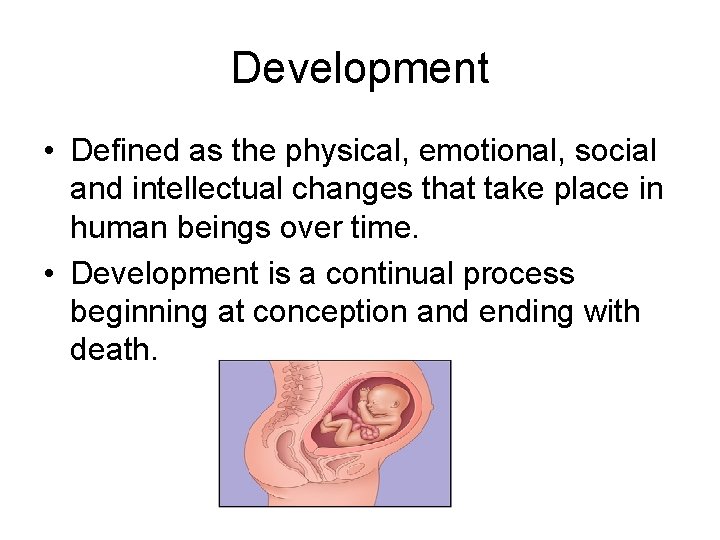
Development • Defined as the physical, emotional, social and intellectual changes that take place in human beings over time. • Development is a continual process beginning at conception and ending with death.
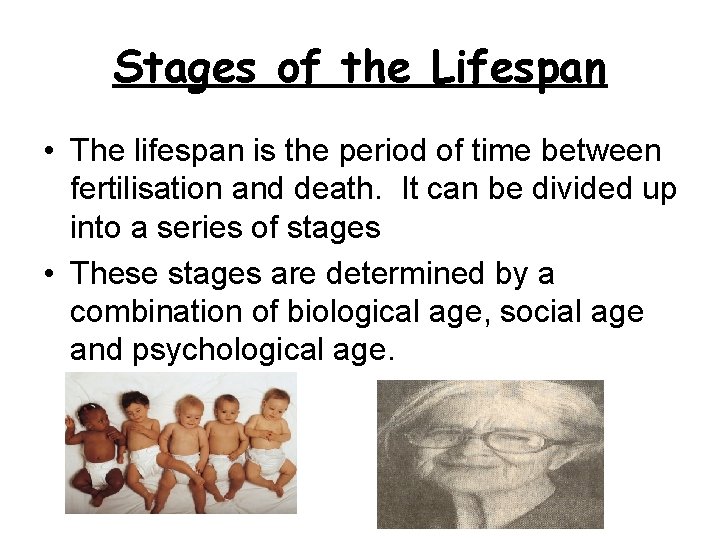
Stages of the Lifespan • The lifespan is the period of time between fertilisation and death. It can be divided up into a series of stages • These stages are determined by a combination of biological age, social age and psychological age.
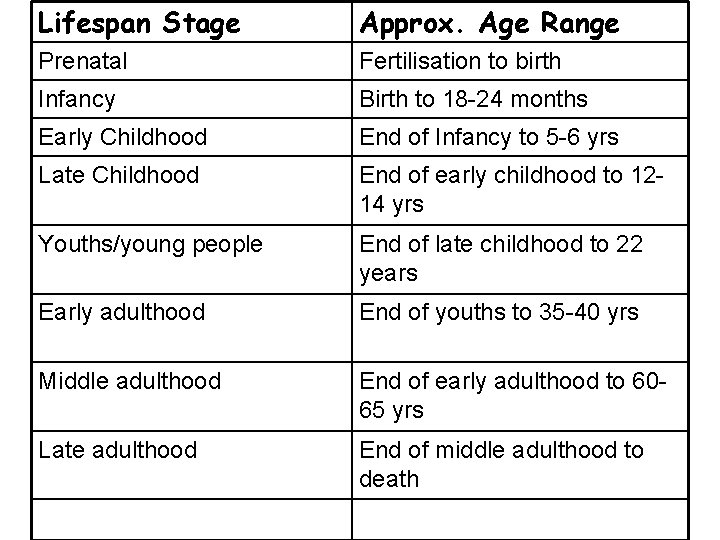
Lifespan Stage Approx. Age Range Prenatal Fertilisation to birth Infancy Birth to 18 -24 months Early Childhood End of Infancy to 5 -6 yrs Late Childhood End of early childhood to 1214 yrs Youths/young people End of late childhood to 22 years Early adulthood End of youths to 35 -40 yrs Middle adulthood End of early adulthood to 6065 yrs Late adulthood End of middle adulthood to death
Types of Development • Development can be divided into many different types. • • PHYSICAL INTELLECTUAL EMOTIONAL SOCIAL
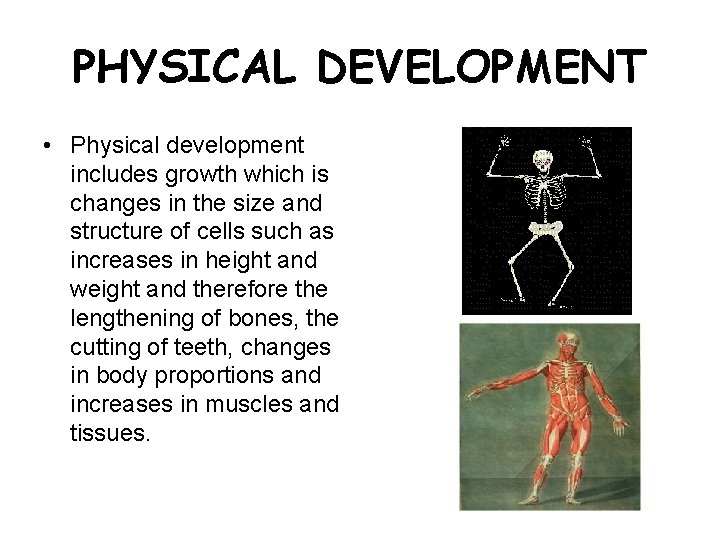
PHYSICAL DEVELOPMENT • Physical development includes growth which is changes in the size and structure of cells such as increases in height and weight and therefore the lengthening of bones, the cutting of teeth, changes in body proportions and increases in muscles and tissues.
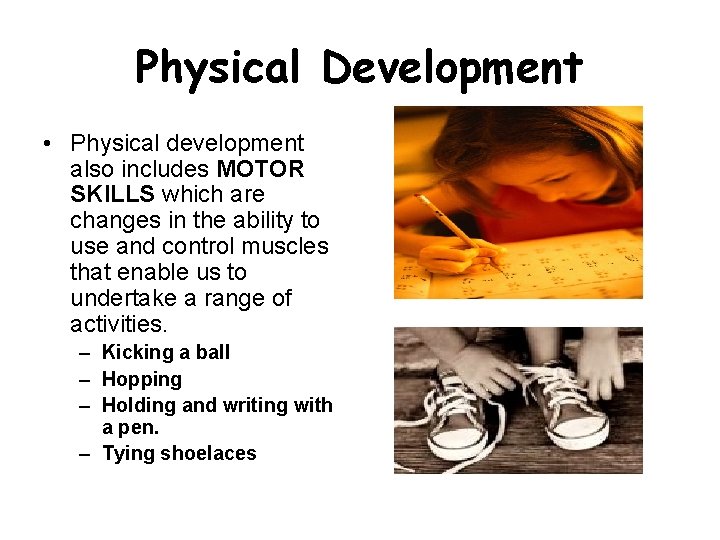
Physical Development • Physical development also includes MOTOR SKILLS which are changes in the ability to use and control muscles that enable us to undertake a range of activities. – Kicking a ball – Hopping – Holding and writing with a pen. – Tying shoelaces
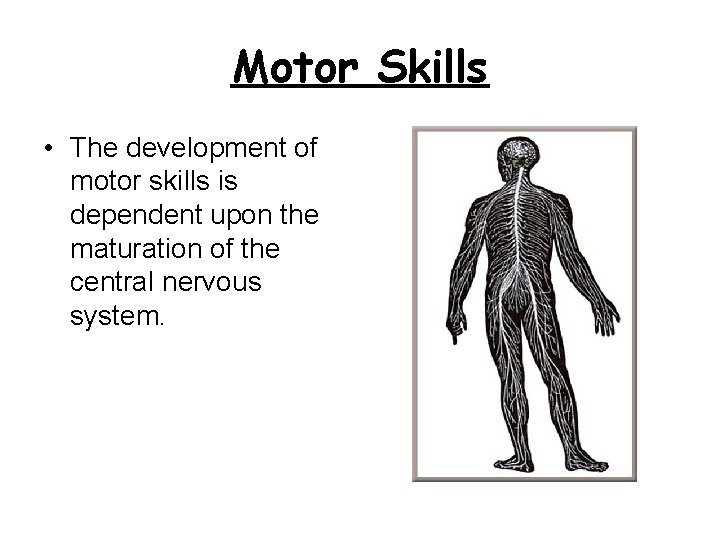
Motor Skills • The development of motor skills is dependent upon the maturation of the central nervous system.
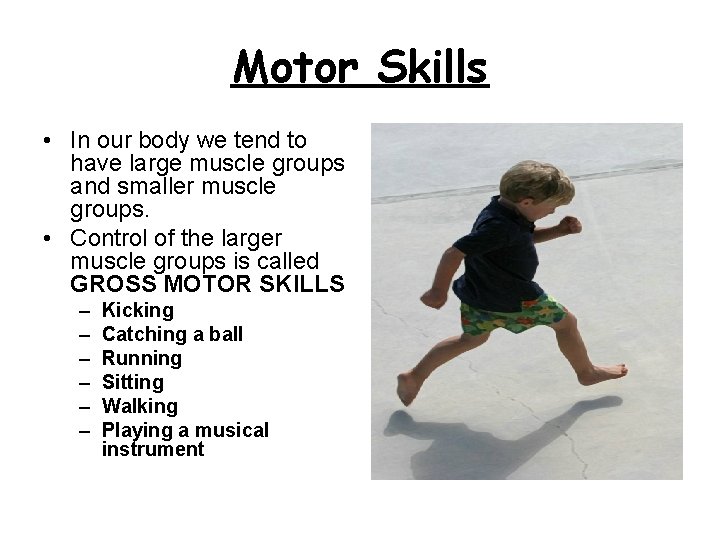
Motor Skills • In our body we tend to have large muscle groups and smaller muscle groups. • Control of the larger muscle groups is called GROSS MOTOR SKILLS – – – Kicking Catching a ball Running Sitting Walking Playing a musical instrument
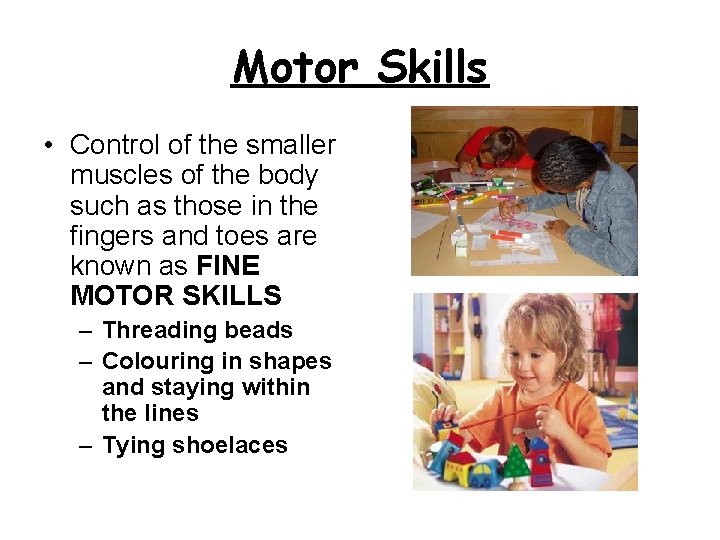
Motor Skills • Control of the smaller muscles of the body such as those in the fingers and toes are known as FINE MOTOR SKILLS – Threading beads – Colouring in shapes and staying within the lines – Tying shoelaces
SOCIAL DEVELOPMENT • Social development relies on the interaction with others and refers to the development of knowledge and skills, attitudes, values and behaviours necessary for the appropriate interaction and relationships with other people.
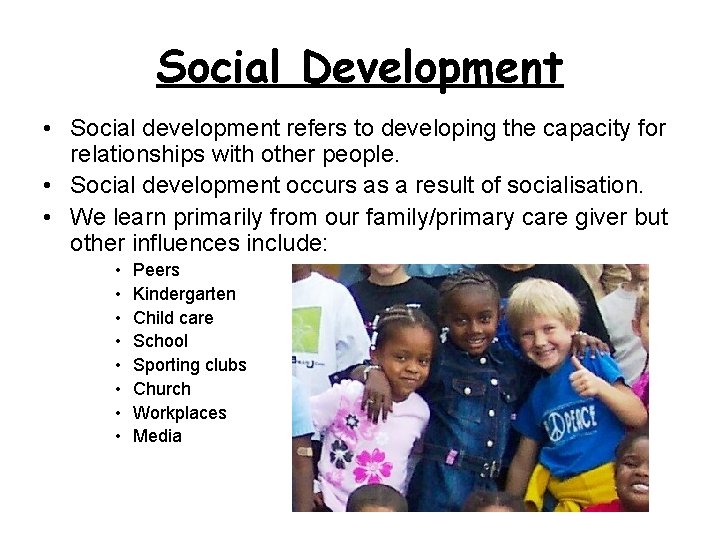
Social Development • Social development refers to developing the capacity for relationships with other people. • Social development occurs as a result of socialisation. • We learn primarily from our family/primary care giver but other influences include: • • Peers Kindergarten Child care School Sporting clubs Church Workplaces Media
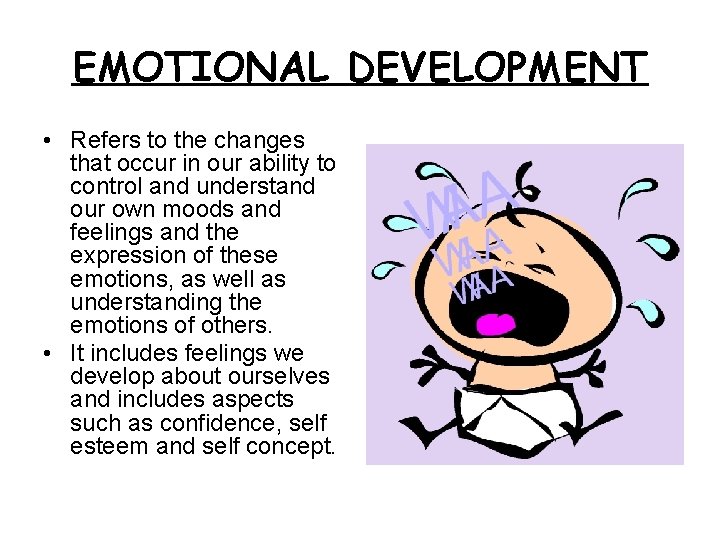
EMOTIONAL DEVELOPMENT • Refers to the changes that occur in our ability to control and understand our own moods and feelings and the expression of these emotions, as well as understanding the emotions of others. • It includes feelings we develop about ourselves and includes aspects such as confidence, self esteem and self concept.
INTELLECTUAL DEVELOPMENT • Refers to changes in our ability to think and reason and includes the establishment of language skills, understanding the basic concepts for daily living such as numbers, time and space and our ability to solve problems.
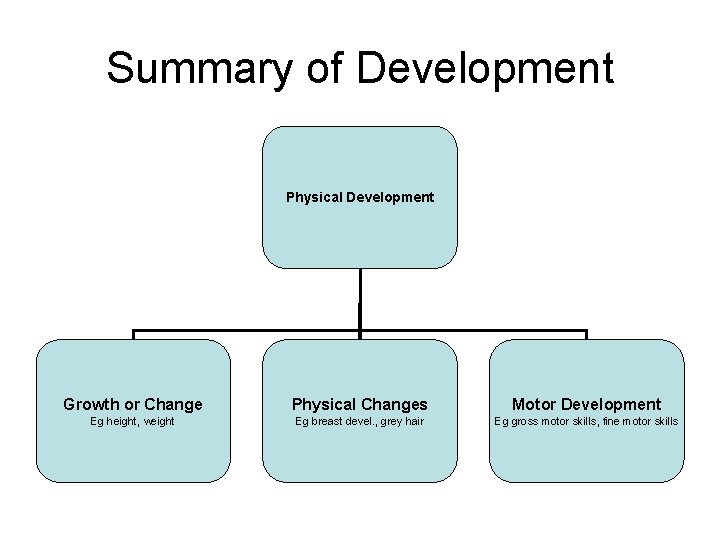
Summary of Development Physical Development Growth or Change Physical Changes Motor Development Eg height, weight Eg breast devel. , grey hair Eg gross motor skills, fine motor skills
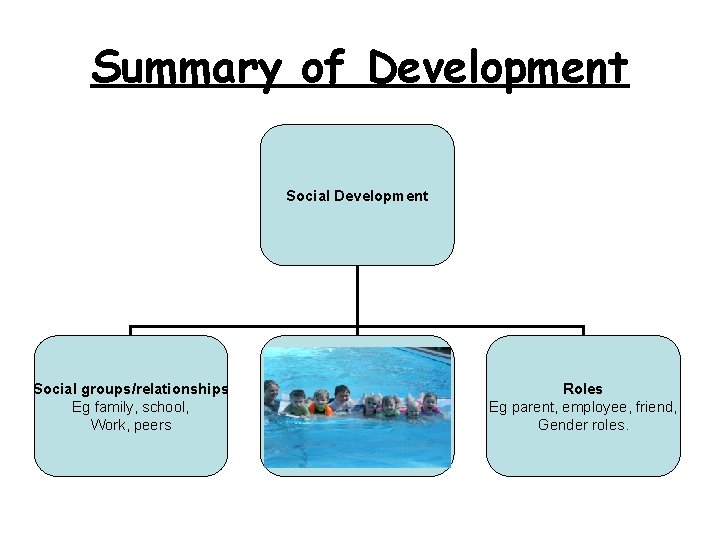
Summary of Development Social groups/relationships Eg family, school, Work, peers Roles Eg parent, employee, friend, Gender roles.
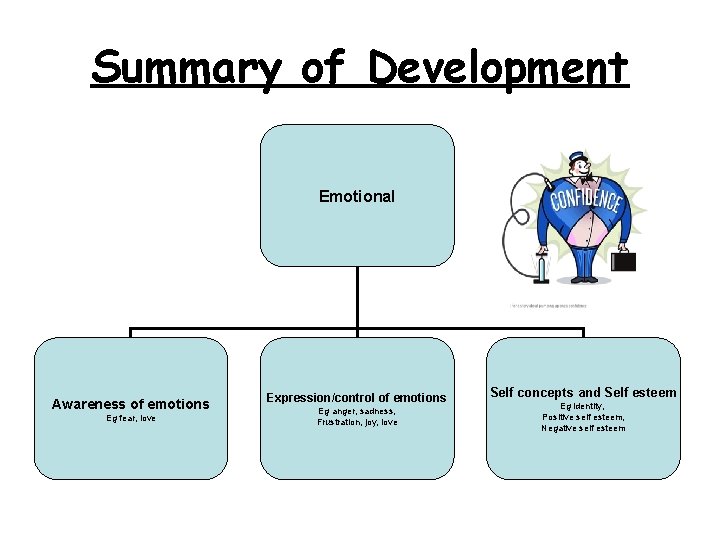
Summary of Development Emotional Awareness of emotions Eg fear, love Expression/control of emotions Eg anger, sadness, Frustration, joy, love Self concepts and Self esteem Eg identity, Positive self esteem, Negative self esteem
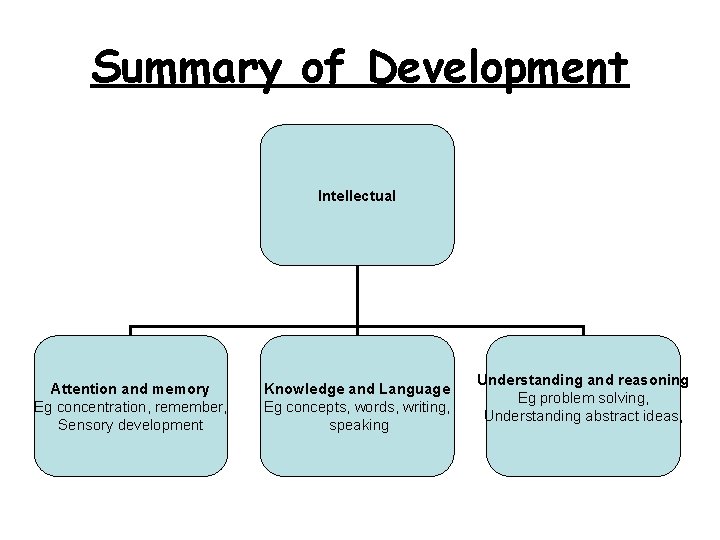
Summary of Development Intellectual Attention and memory Eg concentration, remember, Sensory development Knowledge and Language Eg concepts, words, writing, speaking Understanding and reasoning Eg problem solving, Understanding abstract ideas,
INTERRELATIONSHIP • There is a very strong interrelationship between all types of development and between health and development. • Physical changes may impact social changes and vice versa etc.
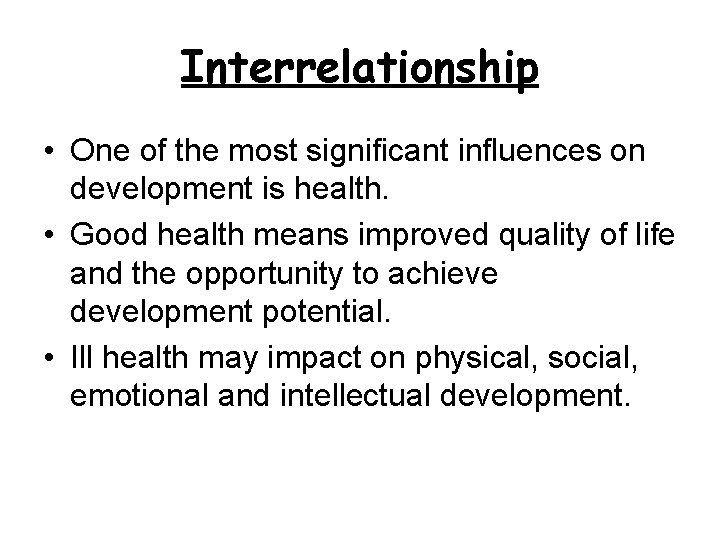
Interrelationship • One of the most significant influences on development is health. • Good health means improved quality of life and the opportunity to achieve development potential. • Ill health may impact on physical, social, emotional and intellectual development.
Interrelationship • In children, ill health may affect the growth of the brain, bones, muscles and organs, particularly if the illness leads to malnutrition. • This could also contribute to poor motor development, impaired learning and delayed sexual development. • Continued ill health may also affect social development. – i. e interacting with others – learning new skills, knowledge, behaviour, poor motor skills (lack of acceptance into social group)
Interrelationship • Different types of development are therefore interrelated and do not occur in isolation. • Growth and development of the brain (physical development) leads to changes in mental abilities (intellectual development) like reasoning, memory and language skills. • These abilities allow the child to make better personal and social adjustment. (social development) • Speech means a child can explain and satisfy its wants (emotional development) • This also has a direct impact on academic achievement (intellectual development).
Activity Create a poster or presentation (can be a web page, a word document, glogster, powerpoint etc… you choose), to explain a little about each type of a person’s growth and development: Intellectual development Physical development Social development and Emotional development. Then…

- Slides: 25