
Types of Governments Grade 7 Social Studies Online
- Slides: 12
Types of Governments Grade 7 Social Studies Online Presentation
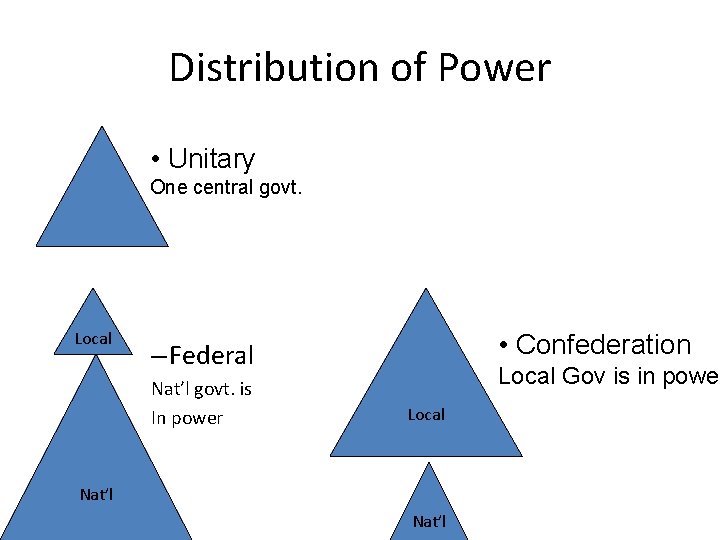
Distribution of Power • Unitary One central govt. Local • Confederation – Federal Nat’l govt. is In power Local Gov is in power Local Nat’l
Unitary Government System • The central government holds nearly all of the power. In a unitary system, local governments such as state or county systems may have some power, but they are all under the control of the central government. • Ex: A monarchy – Saudi Arabia is a monarchy
Confederation Government System • The local governments hold all of the power and the central government depends on the local governments for its existence. • Ex: League of Arab States: Established on March 22, 1945, the League of Arab States aims to strengthen political relations and facilitate cooperation among member states, as well as to "safeguard their independence and sovereignty. "[1] Pursuant to the Arab Pact, the League's founding Charter, all "independent Arab states" are entitled to membership in the organization. [2] The League currently has 22 members - all of the Arab states; [3] and several non-Arab states have been invited to participate in its activities as observers
Federal Government System • Political system in which power is shared among different levels of government. • Power is divided into national and state governments • Israel has a federal form of government and has a democratic republic
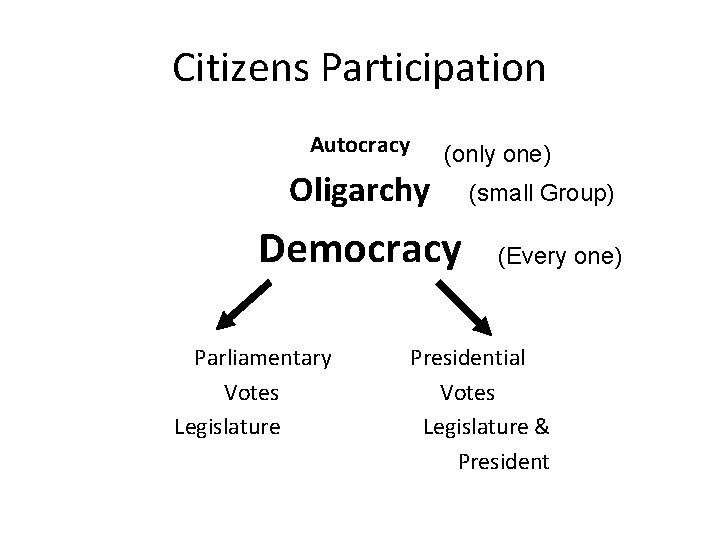
Citizens Participation Autocracy Oligarchy (only one) Democracy Parliamentary Votes Legislature (small Group) (Every one) Presidential Votes Legislature & President
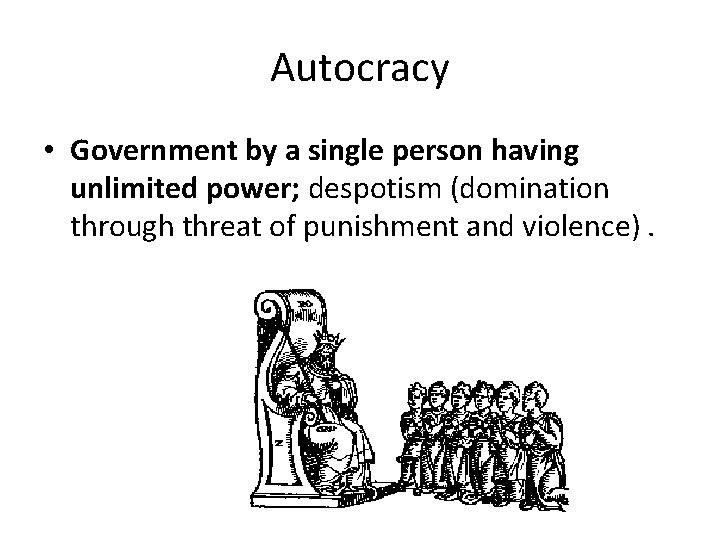
Autocracy • Government by a single person having unlimited power; despotism (domination through threat of punishment and violence).
Monarchy • A monarchy has a king, queen, emperor or empress. • The ruling position can be passed on to the ruler’s heirs. • In some traditional monarchies, the monarch has absolute power. • Ex: Saudi Arabia
Oligarchy • A government in which a few people such as a dominant clan or clique have power. • Ex: Syria – in Syria, the ruling political party, the Ba’ath Party, controls much of the government • Ex: Iran – a small group of religious and political leaders make many of the decisions.
Republic • In a republic, the government is elected by the people. Everyone who is eligible to vote has a chance to have their say over who runs the country. It is distinct from governments controlled by a particular social class or group (aristocracy; oligarchy) or by a single person (despotism; dictatorship; monarchy). • A republic is determined either directly or through elected representatives. • Ex: Israel
Parliamentary Form of Democratic Government • The people vote for those who represent the political party they feel best represents their views of how the government should operate. • The legislature they elect, the Parliament, makes and carries out (enforces) the laws for the country. • The leader is often called the Prime Minister (Ex: UK – queen and prime minister, David Cameron)
Presidential Form of Democratic Government • Also called a congressional form of government. Here, a President, or chief executive, is chosen separately from the legislature. • The legislature passes the laws and it the duty of the president to see that the laws are enforced. • Ex: United States