
Types of Government Unit 10 Vocabulary Terms government
Types of Government Unit 10

Vocabulary Terms � government � power � monarchy � “divine right” theory � absolute monarchy � Louis XIV � constitutional monarchy � republic � Thomas Jefferson � democracy � direct democracy � representative government � dictatorship � Idi Amin Dada � Robert Mugabe � Joseph Stalin � totalitarianism � theocracy � supreme leader � oligarchy
Essential Question � What is the best form of government?
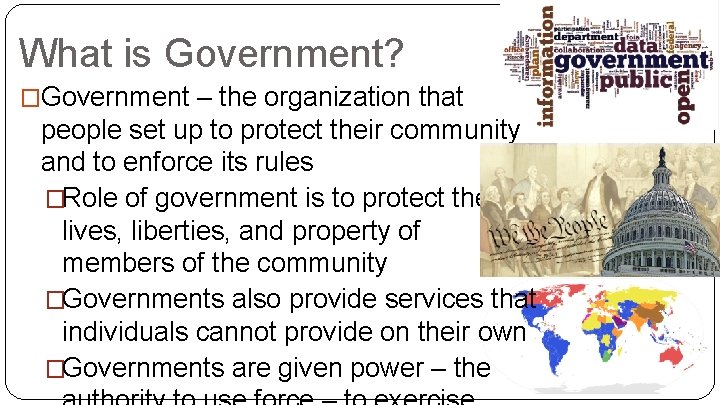
What is Government? �Government – the organization that people set up to protect their community and to enforce its rules �Role of government is to protect the lives, liberties, and property of members of the community �Governments also provide services that individuals cannot provide on their own �Governments are given power – the
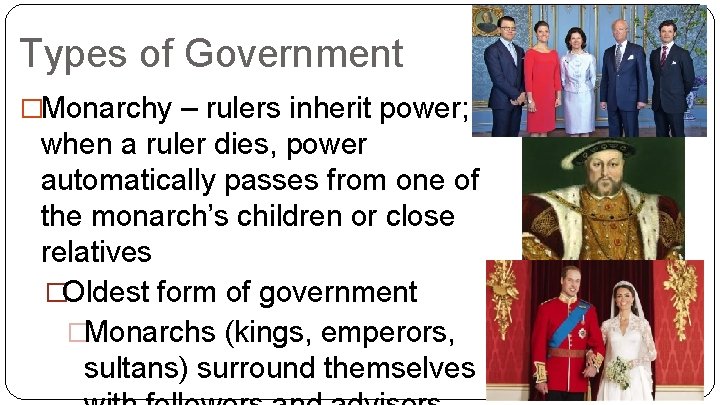
Types of Government �Monarchy – rulers inherit power; when a ruler dies, power automatically passes from one of the monarch’s children or close relatives �Oldest form of government �Monarchs (kings, emperors, sultans) surround themselves
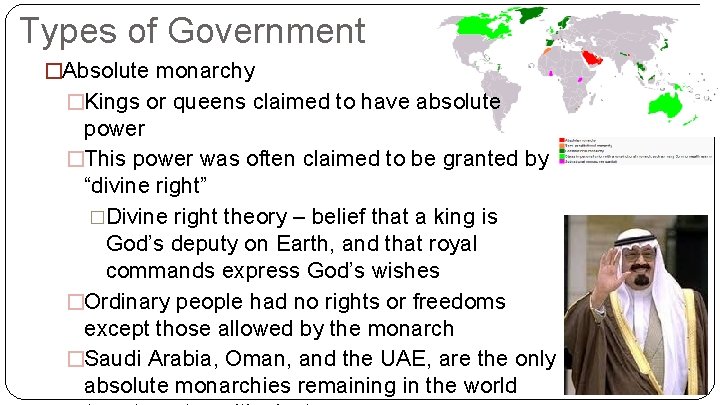
Types of Government �Absolute monarchy �Kings or queens claimed to have absolute power �This power was often claimed to be granted by “divine right” �Divine right theory – belief that a king is God’s deputy on Earth, and that royal commands express God’s wishes �Ordinary people had no rights or freedoms except those allowed by the monarch �Saudi Arabia, Oman, and the UAE, are the only absolute monarchies remaining in the world
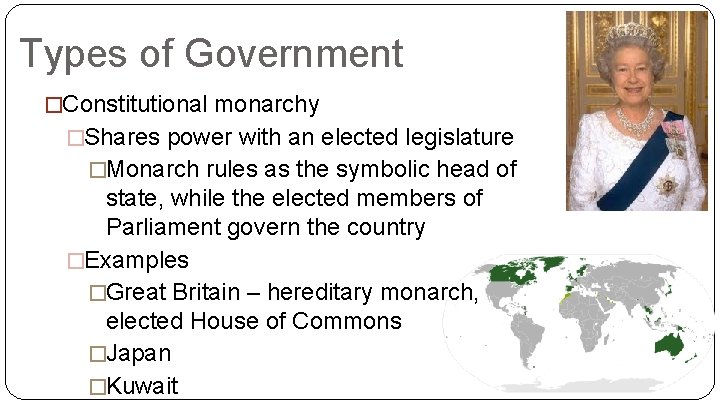
Types of Government �Constitutional monarchy �Shares power with an elected legislature �Monarch rules as the symbolic head of state, while the elected members of Parliament govern the country �Examples �Great Britain – hereditary monarch, elected House of Commons �Japan �Kuwait
Types of Government �Republic �Power is held by the people and the representatives they elect �These elected representatives make decisions for the people based on their wants and needs �Government without a king or queen �Examples �Roman Republic (509 BC – 27 BC) �The United States of America (established in 1776) �South Sudan (established in 2011)
Types of Government � Democracy – government authority is based on the will of the people �People are guaranteed certain basic rights, and are granted the freedom to criticize the government freely �Direct democracy �People vote on issues directly �Developed in ancient Athens in the 5 th century B. C. , as citizens of ancient Athens assembled to directly make their decisions regarding the city-state
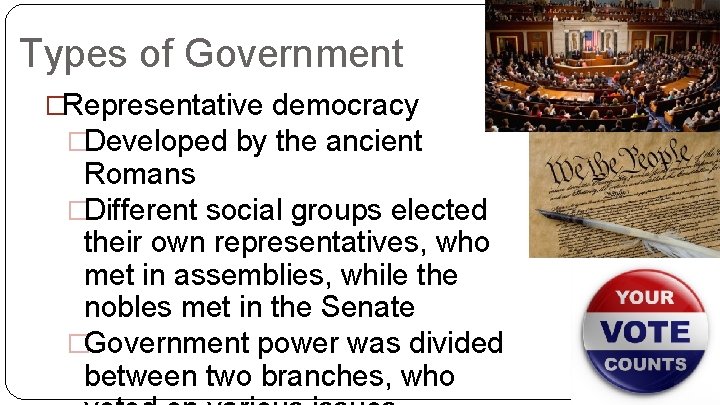
Types of Government �Representative democracy �Developed by the ancient Romans �Different social groups elected their own representatives, who met in assemblies, while the nobles met in the Senate �Government power was divided between two branches, who
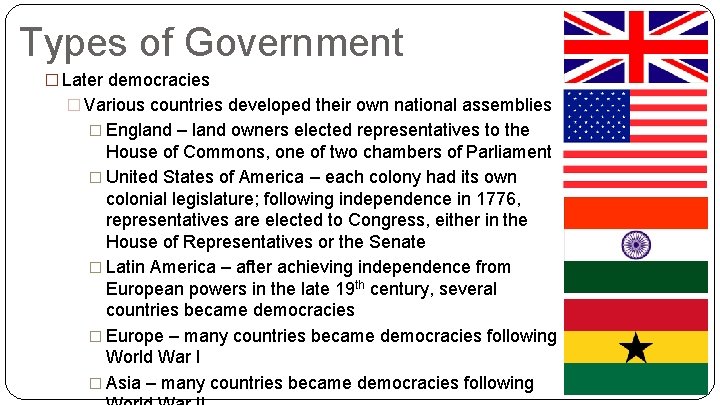
Types of Government � Later democracies � Various countries developed their own national assemblies � England – land owners elected representatives to the House of Commons, one of two chambers of Parliament � United States of America – each colony had its own colonial legislature; following independence in 1776, representatives are elected to Congress, either in the House of Representatives or the Senate � Latin America – after achieving independence from European powers in the late 19 th century, several countries became democracies � Europe – many countries became democracies following World War I � Asia – many countries became democracies following
Types of Government � Dictatorship � An individual leader or political party enjoys great power and total control over the citizens � Seizes control by force or is placed into a position of authority by others � Since 1945, Latin America, the Middle East, and Africa have been common areas for military dictatorships, as the military sometimes seized power and established a dictatorship � Uganda – Idi Amin Dada became a brutal military dictator while serving as president from 1971 -1979 � Zimbabwe – although Robert Mugabe was elected to power, he quickly became a dictator who blocked his opponents from voting � Iraq – Saddam Hussein (ruled 1979 -2003) was known for torturing those who spoke out against him and for invading neighboring countries to increase his own wealth and power
Types of Government �Dictators are free to do as they please, while other citizens have few rights and very little influence over the government �Decisions can be made quickly under the rule of a dictator �Ancient Romans used to appoint dictators when they were at war and needed strong leadership �When the war was over, the dictator was supposed to give up his power �Modern-day dictators tend to hold on to power until they are overthrown �Sometimes dictators hold elections to obtain legitimacy for their government �While an election victory might justify the rule of the dictator, it is
Types of Government �Totalitarianism �System of government in which the government controls all aspects of individual life (total control) �People can only belong to organizations controlled by the government – this means no separate political parties, labor unions or other organizations are allowed �The government controls or prohibits all

Types of Government �Modern dictators �Adolf Hitler – Germany �German politician and leader of the Nazi Party, whose foreign policy caused the onset of World War II �Responsible for the genocide of 6 million Jews and millions
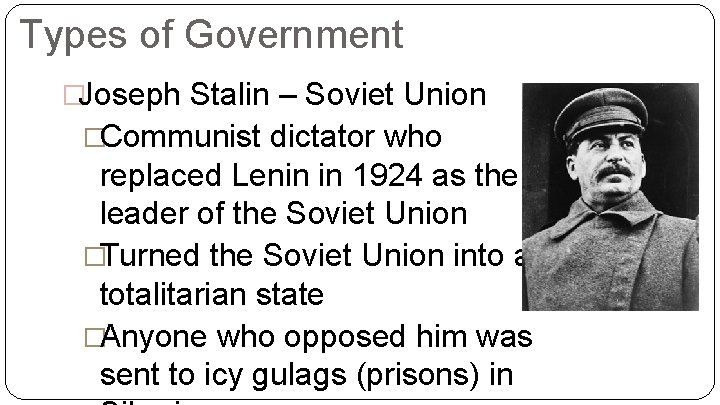
Types of Government �Joseph Stalin – Soviet Union �Communist dictator who replaced Lenin in 1924 as the leader of the Soviet Union �Turned the Soviet Union into a totalitarian state �Anyone who opposed him was sent to icy gulags (prisons) in
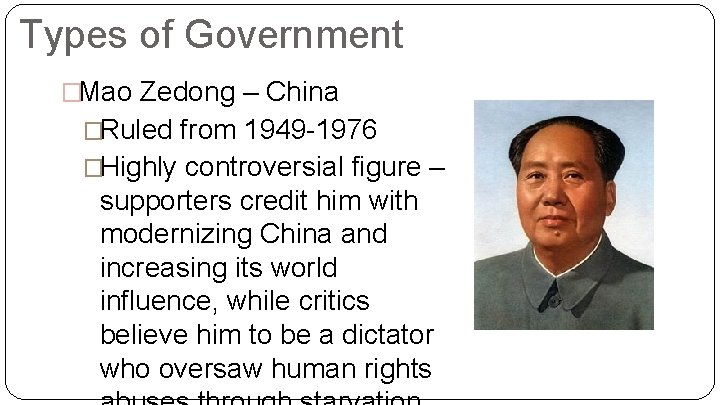
Types of Government �Mao Zedong – China �Ruled from 1949 -1976 �Highly controversial figure – supporters credit him with modernizing China and increasing its world influence, while critics believe him to be a dictator who oversaw human rights
Types of Government � Theocracy �Government run by religious leaders �The government claims to be directed by God, or divinely blessed �No separation of church and state, and citizens of other faiths are often excluded or expelled �Early theocracies �Pharaohs of ancient Egypt �Emperor of the Byzantine Empire �Pope over territories in Italy
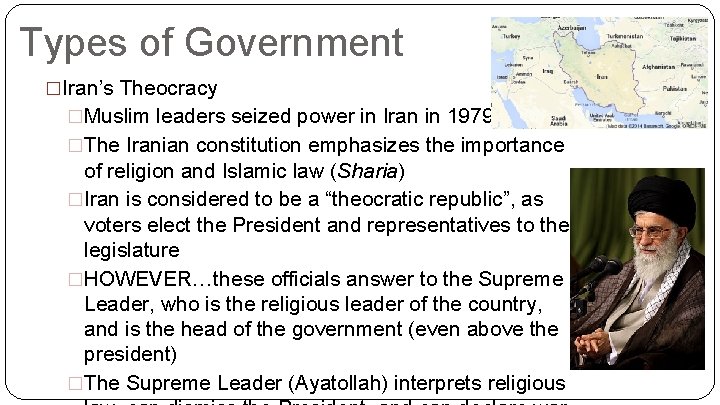
Types of Government �Iran’s Theocracy �Muslim leaders seized power in Iran in 1979 �The Iranian constitution emphasizes the importance of religion and Islamic law (Sharia) �Iran is considered to be a “theocratic republic”, as voters elect the President and representatives to the legislature �HOWEVER…these officials answer to the Supreme Leader, who is the religious leader of the country, and is the head of the government (even above the president) �The Supreme Leader (Ayatollah) interprets religious
Types of Government � Oligarchy – means “to rule or to command”; power rests with a small group of people who could be distinguished by royalty, wealth, family ties, education, corporate, or military control �Russian Federation (1991 -present) – many Russian producers in the areas of natural gas, petroleum, and precious metals are seen as oligarchs (possessing great wealth and political influence) �South Africa (1948 -1994) – system of apartheid (racial segregation) enforced by the government, which kept the rights of the black majority curtailed and allowed the white
- Slides: 20