
Types of Forces A Time for Physics First
- Slides: 20
Types of Forces A Time for Physics First Summer 2010
What is a Force? o A force is nothing else than a push or a pull. o A force applied to an object might change its shape (deformation) o A force applied to an object might affect the object’s motion
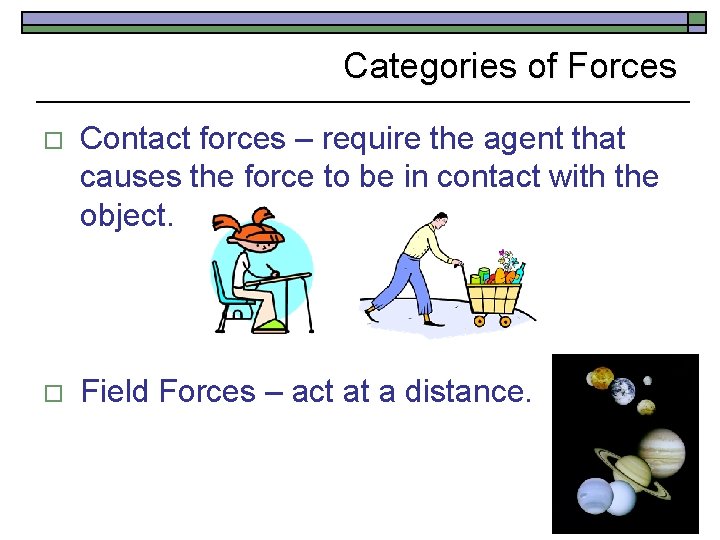
Categories of Forces o Contact forces – require the agent that causes the force to be in contact with the object. o Field Forces – act at a distance.
Field Forces o Gravity (Fg) – force created by the mass of an object being affected by gravity n o o holds stars, planets together; depends on the mass of objects. Electromagnetic (Fm)(magnetic)– responsible for binding of atoms and molecules; depends on the charge on objects. Static-Electric (Fs) An accumulation of electric charge on an insulated body.
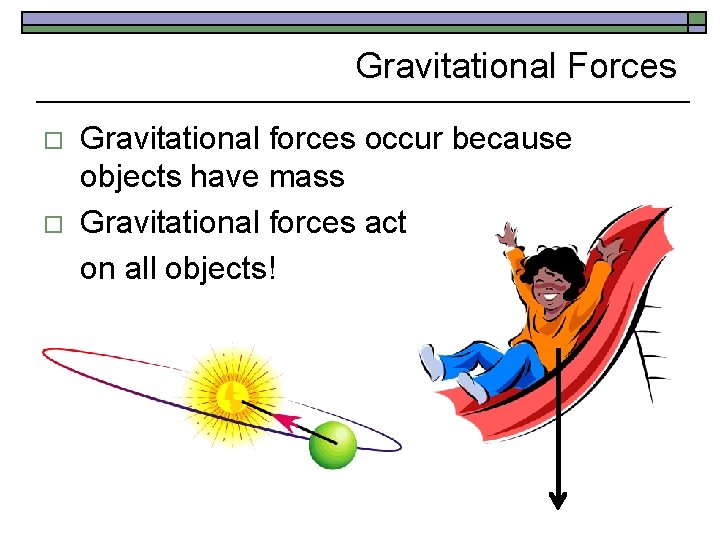
Gravitational Forces o o Gravitational forces occur because objects have mass Gravitational forces act on all objects!
Contact Forces
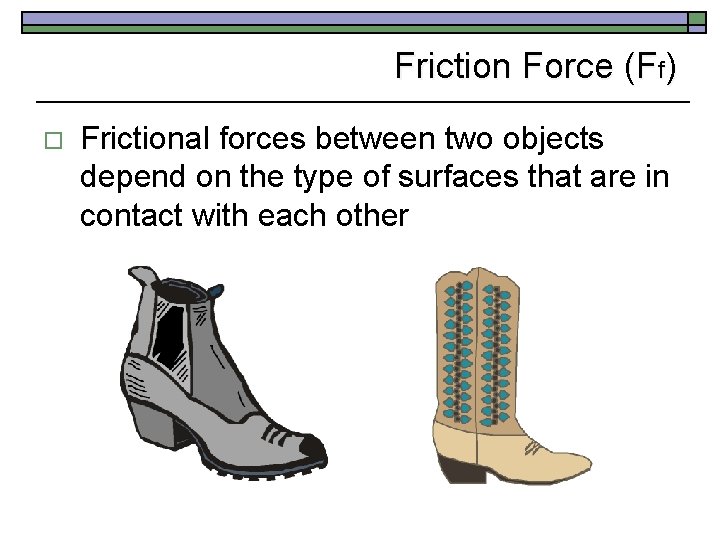
Friction Force (Ff) o Frictional forces between two objects depend on the type of surfaces that are in contact with each other
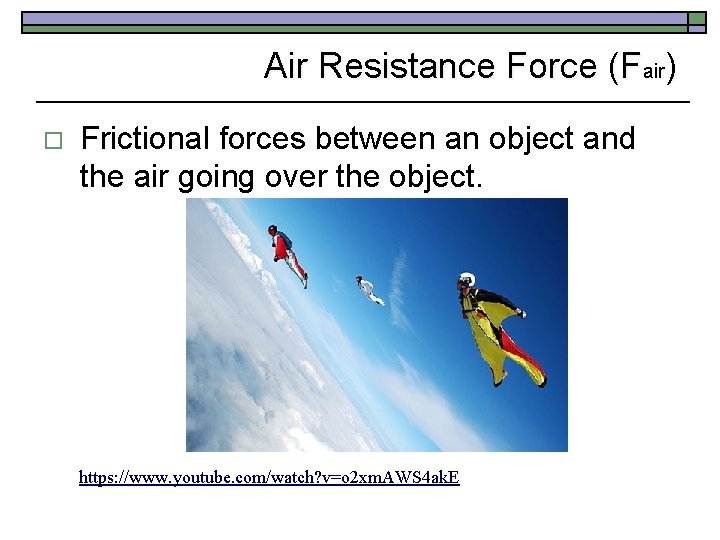
Air Resistance Force (Fair) o Frictional forces between an object and the air going over the object. https: //www. youtube. com/watch? v=o 2 xm. AWS 4 ak. E
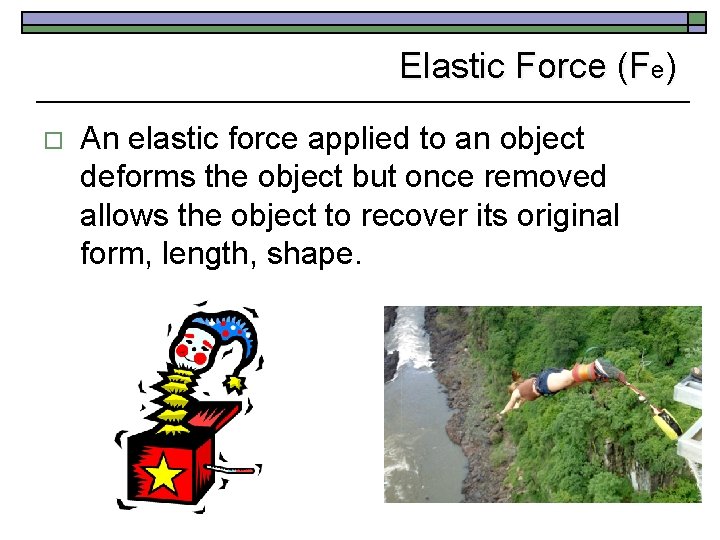
Elastic Force (Fe) o An elastic force applied to an object deforms the object but once removed allows the object to recover its original form, length, shape.
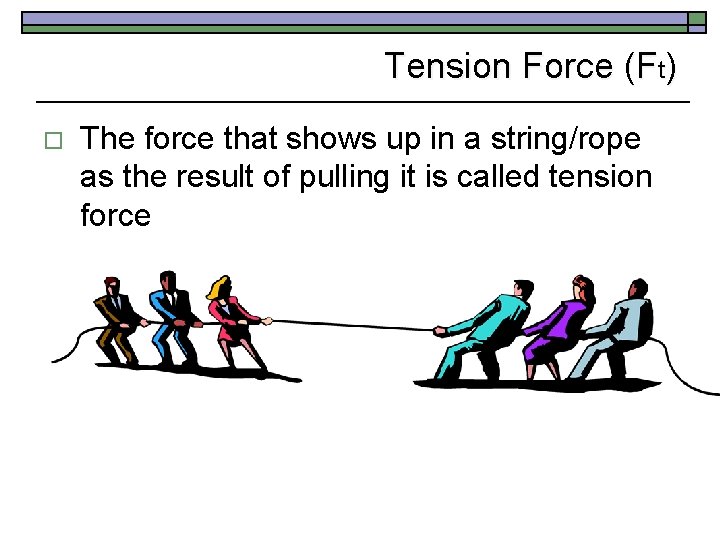
Tension Force (Ft) o The force that shows up in a string/rope as the result of pulling it is called tension force
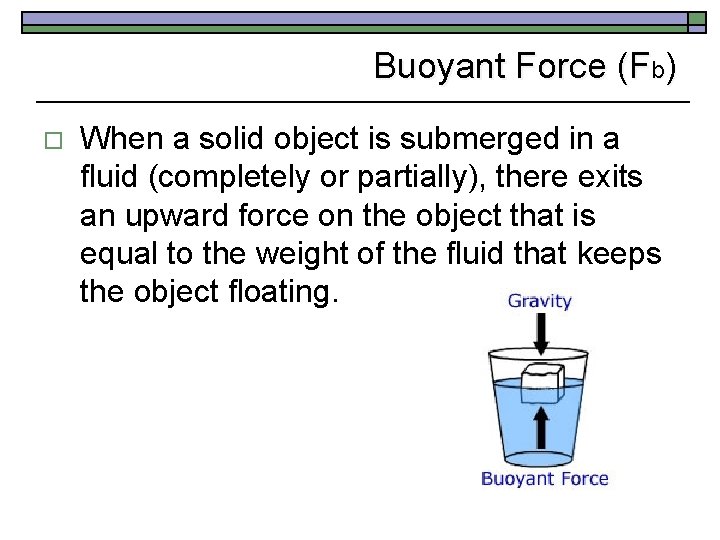
Buoyant Force (Fb) o When a solid object is submerged in a fluid (completely or partially), there exits an upward force on the object that is equal to the weight of the fluid that keeps the object floating.
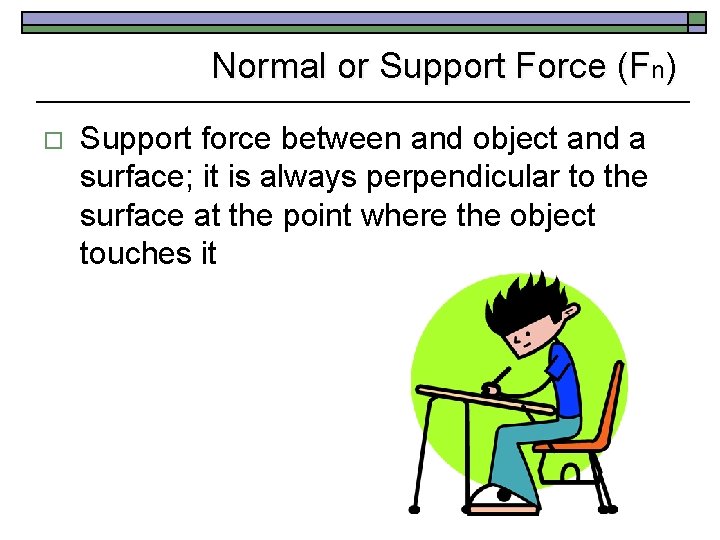
Normal or Support Force (Fn) o Support force between and object and a surface; it is always perpendicular to the surface at the point where the object touches it
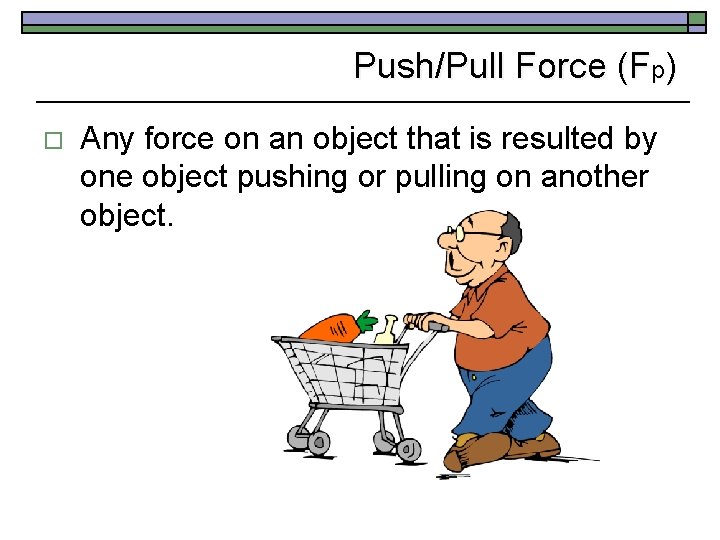
Push/Pull Force (Fp) o Any force on an object that is resulted by one object pushing or pulling on another object.
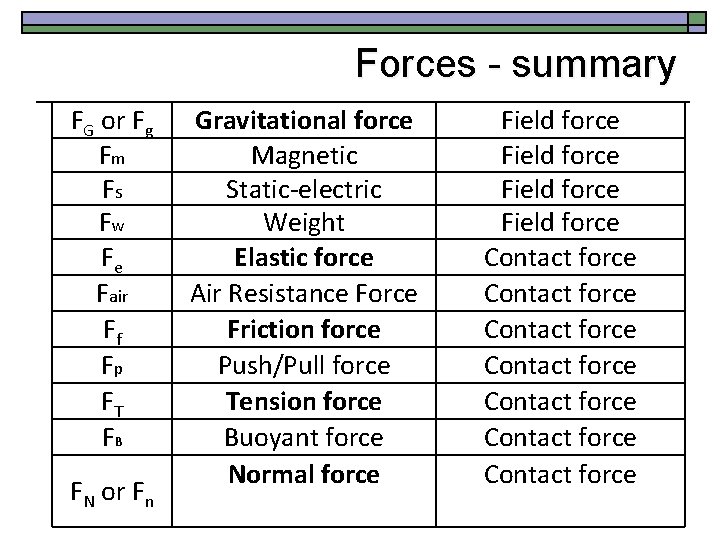
Forces - summary FG or Fg Fm Fs Fw Fe Fair Ff Fp FT FB FN or Fn Gravitational force Magnetic Static-electric Weight Elastic force Air Resistance Force Friction force Push/Pull force Tension force Buoyant force Normal force Field force Contact force Contact force
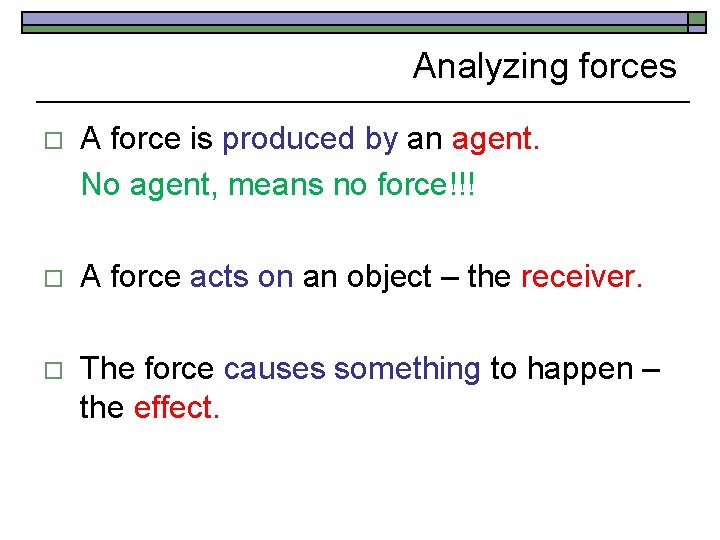
Analyzing forces o A force is produced by an agent. No agent, means no force!!! o A force acts on an object – the receiver. o The force causes something to happen – the effect.
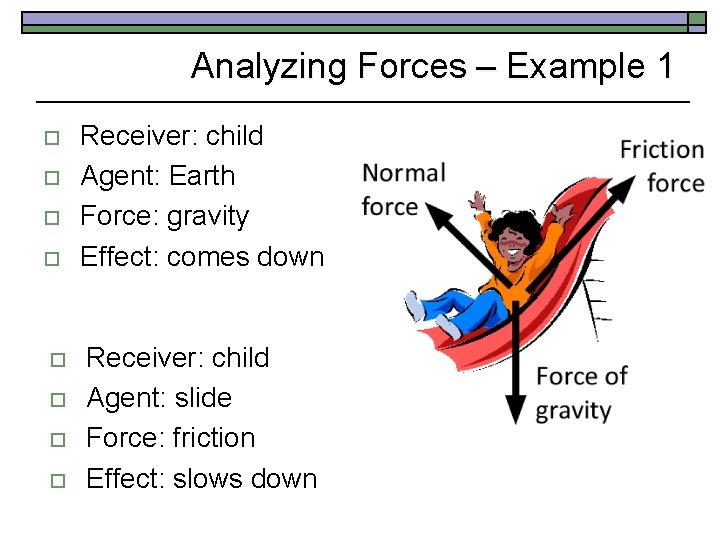
Analyzing Forces – Example 1 o o o o Receiver: child Agent: Earth Force: gravity Effect: comes down Receiver: child Agent: slide Force: friction Effect: slows down
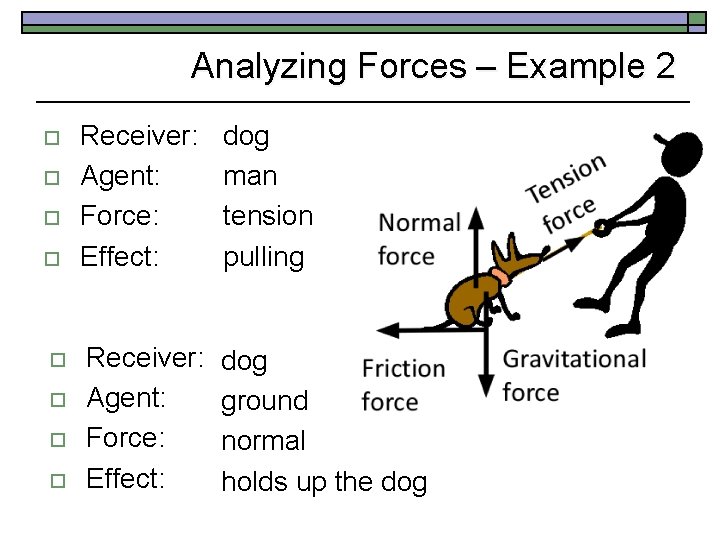
Analyzing Forces – Example 2 o o o o Receiver: Agent: Force: Effect: dog man tension pulling Receiver: Agent: Force: Effect: dog ground normal holds up the dog
Analyzing Forces o o o Determine the object that is the receiver. Identify the agents (objects that apply forces to the receiver). For each agent, identify the force it applies. Represent the direction of the force with an arrow starting on the receiver. Describe the effect of the identified forces on the receiver.
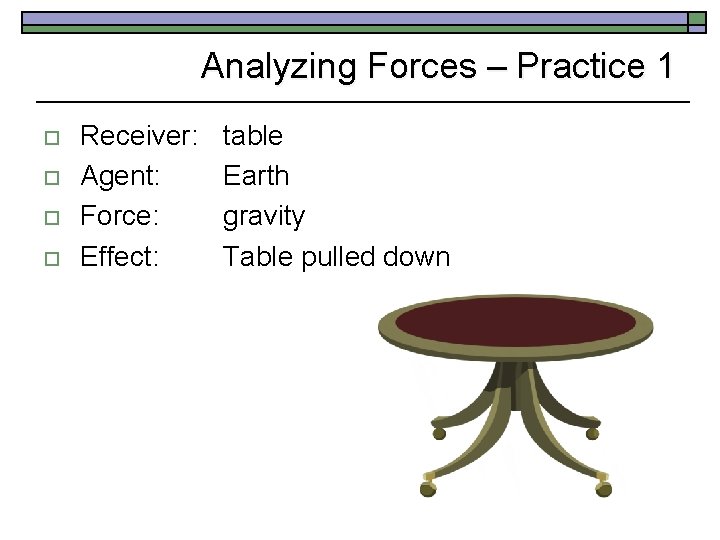
Analyzing Forces – Practice 1 o o Receiver: Agent: Force: Effect: table Earth gravity Table pulled down
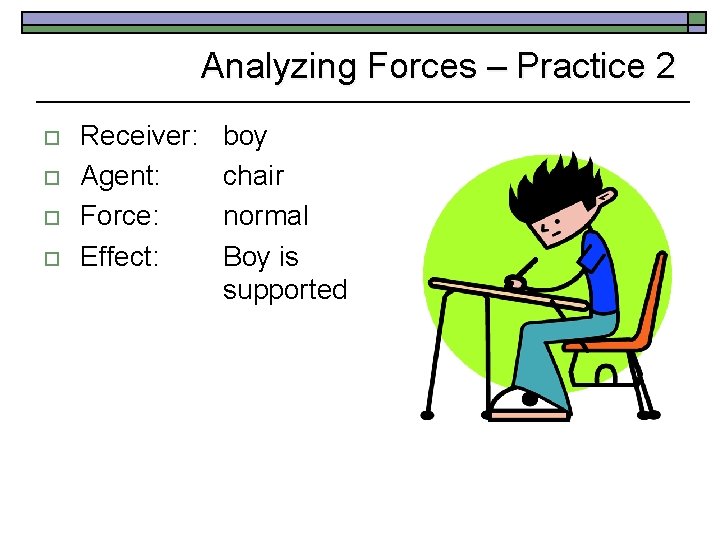
Analyzing Forces – Practice 2 o o Receiver: Agent: Force: Effect: boy chair normal Boy is supported