
Types of fixatives Aldehydes include formaldehyde formalin when



- Slides: 12
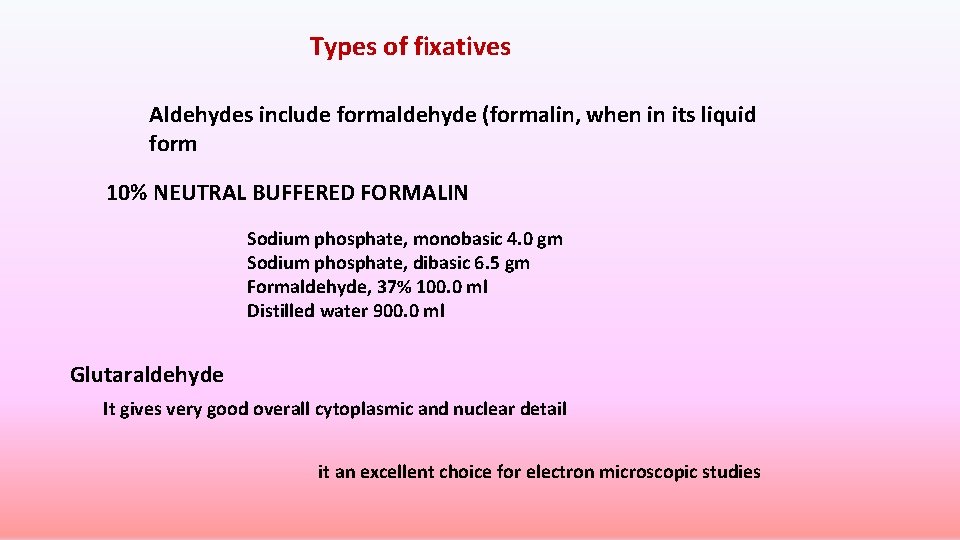
Types of fixatives Aldehydes include formaldehyde (formalin, when in its liquid form 10% NEUTRAL BUFFERED FORMALIN Sodium phosphate, monobasic 4. 0 gm Sodium phosphate, dibasic 6. 5 gm Formaldehyde, 37% 100. 0 ml Distilled water 900. 0 ml Glutaraldehyde It gives very good overall cytoplasmic and nuclear detail it an excellent choice for electron microscopic studies
Buffer A buffer is a solution containing either a weak acid and its salt or a weak base and its salt, which is resistant to changes in p. H. a buffer is an aqueous solution of either a weak acid and its conjugate base or a weak base and its conjugate acid Buffers are used to maintain a stable p. H in a solution they can neutralize small quantities of additional acid of base there is a working p. H range and a set amount of acid or base that can be neutralized before the p. H will change. The amount of acid or base that can be added to a buffer before changing its p. H is called its buffer capacity
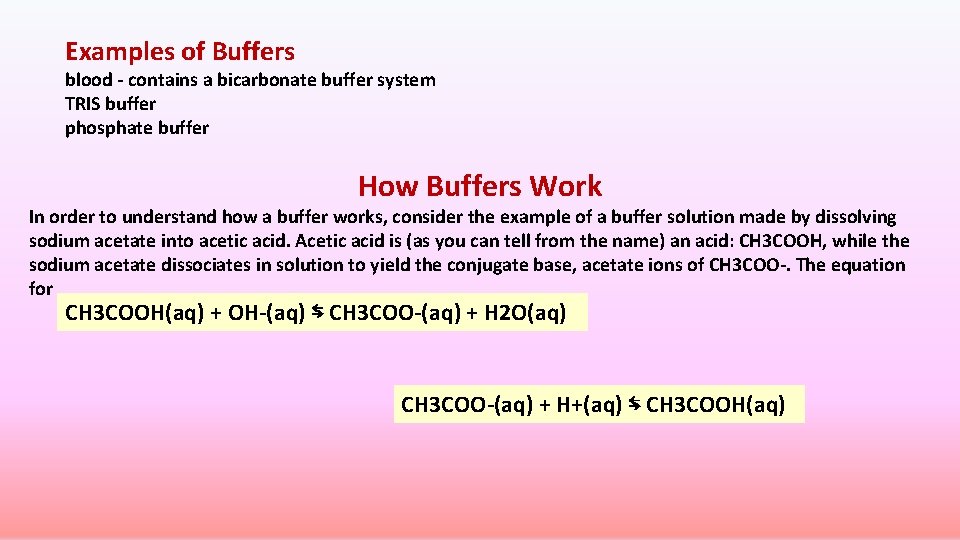
Examples of Buffers blood - contains a bicarbonate buffer system TRIS buffer phosphate buffer How Buffers Work In order to understand how a buffer works, consider the example of a buffer solution made by dissolving sodium acetate into acetic acid. Acetic acid is (as you can tell from the name) an acid: CH 3 COOH, while the sodium acetate dissociates in solution to yield the conjugate base, acetate ions of CH 3 COO-. The equation for CH 3 COOH(aq) + OH-(aq) ⇆ CH 3 COO-(aq) + H 2 O(aq) CH 3 COO-(aq) + H+(aq) ⇆ CH 3 COOH(aq)
Oxidizing agents include permanganate fixatives, such as potassium permanganate, dichromate fixatives (potassium dichromate), osmium tetroxide, and chromic acid. While these fixatives cross-link proteins, they cause extensive denaturation. Alcohols including methanol and ethanol, and protein denaturants (acetic acid) are not used routinely as they cause brittleness and hardness to tissues preserve cells through a process of dehydration and precipitation of proteins.
Mercurial They contain mercuric chloride which is a known component in fixatives such as B-5 and Zenker’s These fixatives offer poor penetration and tissue hardness, but are fast and provide excellent nuclear detail, lymph nodes, spleen, thymus, and bone marrow Mercury deposits must be removed (dezenkerized) prior to staining, otherwise black deposits will occur in tissue sections
picrate include fixatives with picric acid Bouin’s solution This fixative provides good nuclear detail and does not cause much hardness It is recommended for fixation of testis, gastrointestinal tract, and endocrine tissues.
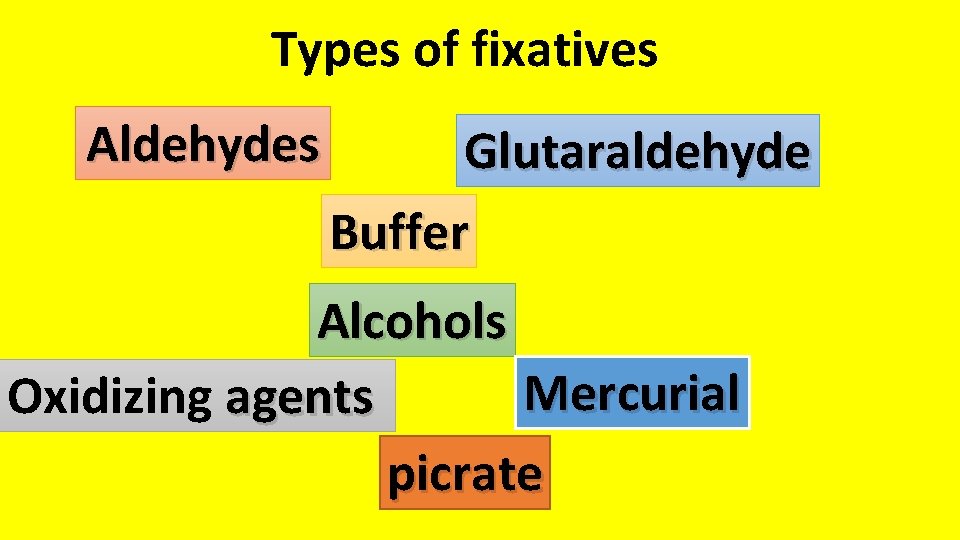
Types of fixatives Aldehydes Glutaraldehyde Buffer Alcohols Mercurial Oxidizing agents picrate
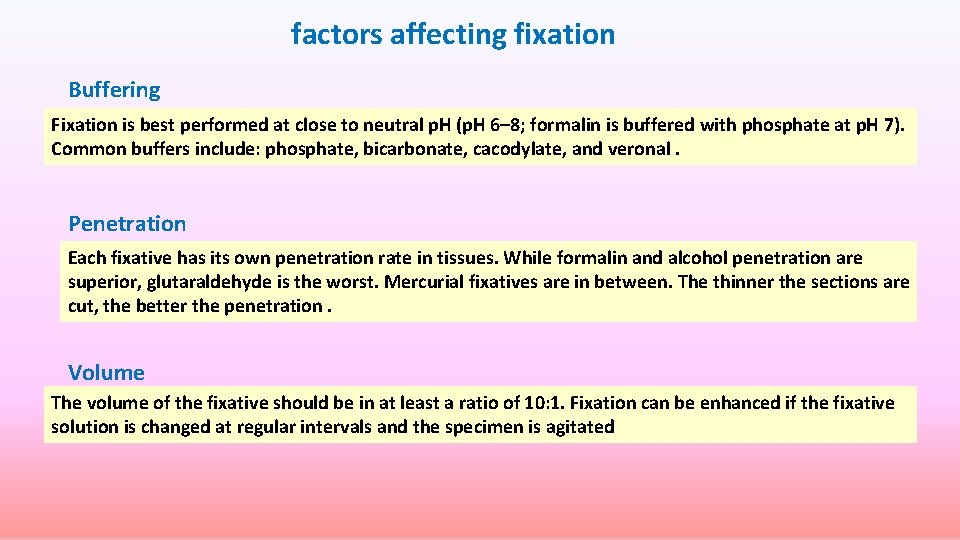
factors affecting fixation Buffering Fixation is best performed at close to neutral p. H (p. H 6– 8; formalin is buffered with phosphate at p. H 7). Common buffers include: phosphate, bicarbonate, cacodylate, and veronal. Penetration Each fixative has its own penetration rate in tissues. While formalin and alcohol penetration are superior, glutaraldehyde is the worst. Mercurial fixatives are in between. The thinner the sections are cut, the better the penetration. Volume The volume of the fixative should be in at least a ratio of 10: 1. Fixation can be enhanced if the fixative solution is changed at regular intervals and the specimen is agitated
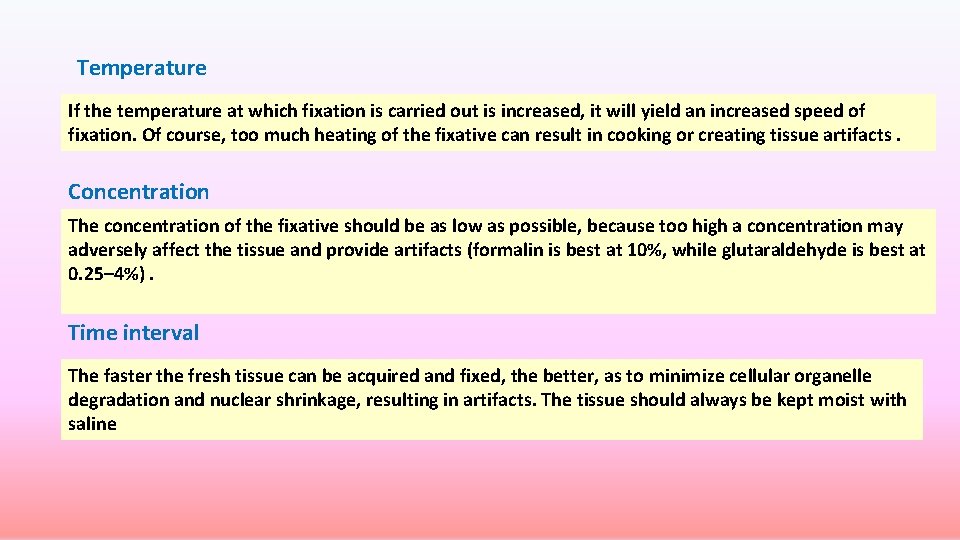
Temperature If the temperature at which fixation is carried out is increased, it will yield an increased speed of fixation. Of course, too much heating of the fixative can result in cooking or creating tissue artifacts. Concentration The concentration of the fixative should be as low as possible, because too high a concentration may adversely affect the tissue and provide artifacts (formalin is best at 10%, while glutaraldehyde is best at 0. 25– 4%). Time interval The faster the fresh tissue can be acquired and fixed, the better, as to minimize cellular organelle degradation and nuclear shrinkage, resulting in artifacts. The tissue should always be kept moist with saline
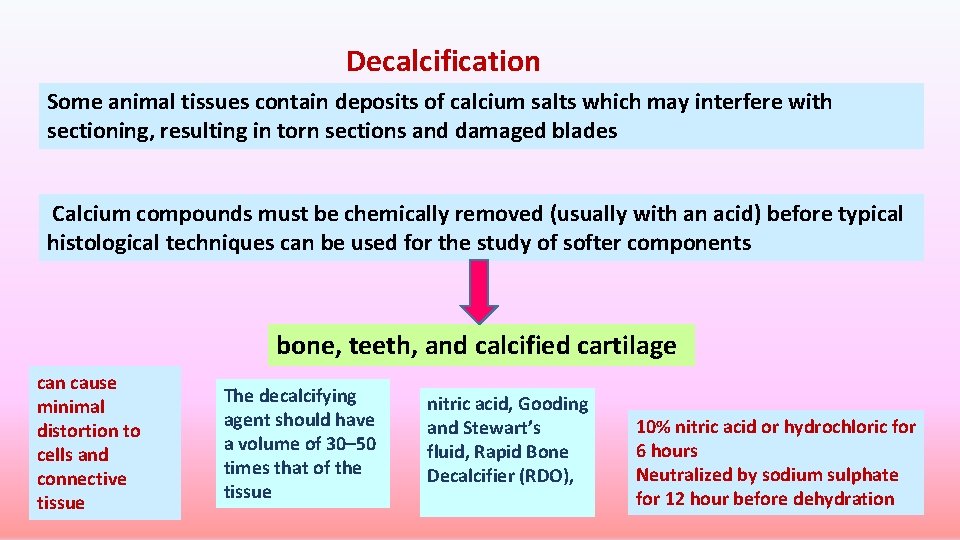
Decalcification Some animal tissues contain deposits of calcium salts which may interfere with sectioning, resulting in torn sections and damaged blades Calcium compounds must be chemically removed (usually with an acid) before typical histological techniques can be used for the study of softer components bone, teeth, and calcified cartilage can cause minimal distortion to cells and connective tissue The decalcifying agent should have a volume of 30– 50 times that of the tissue nitric acid, Gooding and Stewart’s fluid, Rapid Bone Decalcifier (RDO), 10% nitric acid or hydrochloric for 6 hours Neutralized by sodium sulphate for 12 hour before dehydration
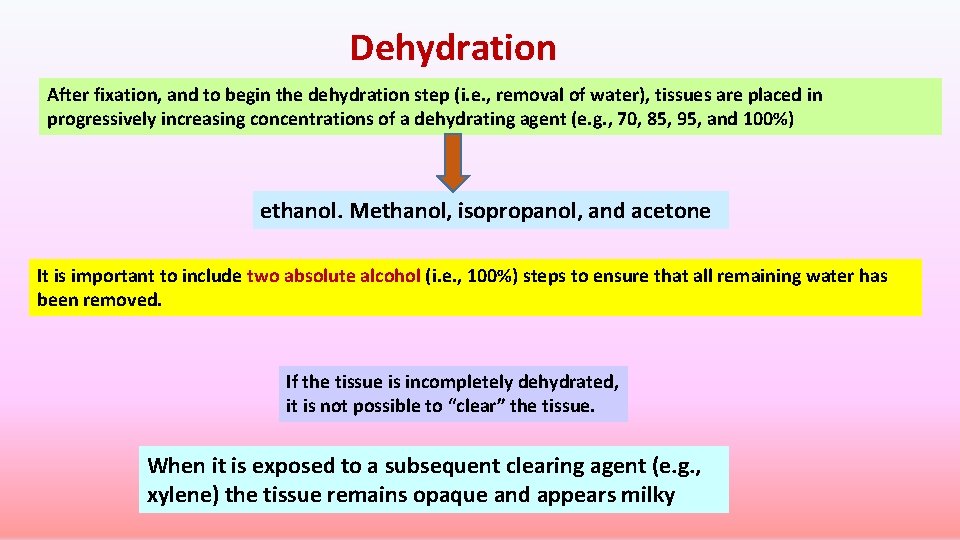
Dehydration After fixation, and to begin the dehydration step (i. e. , removal of water), tissues are placed in progressively increasing concentrations of a dehydrating agent (e. g. , 70, 85, 95, and 100%) ethanol. Methanol, isopropanol, and acetone It is important to include two absolute alcohol (i. e. , 100%) steps to ensure that all remaining water has been removed. If the tissue is incompletely dehydrated, it is not possible to “clear” the tissue. When it is exposed to a subsequent clearing agent (e. g. , xylene) the tissue remains opaque and appears milky