
Types of Faults Module 5 In this lesson


- Slides: 12
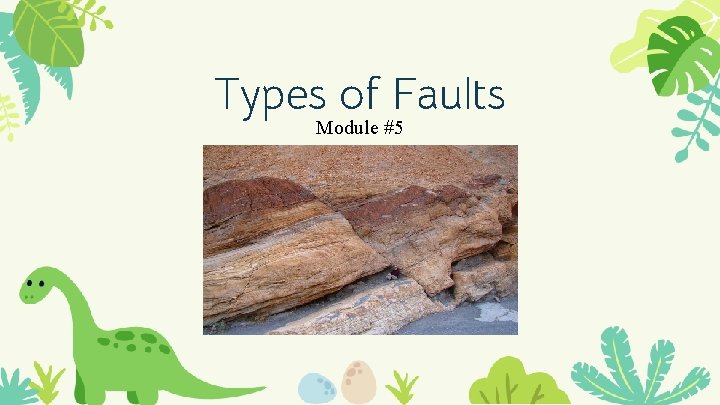
Types of Faults Module #5
In this lesson, you will learn the following: -Identify the different types of faults -Know the importance of studying faults -Produce an output that shows your grasps about the discussed lesson.
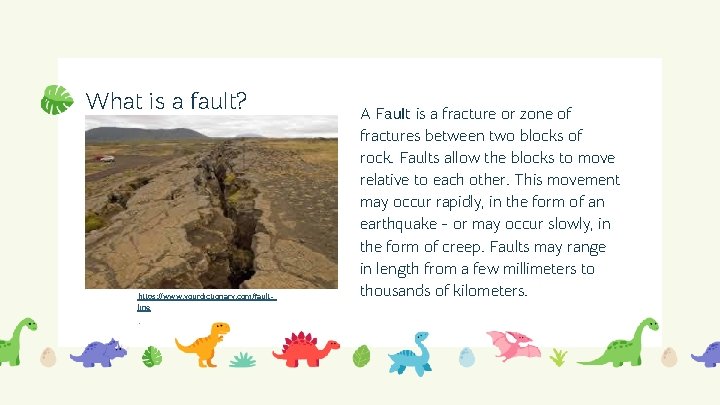
What is a fault? https: //www. yourdictionary. com/faultline . A Fault is a fracture or zone of fractures between two blocks of rock. Faults allow the blocks to move relative to each other. This movement may occur rapidly, in the form of an earthquake - or may occur slowly, in the form of creep. Faults may range in length from a few millimeters to thousands of kilometers.
Why do we study faults? We need to know where faults are and how they behave. We know a fault exists only if it has produced an earthquake or it has left a recognizable mark on the earth's surface. Faults are important due to their various dangerous as well as useful effects.
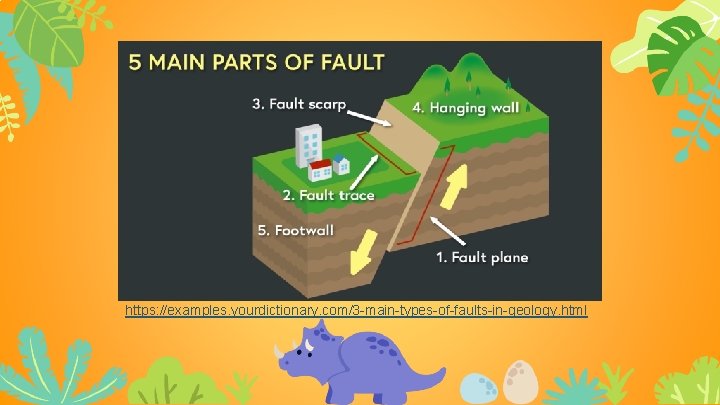
Main parts of a fault
https: //examples. yourdictionary. com/3 -main-types-of-faults-in-geology. html
Types of Faults
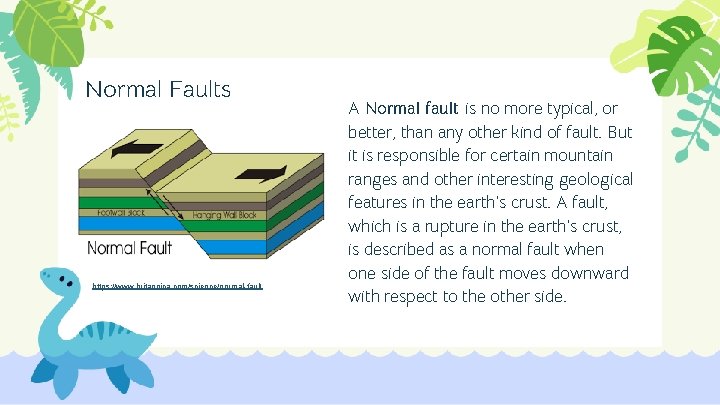
Normal Faults https: //www. britannica. com/science/normal-fault A Normal fault is no more typical, or better, than any other kind of fault. But it is responsible for certain mountain ranges and other interesting geological features in the earth's crust. A fault, which is a rupture in the earth's crust, is described as a normal fault when one side of the fault moves downward with respect to the other side.
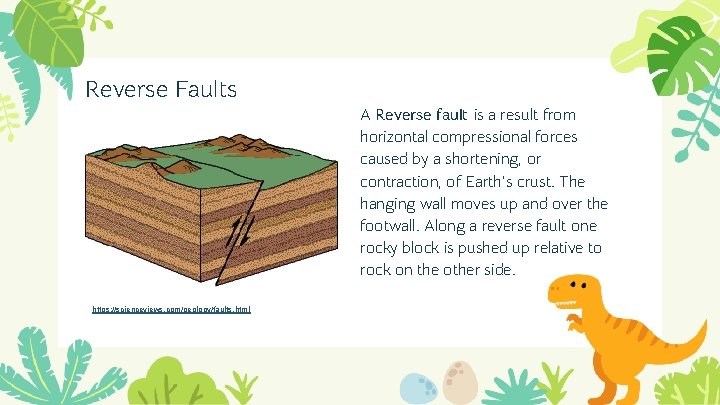
Reverse Faults https: //scienceviews. com/geology/faults. html A Reverse fault is a result from horizontal compressional forces caused by a shortening, or contraction, of Earth’s crust. The hanging wall moves up and over the footwall. Along a reverse fault one rocky block is pushed up relative to rock on the other side.
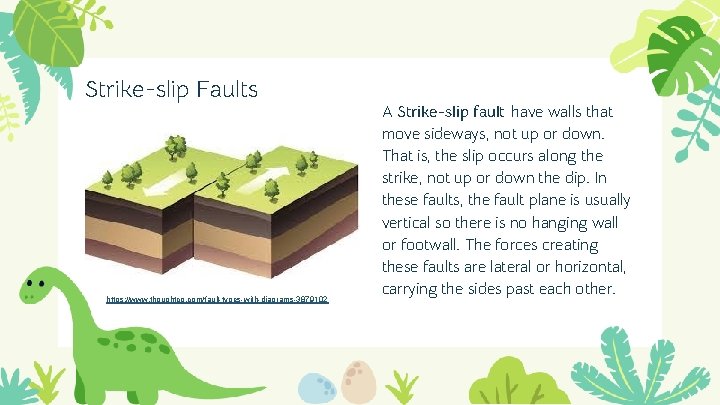
Strike-slip Faults https: //www. thoughtco. com/fault-types-with-diagrams-3879102 A Strike-slip fault have walls that move sideways, not up or down. That is, the slip occurs along the strike, not up or down the dip. In these faults, the fault plane is usually vertical so there is no hanging wall or footwall. The forces creating these faults are lateral or horizontal, carrying the sides past each other.
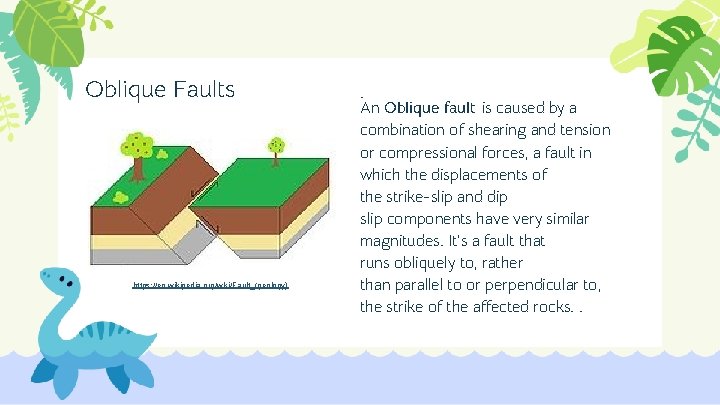
Oblique Faults https: //en. wikipedia. org/wiki/Fault_(geology) . An Oblique fault is caused by a combination of shearing and tension or compressional forces, a fault in which the displacements of the strike-slip and dip slip components have very similar magnitudes. It’s a fault that runs obliquely to, rather than parallel to or perpendicular to, the strike of the affected rocks. .
Thanks for listening! Don’t forget to answer your Learning Activity Plan (LAP).