
Types of Fasteners A Nails are metal fasteners
- Slides: 10
Types of Fasteners
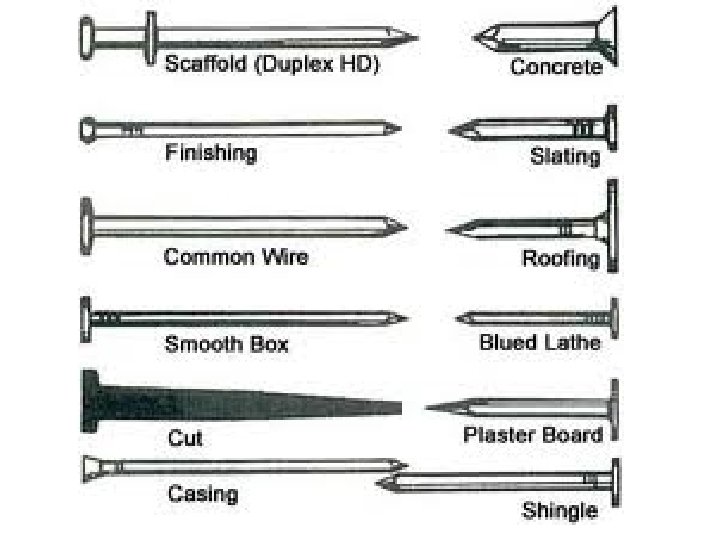
• A. Nails are metal fasteners driven into the material it holds. – 1. Common nails are used for general construction and have a flat head and diamond-shaped point. – 2. Finishing nails have small heads that can be set below surface. – 3. Brads are thin, short nails with small heads. – 4. Cut or casing nails are square on the ends and are used for tongue and groove board nailing. – 5. Others – roofing, box, staple, duplex
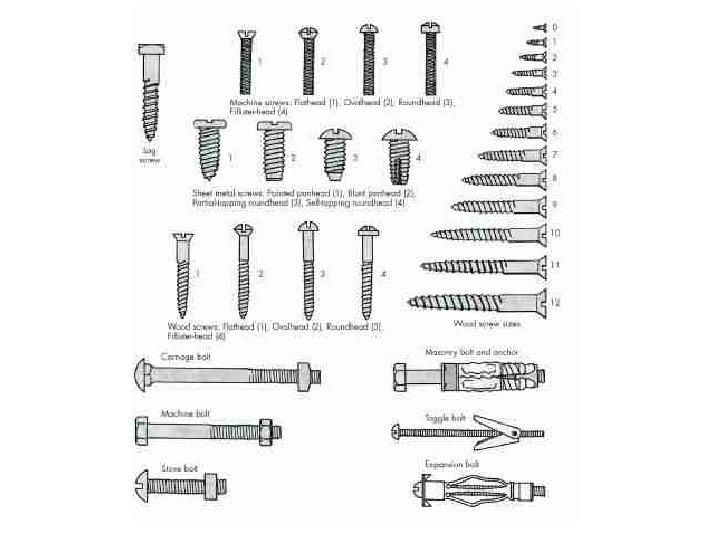
• Screws are fasteners with threads that bite into the material they fasten. – 1. Kind based on material they hold – wood, sheetmetal, drywall, etc. – 2. Kind based on metal they are made from – steel, brass, etc. – 3. Kind based on shape of head – flat, round, oval, pan, etc. – 4. Size is determined by diameter (gauge) and length (inches) of the shank.
• Bolts are fasteners that require a threaded nut. – 1. A lag bolt is sometimes called a lag screw because it has threads similar to a wood screw and does NOT use a nut. – 2. A carriage bolt has a round head over a square shank or shoulders. – 3. A stove bolt may have either a round head or a flat head and the shank is threaded the entire length from bottom to top. – 4. A machine bolt has either a square head or a hex head and is threaded on the bottom for about 1". It is NOT threaded all the way to the top. – 5. A cap screw is much like a machine bolt but has threads the entire length, is usually 2" or less in length, threads into something other than a nut, and may have different kind of head.
• A. Specific types and sizes of fasteners are used for their designed purposes.
Nails • 1. Common nails are used for construction such as framing because of their heads and size of shank. • 2. Finishing are used for trim because of small heads that can be countersunk below surface of wood. • 3. Casing nails are used to fasten tongue and groove boards and to nail some trim work. • 4. Spiral groove nails are used to fasten metal on roofs because the nails are less likely to work loose and cause leaks.
Screws • 1. Flathead and roundhead wood screws fasten wood to wood. • 2. A countersink cuts a “V” in the surface of wood so that a flathead screw will be flush or just below surface. • 3. Roundhead screws will be above surface unless a hole is drilled deep enough to hide head of screw.
Bolts • 1. Machine bolts are used when a strong bolt is needed, but it needs to be removed to dismantle metal equipment on a regular basis. • 2. Lag screws are used with expansion shields to fasten wood to masonry materials such as concrete, bricks, or blocks. • 3. Stove bolts are used to fasten lightweight metal structures.