
Types of Experimental Designs INDEPENDENT GROUP DESIGN REPEATED
- Slides: 15
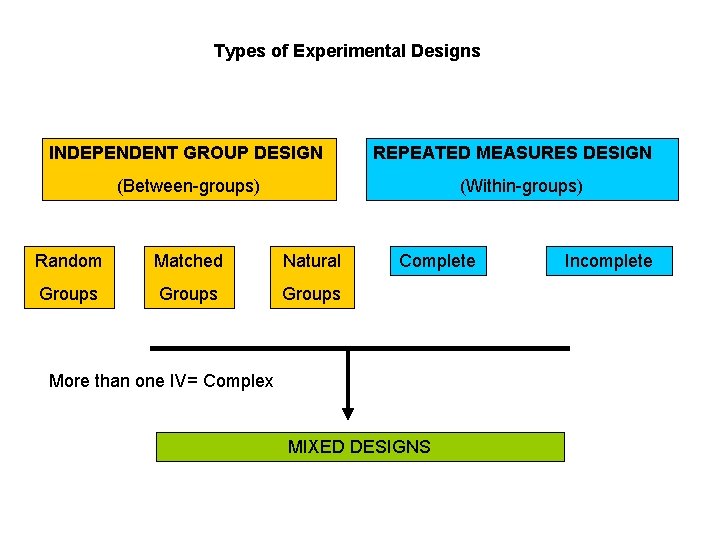
Types of Experimental Designs INDEPENDENT GROUP DESIGN REPEATED MEASURES DESIGN (Between-groups) (Within-groups) Random Matched Natural Groups Complete More than one IV= Complex MIXED DESIGNS Incomplete
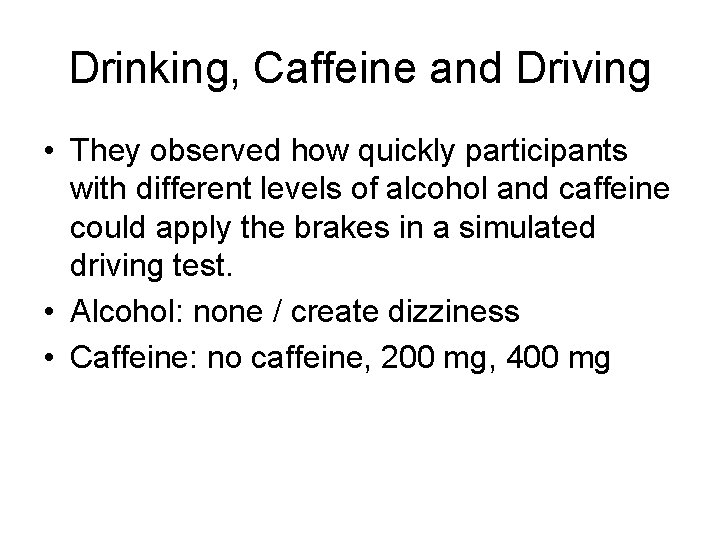
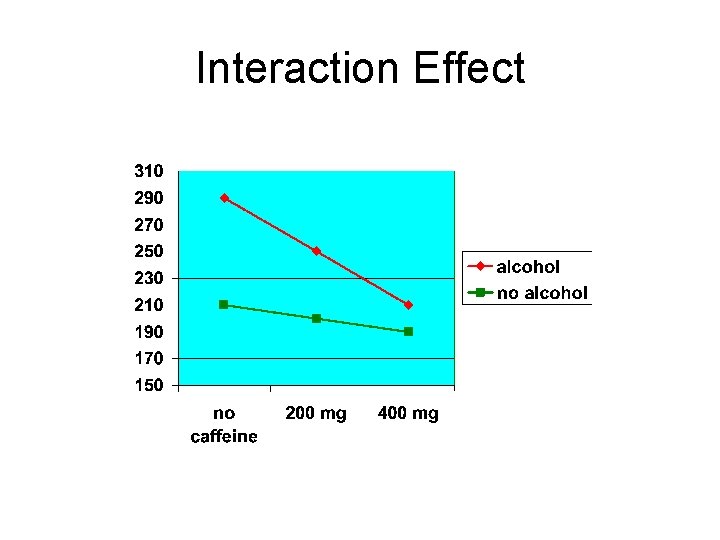
Drinking, Caffeine and Driving • They observed how quickly participants with different levels of alcohol and caffeine could apply the brakes in a simulated driving test. • Alcohol: none / create dizziness • Caffeine: no caffeine, 200 mg, 400 mg
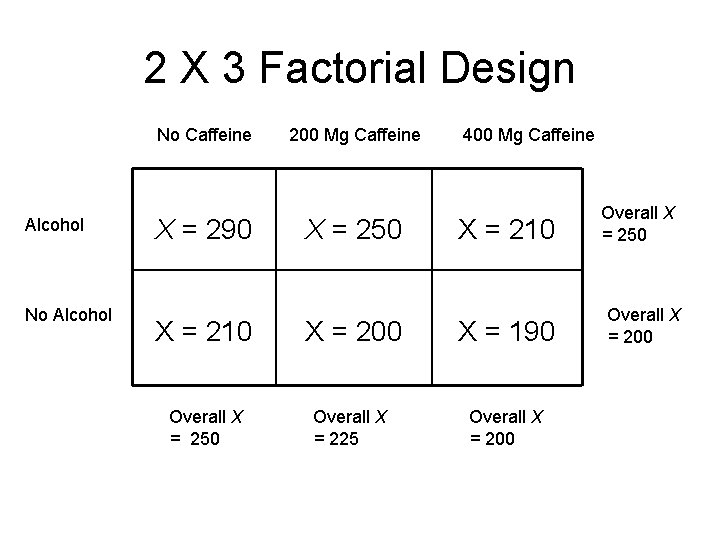
2 X 3 Factorial Design No Caffeine Alcohol No Alcohol X = 290 200 Mg Caffeine X = 250 400 Mg Caffeine X = 210 X = 200 X = 190 Overall X = 250 Overall X = 225 Overall X = 200 Overall X = 250 Overall X = 200
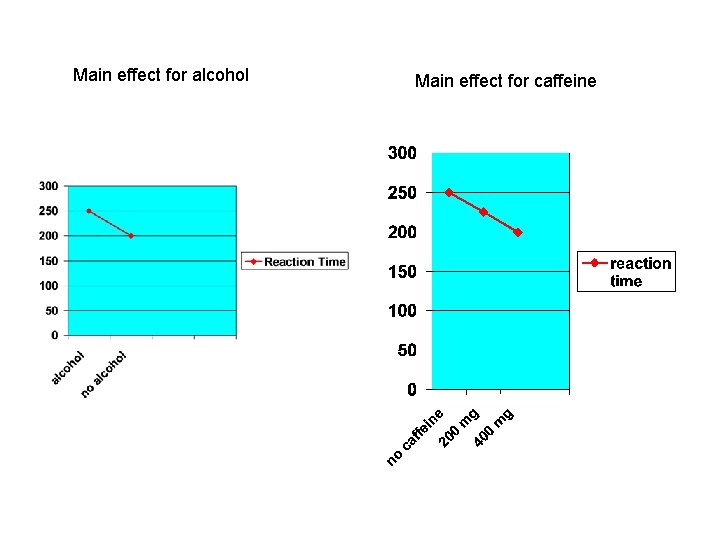
Main effect for alcohol Main effect for caffeine
Interaction Effect
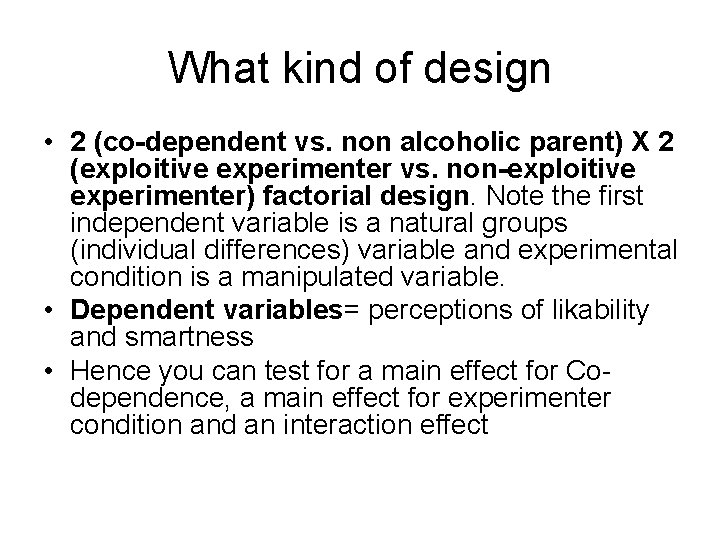
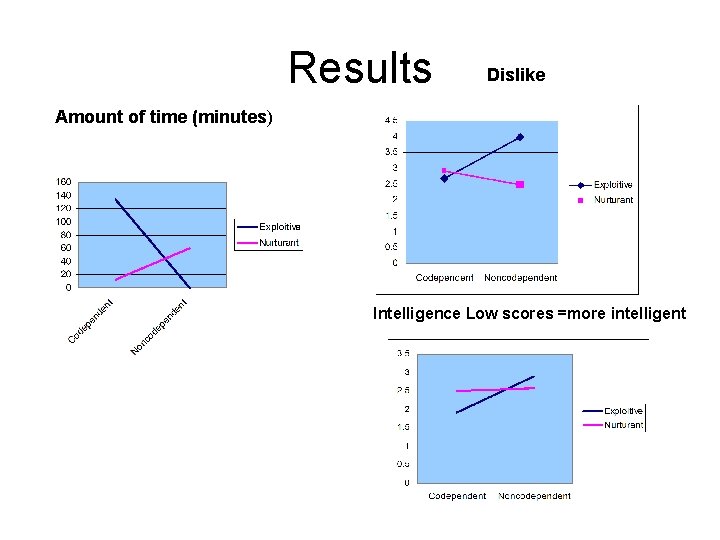
What kind of design • 2 (co-dependent vs. non alcoholic parent) X 2 (exploitive experimenter vs. non-exploitive experimenter) factorial design. Note the first independent variable is a natural groups (individual differences) variable and experimental condition is a manipulated variable. • Dependent variables= perceptions of likability and smartness • Hence you can test for a main effect for Codependence, a main effect for experimenter condition and an interaction effect
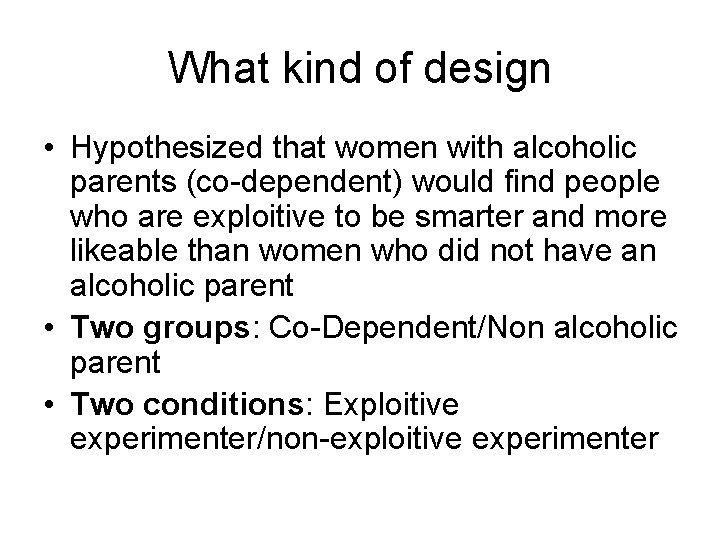
What kind of design • Hypothesized that women with alcoholic parents (co-dependent) would find people who are exploitive to be smarter and more likeable than women who did not have an alcoholic parent • Two groups: Co-Dependent/Non alcoholic parent • Two conditions: Exploitive experimenter/non-exploitive experimenter
Helping out Mr. Wrong: Evidence of codependency with an alcoholic parents Hypothesis: Women with an alcoholic parents would be more helpful and more attracted to a man who was portrayed as exploitive than to a man who was portrayed in a more socially desirable manner. Women who did not have an alcoholic parent would be more helpful and attracted to man who was portrayed positively than to one portrayed as exploitive Lyon and Greenberg, 1991, JPSP
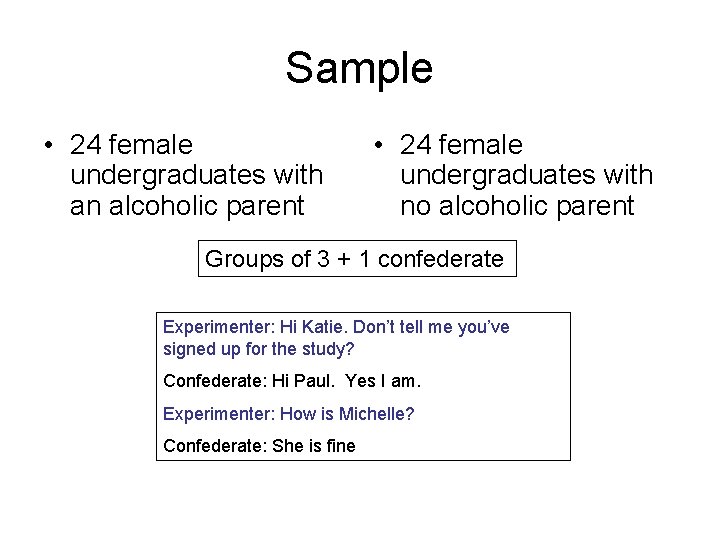
Sample • 24 female undergraduates with an alcoholic parent • 24 female undergraduates with no alcoholic parent Groups of 3 + 1 confederate Experimenter: Hi Katie. Don’t tell me you’ve signed up for the study? Confederate: Hi Paul. Yes I am. Experimenter: How is Michelle? Confederate: She is fine
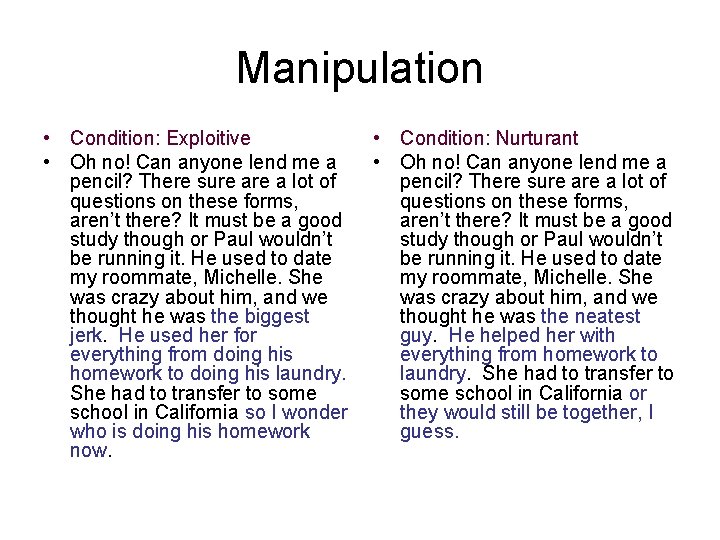
Manipulation • Condition: Exploitive • Oh no! Can anyone lend me a pencil? There sure a lot of questions on these forms, aren’t there? It must be a good study though or Paul wouldn’t be running it. He used to date my roommate, Michelle. She was crazy about him, and we thought he was the biggest jerk. He used her for everything from doing his homework to doing his laundry. She had to transfer to some school in California so I wonder who is doing his homework now. • Condition: Nurturant • Oh no! Can anyone lend me a pencil? There sure a lot of questions on these forms, aren’t there? It must be a good study though or Paul wouldn’t be running it. He used to date my roommate, Michelle. She was crazy about him, and we thought he was the neatest guy. He helped her with everything from homework to laundry. She had to transfer to some school in California or they would still be together, I guess.
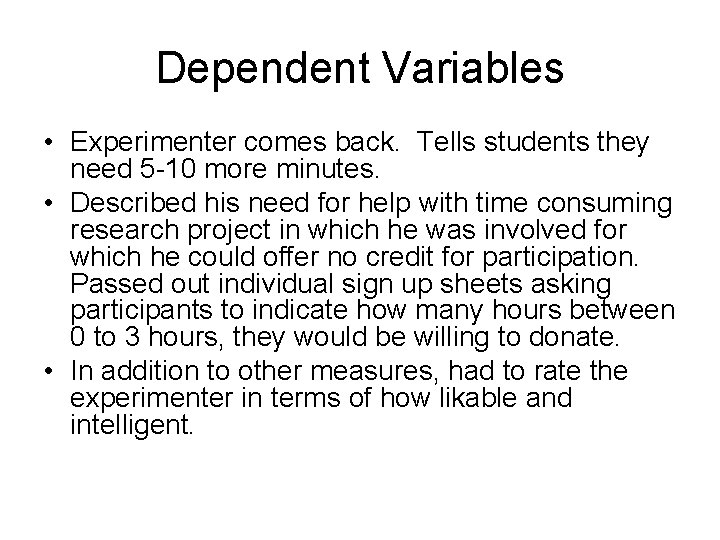
Dependent Variables • Experimenter comes back. Tells students they need 5 -10 more minutes. • Described his need for help with time consuming research project in which he was involved for which he could offer no credit for participation. Passed out individual sign up sheets asking participants to indicate how many hours between 0 to 3 hours, they would be willing to donate. • In addition to other measures, had to rate the experimenter in terms of how likable and intelligent.
Results Dislike Amount of time (minutes) Intelligence Low scores =more intelligent
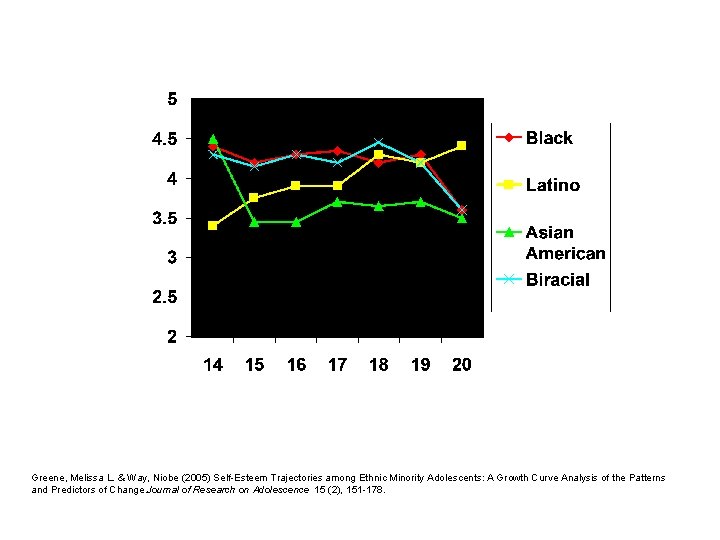
What kind of design • You are interested in examining age differences in self-esteem and if changes are related to ethnicity • This was a mixed design. A 4 (between groups (individual difference variable) X 7 (within group (or repeated measures design)) • Dependent variable is self-esteem
Greene, Melissa L. & Way, Niobe (2005) Self-Esteem Trajectories among Ethnic Minority Adolescents: A Growth Curve Analysis of the Patterns and Predictors of Change. Journal of Research on Adolescence 15 (2), 151 -178.
What kind of design? • Comparing the experience of biological parents, adoptive parents and stepparents before obtaining/having the child and one year later in terms of marital satisfaction, life satisfaction, conflict, and stress level