
Types of Evidence Types of Evidence Objectives You
Types of Evidence

Types of Evidence Objectives You will understand: The value of indirect and direct evidence in a court of law. That eyewitness accounts have limitations. What physical evidence can and cannot prove in court. That the forensic scientist’s main goal is to find a unique source for the evidence. You will be able to: Explain the difference between indirect and direct evidence. Describe what is meant by physical evidence and give examples. Distinguish individual evidence from class evidence. Determine the significance of class evidence. 2

Types of Evidence Scientific Evidence? 4 Dr. Lisa Mc. Cormick was called to be an expert witness for a murder trial. Dr. Mc. Cormick claims that the blood samples of the victim contained a drug that only the suspect knows how to make. She said she knew that this drug was in the victim’s body after she drew the blood and mixed it in a new “special solution” that turns yellow in the presence of the drug. Should her testimony be used in the court of law? 3
Types of Evidence Admissibility of Evidence 4 The Frye Standard 4 From the 1923 case Frye v. United States 4 Scientific evidence is allowed into the courtroom if it is generally accepted by the relevant scientific community. The Frye standard does not offer any guidance on reliability. The evidence is presented in the trial and the jury decides if it can be used. 4

Types of Evidence Introduction to Forensic Science and the Law Admissibility of Evidence 4 The Daubert Ruling 4 From the 1993 case Daubert v. Dow 4 The judge decides if the evidence can be entered into the trial. Admissibility is determined by: Whether theory or technique can be tested Whether the science has been offered for peer review Whether the rate of error is acceptable Whether the method at issue enjoys widespread acceptance Whether theory or technique follows standards 5
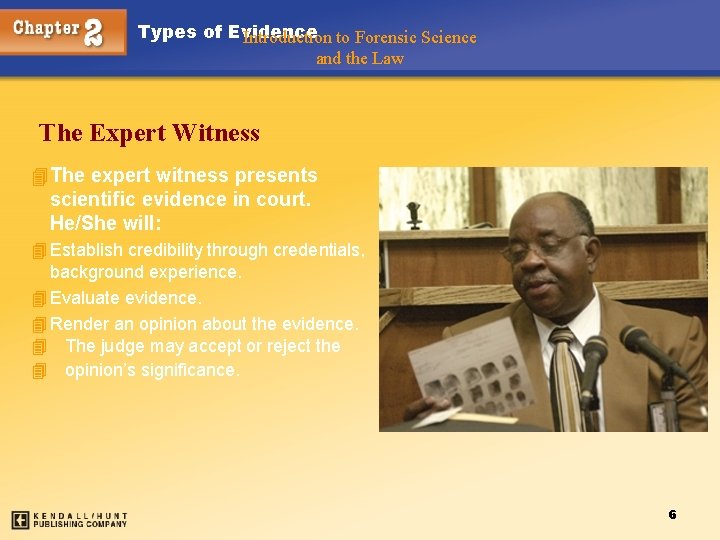
Types of Evidence Introduction to Forensic Science and the Law The Expert Witness 4 The expert witness presents scientific evidence in court. He/She will: 4 Establish credibility through credentials, background experience. 4 Evaluate evidence. 4 Render an opinion about the evidence. 4 The judge may accept or reject the 4 opinion’s significance. 6
Types of Evidence Introduction to Forensic Science and the Law Facets of Guilt To prove a case, the “MMO” must be established; it must be shown that the suspect had: Motive—person had a reason to do the crime (not necessary to prove in a court of law) Means—person had the ability to do the crime Opportunity—person can be placed at the crime scene 7
Types of Evidence Catalyst 10/2/12 One evening as Max was out walking, Mrs. Zenitt called his name. He hurried across the street. She was standing in her front yard, but she guided him around to the back. "I was watching TV in the living room, " she told him, "and I heard a crash. Just look!" She pointed to her back porch window. "Someone threw a rock through it. It's broken into a dozen pieces!“ "Do you know who did it? " he asked. "No, ” she replied, “He ran off, but I think maybe it was David Loring. We had a spat the other day because I told his parents he had to stop using my yard as a short cut. But I wouldn't accuse him of breaking a window without more proof. “ "I'll talk to him, " Max said. [LET ME KNOW IF YOU’RE DONE 8 READING. ]
Types of Evidence He found David panting as he bounced a basketball under the light on his garage. "Did you just run from Mrs. Zenitt's? " Max asked. "Did you break her window? " David shook his head. "No. I'm all out of breath because I've been out here shooting baskets. I don't know anything about a broken porch window. " "You're not telling the truth, " Max said. How did Max figure it out? 9
Types of Evidence Max knew David was not telling the truth because he said "porch window. " Max had not mentioned which of Mrs. Zenitt's windows had been broken. "This case was a real pane, but the solution was as clear as glass, " Max told Nina later. 10

Types of Evidence Agenda 10/1/12 4 Catalyst 4 Announcements 4 Physical Evidence Continued 4 Testimonial Evidence Introduction 4 Homework 4 Read pages 34 – 49 and answer the Check. Point questions at the end. DUE TOMORROW Wednesday, October 3 rd at the BEGINNING of class (first 5 minutes). 11
Types of Evidence Announcements 4 Chapter 1 Check. Point questions due yesterday! If you submit today, I WILL be on time. (Remember your score is decreased by 20% for every day that it is late. ) 4 No one submitted the Due Process Rights worksheet from last Tuesday. Today is the LAST day to submit it! 4 Receive text messaging reminders! Text “@1 forensics” to 442 -3314172. Optional, but highly recommended if you’re missing a lot of work because you keep forgetting. 4 If you’re interested in working on college apps, meetings start this week. Please fill out the survey posted on Edmodo if you are interested. (This is optional, of course. ) 12

Types of Evidence Classification of Evidence Testimonial evidence is a statement made under oath; also known as direct evidence or prima facie evidence. Physical evidence is any object or material that is relevant in a crime; also known as indirect evidence. Examples are hair, fiber, fingerprints, documents, blood, soil, drugs, toolmarks, impressions, glass. 13
Types of Evidence Catalyst 10/3/12 4 Think about the intrusion that took place yesterday at the cafeteria. Answer the following questions on your Catalyst sheet (pick up as you walk in. ) 41. Where did the crime take place? Describe the scene with as MANY DETAILS as you can. (Color of objects, size, their location, etc. ) 42. Describe the victim. What was he wearing? Be specific. 43. Describe the perpetrator. What was he wearing? Be specific. 44. Recreate any dialogue that you remember. (Between the perpetrator and the victim, between the bystanders, etc. ) 14
Types of Evidence THE INVASION OF AN INTRUDER—QUESTIONNAIRE 15
Types of Evidence What time did the intruder enter the classroom? 41: 59 pm 41: 58 pm 41: 55 pm 42: 00 pm 16
Types of Evidence What did the intruder look like? 4 “Medium size, skinny, looks like he was dark skinned and army outfit” 4 “African-American 5, 6” 4 “ 5’ 7, 165 lb, 52, black hair” 4 “African-American about 5’ 9, black hair, late 30 s, and about 180 lbs” 4 “Camouflage (brown) African American, colorful cloths on his right leg, glasses, & black hat” 4 “tall black male wearing camouflage, sunglasses, mask around mouth, around 180 pounds, around 5’ 10” 4 “Army wear, African American, black vest, purple hat, tall, sunglasses, towel on his knee, belt” 17
Types of Evidence What did the intruder do? 4 “throw stuff around put Mr. Gutierrez on the wall and took his laptop” 4 “throw bombs, arrested the teacher and took the computer” 4 “He threw bottles and took the computer” 4 “He robbed my teacher” 4 “the intruder turned mr. G around and put his hands behind his back (and he had handcuffs)” 4 “…up against the chalkboard and checked his pockets and then took his laptop. ” 18
Types of Evidence How long did this invasion last? 4 30 seconds 4 40 seconds 4 1 minute 4 2 minutes 4 30 -40 seconds 4 15 seconds 4 5 minutes 19
Pros & Cons of Testimonial Evidence Presentation developed by T. Trimpe 2006 http: //sciencespot. net/
Types of Evidence What do you think are some of the factors that affected your ability to remember? 21
What is testimonial evidence? Testimonial evidence includes oral or written statements given to police as well as testimony in court by people who witnessed an event. Eyewitness accounts can be a useful tool in helping investigators with analyzing a crime scene, but are not viewed to be highly reliable. In addition, eyewitness identifications (right or wrong) can have a big influence on the outcome of an investigation or trial. People are likely to view the same scene in different ways depending on their positions, line of sight, familiarity with the area, and other factors that can interfere with a person’s ability to remember details. The Bunny Effect CBS News Video
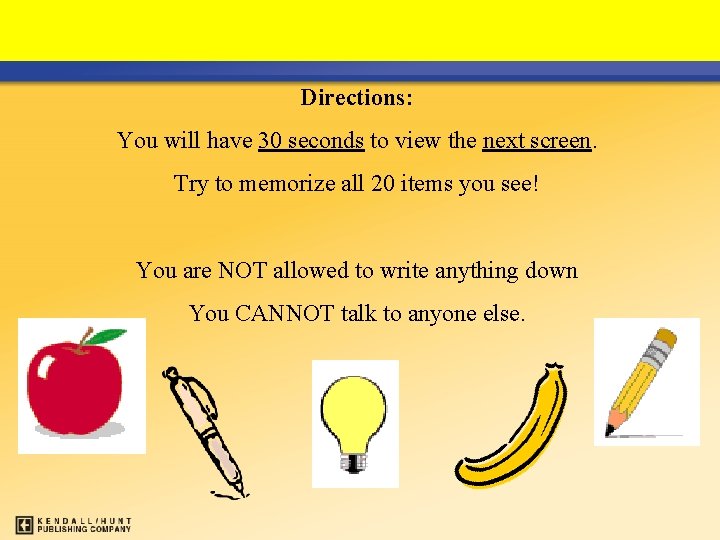
Memory Challenge Directions: You will have 30 seconds to view the next screen. Try to memorize all 20 items you see! You are NOT allowed to write anything down You CANNOT talk to anyone else.
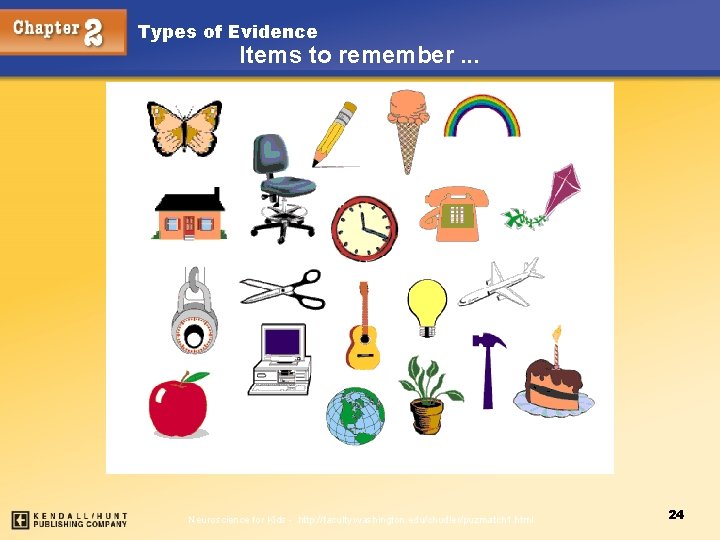
Types of Evidence Items to remember. . . Neuroscience for Kids - http: //faculty. washington. edu/chudler/puzmatch 1. html 24
Types of Evidence You have 2 minutes to list as many of the items as you can! 4 Go! 25
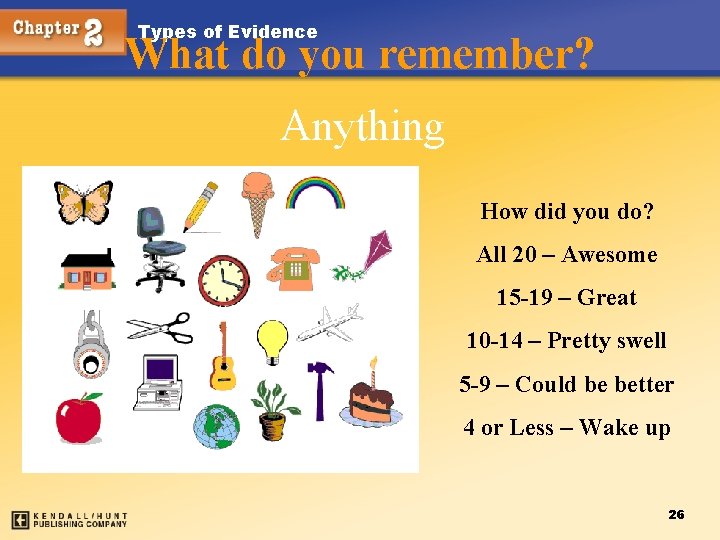
Types of Evidence What do you remember? Anything How did you do? All 20 – Awesome 15 -19 – Great 10 -14 – Pretty swell 5 -9 – Could be better 4 or Less – Wake up 26
Did you know? Types of Evidence According to The Innocence Project (2008) "Eyewitness misidentification is the single greatest cause of wrongful convictions nationwide, playing a role in more than 75% of convictions overturned through DNA testing. " Still, the criminal justice system profoundly relies on eyewitness identification and testimony for investigating and prosecuting crimes (Wells & Olson, 2003). What factors affect a person’s memory and their ability to identify a suspect? Source: http: //www. helium. com/items/1276135 -accurate-eyewitness-accounts 27
Witness Factors Types of Evidence 4 Age may play a role in the accuracy of an eyewitness’ statement or identification of a suspect. Studies have shown that when a lineup contains the actual culprit, both young children and elderly perform well, but when the lineup does not contain the culprit there is a higher rate of mistaken identifications. 4 The race of the witness may also play a role. The Cross Race Effect (CRE) is a phenomenon in which people are better at recognizing faces of their own race rather than those of other races. 4 The use of drugs can alter a person’s ability to recall the events of a crime even after they are no longer under the influence. 4 A person’s memory of an event can be influenced by other witnesses, investigators, and/or the media. Investigators use open-ended questioning and follow procedures for conducting line-ups to limit their influence on a witness’ memory of an event or identification of a suspect. Source: http: //www. helium. com/items/1276135 -accurate-eyewitness-accounts 28
Types of. Scene Evidence & Suspect Factors Crime 4 Extreme Trauma. (For example, a witness confronted with a weapon tends to focus on the weapon rather than the perpetrator’s face. ) 4 Amount of time to see the perpetrator’s face. 4 Studies have shown that faces that are either highly attractive, highly unattractive, or distinctive are more likely to be accurately recognized. 4 Simple disguises, such as hats or sunglasses, can interfere with accurate eyewitness identification. 4 body piercings and tattoos increases the likelihood of an accurate identification. 4 The time of day in which the crime occurred as well as a person’s view of the scene may affect what a he/she is able to see. 4 A person who is familiar with the area in which the crime took place, may have a better recall of the positions of the victims or suspects. Source: http: //www. helium. com/items/1276135 -accurate-eyewitness-accounts 29
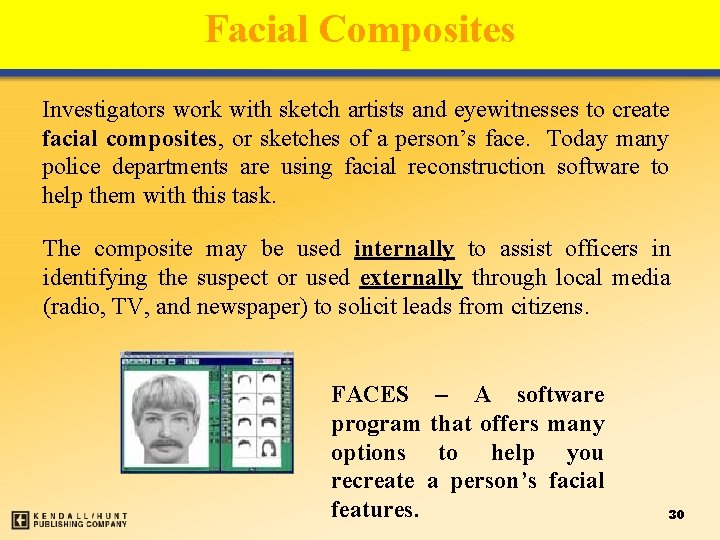
Facial Composites Types of Evidence Investigators work with sketch artists and eyewitnesses to create facial composites, or sketches of a person’s face. Today many police departments are using facial reconstruction software to help them with this task. The composite may be used internally to assist officers in identifying the suspect or used externally through local media (radio, TV, and newspaper) to solicit leads from citizens. FACES – A software program that offers many options to help you recreate a person’s facial features. 30
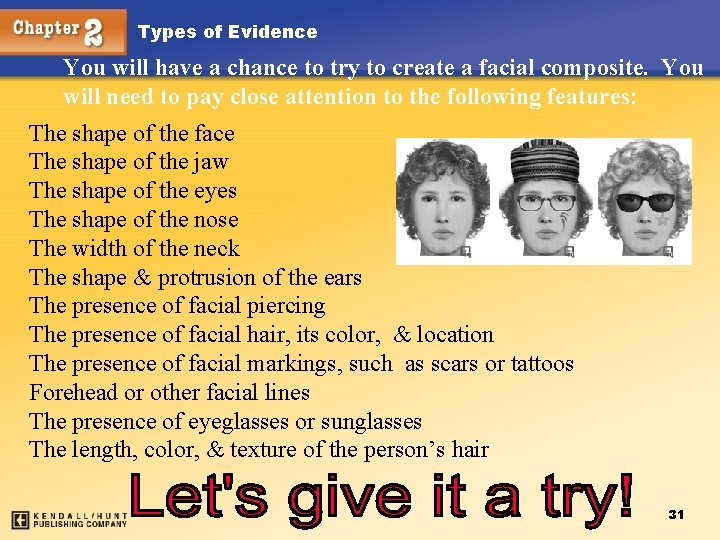
Types of Evidence You will have a chance to try to create a facial composite. You will need to pay close attention to the following features: The shape of the face The shape of the jaw The shape of the eyes The shape of the nose The width of the neck The shape & protrusion of the ears The presence of facial piercing The presence of facial hair, its color, & location The presence of facial markings, such as scars or tattoos Forehead or other facial lines The presence of eyeglasses or sunglasses The length, color, & texture of the person’s hair 31
Types of Evidence Classwork 4 Answer Check. Point questions at the end of chapter 2. (Read pages 34 – 40; answer up to question 7. ) 4 www. scilinks. org Type in the code: forensics 2 E 37. 32
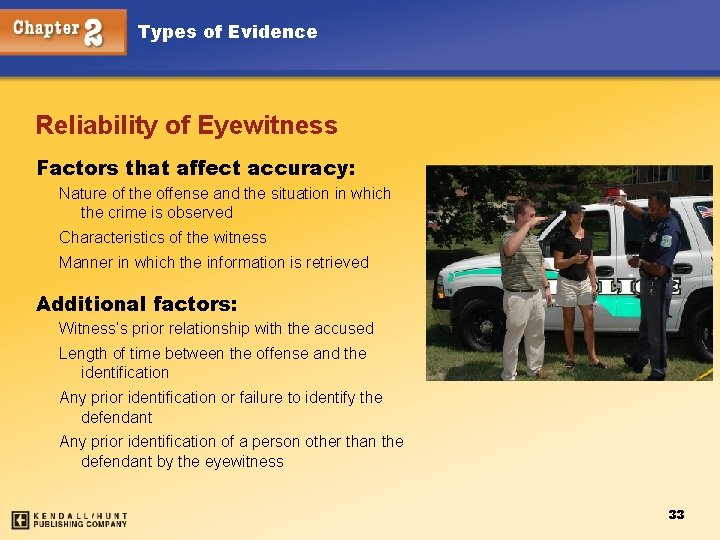
Types of Evidence Reliability of Eyewitness Factors that affect accuracy: Nature of the offense and the situation in which the crime is observed Characteristics of the witness Manner in which the information is retrieved Additional factors: Witness’s prior relationship with the accused Length of time between the offense and the identification Any prior identification or failure to identify the defendant Any prior identification of a person other than the defendant by the eyewitness 33
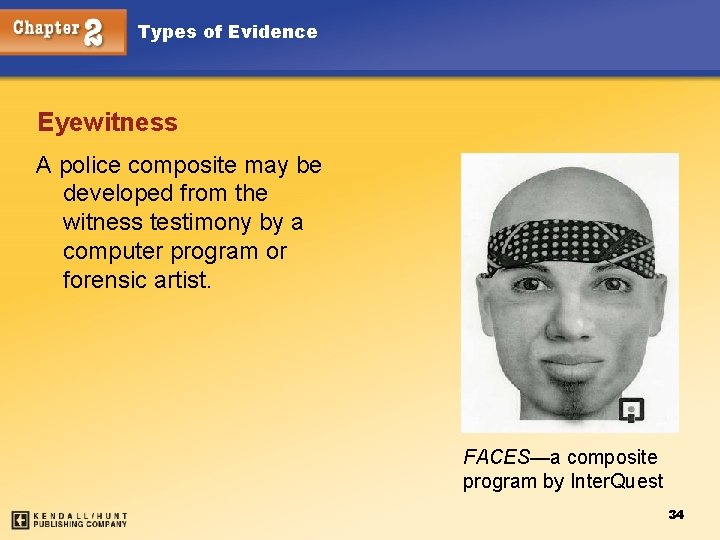
Types of Evidence Eyewitness A police composite may be developed from the witness testimony by a computer program or forensic artist. FACES—a composite program by Inter. Quest 34
Types of Evidence Catalyst 10/4/12 1. Discuss three factors that may affect an eyewitness’ reliability. 2. Give some examples of physical evidence that can be obtained from Tuesday’s “intrusion. ” Be as specific as possible. SUBMIT Chapter 2 Check. Point questions IN BIN by the sink OR EMAIL TO gutierrezbr@elizabeth. k 12. nj. us within the first 5 minutes of class. 35
Types of Evidence Agenda 10/4/12 4 Catalyst 4 Announcements 4 College Prep meeting today at 9 th period. Meet by the couches. 4 Types of Physical Evidence 4 Class vs. Individual Evidence 4 Web Crime Scene Introduction 36
Types of Evidence Objectives We will be able 4 To describe the different types of physical evidence and their significance 4 Distinguish between class and individualized evidence 37
Types of Evidence Physical Evidence As a result of the influences on eyewitness memory, physical evidence becomes critical. 4 Is generally more reliable than testimonial evidence 4 Can prove that a crime has been committed 4 Can corroborate or refute testimony 4 Can link a suspect with a victim or with a crime scene 4 Can establish the identity of persons associated with a crime 4 Can allow reconstruction of events of a crime 38
Types of Evidence Types of Physical Evidence Transient evidence is temporary; easily changed or lost; usually observed by the first officer at the scene. Pattern evidence is produced by direct contact between a person and an object or between two objects. Conditional evidence is produced by a specific event or action; important in crime scene reconstruction and in determining the set of circumstances or sequence within a particular event. Transfer evidence is produced by contact between person(s) and object(s), or between person(s) and person(s). Associative evidence is something that may associate a victim or suspect with a scene or with each other; e. g. , personal belongings. —Henry C. Lee and Jerry Labriola, Famous Crimes Revisited, 2001 39
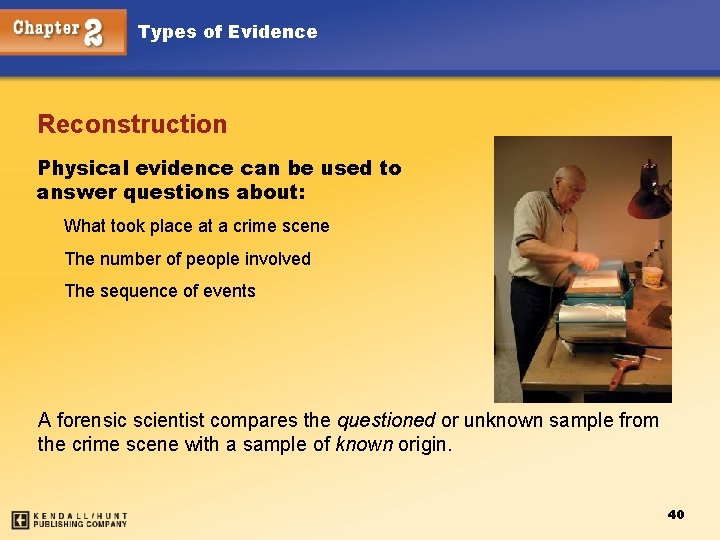
Types of Evidence Reconstruction Physical evidence can be used to answer questions about: What took place at a crime scene The number of people involved The sequence of events A forensic scientist compares the questioned or unknown sample from the crime scene with a sample of known origin. 40
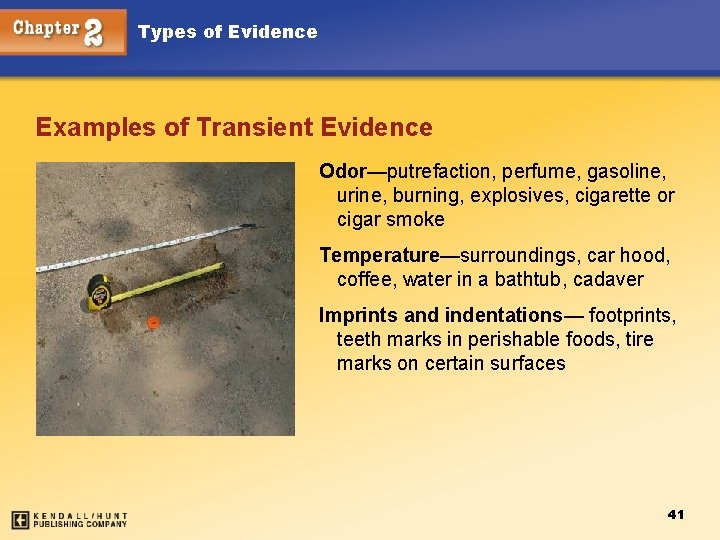
Types of Evidence Examples of Transient Evidence Odor—putrefaction, perfume, gasoline, urine, burning, explosives, cigarette or cigar smoke Temperature—surroundings, car hood, coffee, water in a bathtub, cadaver Imprints and indentations— footprints, teeth marks in perishable foods, tire marks on certain surfaces 41
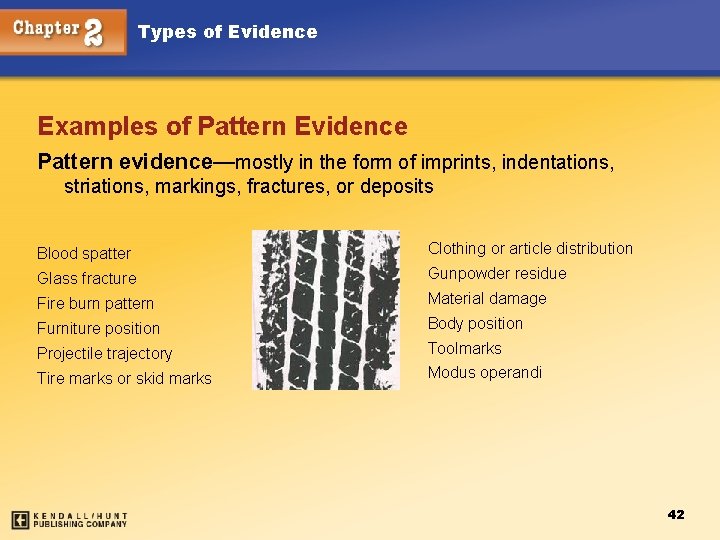
Types of Evidence Examples of Pattern Evidence Pattern evidence—mostly in the form of imprints, indentations, striations, markings, fractures, or deposits Blood spatter Clothing or article distribution Glass fracture Gunpowder residue Fire burn pattern Material damage Furniture position Body position Projectile trajectory Toolmarks Tire marks or skid marks Modus operandi 42
Types of Evidence Examples of Conditional Evidence Light—headlight, lighting conditions, lights on or off Smoke—color, direction of travel, density, odor Fire—color and direction of the flames, speed of spread, temperature and condition of fire Location—of injuries or wounds, of bloodstains, of the victim’s vehicle, of weapons or cartridge cases, of broken glass Vehicles—doors locked or unlocked, windows opened or closed, radio off or on, odometer mileage Body—position and types of wounds; rigor, livor, and algor mortis Scene—condition of furniture, doors and windows, any disturbance or signs of a struggle 43
Types of Evidence Classification of Evidence by Nature Biological—blood, semen, saliva, sweat, tears, hair, bone, tissues, urine, feces, animal material, insects, bacteria, fungi, botanical material Chemical—fibers, glass, soil, gunpowder, metals, minerals, narcotics, drugs, paper, ink, cosmetics, paint, plastic, lubricants, fertilizer Physical—fingerprints, footprints, shoeprints, handwriting, firearms, tire marks, toolmarks, typewriting Miscellaneous—laundry marks, voice analysis, polygraph, photography, stress evaluation, psycholinguistic analysis, vehicle identification 44
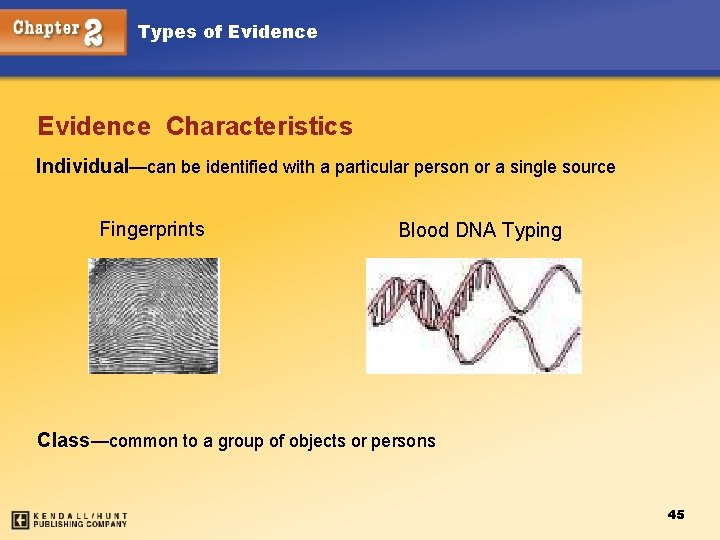
Types of Evidence Characteristics Individual—can be identified with a particular person or a single source Fingerprints Blood DNA Typing Class—common to a group of objects or persons 45
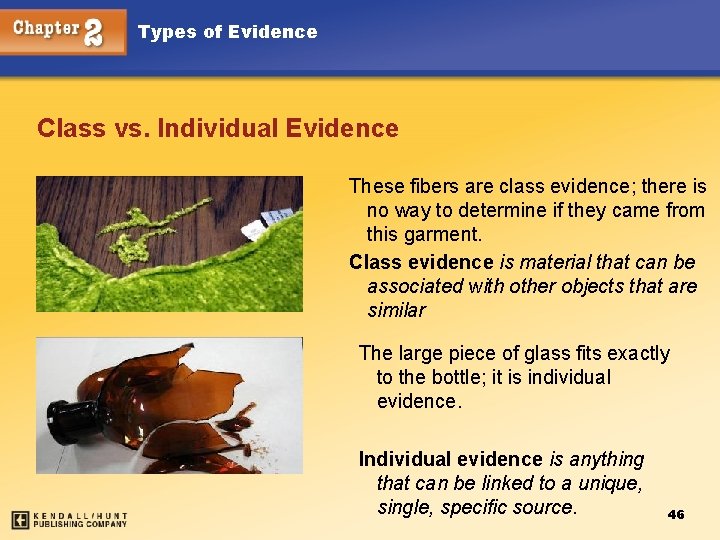
Types of Evidence Class vs. Individual Evidence These fibers are class evidence; there is no way to determine if they came from this garment. Class evidence is material that can be associated with other objects that are similar The large piece of glass fits exactly to the bottle; it is individual evidence. Individual evidence is anything that can be linked to a unique, single, specific source. 46
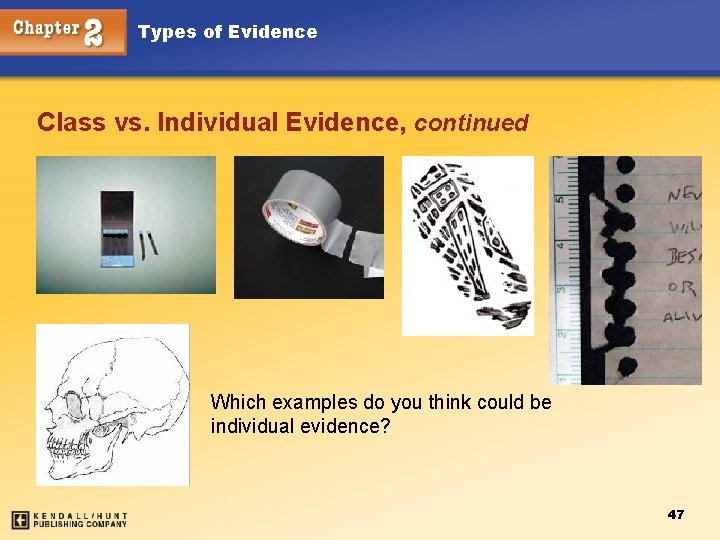
Types of Evidence Class vs. Individual Evidence, continued Which examples do you think could be individual evidence? 47
Types of Evidence Class Practice 4 Turn to pages 46 -47. Answer questions 1 - 11. 48
Types of Evidence Introduction to Crime Scene 4 www. scilinks. org Type in the code: forensics 2 E 37. 4 Click on the FIRST link titled “BC News – Crime scene forensics: How does it work? ” 4 Summarize the description for each scene. 49
Types of Evidence FBI Investigation Read a case investigated by the FBI. Observe the various units of their lab and read the section: “How Did They Do That? ” www. fbi. gov/kids/6 th 12 th/investigates. htm 50
Types of Evidence Forensic Investigations Include some or all of these seven major activities: 1. Recognition—the ability to distinguish important evidence from unrelated material Pattern recognition Physical property observation Information analysis Field testing 2. Preservation through the collection and proper packaging of evidence 51
Types of Evidence Forensic Investigations, continued 3. Identification using scientific testing Physical properties Chemical properties Morphological (structural) properties Biological properties Immunological properties 4. Comparison of class characteristics measured against those of known standards or controls; if all measurements are equal, then the two samples may be considered to have come from the same source or origin 52
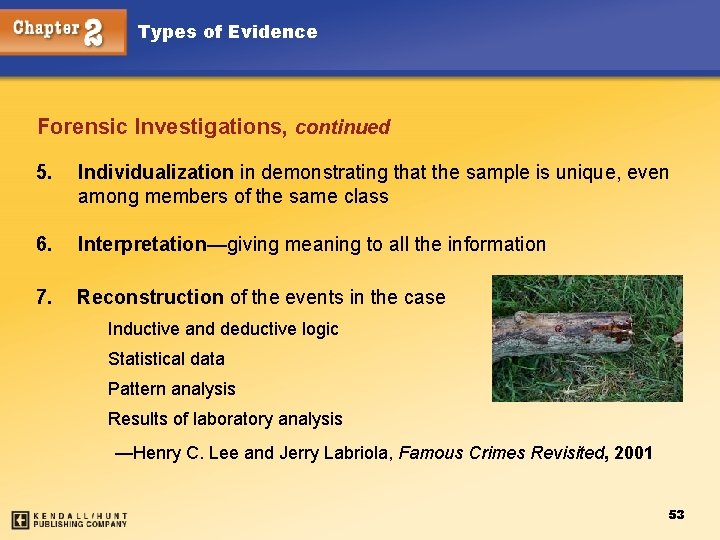
Types of Evidence Forensic Investigations, continued 5. Individualization in demonstrating that the sample is unique, even among members of the same class 6. Interpretation—giving meaning to all the information 7. Reconstruction of the events in the case Inductive and deductive logic Statistical data Pattern analysis Results of laboratory analysis —Henry C. Lee and Jerry Labriola, Famous Crimes Revisited, 2001 53
- Slides: 53