
Types of evaluation Controlled settings involving users eg





- Slides: 12
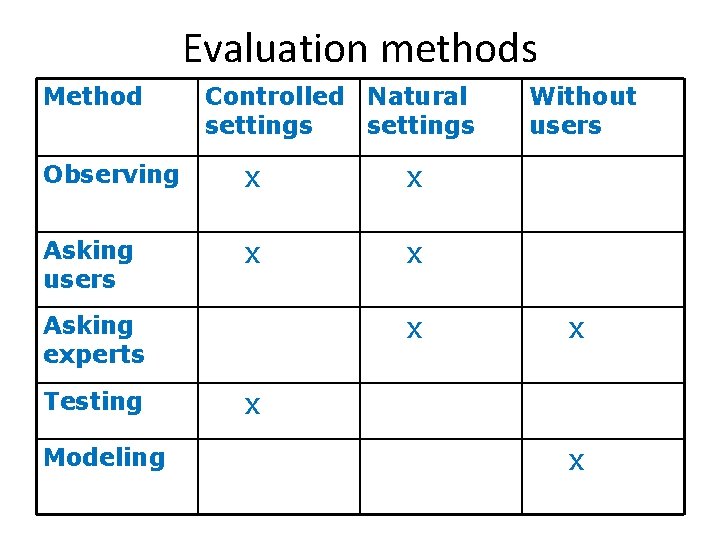
Types of evaluation • Controlled settings involving users, eg usability testing & experiments in laboratories and living labs. • Natural settings involving users, eg field studies to see how the product is used in the real world. • Any settings not involving users, eg consultants critique; to predict, analyze & model aspects of the interface analytics.
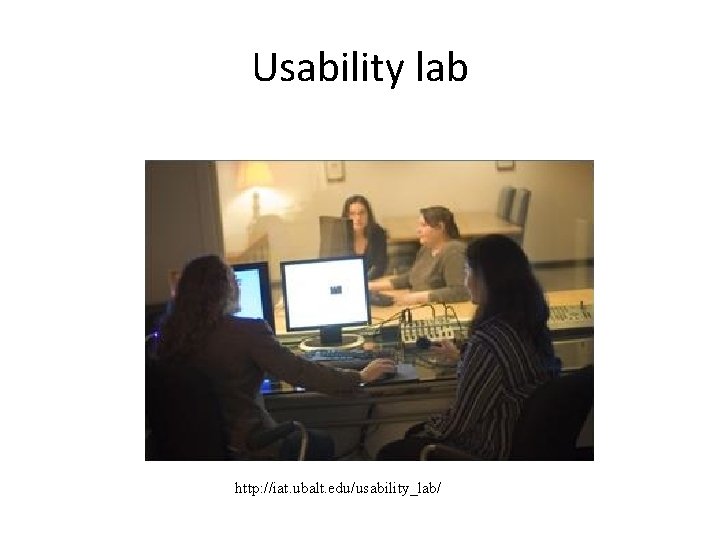
Usability lab http: //iat. ubalt. edu/usability_lab/
Living labs • People’s use of technology in their everyday lives can be evaluated in living labs. • Such evaluations are too difficult to do in a usability lab. • Eg the Aware Home was embedded with a complex network of sensors and audio/video recording devices (Abowd et al. , 2000).
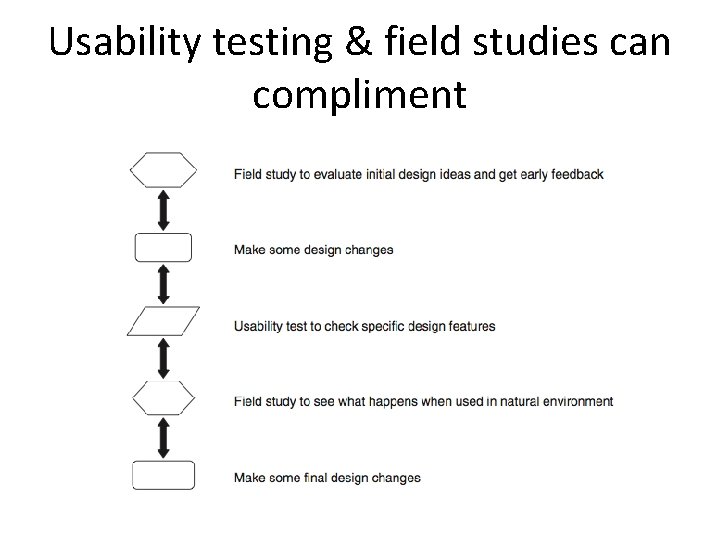
Usability testing & field studies can compliment
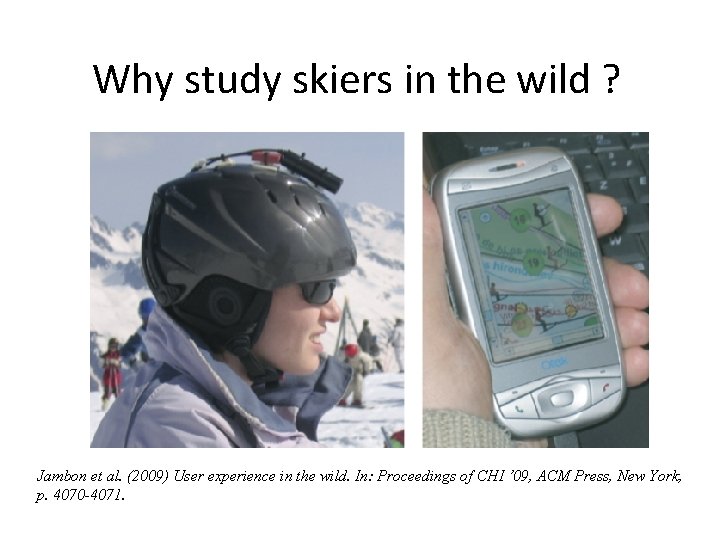
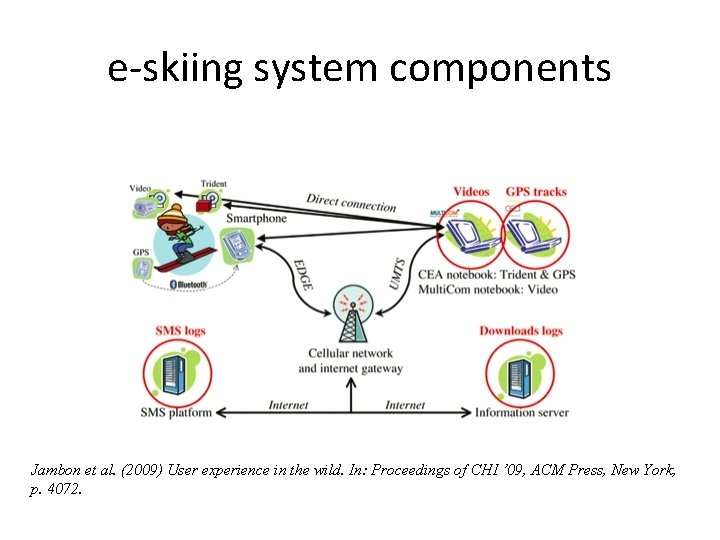
Evaluation case studies • Experiment to investigate a computer game • In the wild field study of skiers
Challenge & engagement in a collaborative immersive game • Physiological measures were used. • Players were more engaged when playing against another person than when playing against a computer. • What precautionary measures did the evaluators take?
What does this data tell you?
Why study skiers in the wild ? Jambon et al. (2009) User experience in the wild. In: Proceedings of CHI ’ 09, ACM Press, New York, p. 4070 -4071.
e-skiing system components Jambon et al. (2009) User experience in the wild. In: Proceedings of CHI ’ 09, ACM Press, New York, p. 4072.
Evaluating an ambient system • The Hello Wall is a new kind of system that is designed to explore how people react to its presence. • What are the challenges of evaluating systems like this?
Evaluation methods Method Controlled Natural settings Observing x x Asking users x x x Asking experts Testing Modeling Without users x x x