
Types of Data Types of data Categorical data


- Slides: 21
Types of Data
Types of data • Categorical data • Measurement data
Categorical Data • The objects being studied are grouped into categories based on some qualitative trait. • The resulting data are merely labels or categories.
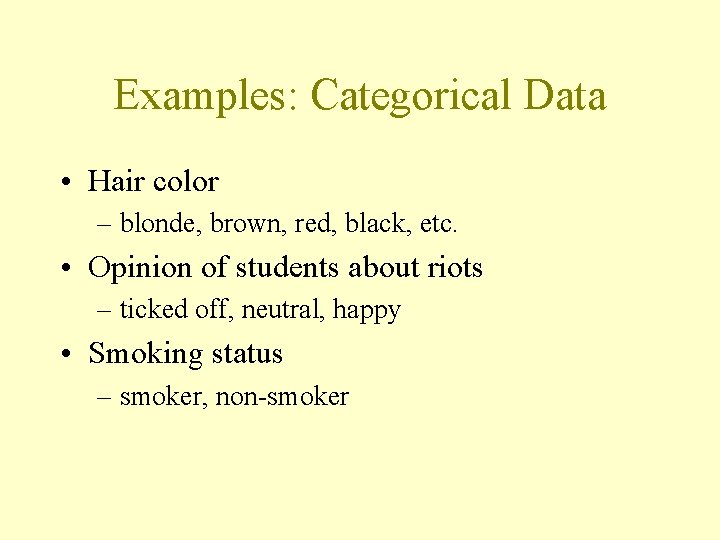
Examples: Categorical Data • Hair color – blonde, brown, red, black, etc. • Opinion of students about riots – ticked off, neutral, happy • Smoking status – smoker, non-smoker
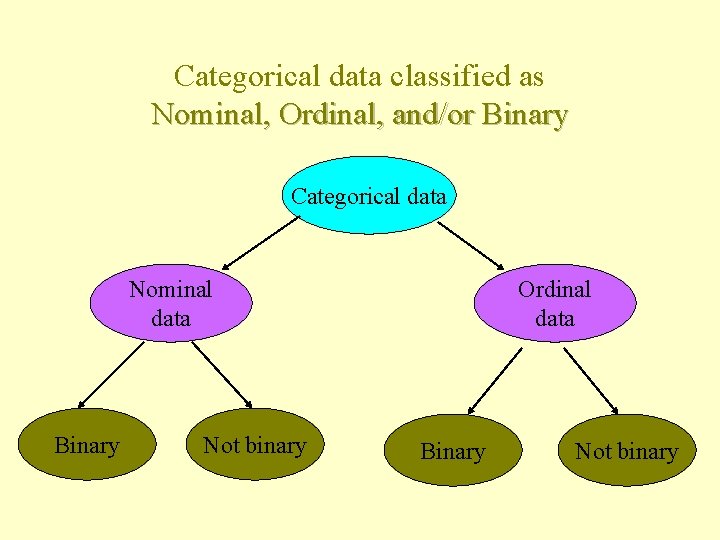
Categorical data classified as Nominal, Ordinal, and/or Binary Categorical data Nominal data Binary Not binary Ordinal data Binary Not binary
Nominal Data • A type of categorical data in which objects fall into unordered categories.
Examples: Nominal Data • Hair color – blonde, brown, red, black, etc. • Race – Caucasian, African-American, Asian, etc. • Smoking status – smoker, non-smoker
Ordinal Data • A type of categorical data in which order is important.
Examples: Ordinal Data • Class – fresh, sophomore, junior, senior, super senior • Degree of illness – none, mild, moderate, severe, …, going, gone • Opinion of students about riots – ticked off, neutral, happy
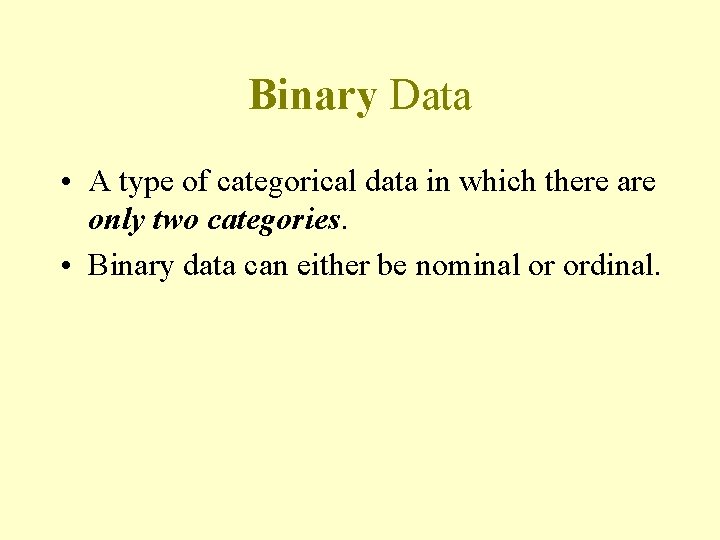
Binary Data • A type of categorical data in which there are only two categories. • Binary data can either be nominal or ordinal.
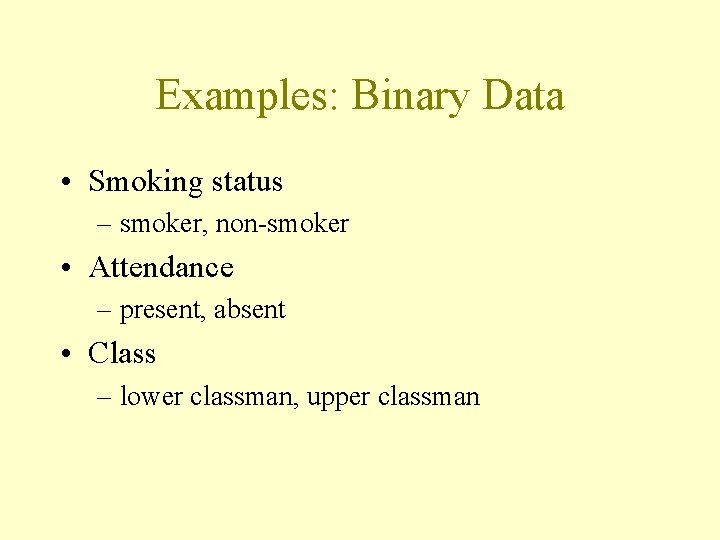
Examples: Binary Data • Smoking status – smoker, non-smoker • Attendance – present, absent • Class – lower classman, upper classman
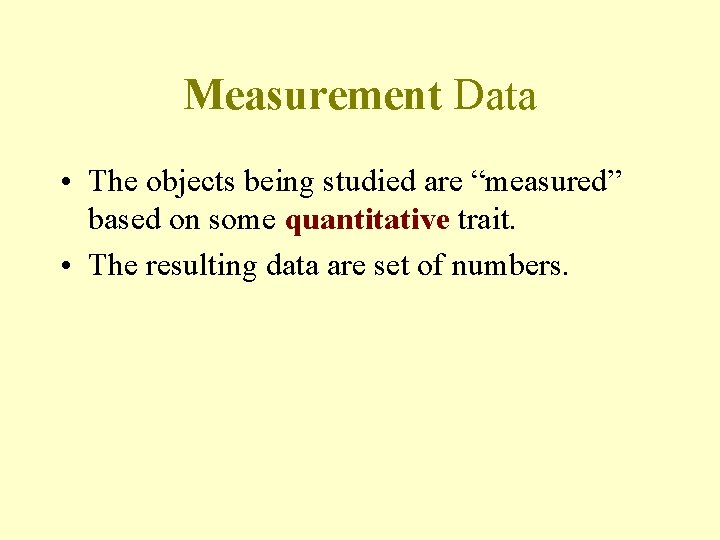
Measurement Data • The objects being studied are “measured” based on some quantitative trait. • The resulting data are set of numbers.
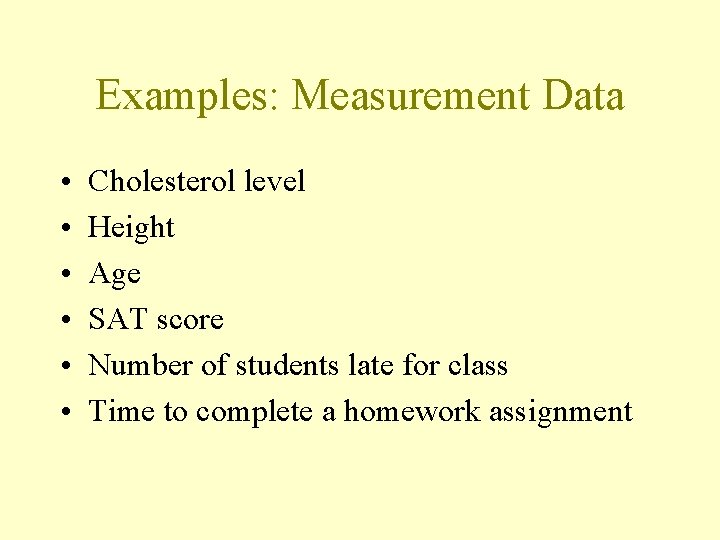
Examples: Measurement Data • • • Cholesterol level Height Age SAT score Number of students late for class Time to complete a homework assignment
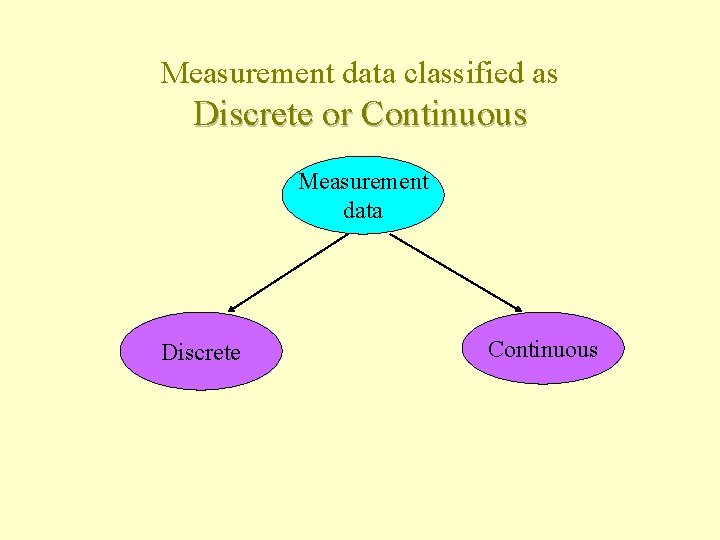
Measurement data classified as Discrete or Continuous Measurement data Discrete Continuous
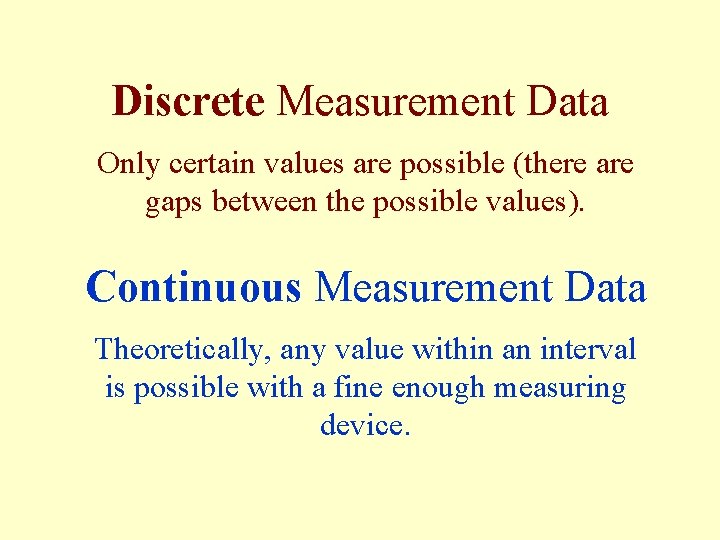
Discrete Measurement Data Only certain values are possible (there are gaps between the possible values). Continuous Measurement Data Theoretically, any value within an interval is possible with a fine enough measuring device.
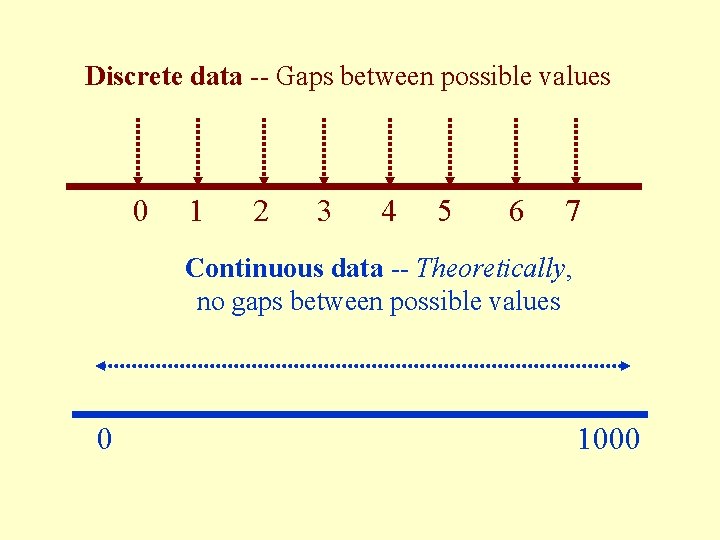
Discrete data -- Gaps between possible values 0 1 2 3 4 5 6 7 Continuous data -- Theoretically, no gaps between possible values 0 1000
Examples: Discrete Measurement Data • • SAT scores Number of students late for class Number of crimes reported to SC police Number of times the word number is used Generally, discrete data are counts.
Examples: Continuous Measurement Data • • Cholesterol level Height Age Time to complete a homework assignment Generally, continuous data come from measurements.
Who Cares? The type(s) of data collected in a study determine the type of statistical analysis used.
For example. . . • Categorical data are commonly summarized using “percentages” (or “proportions”). – 11% of students have a tattoo – 2%, 33%, 39%, and 26% of the students in class are, respectively, freshmen, sophomores, juniors, and seniors
And for example … • Measurement data are typically summarized using “averages” (or “means”). – Average number of siblings Fall 1998 Stat 250 students have is 1. 9. – Average weight of male Fall 1998 Stat 250 students is 173 pounds. – Average weight of female Fall 1998 Stat 250 students is 138 pounds.