
Types of Culture General classification of the culture
- Slides: 16
Types of Culture
• General classification of the culture which can be as following: • Popular Culture • High or Elite Culture • Low Culture or sub culture • Primary & Secondary Culture • Folk Culture • Co-Culture
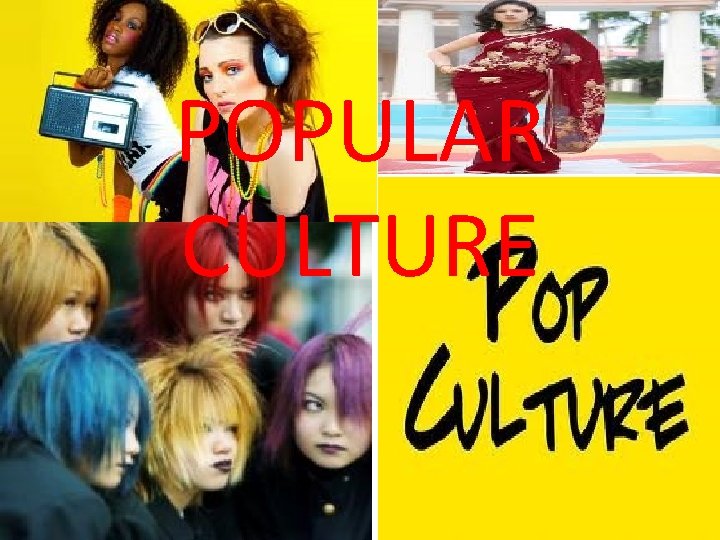
Popular culture • Popular culture is the entirety of ideas, perspective, attitudes, memes(an element of a culture or system of behaviour passed from one individual to another by imitation or other non-genetic means), images and other phenomena that are preferred by an informal consensus within the mainstream of a given culture, especially Western Culture of the early to mid 20 th century. • It then includes the emerging global mainstream of the late 20 th and early 21 st century. Heavily influenced by mass media, this collection of ideas pervades the everyday lives of the society.
POPULAR CULTURE
• Styles of dress, the use of slang, greeting rituals and the foods that people eat are all examples of popular culture. • Sports are played and watched by members of all social classes, but the masses are responsible for the huge popularity of sports. Some sporting events, such as the World Cup and the Olympics, are consumed by a world community.
Idea of Popular culture • The idea of popular culture only came about in the second half of the nineteenth century and for the first fifty years or so was viewed very negatively by those who dared to acknowledge its existence. • Popular music, popular Sports & leisure, popular literature, popular art are all part of popular culture. Popular culture is impersonal. • The audience for popular culture is usually quite large, hence the label 'popular', and therefore, due to the number of people it aims to please, it can not draw from the traditions of a small group. • It must draw from a greater consciousness.
Popular culture and media • Popular culture has, in this century, been quite innovative in its use of media, particularly media which can communicate to a large number of people at once: the radio, film, television, the Internet. • Finally, despite the association of popular with mass markets, many creators of popular culture are in their business simply because they love to create (though there a sizeable number in it for the money). • In short: • POPULAR CULTURE IS WHATEVER IS WIDELY POPULAR • POPULAR CULTURE IS MASS COMMERCIAL CULTURE • POPULAR CULTURE IS CREATED BY THE PEOPLE
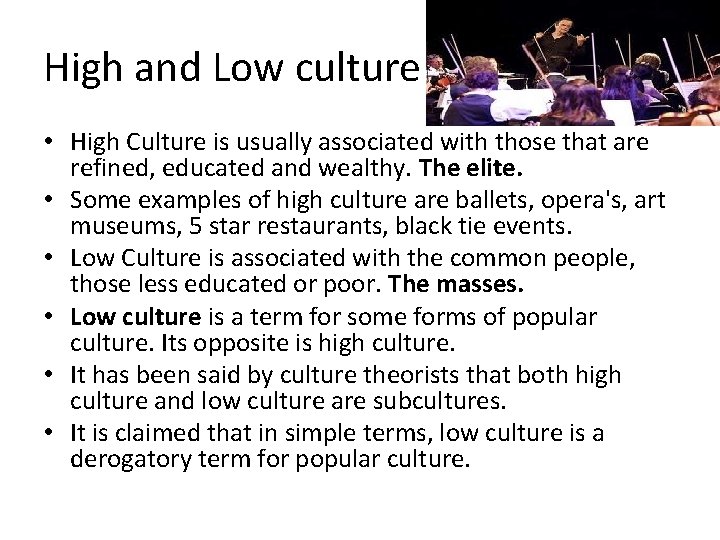
High and Low culture • High Culture is usually associated with those that are refined, educated and wealthy. The elite. • Some examples of high culture are ballets, opera's, art museums, 5 star restaurants, black tie events. • Low Culture is associated with the common people, those less educated or poor. The masses. • Low culture is a term for some forms of popular culture. Its opposite is high culture. • It has been said by culture theorists that both high culture and low culture are subcultures. • It is claimed that in simple terms, low culture is a derogatory term for popular culture.
• We recognize high and low culture; • Where the following fit: rap music, classical music, bars, symphonies, SUVs, cats, dogs, etc. • How many of those are instantly associated with high culture? Low culture? Some things may not be clear cut, and some would argue that the lines are blurring, but we tend to know what a status symbol is.
• Let’s talk about jazz. Is jazz high or low culture? Some would say high culture. • Jazz began as the music of the street, a prime African-American form of expression. It was low, very low culture. • Classical music was high culture, had been for centuries. Which form of music was approved by the white community of the time, was high culture.
Primary and Secondary Culture • Primary Culture: It is the main culture being followed by any individual or any group. • Secondary Culture: It can be defined as the other culture being followed by any individual or group along with Primary culture. It is always on second priority. It may or may not be followed simultaneously with the main culture.
FOLK CULTURE • Folk Culture - The creations of folk culture are communal and anticipated. They are communal because the creator and their audience belong to the same small societal division - the social distance between them is negligible. • They are anticipated because the creator draws from the traditional knowledge and the everyday experience of their societal group. Michael Bell has described folk culture as "personal".
• Those who create folk culture work with and within the true patterns of experience, and those who are its audience expect that their experiences will reflect the conventions of what has gone before and served them well in the past.
• Folk culture, accordingly, is a culture of continuity, governed by traditions and the expectation that the experience of daily life, lived as most people do most of the time, will continue largely as it has gone before.
• Like high culture, folk culture audiences are small, limited to the group in which the folk creation is made. • Folk culture of course consists of folk music, folk art, folktales, folkdance, folk costumes, but also localised jokes, oral literature and history, home remedies, old wives' tales, and superstitions, among others.
• Co-Culture: The term co-culture has been created which suggest to convey the idea that no one culture is superior to our co-existing culture. As earlier it was a popular idea that sub-culture is an inferior culture. To overcome this idea Co-culture terms was coined.