
Types of Criticism AIM understanding the critical filters




- Slides: 19
Types of Criticism AIM: understanding the critical filters we can apply to view a text through
What is the point of schools of criticsim? • • • Eco-criticism Post-colonial criticism Feminist criticism Moral criticism Humanist criticism Aesthetic criticism
• Aspects of patriarchy in modern culture, or modern patriarchal apparatuses/ systems:
capitalism • a highly competitive system in which risktaking and aggressive competitiveness are favoured above a more co-operative MO (these tend to be male traits, and so men continue to dominate the board-room). Board -room cameraderie is also a very male sphere; men are already in charge, and they continue to favour people "like them" for promotions above women of equal capability. (25% female CEOs in modern business).
employment • look at astronauts. NASA devised a list of qualities desirable in their cosmonauts, and these were universally more likely to be found in women than in men. YET this is a maledominated sphere! (this proves the feminist case of oppression)
Marriage • formalities such as dowries (now ameliorated to the wife's parents paying for the wedding), asking permission, the male doing the proposing (having asked daddy if it's ok)
The family • the atomic family of men and women polarised: bread-winner and home-maker. • Ruskin (further reading) film: Effie Grey
Sex • Men being the dominant. . . women being "receptive". • Men having the freedom to use condoms, and women having no control over birth control until the 60's. • Women being the ones expected to have implants and hormonal treatments. • “Player” vs “slut” ideologies.
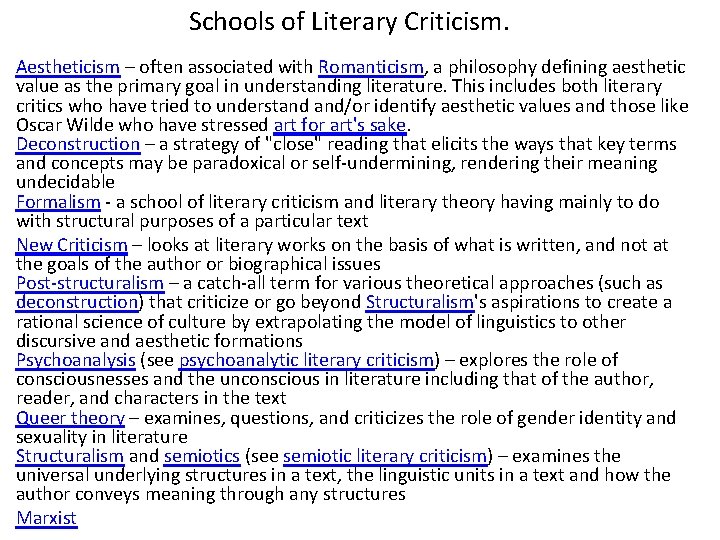
Schools of Literary Criticism. Aestheticism – often associated with Romanticism, a philosophy defining aesthetic value as the primary goal in understanding literature. This includes both literary critics who have tried to understand and/or identify aesthetic values and those like Oscar Wilde who have stressed art for art's sake. Deconstruction – a strategy of "close" reading that elicits the ways that key terms and concepts may be paradoxical or self-undermining, rendering their meaning undecidable Formalism - a school of literary criticism and literary theory having mainly to do with structural purposes of a particular text New Criticism – looks at literary works on the basis of what is written, and not at the goals of the author or biographical issues Post-structuralism – a catch-all term for various theoretical approaches (such as deconstruction) that criticize or go beyond Structuralism's aspirations to create a rational science of culture by extrapolating the model of linguistics to other discursive and aesthetic formations Psychoanalysis (see psychoanalytic literary criticism) – explores the role of consciousnesses and the unconscious in literature including that of the author, reader, and characters in the text Queer theory – examines, questions, and criticizes the role of gender identity and sexuality in literature Structuralism and semiotics (see semiotic literary criticism) – examines the universal underlying structures in a text, the linguistic units in a text and how the author conveys meaning through any structures Marxist
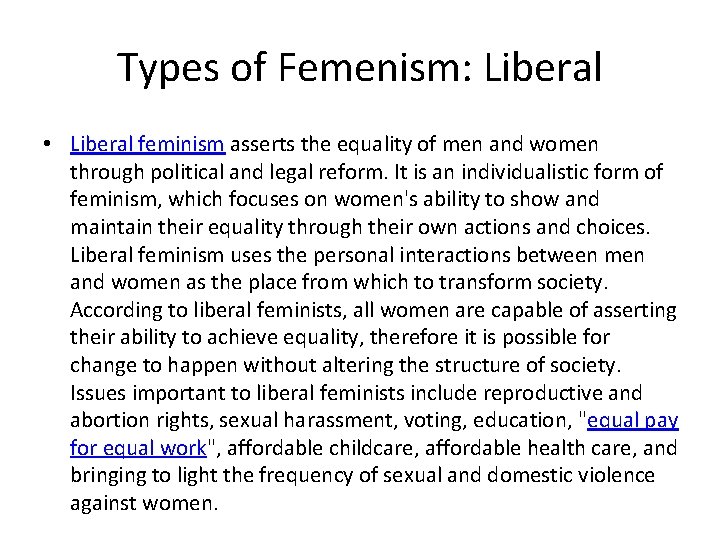
Types of Femenism: Liberal • Liberal feminism asserts the equality of men and women through political and legal reform. It is an individualistic form of feminism, which focuses on women's ability to show and maintain their equality through their own actions and choices. Liberal feminism uses the personal interactions between men and women as the place from which to transform society. According to liberal feminists, all women are capable of asserting their ability to achieve equality, therefore it is possible for change to happen without altering the structure of society. Issues important to liberal feminists include reproductive and abortion rights, sexual harassment, voting, education, "equal pay for equal work", affordable childcare, affordable health care, and bringing to light the frequency of sexual and domestic violence against women.
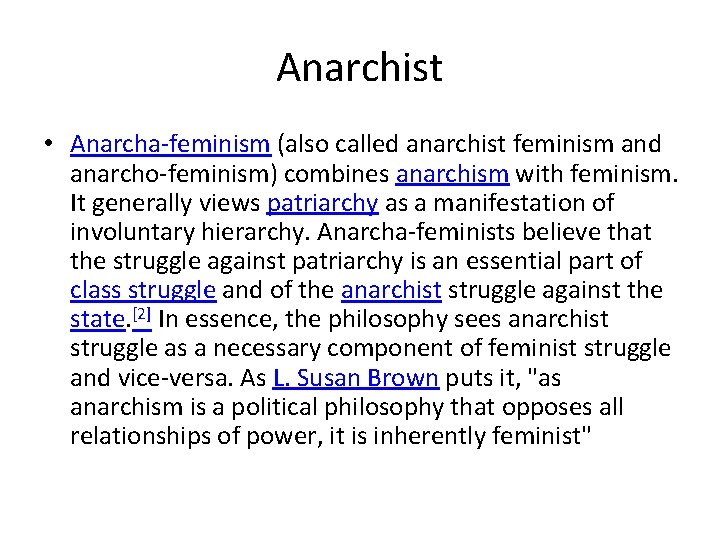
Anarchist • Anarcha-feminism (also called anarchist feminism and anarcho-feminism) combines anarchism with feminism. It generally views patriarchy as a manifestation of involuntary hierarchy. Anarcha-feminists believe that the struggle against patriarchy is an essential part of class struggle and of the anarchist struggle against the state. [2] In essence, the philosophy sees anarchist struggle as a necessary component of feminist struggle and vice-versa. As L. Susan Brown puts it, "as anarchism is a political philosophy that opposes all relationships of power, it is inherently feminist"
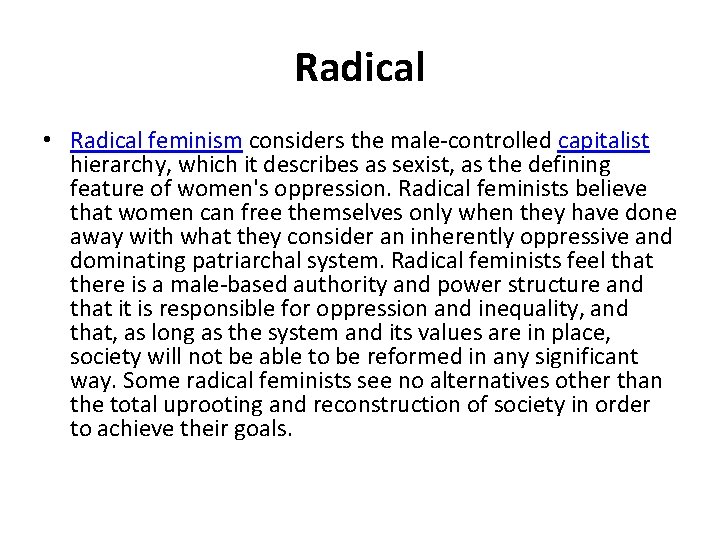
Radical • Radical feminism considers the male-controlled capitalist hierarchy, which it describes as sexist, as the defining feature of women's oppression. Radical feminists believe that women can free themselves only when they have done away with what they consider an inherently oppressive and dominating patriarchal system. Radical feminists feel that there is a male-based authority and power structure and that it is responsible for oppression and inequality, and that, as long as the system and its values are in place, society will not be able to be reformed in any significant way. Some radical feminists see no alternatives other than the total uprooting and reconstruction of society in order to achieve their goals.
Cultural • Cultural feminism is the ideology of a "female nature" or "female essence" that attempts to revalidate what they consider undervalued female attributes. [17] It emphasizes the difference between women and men but considers that difference to be psychological, and to be culturally constructed rather than biologically innate. [18] Its critics assert that, because it is based on an essentialist view of the differences between women and advocates independence and institution building, it has led feminists to retreat from politics to "life-style". [19] One such critic, Alice Echols (a feminist historian and cultural theorist), credits Redstockings member Brooke Williams with introducing the term cultural feminism in 1975 to describe the depoliticisation of radical feminism.
Separatist and lesbian • Separatist feminism is a form of radical feminism that does not support heterosexual relationships. Lesbian feminism is thus closely related. Separatist feminism's proponents argue that the sexual disparities between men and women are unresolvable. Separatist feminists generally do not feel that men can make positive contributions to the feminist movement and that even well-intentioned men replicate patriarchal dynamics. [20] Author Marilyn Frye describes separatist feminism as "separation of various sorts or modes from men and from institutions, relationships, roles and activities that are male-defined, male-dominated, and operating for the benefit of males and the maintenance of male privilege—this separation being initiated or maintained, at will, by women"
Marxism • Marxism aims to revolutionize the concept of work through creating a classless society built on control and ownership of the means of production. Marx believed that Economic Determinism, Dialectical Materialism and Class Struggle were three principles that explained his theories. The Bourgeois (Dominant class who control and own the means of production) and Proletariat (Subordinate class: Don’t own and control the means of production) were the only two classes who engaged in hostile interaction to achieve class consciousness. Marx believed that all past history is a struggle between hostile and competing economic classes in state of change.