
TYPES OF CONJUNCTIVITIS PRESENTED BY Dr Vijay Kumar

TYPES OF CONJUNCTIVITIS PRESENTED BY: Dr. Vijay Kumar Singh Career Medical College
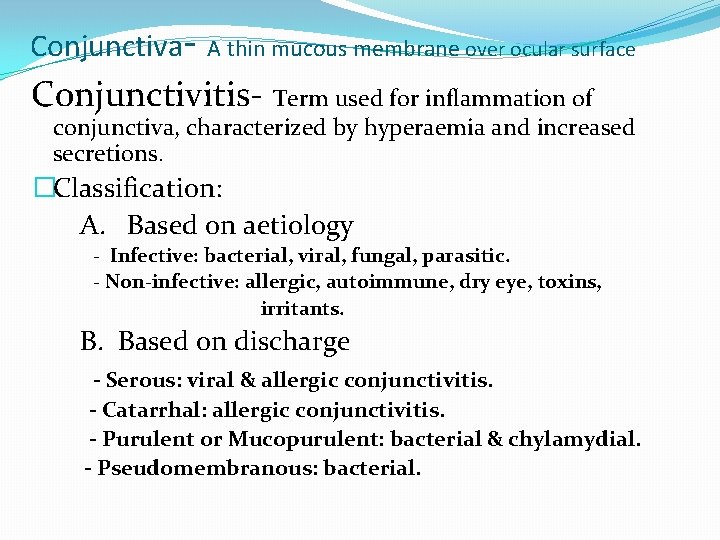
Conjunctiva- A thin mucous membrane over ocular surface Conjunctivitis- Term used for inflammation of conjunctiva, characterized by hyperaemia and increased secretions. �Classification: A. Based on aetiology - Infective: bacterial, viral, fungal, parasitic. - Non-infective: allergic, autoimmune, dry eye, toxins, irritants. B. Based on discharge - Serous: viral & allergic conjunctivitis. - Catarrhal: allergic conjunctivitis. - Purulent or Mucopurulent: bacterial & chylamydial. - Pseudomembranous: bacterial.
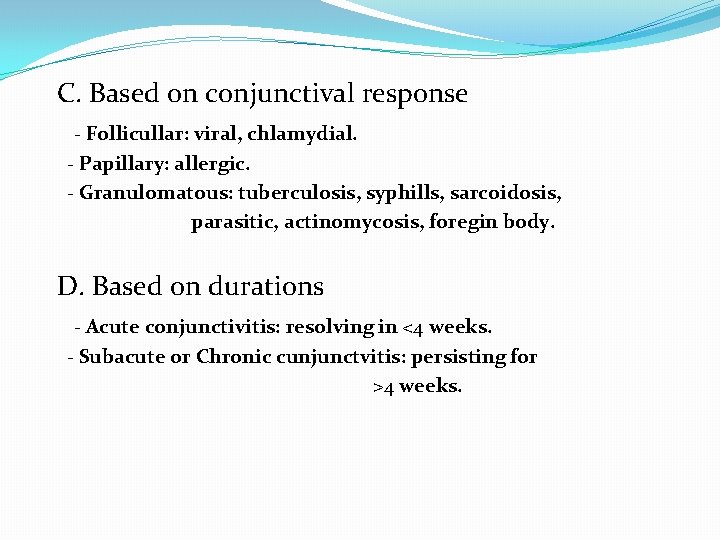
C. Based on conjunctival response - Follicullar: viral, chlamydial. - Papillary: allergic. - Granulomatous: tuberculosis, syphills, sarcoidosis, parasitic, actinomycosis, foregin body. D. Based on durations - Acute conjunctivitis: resolving in <4 weeks. - Subacute or Chronic cunjunctvitis: persisting for >4 weeks.

Bacterial conjunctivitis � These are types of infective conjunctivitis caused becausae of bacterial infections. � Common predispossing factors: ~ flies, hot dry climate, poor sanitation & poor hygine. � Mode of infection: - Exogenous: contamined water, air, hand, towels. - Endogenous: through blood. - Local spread: from srrounding structures such as lacrimal sac & lids. � Various clinical types: - Acute mucopurulent conjunctivitis - Acute membranous or pseudomembranous conjunctivitis - Chronic bacterial conjunctivitis - Chronic angular conjunctivitis
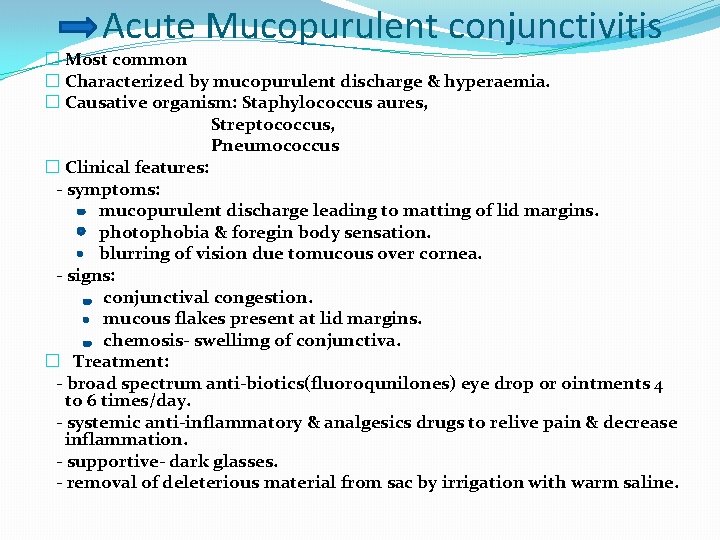
Acute Mucopurulent conjunctivitis � Most common � Characterized by mucopurulent discharge & hyperaemia. � Causative organism: Staphylococcus aures, Streptococcus, Pneumococcus � Clinical features: - symptoms: mucopurulent discharge leading to matting of lid margins. photophobia & foregin body sensation. blurring of vision due tomucous over cornea. - signs: conjunctival congestion. mucous flakes present at lid margins. chemosis- swellimg of conjunctiva. � Treatment: - broad spectrum anti-biotics(fluoroqunilones) eye drop or ointments 4 to 6 times/day. - systemic anti-inflammatory & analgesics drugs to relive pain & decrease inflammation. - supportive- dark glasses. - removal of deleterious material from sac by irrigation with warm saline.
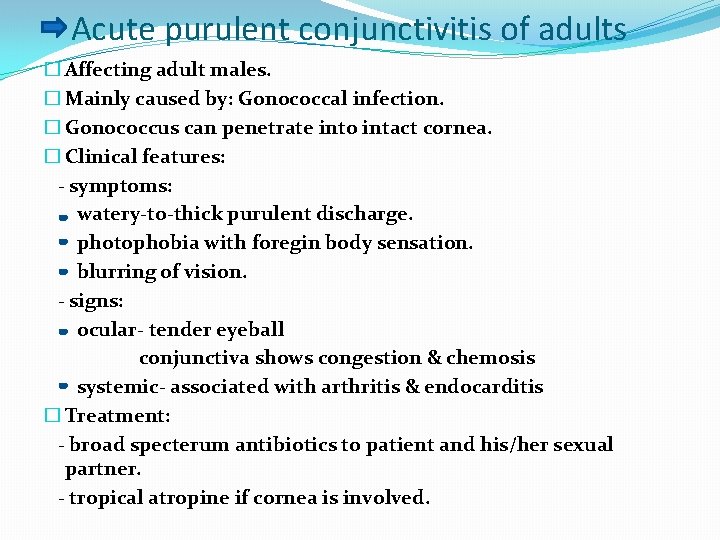
Acute purulent conjunctivitis of adults � Affecting adult males. � Mainly caused by: Gonococcal infection. � Gonococcus can penetrate into intact cornea. � Clinical features: - symptoms: watery-to-thick purulent discharge. photophobia with foregin body sensation. blurring of vision. - signs: ocular- tender eyeball conjunctiva shows congestion & chemosis systemic- associated with arthritis & endocarditis � Treatment: - broad specterum antibiotics to patient and his/her sexual partner. - tropical atropine if cornea is involved.
Opthalmia Neonatorum �Type of acute purulent conjunctivitis in new born. �Defined as bilateral conjunctival inflammation with mucoid, mucopurulent or purulent discharge from one or both eyes in infancy. �Sources of infection during at the time & after birth. �Causative agents: - birth to 2 days: - Gonococcus & chemical (silver nitrate). - 2 -5 days: - Staphylococcus aureus, Streptococcus. - 5 -7 days: - Herpes Simplex-II - after 7 days: - serotype D to K of Chlamydia Trachomatis

Acute Membrnous and pseudomembranous conjunctivitis � Characterized by membrane formations. � True membrane, it is Membranous. � False membrane (easily removed without bleeding & leaving behind intact epithelium of conjunctiva), it is Pseudomembranous. � Common causative agents: - Corynebacterium diptheriae - Streptococcus haemolyticus � Clinical features: - symptoms: discharge, pain & swelling of eyelids. - signs: lid tenderness, thick greenish yellow membrane over conjunctiva. � Treatment: - Penicillin eye dropd & broad spectrum antibiotics ointment at bed time. - isolation of patient & immunization against Diptheria. IM injection of Crystalline Penicillin can be given.
Chlamydial conjunctivitis �Chlamydia share features of both bacteria & viruses. like viruses, they obligate intracellular & filterable, but like bacteria they contain both DNA & RNA, multiply by binary fission & are sensitive to antibiotics. �Jones classification of chlamydial infections: - Class 1: Blinding trachoma (caused by C. trachomatis serotypes A, B, Ba & C), associated with secondary bacterial infections. - Class 2: Nonblinding trachoma, usually not associated with secondary becterial infections. - Class 3: Paratrachoma (oculogenital chlamydial disease).
Trachoma � Leading cause of preventable blindness in the world. � It is choronic keratoconjunctivitis (affecting both conjunctiva & cornea). � Charaterized by follicular & papillary reactions in conjunctiva. � Causative organism: Chlamydia trachomatis � Predisposing factors: - age: no age bar - sex: females - climate: dry & dusty weather - socioeconomic status: poor classes due to unhygienic living conditions. - environmental factors: exposure to dust, smoke, irritants, sunlight, etc. � Modeof infections: - conjunctival discharge of affected person is the most common source. - direct spread through air or water: vector transmission, material transfer through contaminated fingers, instruments, etc
� Clinical features: - symptoms: mild foregin body sensation, lacrimation scanty mucoid discharge, photophobia, blurring of vision. - signs: Conjunctival signs: ~ congestion seen in conjunctiva. ~ conjunctival follicles resembling bolied sago grains. ~ centre of the follicles contains mononuclear histocytes, lymphocytes & large nucleated cells(Leber cells). Leber cells, signs of necrosis and fibrosis in follicles &presence of follicles on bulbar conjunctiva are pathognomic features. Corneal signs: ~ superfical keratitis is seen. ~ corneal ulcer may be seen. ~ corneal opacity is seen.
Adult Inclusion Conjunctivitis �AKA swimming pool conjunctivitis �Caused by: serotype D to K ofchlamydia trachomatis. �The organism may be transferred from genitals by fingers or through contaminated swimming pool water. �Clinical features: - symptoms: mucopurulent discharge, photophobia, foregin body sensation, blurring of vision - signs: conjunctival hyperaemia, acute follicular hypertrophy with inclusion bodies �Treatment: - tropical: Tetracycline 1% & Azithromycin ointment - systemic: Tetracycline/ Erythromycin/ Doxycycline - patient’s sexual partner should be examined & treated. - improvement in personal hygiene & regular chlorination of swimming pool water are prophylaxis management.
Viral Conjunctivitis �Mostly caused by: - Adeno viruses - Herpes viruses - Poxviruses �The characteristic feature is the involvement of both conjunctiva & cornea. �Clinical presentations: - Acute serous conjunctivitis - Acute haemorrhagic conjunctivitis - Acute and chronic follicular conjunctivitis
Acute Heamorrhagic Cunjunctivitis �Commonly caused by Picornaviruses(enterovirus type 70) and coxsackievirus. �Clinical features: - symptoms: pain, redness, watering, mild photophobia, visual blurring, lid swelling - signs: conjunctival congestion, chemosis, multiple haemorrhages in bulbar conjunctiva, folicullar hyperplasia, lid oedema, epithelial keratitis �Treatment: - usually self-limiting but being contagious, there is high risk of cross-infection. - broad spetrum-spectrum antibiotic eye drops to prevent secondary bacterial infections.
Allergic Conjunctivitis �This counctival inflammation because of allergic or hypersensitivity reactions which may be immediate (humoural) or delayed (xellular). �It includes: - Simple allergic conjunctivitis - Vernal keratoconjunctivitis (VKC) - Atopic keratoconjunctivitis (AKC) - Giant papillary conjunctivitis (GPC) - Contact dermatoconjunctivitis (CDC)
Vernal Keratoconjunctivitis (VKC) or Spring Catarrh bilateral, recurrent, allergic conjunctivitis characterized by ropy discharge & intense itching. common in boys of 4 -20 years of age, summer seasons & tropics. It is found more in patients with family history of asthma, hay fever & other atopic diseases. � It is a type I hypersensitivity (Ig. E mediated) reactions to pollens. � Clinical features: - symptoms: marked burning & itching which is usually intolerable & increases in heat & humidity. Stringy (ropy) discharge, sticking of eyelids mild photophobia, lacrimation, heaviness of lids. - signs: conjunctival signs: congestions, gelatinous thickening of tissue around limbus and discrete white raised dots along limbus are seen. corneal signs: ulcerative vernal keratitis (shield ulcer) characterized by shallow transverse ulcer in upper part of cornea. subepithelial scarring or corneal opacity. � �
�Investigations: - conjunctival scraping shows marked eosinophils. - skin & serum testing is done for allergens. �Treatment: ~ local therapy: - tropical weak steroid for short periods. - mast cell stabilizers such as sodium cromoglycate(2%) & tropical antihistaminics. ~ systemic: - oral antihistamics in severe cases - oral steroids for short duration ~ treatment of vernal keratopathy: - large vernal plaque: surgical excision - severe shield ulcer resistant to conservative measure: debridement, superficial keratectomy, laser keratectomy, amniotic membrane transplant.
Contact Dermatoconjunctivitis �It is delayed hypersensitivity (type IV) response to prolonged contact with chemicals or drugs such as atropine, penicillin, neomycin or gentamicin. �Clinical features: - Cutaneous involvement: Eczematous reaction, involving areas of contact - Cunjunctival response: hyperaemia with generalized papillary response. �Treatment: - Discontinuation of causative agent - Topical steroids - Local steroid application on affected skin
Mucous membrane pemphigoid � It is a group of chronic autoimmune type 2(cytotoxic) hypersensetivity mucocutaneous blistering diseases. � Generally affecting women older than 50 years and of insidious onset with remissions and excerbations. � Clinical features : - fine subconjunctival fibrosis - necrosis - dry eye - trichiasis, chronic blepharitis and lid margin kretanization - corneal epithelial defects, infiltration, peripheral vascularization - systemic mucosal involvement & skin lesions � Treatment: - tropical treatment by artificial tears, steroids & antibiotics ointments. - systemic: ~ Dapsone ~ Antimetabolites ~ steroids ~ immunoglobulin therapy - contact lenses to protect cornea from trichiatic lashes & from dehydration.

Thank you
- Slides: 20