
Types of Conformity Internalisation Identification Compliance Types of



- Slides: 50
Types of Conformity: Internalisation Identification Compliance
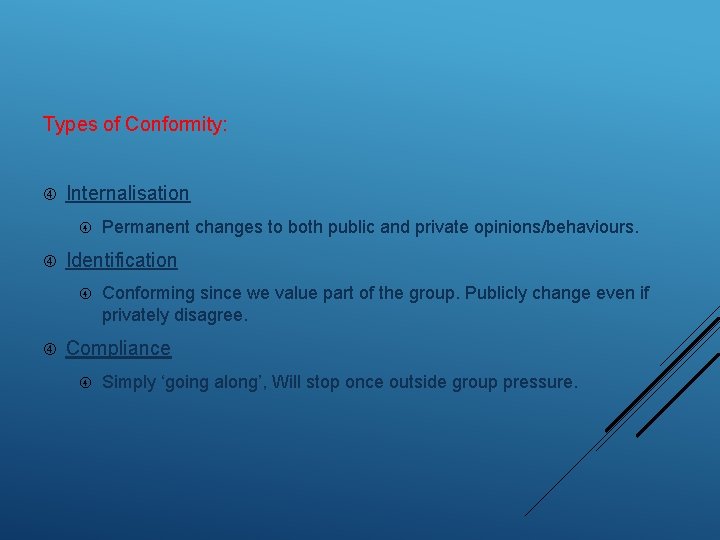
Types of Conformity: Internalisation Identification Permanent changes to both public and private opinions/behaviours. Conforming since we value part of the group. Publicly change even if privately disagree. Compliance Simply ‘going along’, Will stop once outside group pressure.
Explanations for Conformity Deutsch & Gerald two process model Informational Social Influence (ISI) Normative Social Influence (NSI)
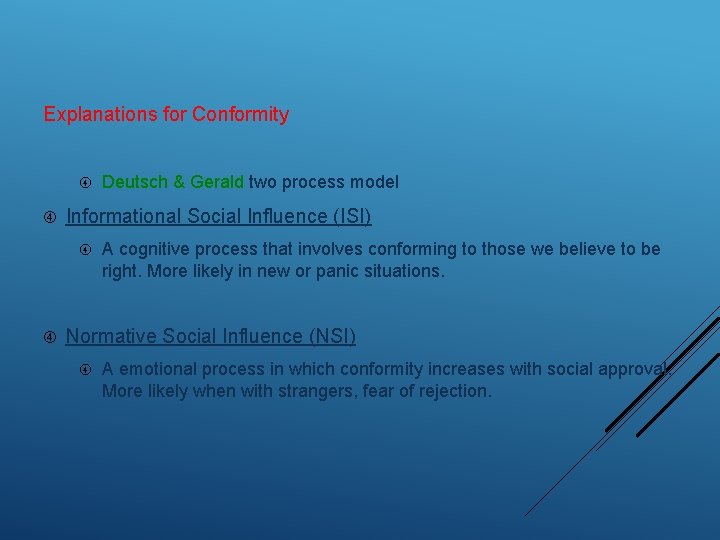
Explanations for Conformity Informational Social Influence (ISI) Deutsch & Gerald two process model A cognitive process that involves conforming to those we believe to be right. More likely in new or panic situations. Normative Social Influence (NSI) A emotional process in which conformity increases with social approval. More likely when with strangers, fear of rejection.
Evaluation Research Support Individual Differences in NSI ISI & NSI work together
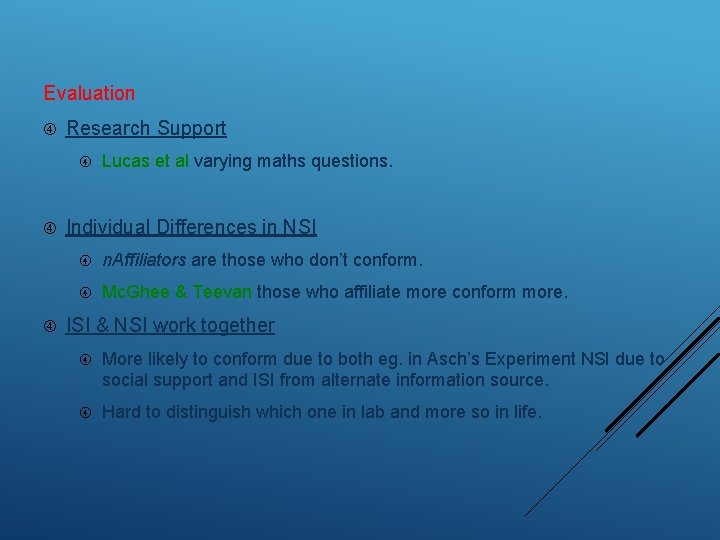
Evaluation Research Support Lucas et al varying maths questions. Individual Differences in NSI n. Affiliators are those who don’t conform. Mc. Ghee & Teevan those who affiliate more conform more. ISI & NSI work together More likely to conform due to both eg. in Asch’s Experiment NSI due to social support and ISI from alternate information source. Hard to distinguish which one in lab and more so in life.
Asch’s Research (1951, 1955) Procedure Findings Variations
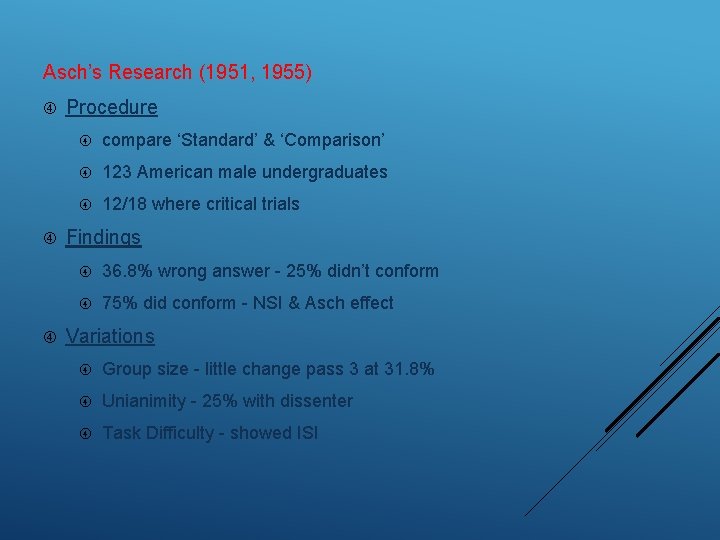
Asch’s Research (1951, 1955) Procedure compare ‘Standard’ & ‘Comparison’ 123 American male undergraduates 12/18 where critical trials Findings 36. 8% wrong answer - 25% didn’t conform 75% did conform - NSI & Asch effect Variations Group size - little change pass 3 at 31. 8% Unianimity - 25% with dissenter Task Difficulty - showed ISI
Evaluation Child of its time Artificial situation & task Limited application & finding
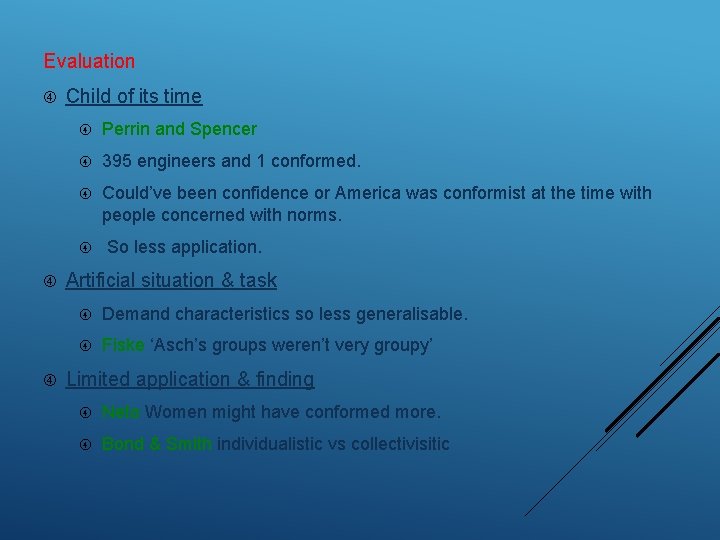
Evaluation Child of its time Perrin and Spencer 395 engineers and 1 conformed. Could’ve been confidence or America was conformist at the time with people concerned with norms. So less application. Artificial situation & task Demand characteristics so less generalisable. Fiske ‘Asch’s groups weren’t very groupy’ Limited application & finding Neto Women might have conformed more. Bond & Smith individualistic vs collectivisitic
Standford Prison Experiment (1971) Do people conform to social roles? Procedure Findings Conclusion
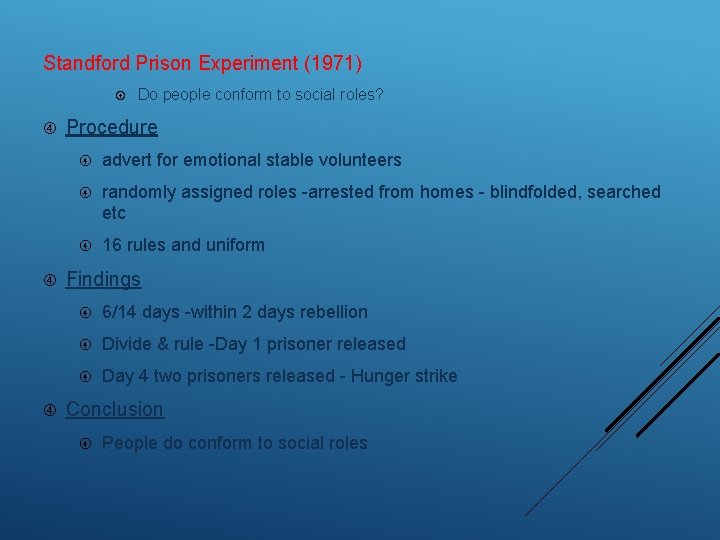
Standford Prison Experiment (1971) Do people conform to social roles? Procedure advert for emotional stable volunteers randomly assigned roles -arrested from homes - blindfolded, searched etc 16 rules and uniform Findings 6/14 days -within 2 days rebellion Divide & rule -Day 1 prisoner released Day 4 two prisoners released - Hunger strike Conclusion People do conform to social roles
Evaluation Control Lack of Realism Role of Dispositional Influences
Evaluation Control Lack of Realism random assignment rules out chance increasing internal validity. Banuazizi & Mohavedi participants acted stereotypically eg Cool Hand Luke and explains prisoners riot. However 90% of quantitative conversation show the prisoners thought it was real eg ‘ 416’. Role of Dispositional Influences Fromm minimisation of personality factors eg 1/3 brutal, 1/3 normal,
Milgram’s obedience study (1963) Inspired by behaviour of Germans Procedure Findings
Milgram’s obedience study (1963) Inspired by behaviour of Germans Procedure 40 males -Ad for memory study -paid $4. 50 -rigged draw -demo -300 V pounded etc Prod 1: Please continue. Prod 2: The experiment requires you to continue. Prod 3: It is absolutely essential that you continue. Prod 4: You have no other choice but to continue. Findings No-one stopped below 300 V 12. 5% stopped at 300 V 65% all the way 450 V Qualitative data included lip bitting, 3 seizures Before study 14 students believed only 3% would go all the way. During debrief 84% enjoyed it
Evaluation Low external validity Good external validity Supporting replication Ethical Issue
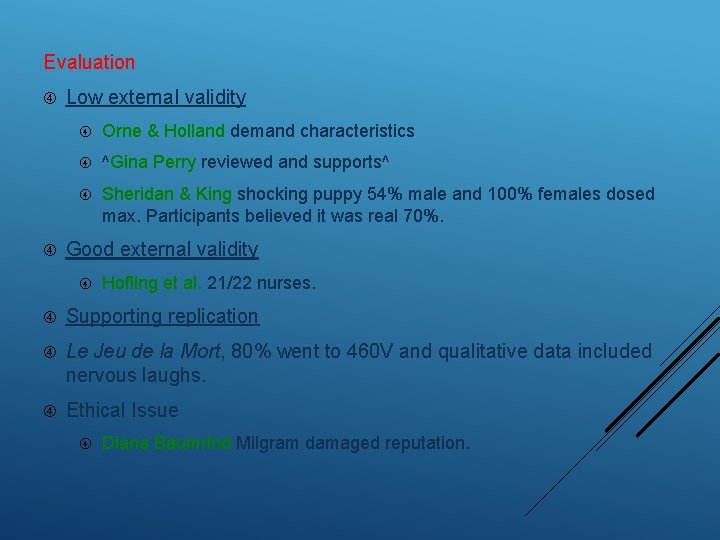
Evaluation Low external validity Orne & Holland demand characteristics ^Gina Perry reviewed and supports^ Sheridan & King shocking puppy 54% male and 100% females dosed max. Participants believed it was real 70%. Good external validity Hofling et al. 21/22 nurses. Supporting replication Le Jeu de la Mort, 80% went to 460 V and qualitative data included nervous laughs. Ethical Issue Diana Baumrind Milgram damaged reputation.
Situational variables Proximity; Location; Uniform;
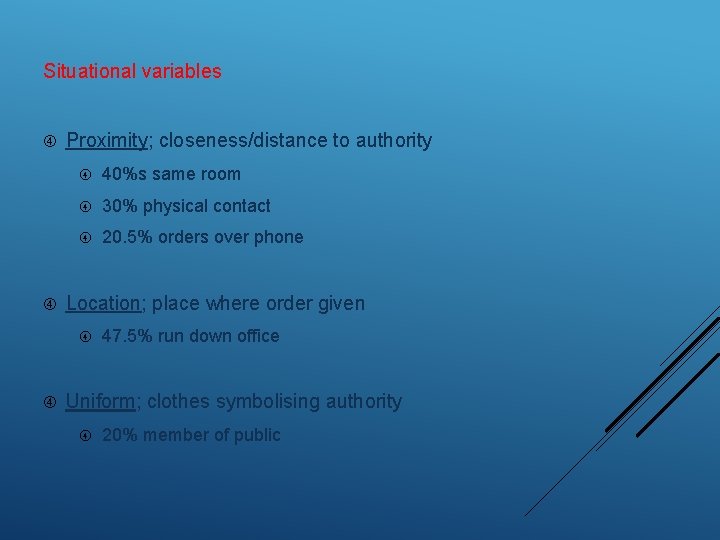
Situational variables Proximity; closeness/distance to authority 40%s same room 30% physical contact 20. 5% orders over phone Location; place where order given 47. 5% run down office Uniform; clothes symbolising authority 20% member of public
Evaluation Research Support Lack of internal validity Cross-cultural replication ‘Obedience Alibi’
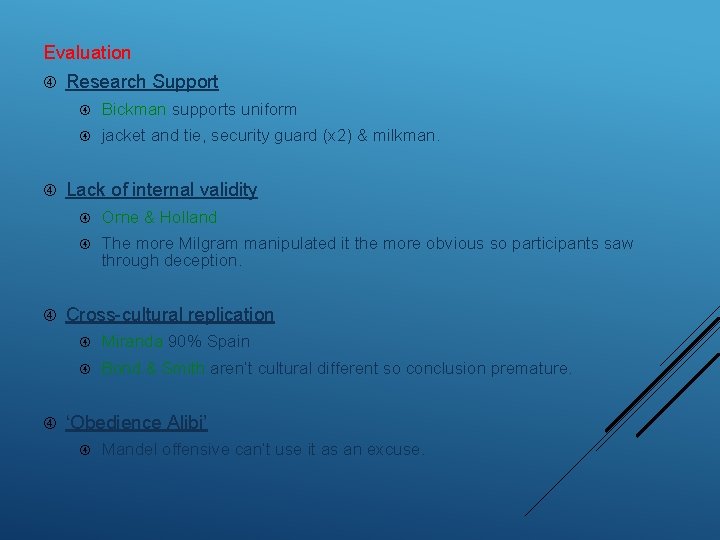
Evaluation Research Support Bickman supports uniform jacket and tie, security guard (x 2) & milkman. Lack of internal validity Orne & Holland The more Milgram manipulated it the more obvious so participants saw through deception. Cross-cultural replication Miranda 90% Spain Bond & Smith aren’t cultural different so conclusion premature. ‘Obedience Alibi’ Mandel offensive can’t use it as an excuse.
Socio psychological factors Agentic State Autonomous State Binding factors
Socio psychological factors Inspired by trial of Adolf Eichmann who didn’t feel responsible for his actions. Agentic State No longer feel responsible for your action Autonomous State free , independent and responsible Agentic shift is change between states due to social hierarchy Binding factors reduce responsibility and guilt eg ‘He volunteered, I’m just doing what i’m meant to’
Evaluation Research support A limited explanation
Evaluation Research support Blass & Schmitt students blamed experimenter due to his authority. A limited explanation Can’t explain why some didn’t obey ( social hierarchy ) and why nurses in Hoflings study didn’t show any stress.
Legitimacy of authority Destructive authority
Legitimacy of authority Societal hierarchies give power to people of importance eg police and government this allows for a smooth running society. Destructive authority Abuse of power leads to suffering, can be seen with the prods in Milgram’s study.
Evaluation Cultural differences Real life crimes of obedience
Evaluation Cultural differences Kilham & Mann Australia 16% Mantell 85% Germany Reflects relativism of society. Real life crimes of obedience Kelman & Hamilton argued that events such as My Lai can be understood with the hierarchy.
Authoritarian Personality Procedure Adorno et al. 1950 Findings Authoritarian characteristics Origins of the authoritarian personality
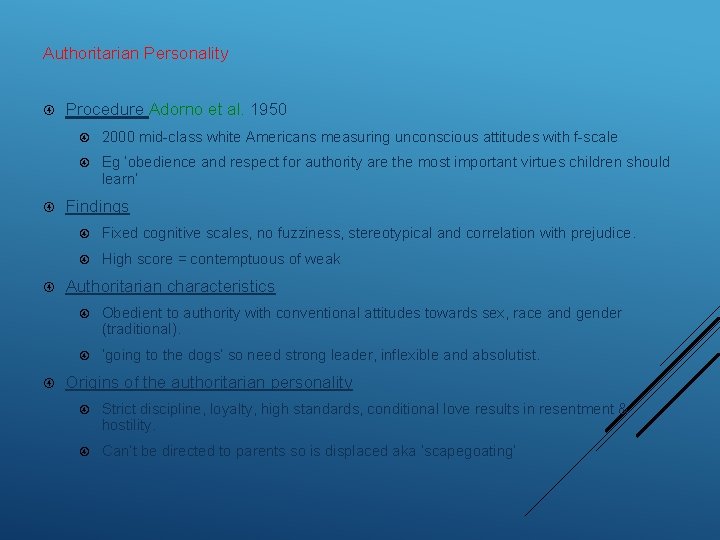
Authoritarian Personality Procedure Adorno et al. 1950 2000 mid-class white Americans measuring unconscious attitudes with f-scale Eg ‘obedience and respect for authority are the most important virtues children should learn’ Findings Fixed cognitive scales, no fuzziness, stereotypical and correlation with prejudice. High score = contemptuous of weak Authoritarian characteristics Obedient to authority with conventional attitudes towards sex, race and gender (traditional). ‘going to the dogs’ so need strong leader, inflexible and absolutist. Origins of the authoritarian personality Strict discipline, loyalty, high standards, conditional love results in resentment & hostility. Can’t be directed to parents so is displaced aka ‘scapegoating’
Evaluation Research support Limited explanation Political bias Methodological issue
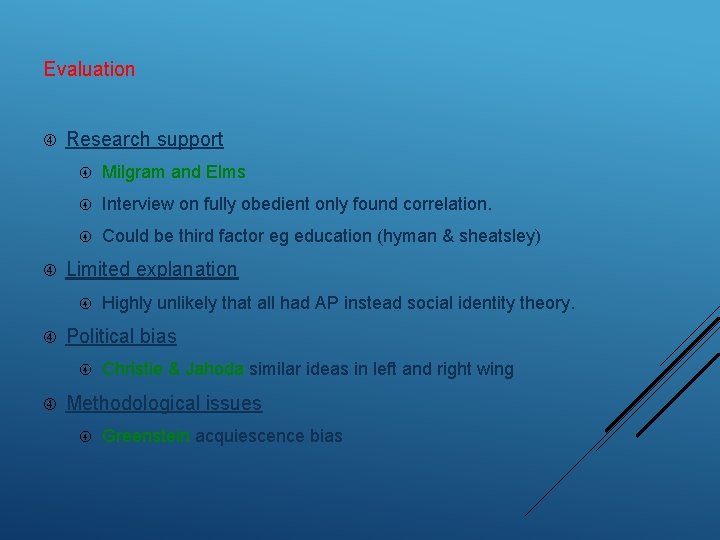
Evaluation Research support Milgram and Elms Interview on fully obedient only found correlation. Could be third factor eg education (hyman & sheatsley) Limited explanation Political bias Highly unlikely that all had AP instead social identity theory. Christie & Jahoda similar ideas in left and right wing Methodological issues Greenstein acquiescence bias
Resistance to social influence Social support conformity Evaluation Research support
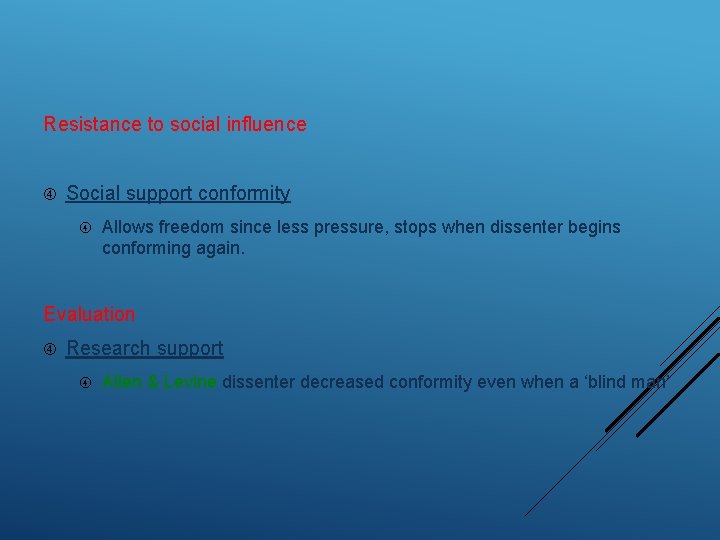
Resistance to social influence Social support conformity Allows freedom since less pressure, stops when dissenter begins conforming again. Evaluation Research support Allen & Levine dissenter decreased conformity even when a ‘blind man’
Resistance to social influence Social support obedience Evaluation Research support
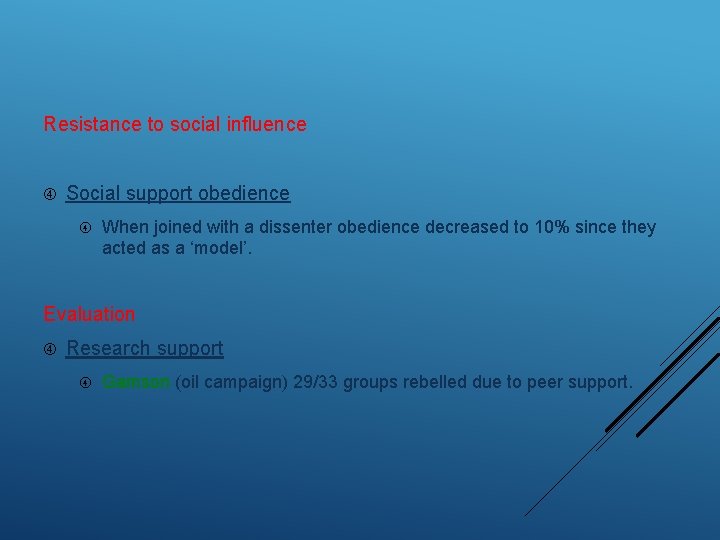
Resistance to social influence Social support obedience When joined with a dissenter obedience decreased to 10% since they acted as a ‘model’. Evaluation Research support Gamson (oil campaign) 29/33 groups rebelled due to peer support.
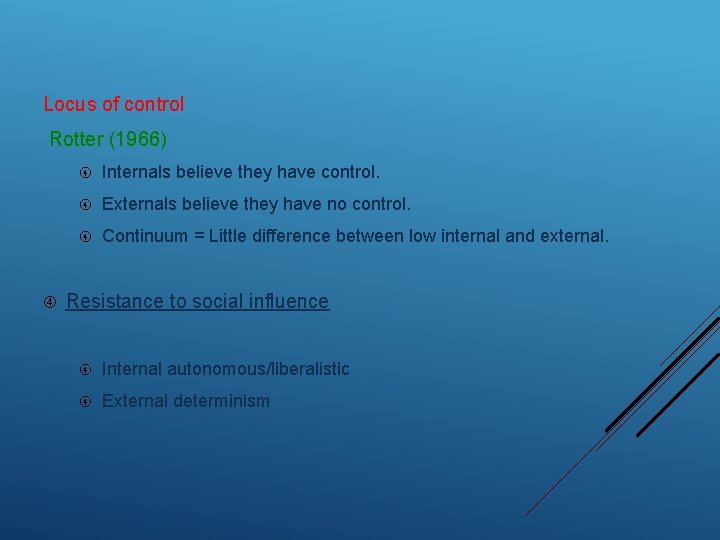
Locus of control Rotter (1966) Resistance to social influence
Locus of control Rotter (1966) Internals believe they have control. Externals believe they have no control. Continuum = Little difference between low internal and external. Resistance to social influence Internal autonomous/liberalistic External determinism
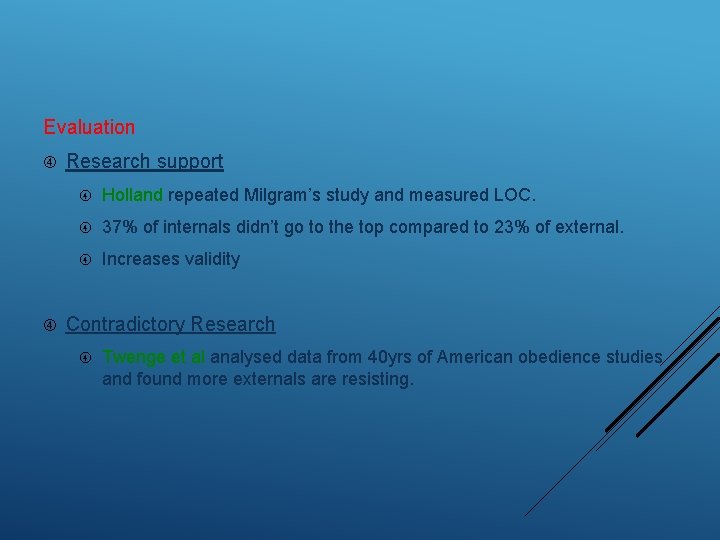
Evaluation Research support Contradictory Research
Evaluation Research support Holland repeated Milgram’s study and measured LOC. 37% of internals didn’t go to the top compared to 23% of external. Increases validity Contradictory Research Twenge et al analysed data from 40 yrs of American obedience studies and found more externals are resisting.
Minority influence Consistency Commitment Flexibility
Minority influence Consistency Synchronic (same) Diachronic (time) Commitment Due to internalisation. Grabs attention via Augmentation Principle. Flexibility Nemeth Can’t be rigid, need balance Process of change due to snowball effect
Evaluation Research support for consistency Research support for depth of thought Artificial task
Evaluation Research support for consistency Research support for depth of thought Moscovici blue/green slides and Wood carried out meta-analysis of 100 similar studies. Martin et al minority caused greater processing and therefore participants less likely to change. Artificial task Just as artificial as Asch’s study so less external validity, normally matter of life and death
Social change Lessons from conformity Lessons from obedience
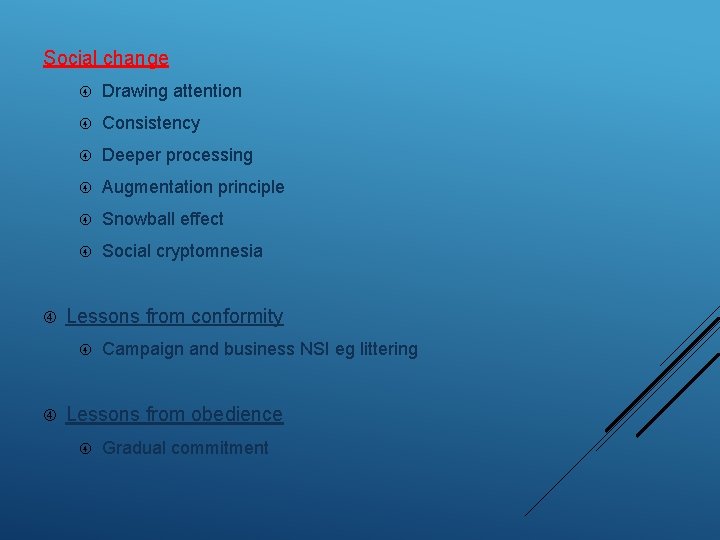
Social change Drawing attention Consistency Deeper processing Augmentation principle Snowball effect Social cryptomnesia Lessons from conformity Campaign and business NSI eg littering Lessons from obedience Gradual commitment
Evaluation Research support for NSI Minority influence is only indirect Role of deeper processing Barriers to social change
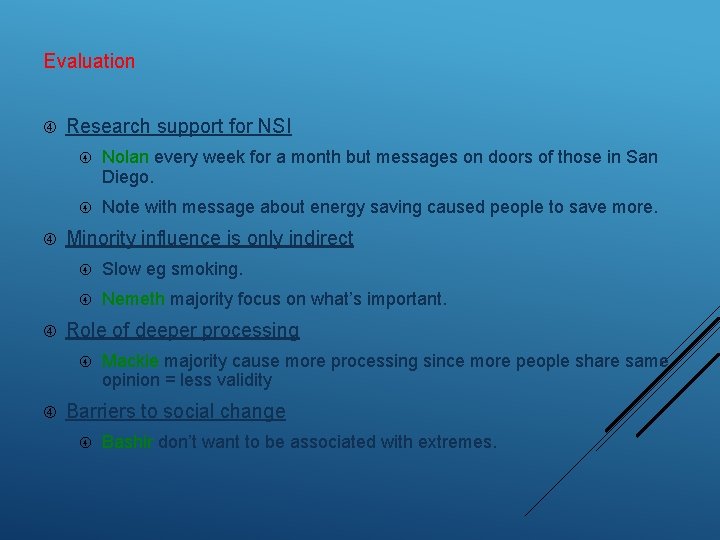
Evaluation Research support for NSI Nolan every week for a month but messages on doors of those in San Diego. Note with message about energy saving caused people to save more. Minority influence is only indirect Slow eg smoking. Nemeth majority focus on what’s important. Role of deeper processing Mackie majority cause more processing since more people share same opinion = less validity Barriers to social change Bashir don’t want to be associated with extremes.