
TYPES OF COMPANIES On the basis of Incorporation
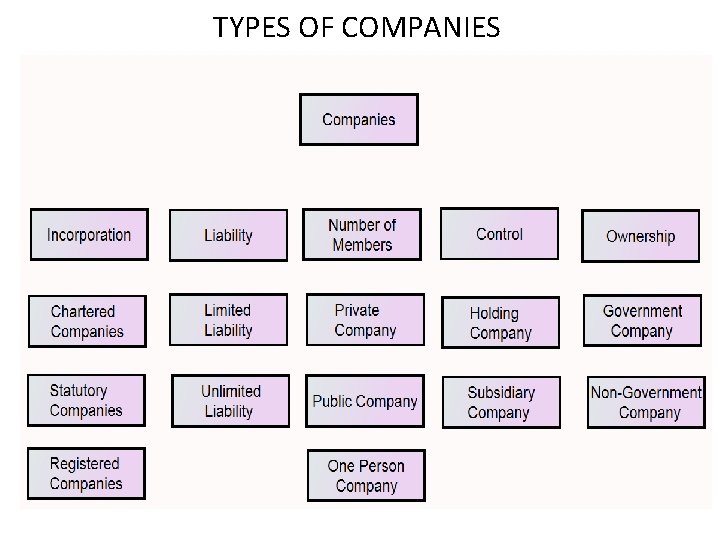
TYPES OF COMPANIES
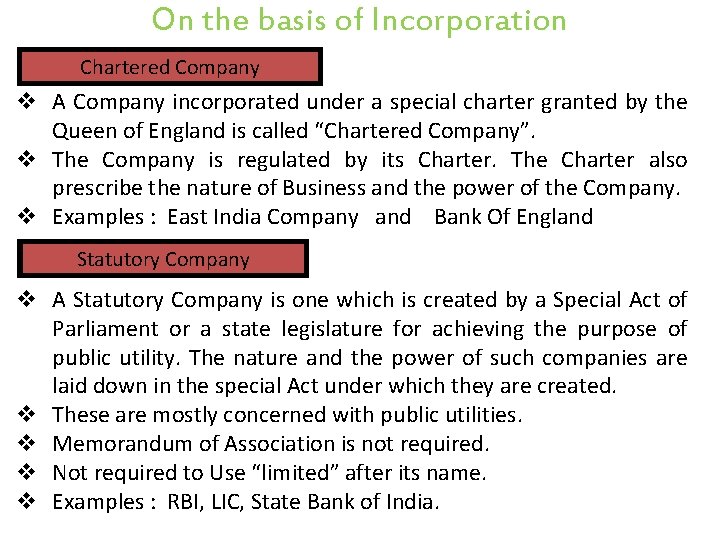
On the basis of Incorporation Chartered Company v A Company incorporated under a special charter granted by the Queen of England is called “Chartered Company”. v The Company is regulated by its Charter. The Charter also prescribe the nature of Business and the power of the Company. v Examples : East India Company and Bank Of England Statutory Company v A Statutory Company is one which is created by a Special Act of Parliament or a state legislature for achieving the purpose of public utility. The nature and the power of such companies are laid down in the special Act under which they are created. v These are mostly concerned with public utilities. v Memorandum of Association is not required. v Not required to Use “limited” after its name. v Examples : RBI, LIC, State Bank of India.
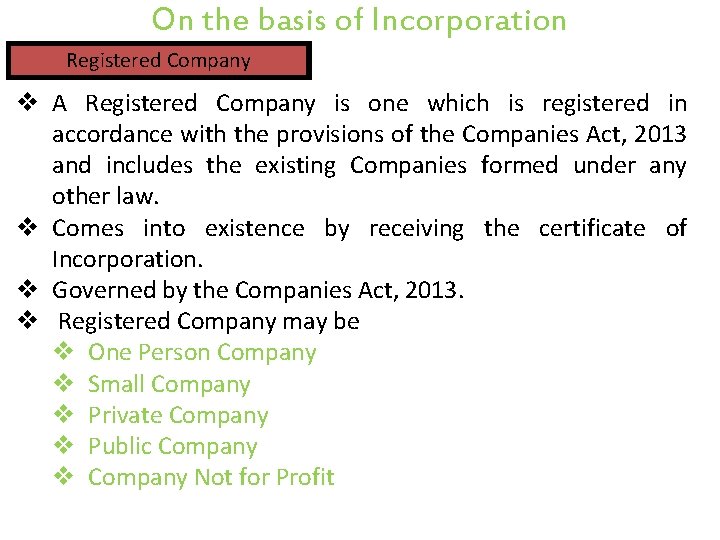
On the basis of Incorporation Registered Company v A Registered Company is one which is registered in accordance with the provisions of the Companies Act, 2013 and includes the existing Companies formed under any other law. v Comes into existence by receiving the certificate of Incorporation. v Governed by the Companies Act, 2013. v Registered Company may be v One Person Company v Small Company v Private Company v Public Company v Company Not for Profit
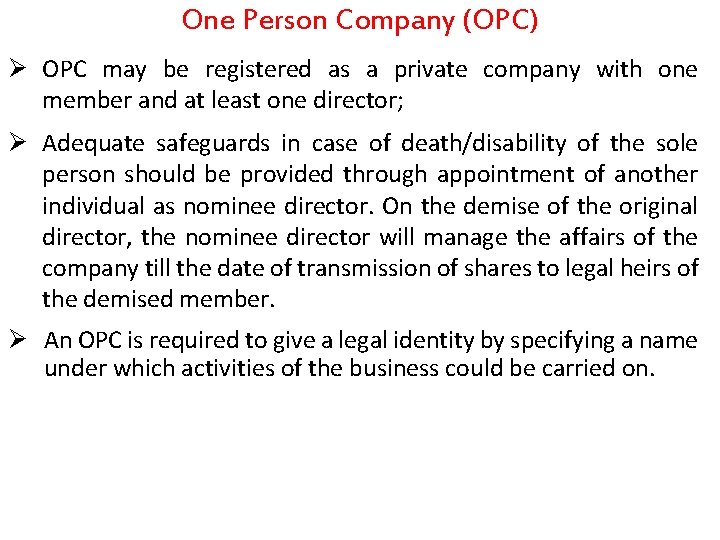
One Person Company (OPC) Ø OPC may be registered as a private company with one member and at least one director; Ø Adequate safeguards in case of death/disability of the sole person should be provided through appointment of another individual as nominee director. On the demise of the original director, the nominee director will manage the affairs of the company till the date of transmission of shares to legal heirs of the demised member. Ø An OPC is required to give a legal identity by specifying a name under which activities of the business could be carried on.
One Person Company Ø OPC can get itself converted into a private or public company Ø Increasing the minimum number of members and directors to 2 or minimum of 7 members and 3 directors as the case may be. Ø If minimum paid-up capital of an OPC exceeds 50 lakh INR or its average annual turnover during the period of immediately preceding 3 consecutive financial years exceeds 2 crore rupees, it will not be entitled to continue as an OPC. Such OPC shall be required to convert itself into either a private company or a public company in accordance with the provisions. Ø within 6 months of the date on which its paid up share capital is increased beyond 50 lakh INR Ø the last day of the period immediately preceding 3 consecutive financial years during which its average annual turnover exceeded 2 crore rupees Ø the close of the financial year during which its balance sheet total exceeded 1 crore INR
Benefits of One Person Company • OPC will give the young business all the benefits of a private limited company which categorically means they will have access to credits, banks, loans, limited liability, legal protection for business, etc all in the name of a separate legal entity. • Business will not come to an end on the death of an individual person. • No need to arrange AGM during the year.
Small Company The Act identifies some companies as small companies based on their capital and turnover position for the purpose of providing certain relief/exemptions to these companies. A company has been defined as a company, other than a public company Ø Paid up share capital of which does not exceed 50 lakh INR or such higher amount as may be prescribed which shall not be more than 5 crore INR, OR Ø Turnover of which as per its last profit-and-loss account does not exceed two crore INR or such higher amount as may be prescribed which shall not be more than 2 crore INR. Ø Provided that nothing in this section apply to Ø A holding company or a subsidiary company Ø A company registered under section 8 Ø A company or body corporate governed by any special Act
Private Company Ø A company which has a minimum paid up capital of Rs 1, 000 or such higher paid up capital as may be prescribed, and by its articles Ø Restrict the right to transfer its share Ø Limit the number of its member to 200 Ø Prohibits any invitation to the public to subscribe for any share or debentures of the company Ø Prohibits any invitation or acceptance of deposits from person other than its members, directors or their relatives. Public Company Ø A public company means a company which Ø has a minimum paid up capital of Rs 5 lakh or such higher paid up capital, as may be prescribed Ø Is a private company which is subsidiary of public company
Company Not for Profit Ø According to Section 25, the Central Government may by license grant that an association may be registered as a company with limited liability, without using the words ‘limited’ or ‘pvt ltd’ as a part of its name. Ø An association must satisfy the following condition: Ø The association about to be formed as a limited company aims at the promotion of commerce, art, science, religion, charity, or any other useful objective ; Ø It intends to apply its profits, if any, for promoting its objects; and Ø It prohibits the payment of dividend to its members. Central Govt. has a power to revoke the license of such company.
On the basis of Liability Limited by shares v A company limited by shares is a company in which the liability of its members is limited by its Memorandum to the amount unpaid on the shares respectively held by them. v It may either public or private Company. v If member of the company pays a full amount on shares then his liability would be nil. v Such liability can be enforced either during the lifetime or during the winding up of the company. Limited by Guarantee v Liability of its members is limited by its Memorandum to such amount as the members may respectively undertake to contribute to the assets of the company in the event of its being wound up. v For the purpose of Commerce, science, art, religion, charity or any other useful objects. v Such liability can be enforced only after the commencement of winding up of the company and not during the lifetime of it.
![On the basis of Liability Unlimited Company [Section 12(2)(c)] v An unlimited company or](http://slidetodoc.com/presentation_image_h2/75584a0f70660e2dde037b3da7ac768c/image-11.jpg "On the basis of Liability Unlimited Company [Section 12(2)(c)] v An unlimited company or")
On the basis of Liability Unlimited Company [Section 12(2)(c)] v An unlimited company or private unlimited company is a hybrid company incorporated either with or without a share capital (and similar to its limited company counterpart) but where the liability of the members or shareholders is not limited - that is, its members or shareholders have a joint, several and unlimited obligation to meet any insufficiency in the assets of the company in the event of the company's formal liquidation.
On the basis of Control Holding and Subsidiary Company v The term Holding and Subsidiary are interrelated. v A company shall be deemed to be subsidiary of another company if : ü That other company controls the composition of its board of directors ; or ü That other company holds more than half in face value of its equity share capital v The control of the composition of the Board of Directors of the company means that the holding company has the power at its discretion to appoint or remove all or majority of directors of the subsidiary company without consent or concurrence of any other person. v If Company B is subsidiary of the Company A and Company C is subsidiary of Company B, therefore Company C is subsidiary of Company A. v A subsidiary cannot purchase even a single share of its holding company after 1 -4 -1956 after it became its subsidiary.
On the basis of Ownership Foreign Company v Means any company or body incorporated outside India which v Has a place of business in India whether by itself or through an agent, physically or through electronic mode; and v Conduct any business activity in India in any other manner v Copy’s of memorandum, articles etc. must be filed by every foreign companies act at the following two places: a. R. O. C at New Delhi b. R. O. C at the state where the company was principle place of business. Domestic Company
![On the basis of Ownership Government company [Section 617] v Means any company in](http://slidetodoc.com/presentation_image_h2/75584a0f70660e2dde037b3da7ac768c/image-14.jpg "On the basis of Ownership Government company [Section 617] v Means any company in")
On the basis of Ownership Government company [Section 617] v Means any company in which not less than 51% of the paid up share capital is held by the Central Government or any State Government or partly by the Central Government and partly by the one or more State Governments. v Government Companies are also governed by the provisions of the Companies Act. However, the Central Government may direct that certain provisions of the Companies Act shall not apply or shall apply only with such exceptions, modifications and adaptations as may be specified to such government companies. v Even a subsidiary company of Government is regarded as a government Company. v Example: HAL, BEL Non-Government company [Section 617]
- Slides: 14