
Types of Communication Types of Communication Verbal Nonverbal
Types of Communication

Types of Communication Verbal Nonverbal
VERBAL COMMUNICATION The sharing of information between individuals by using speech or writing. Verbal communication is best suited to convey specific information, and is better suited to communication through technology over long distances.
ROLE OF LANGUAGE IN VERBAL COMMUNICATION What is Language? Edward Sapir: “Language is not only a vehicle for the expression of thoughts, perceptions, sentiments, and values characteristic of a community; it also represents a fundamental expression of social identity. ” Benjamin Whorf: “Language shapes thoughts and emotions, determining one’s perception of reality. ”
Do you think that human language is learned or inherited?
HUMAN LANGUAGE Human language is unique because it is a symbolic communication system that is learned instead of biologically inherited. However, the ability to acquire any language whatsoever is innate. Linguists believe that human beings have a mechanism which is called Language Acquisition Device (LAD).
IMPORTANCE OF LANGUAGE Language is a tool to learn knowledge transmit information express feelings, emotions and ideas forge cultural ties construct social identity
VERBAL GENDER AND CULTURAL DIFFERENCES When communicating verbally, men tend to seek and offer solutions, while women tend to focus on empathy (John Gray, “Men are from Mars; women are from Venus”). Men are more goal-oriented while women are more relationshiporiented. People from different cultures also differ in how they express themselves, even when the literal meanings of words are translated into the native language of the listener. “Yes" -------"maybe” Asian & Pacific Islanders “Yes" -------binding commitment USA, Canada & Northern Europe
…………………CONTINUED Examples: Yes-----I heard what you said. Yes-----I understand what you said. Yes-----I can see this is important for you. Word Your Questions Carefully: Not carefully worded questions Do you want to go to dinner now or wait until the rush –hour is over? Aren’t you coming to dinner?
NONVERBAL COMMUNICATION “The World Beyond Words”
NONVERBAL COMMUNICATION “Messages expressed by nonlinguistic means. ” It includes silent behaviors, environment, artifacts, and vocal intonation It is a powerful mode of communication
RELATIONAL NATURE OF NONVERBALS Nonverbal communication assists with: Identity management- Getting others to see us as we want to be seen; there are several ways of managing identity nonverbally: Ø Ø Ø "Manner" refers to the way we act. "Appearance" involves the way we dress, artifacts we wear, etc. "Setting" involves the physical items we surround ourselves with. Defining our relationships: Level of intimacy Conveying Emotions: For expressing emotions we don’t want to express, can’t express, or don’t know we’re feeling
NONVERBALCOMMUNICATION IS AMBIGUOUS The same nonverbal can have multiple meanings For example: “I’m feeling content” smiles “I’m feeling a little stressed” smiles “I’m a bit sad” smiles “I can’t believe you just did that” smiles “How do I get out of this conversation? ” smiles
NON-VERBAL GENDER AND CULTURAL DIFFERENCES Women tend to be better at interpreting non-verbal messages than men Men are also less adept at sending subtle non-verbal messages. Cultural differences in non-verbal communication can create misunderstandings For example, among North Americans, nodding the head means "yes, " while among Japanese, it means merely "I’m listening" according to Wang De-hua and Li Hui of the Ningbo Institute of Technology.
Improving your nonverbal communication skills Nonverbal cues can speak louder than words Eye contact Facial expression Body movement Space Time Appearance
Eye Contact Ø Ø Ø Windows to the soul Best predicator of the true feelings of the speaker Sustained eye contact Brief eye contact Good eye contact Attention Respect Favourable response Sincerity Confidence Truthfulness
Facial Expression Human face can display over 250, 000 expressions ØMen and women have been found to be equally expressive ØMen show the most emotion in the lower left quadrant of their face ØWomen show emotion over their whole face Raising or lowering eyebrows Squinting the eyes Clenching the jaw Smiling broadly
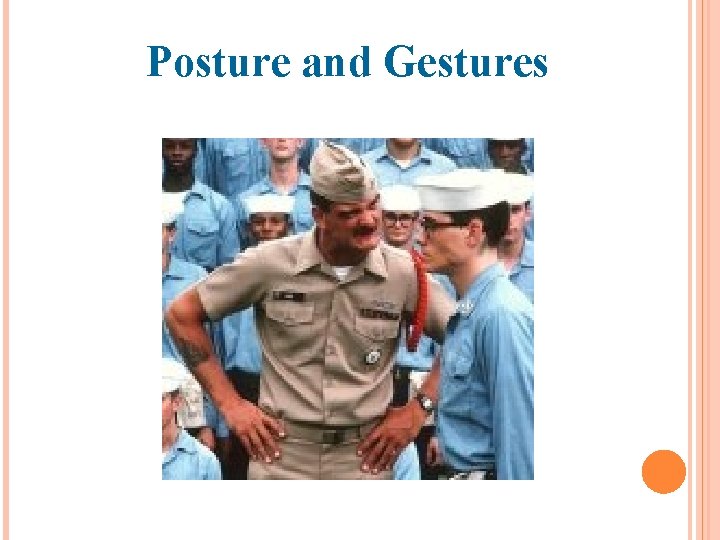
Posture and Gestures
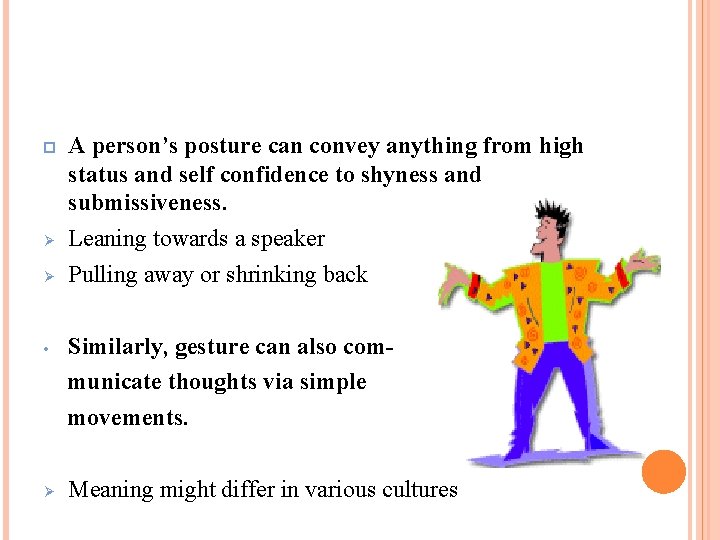
Ø Ø • Ø A person’s posture can convey anything from high status and self confidence to shyness and submissiveness. Leaning towards a speaker Pulling away or shrinking back Similarly, gesture can also communicate thoughts via simple movements. Meaning might differ in various cultures
VOICE Consists of vocal tone, speed, pitch, volume, number and length of pauses, and disfluencies (“um”s, “ah”s), etc. Affects how others perceive us Stereotyping Meaning (e. g. , accents, vocabulary, grammar) of speech can also be altered significantly by tone and character of voice Examples: Ø Are you here?
Try saying “You are my friend” to convey the following meanings: 1) You really are? I hadn’t realized that. 2) That ploy won’t work. I told you we’re through. 3) You couldn’t possibly be my friend after what you did! 4) Mine? Am I the one who is your friend? 5) You? I didn’t think you are anybody’s frind.
SILENCE Can communicate contentment, awkwardness, anger, respect, thoughtfulness, empathy Can also be disconfirming
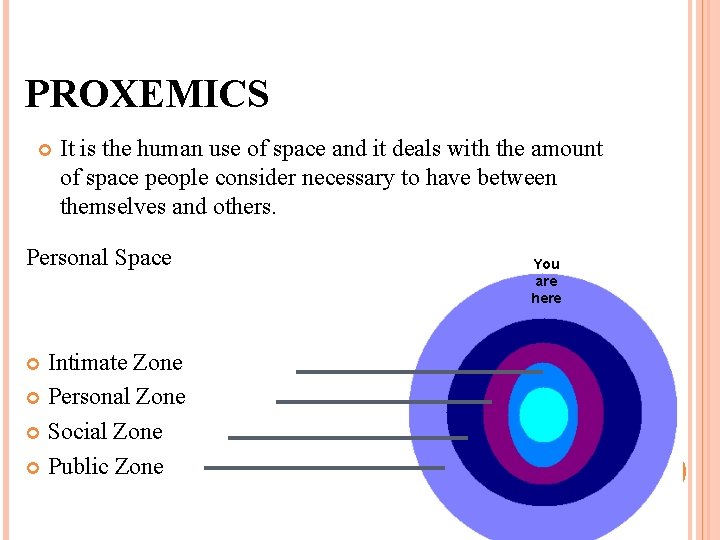
PROXEMICS It is the human use of space and it deals with the amount of space people consider necessary to have between themselves and others. Personal Space Intimate Zone Personal Zone Social Zone Public Zone You are here
Space Geographical space belonging to us (your room, your bed, your apartment, etc. ) How we order the space around us tells something about our objectives People reveal themselves in the design and grouping of their furniture Barrier Behaviour Backing up, putting something between us, breaking eye contact
TIME/CHRONEMICS Our use of time reflects: Power/status Cultural norms Expectations How we structure and use our time tells visitors about our personality and attitude
Appearance Personal Appearance The way you look- your clothing, grooming and posture- telegraphs an instant nonverbal message about you. Judgments about your personality, status, credibility and potential
…………………CONTINUED Eye appeal of official documents The way a memo, letter, report or an email looks like can have a positive or negative impact on the receiver. Envelops through their postage, printing and stationary can suggest routine, important or junk mail.
Some Guidelines for Improving Nonverbal Communication
Establish and maintain eye contact Use posture to show interest Improve your decoding skills Probe for more information Avoid assigning nonverbal meanings out of context Appreciate the power of appearance Observe yourself on video Enlist friends and family
Thank You
- Slides: 30