
TYPES OF BUSINESS OWNERSHIP ADVANTAGES SOLE PROPRIETORSHIP One
TYPES OF BUSINESS OWNERSHIP

ADVANTAGES - SOLE PROPRIETORSHIP One of the biggest advantages of a sole proprietorship is that setting up and administering the business is comparatively easy and inexpensive. For instance, in most provinces, if you choose the sole proprietor form of business ownership and operate it under your own name, you don't even have to register your business. Source: About. com Business

DISADVANTAGES - SOLE PROPRIETORSHIP The owner of a sole proprietorship is solely liable for all debts and actions of the company. All personal wealth is linked to the business. Financial statements are not required in a sole proprietorship as are typically required of a corporation, meaning a lack of financial control is very probable. It is difficult to find outside investors to fund sole proprietorships, meaning growth potential is very limited beyond a certain point. A person who wishes to open a sandwich shop must put their own money into the business, knowing that, should it fail, they will be responsible for all costs and debts that will be incurred.
ADVANTAGES OF A PARTNERSHIP -Two people is better than one - your business is easy to establish and start-up costs are low - more capital is available for the business - you’ll have greater borrowing capacity - high-calibre employees can be made partners - there is opportunity for income splitting, an advantage of particular importance due to resultant tax savings - it’s easy to change your legal structure later if circumstances change.
DISADVANTAGES OF A PARTNERSHIP -the liability of the partners for the debts of the business is unlimited -Each partner is ‘jointly and severally’ liable for the partnership’s debts; that is, each partner is liable for their share of the partnership debts as well as being liable for all the debts -There is a risk of disagreements and friction among partners and management each partner is an agent of the partnership and is liable for actions by other partners if partners join or leave, you will probably have to value all the partnership assets and this can be costly.
ADVANTAGES OF A CORPORATION The liability of the owners towards the creditors is limited to their investment in the company. This means that in case of liquidation of the company, if the company's assets are insufficient to meet the liability, nothing is required to be contributed by the owners. Only the owners' contribution is at stake rather than their personal assets. The corporation is considered a legal person with perpetual existence. It exists until it is liquidated and death or change in ownership has no effect on the corporation. Additional capital can be raised easily through stock markets, etc. The ownership is represented by the number of share certificates held by a person, and this makes the transfer of ownership very easy.
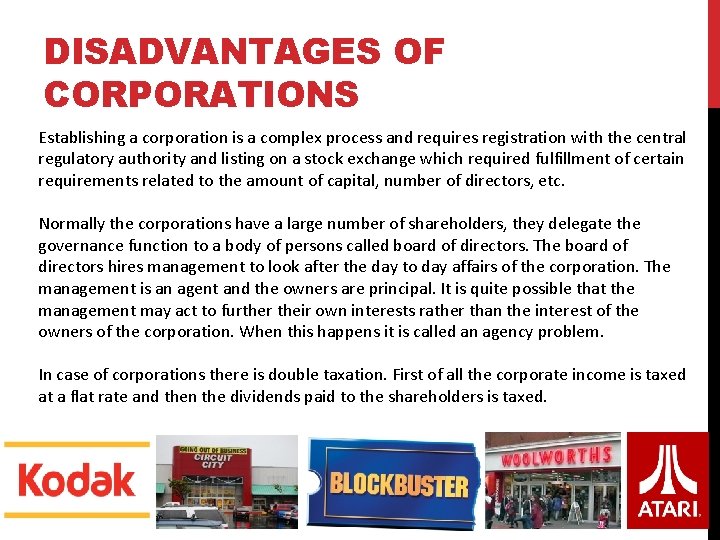
DISADVANTAGES OF CORPORATIONS Establishing a corporation is a complex process and requires registration with the central regulatory authority and listing on a stock exchange which required fulfillment of certain requirements related to the amount of capital, number of directors, etc. Normally the corporations have a large number of shareholders, they delegate the governance function to a body of persons called board of directors. The board of directors hires management to look after the day to day affairs of the corporation. The management is an agent and the owners are principal. It is quite possible that the management may act to further their own interests rather than the interest of the owners of the corporation. When this happens it is called an agency problem. In case of corporations there is double taxation. First of all the corporate income is taxed at a flat rate and then the dividends paid to the shareholders is taxed.

ADVANTAGES OF FRANCHISES About 91% of all franchisees reported profitability over the last 12 months. The business format is proven. You have the opportunity to build your capital as well as your earnings. It is your business and you are the owner manager, providing you follow the system, you decide what goes. The major banks are very supportive of good franchising.

DISADVANTAGES OF FRANCHISES Running any business is hard work, demanding the highest level of personal and family commitment. You make a financial investment, however, no investment is guaranteed, especially when it depends on the efforts of both you and your franchisor as well as the vagaries of the market place. You buy into a proven business system for its benefits but you also take on the responsibility for following it – not doing so may result in you losing the business.
- Slides: 9