
Types of Bonding Objectives 1 Ionic Bonding 2
Types of Bonding Objectives: 1. Ionic Bonding 2. Metallic Bonding 3. Ionic & Metallic naming
Review: Chemical Bonding • Chemical bonds are attractive forces (electrostatic attractions) which hold atoms together to form compounds • Types of bonds: • Ionic: Metal with a Non-metal • Covalent: Non-metal with a Non-metal • Metallic: Metal with a Metal
Chemical Bonding Metal with a Non-Metal • What are the chemical properties of metals? (think trends) • What are the chemical properties of non-metals? • What do you think will happen when they react together?
Chemical Bonding Metal with a Non-Metal • Ionic Bonding • A strong non-metal anion (-) steals electrons from a weak metal cation (+) to form ions • Big electronegativity difference (between cation and anion) • Ions then form ionic compounds
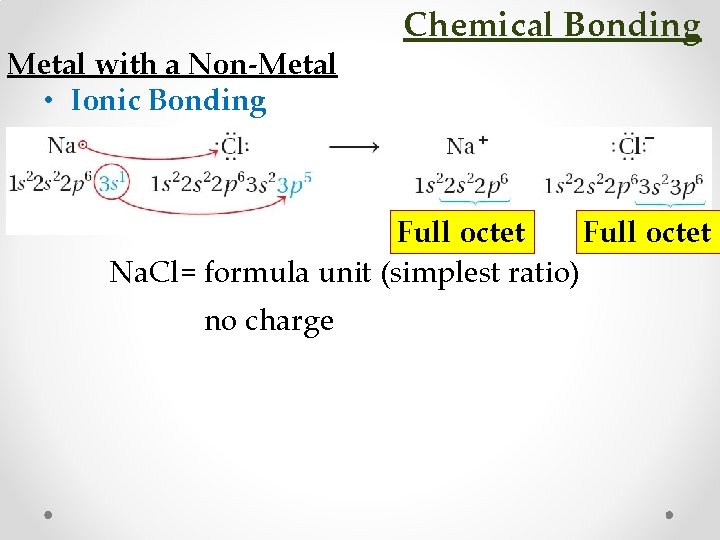
Metal with a Non-Metal • Ionic Bonding Chemical Bonding Full octet Na. Cl= formula unit (simplest ratio) no charge
Chemical Bonding Metal with a Non-Metal • Ionic Bonding • Oxidation number = the charge on the ion • Comes from gaining or losing ions • Polyatomic ions: • An ion that has several different elements • A group of elements with a charge
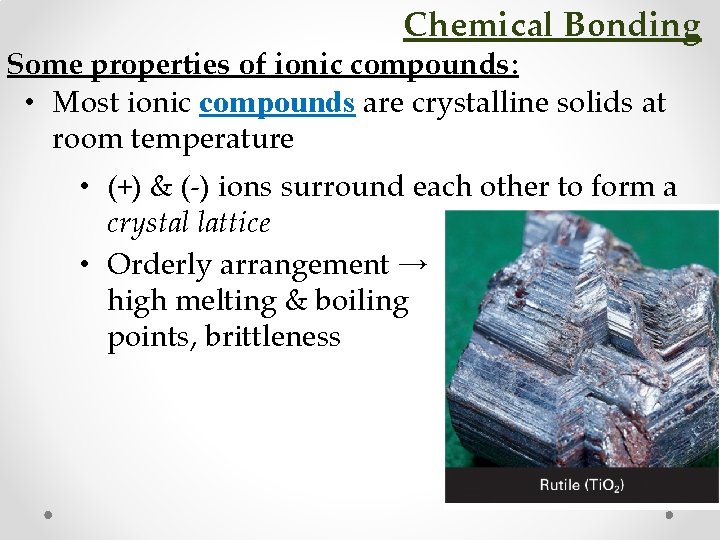
Chemical Bonding Some properties of ionic compounds: • Most ionic compounds are crystalline solids at room temperature • (+) & (-) ions surround each other to form a crystal lattice • Orderly arrangement → high melting & boiling points, brittleness
Chemical Bonding Some properties of ionic compounds: • Solids = insulators • liquid/gas = conductors • Salts = electrolytes: • Ionic substances which dissolve in water • They conduct electricity
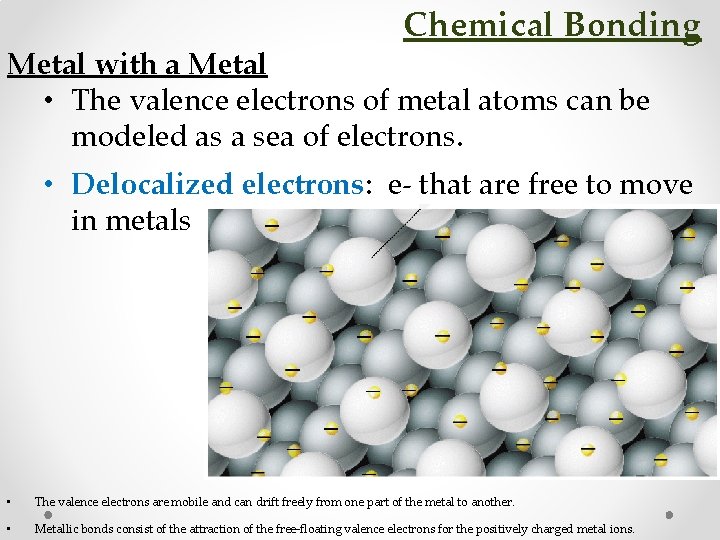
Chemical Bonding Metal with a Metal • The valence electrons of metal atoms can be modeled as a sea of electrons. • Delocalized electrons: e- that are free to move in metals • The valence electrons are mobile and can drift freely from one part of the metal to another. • Metallic bonds consist of the attraction of the free-floating valence electrons for the positively charged metal ions.
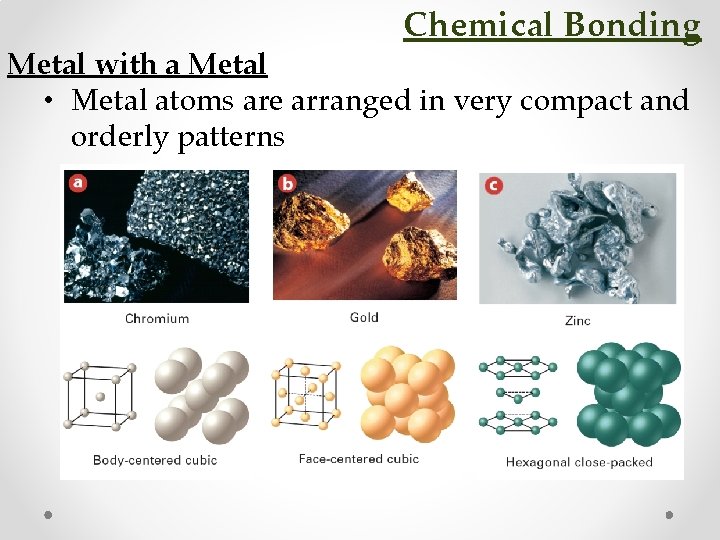
Chemical Bonding Metal with a Metal • Metal atoms are arranged in very compact and orderly patterns
- Slides: 10