
Types of Blood Products and Their Clinical Indication
Types of Blood Products and Their Clinical Indication

Blood Products Whole Blood Packed Red Blood Cell Platelet rich plasma Fresh frozen plasma Liquid Plasma Platelet concentrate Cryopresipitat

Whole Blood

§ Whole blood” is simply the blood that flows through the veins. § It contains red cells, white cells, and platelets suspended in plasma. Whole Blood § Unseparated blood collected into an approved container containing an anticoagulantpreservative solution § Generally, whole blood donation is used for the source for the blood substitutes
§ Up to 510 ml total volume (volume may vary in accordance with local policies) § 450 ml donor blood § 63 ml anticoagulant-preservative Features solution § Hemoglobin ~12 g/ml § Hematocrit 35%– 45% § No functional platelets § No labile coagulation factors (V and VIII)
§ Between +2°C and +6°C in approved blood bank refrigerator, fitted with a temperature chart and alarm § During storage at +2°C and +6°C, changes in composition occur resulting from red cell metabolism Storage. Cariage § 21 days within CPD; 35 days within CPDA-1 § Transport systems where it can be guaranteed that the temperature will not exceed + 10 °C should be used after a maximum period of 24 hours. § Transfusion should be started within 30 minutes of removal from refrigerator
§ Routine screening for Screening transfusion-transmissible infections, including HIV-1 and HIV-2, hepatitis B and C, and syphilis
§ Patients who are actively bleeding § Patients who are lost more than Indication 25% of their volume § Exchange transfusion in infants
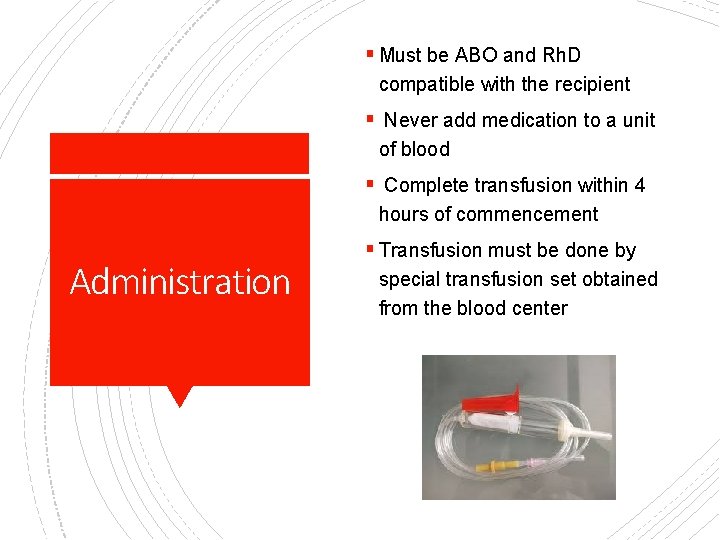
§ Must be ABO and Rh. D compatible with the recipient § Never add medication to a unit of blood § Complete transfusion within 4 hours of commencement Administration § Transfusion must be done by special transfusion set obtained from the blood center

Red Cell Concentrate
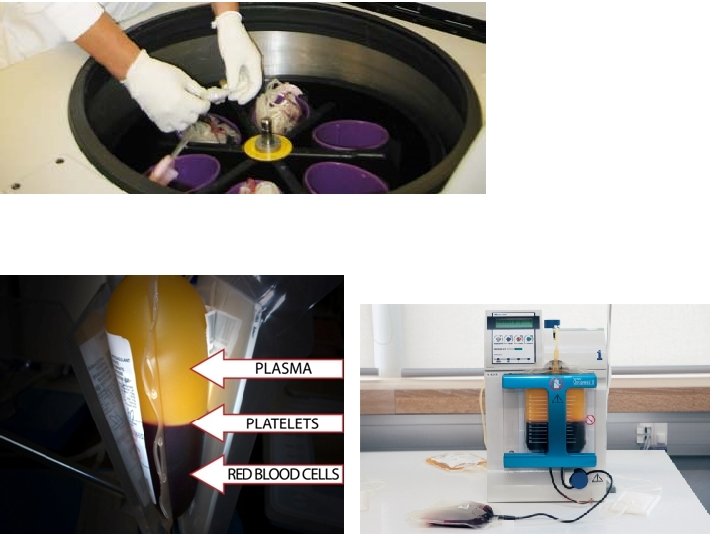

§ 150– 200 ml red cells from which most of the plasma has been removed § ± 100 ml normal saline, adenine, glucose, mannitol solution (SAG-M) or an equivalent red cell nutrient solution has been added Definition& Features § Hemoglobin ~ 20 g/100 ml (not less than 45 g per unit) § Hematocrit 55%– 75% § The amount of leukocyte is 2. 5 -3. 0 x 109. § The amount of thrombocyte changes as the centrifugated method.
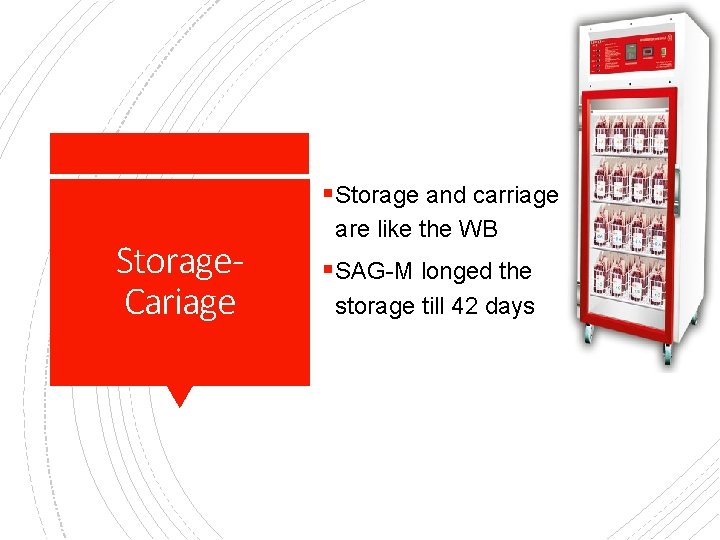
§ Storage and carriage Storage. Cariage are like the WB § SAG-M longed the storage till 42 days
§ Anemia in the patients who can not tolerate the low level of hemoglobin § There is no cut-off value for the Indication transfusion. § Generally, Hb is ≤ 6 gr/dl accepted as the starting to the transfusion. § Acute blood loss
§ Must be ABO and Rh. D compatible with the recipient § Transfusion must be done by special transfusion set obtained from the blood center § Never add medication to a unit Administration of blood § The trf rate is 1 -2 ml/kg/hour § 1 Unit should be completed ~ 1 -2 hours § The rate for emergency is >1 ml/kg/10 minutes

Platelet Concentrate
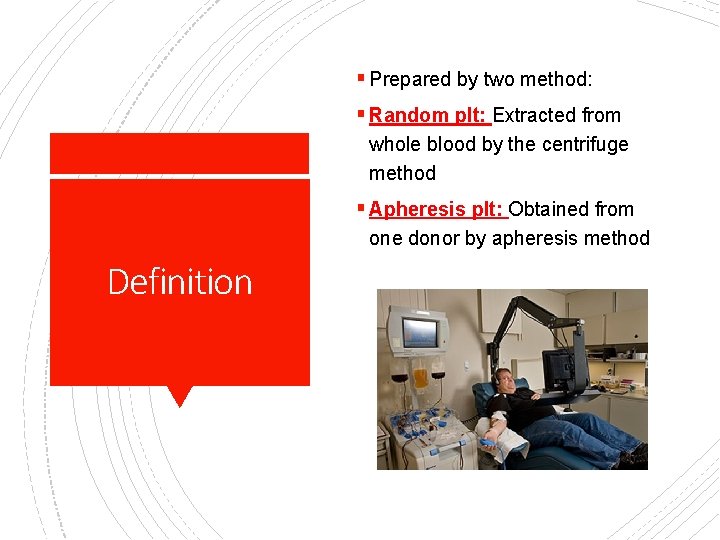
§ Prepared by two method: § Random plt: Extracted from whole blood by the centrifuge method § Apheresis plt: Obtained from one donor by apheresis method Definition
§ Random plt: § Single donor unit in a volume of 50– 60 ml of plasma should contain § At least 45 -85 x 109 platelets Features § Apheresis plt: § At least 2 -8 x 10¹¹ platelets § The contaminations of red blood cells and leukocyte are very low. 4 -6 Unit random plt = 1 U apheresis plt
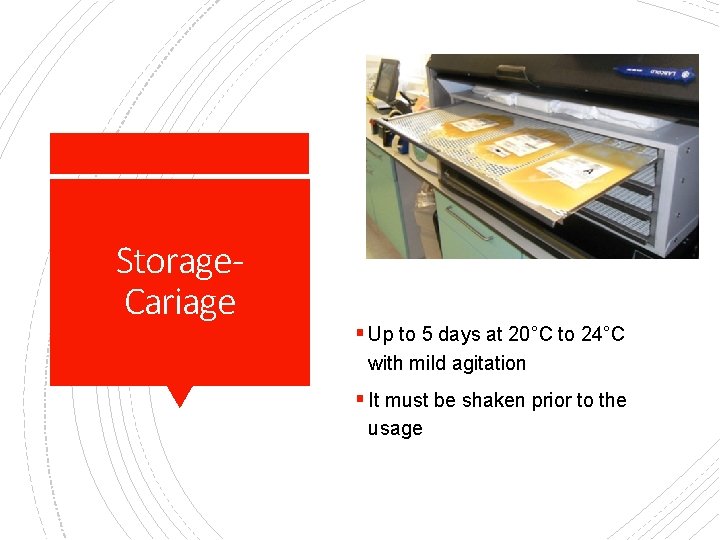
Storage. Cariage § Up to 5 days at 20°C to 24°C with mild agitation § It must be shaken prior to the usage
§ Treatment of bleeding due to § Thrombocytopenia or § platelet function disorders Indication § Prevention of bleeding due to thrombocytopenia, such as in bone marrow failure Generally not indicated: Immune thrombocytopenic, Heparin-induced thrombocytopenia, or Trombotic Thrombocytopenic Purpura
§ Plt count is <10. 000/mm 3 § Hemostatic instability (<20. 000/mm 3) § Minor bleeding, DIC, minor Indication surgery or invasive procedure (<50. 000/mm 3 ) § Major bleeding requiring RBC transfusion or major surgery (80. 000 -100. 000/mm 3) § Massive transfusion

§ Platelet concentrates should be infused as soon as possible, generally within 4 hours Administration § Should be infused over a period of about 30 minutes § Give platelet concentrates that are ABO/Rh compatible, whenever possible

Fresh Frozen Plasma
§ Pack containing the plasma Definition& Features separated from one whole blood donation within 6 hours of collection and then rapidly frozen to – 30°C or colder § Apheresis § Contains normal plasma levels of stable clotting factors, albumin and immunoglobulin
§ 36 months at <-25°C § 3 months at -18°C-25°C § Before use, should be thawed in Storage. Cariage the blood bank in water which is between 30°C to 37°C. § Higher temperatures will destroy clotting factors and proteins § Once thawed, should be stored in a refrigerator at +2°C to +6°C for only 24 hours
§ The coagulation factor deficiency if required but specific factor concentrate is not available. § Treatment of TTP § Replacement solution for Indication plasmapheresis in treatment of TTP or HUS § When it is necessary to urgently correct the effect of warfarin § DIC § Massive transfusion § Severe liver failure but invasive procedure such as biopsy, surgery, catheter insertion
§ Must normally be ABO compatible to avoid risk of hemolysis in recipient § No compatibility testing required Administration § Infuse using a standard blood administration set as soon as possible after thawing § Labile coagulation factors rapidly degrade; use within 6 hours of thawing
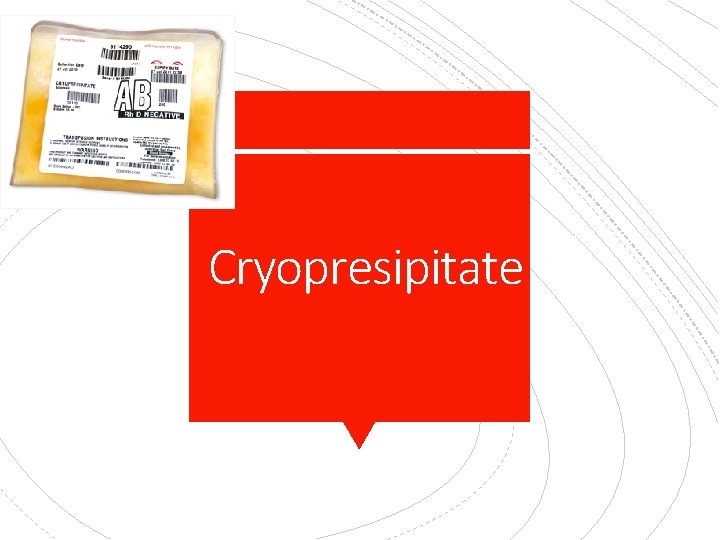
Cryopresipitate

§ Prepared from FFP by high-rate centrifugation Definiton& Features § Before centrifuge, the FFP is kept at 2 -6◦C for 12 or 24 hours. § The last volume is 40 m. L § Rich for factor VIII, v. WF, fibrinogen, factor XIII and fibronectin
§ 36 months at -25°C § 3 months at -18°C-25°C § Before use, should be thawed in Storage. Cariage the blood bank in water which is between 30°C to 37°C. § Higher temperatures will destroy clotting factors and proteins § Once thawed, should be stored in a refrigerator at +2°C to +6°C for only 24 hours

§ DIC Indication § Hypo-/dysfibrinogenemia § Factor III deficiency
§ Must normally be ABO compatible to avoid risk of hemolysis in recipient Administration § No compatibility testing required § Infuse using a standard blood administration set as soon as possible after thawing § use within 6 hours of thawing
Cryo-Poor Plasma (Liquid plasma)
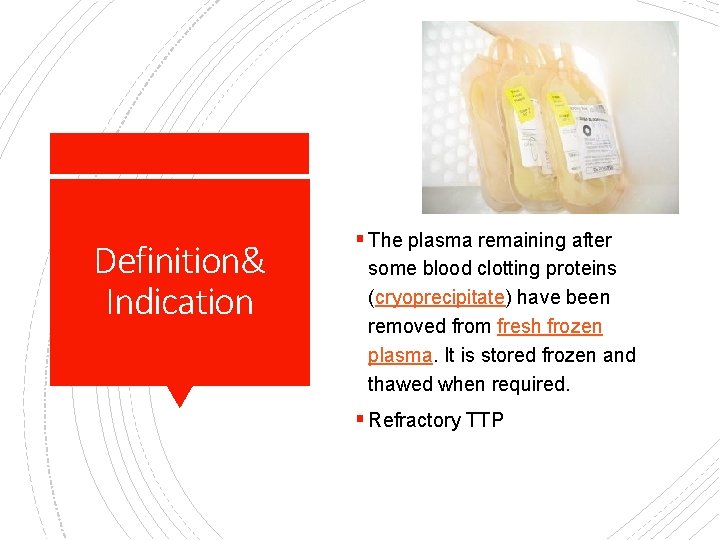
Definition& Indication § The plasma remaining after some blood clotting proteins (cryoprecipitate) have been removed from fresh frozen plasma. It is stored frozen and thawed when required. § Refractory TTP

Granulocyte
§ Specific product § Prepared by apheresis method from a single donor. § The standard dose in adults is one apheresis unit per day (~300 -400 m. L). Definition& Features& Indication § Prior to collection, the donor must be prepared and stimulated by growth factor. § Donor is chosen by the patient relatives (sibling or parents). § HLA-identical and ABO/Rh identical § If not possible ABO identical or minor incompatible of donor-patient’s blood group.

§ The amount of granulocytes per dose Definition& Features& Indication can vary greatly (granulocytes/collection) based on the donor and mobilization regimen given to the donor. § After collection and gamma-irradiation, the granulocyte is immediately given to the patient. § Severe febrile neutropenia
- Slides: 37