
Types of Astronomy How we use different parts
- Slides: 26
Types of Astronomy How we use different parts of the EMS to learn about the Universe
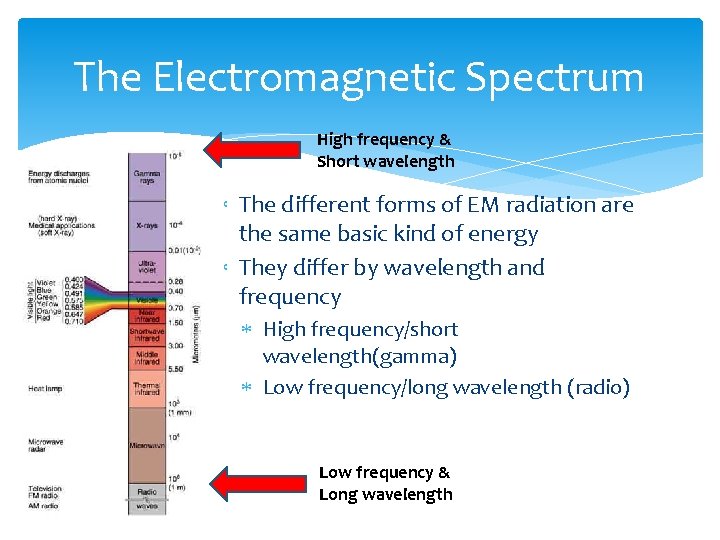
The Electromagnetic Spectrum High frequency & Short wavelength The different forms of EM radiation are the same basic kind of energy They differ by wavelength and frequency High frequency/short wavelength(gamma) Low frequency/long wavelength (radio) Low frequency & Long wavelength
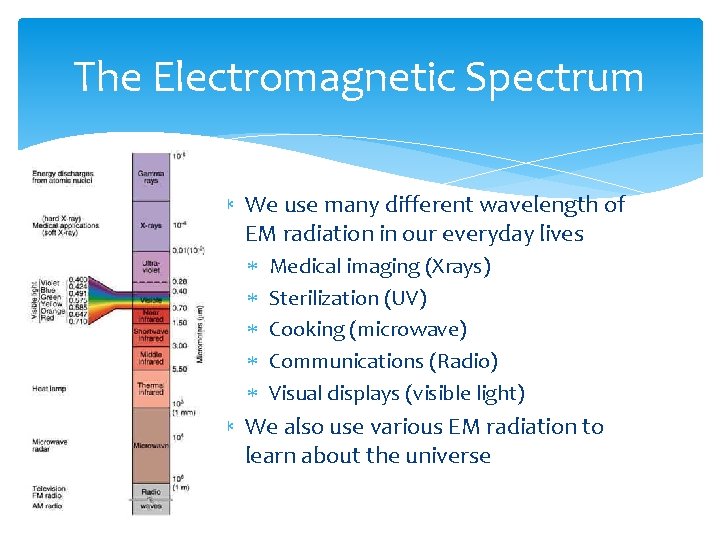
The Electromagnetic Spectrum We use many different wavelength of EM radiation in our everyday lives Medical imaging (Xrays) Sterilization (UV) Cooking (microwave) Communications (Radio) Visual displays (visible light) We also use various EM radiation to learn about the universe
The Early Efforts Visible light from nearby celestial objects have been observed for millenia The Sun, planets, stars, comets, meteors, supernovae Little was known about these objects, so myths grew around them Basic patterns of motion over time were documented These studies formed the basis of mathematics and Science
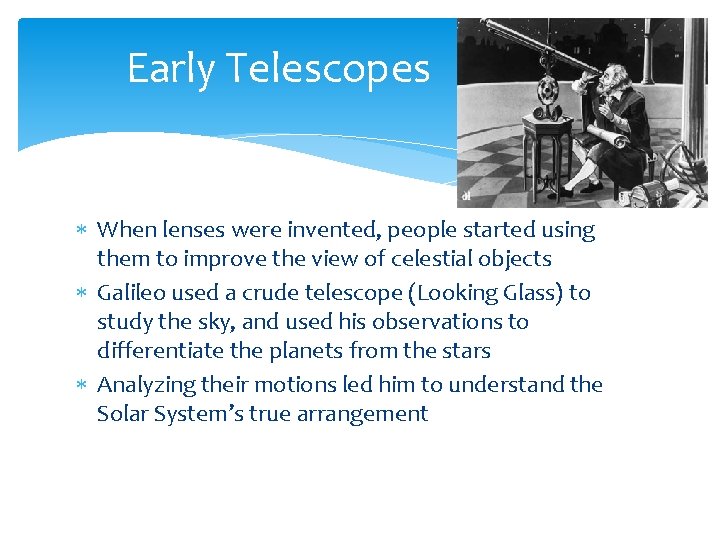
Early Telescopes When lenses were invented, people started using them to improve the view of celestial objects Galileo used a crude telescope (Looking Glass) to study the sky, and used his observations to differentiate the planets from the stars Analyzing their motions led him to understand the Solar System’s true arrangement
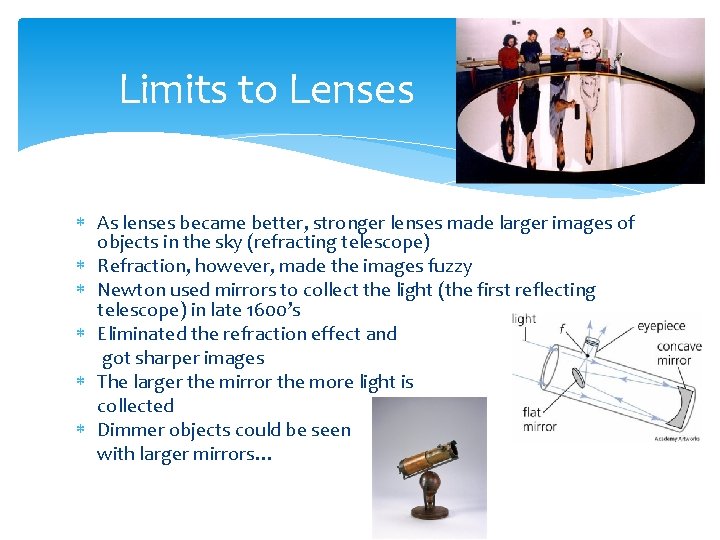
Limits to Lenses As lenses became better, stronger lenses made larger images of objects in the sky (refracting telescope) Refraction, however, made the images fuzzy Newton used mirrors to collect the light (the first reflecting telescope) in late 1600’s Eliminated the refraction effect and got sharper images The larger the mirror the more light is collected Dimmer objects could be seen with larger mirrors…
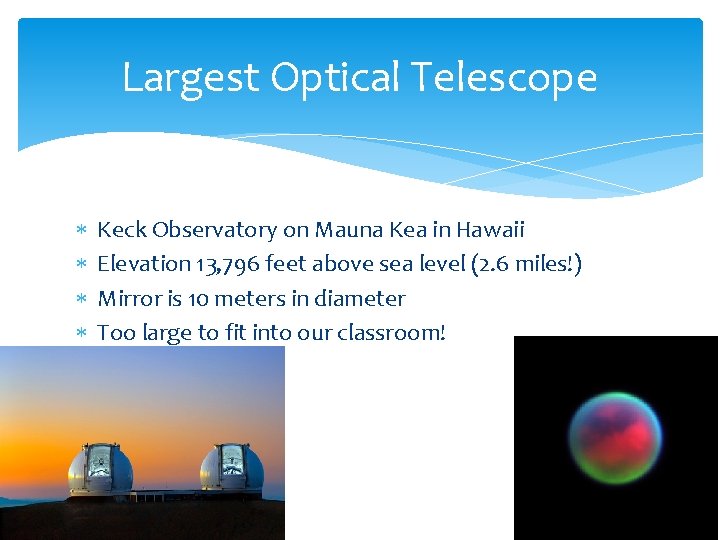
Largest Optical Telescope Keck Observatory on Mauna Kea in Hawaii Elevation 13, 796 feet above sea level (2. 6 miles!) Mirror is 10 meters in diameter Too large to fit into our classroom!
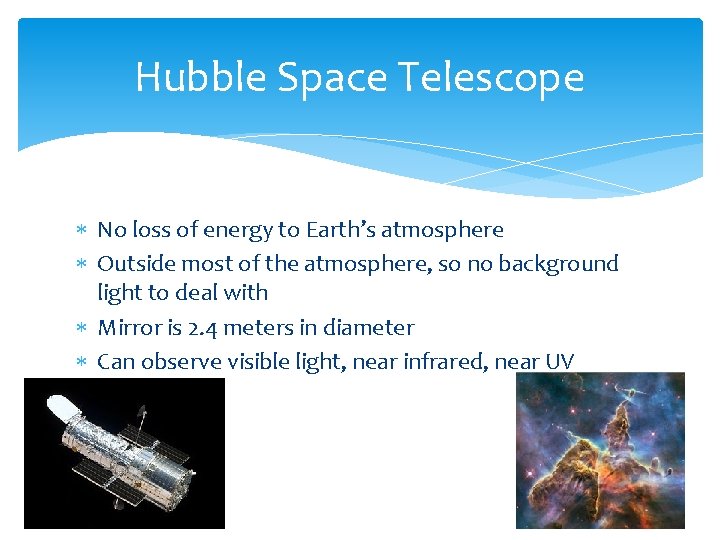
Hubble Space Telescope No loss of energy to Earth’s atmosphere Outside most of the atmosphere, so no background light to deal with Mirror is 2. 4 meters in diameter Can observe visible light, near infrared, near UV
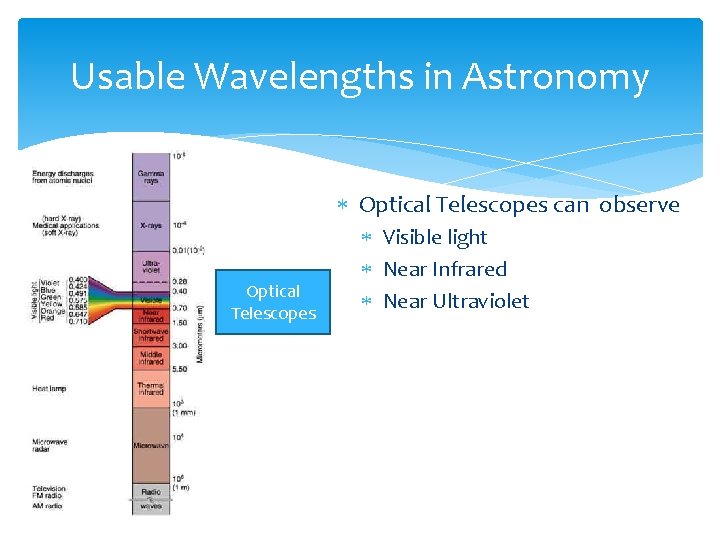
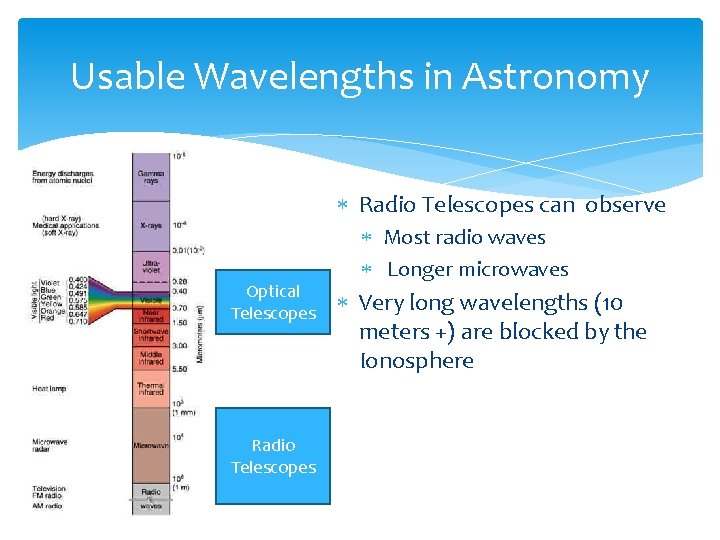
Usable Wavelengths in Astronomy Optical Telescopes can observe Optical Telescopes Visible light Near Infrared Near Ultraviolet
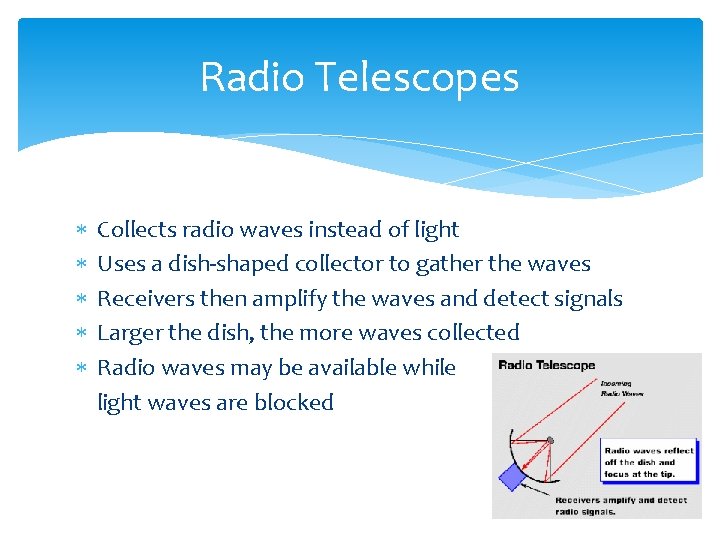
Radio Telescopes Collects radio waves instead of light Uses a dish-shaped collector to gather the waves Receivers then amplify the waves and detect signals Larger the dish, the more waves collected Radio waves may be available while light waves are blocked
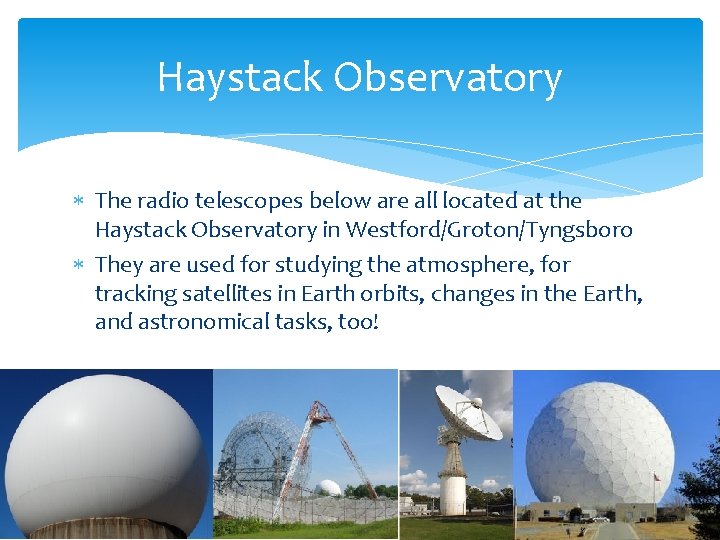
Haystack Observatory The radio telescopes below are all located at the Haystack Observatory in Westford/Groton/Tyngsboro They are used for studying the atmosphere, for tracking satellites in Earth orbits, changes in the Earth, and astronomical tasks, too!
Haystack Observatory IMAGES? ?
Usable Wavelengths in Astronomy Radio Telescopes can observe Optical Telescopes Radio Telescopes Most radio waves Longer microwaves Very long wavelengths (10 meters +) are blocked by the Ionosphere
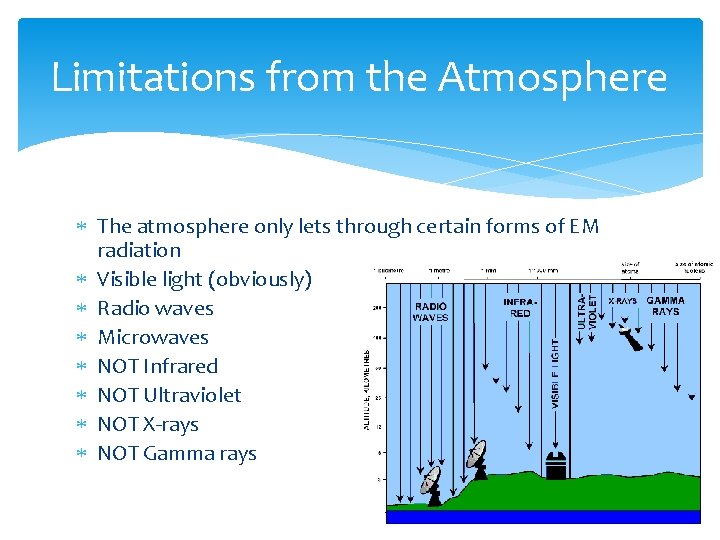
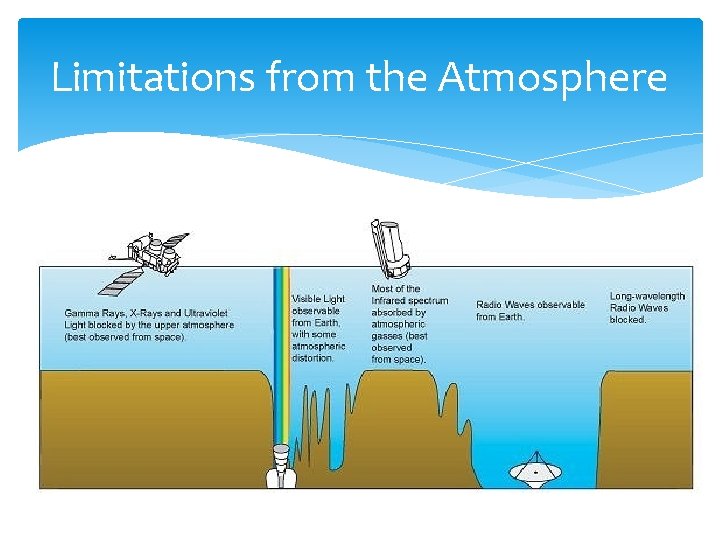
Limitations from the Atmosphere The atmosphere only lets through certain forms of EM radiation Visible light (obviously) Radio waves Microwaves NOT Infrared NOT Ultraviolet NOT X-rays NOT Gamma rays
Limitations from the Atmosphere
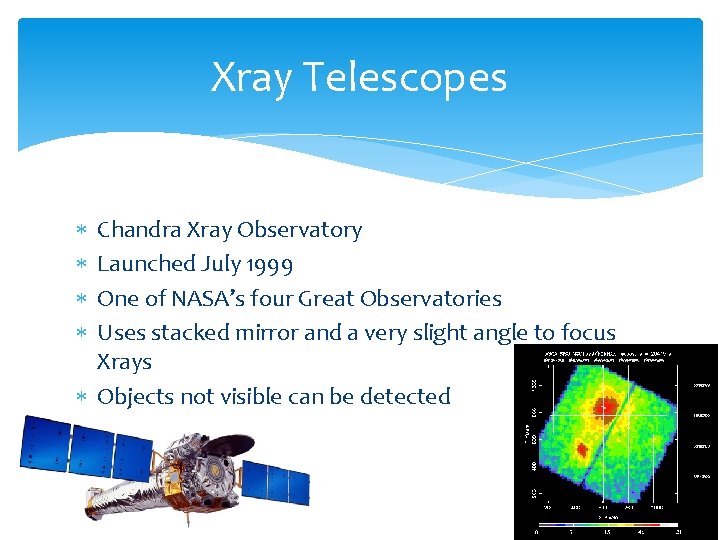
Xray Telescopes Chandra Xray Observatory Launched July 1999 One of NASA’s four Great Observatories Uses stacked mirror and a very slight angle to focus Xrays Objects not visible can be detected
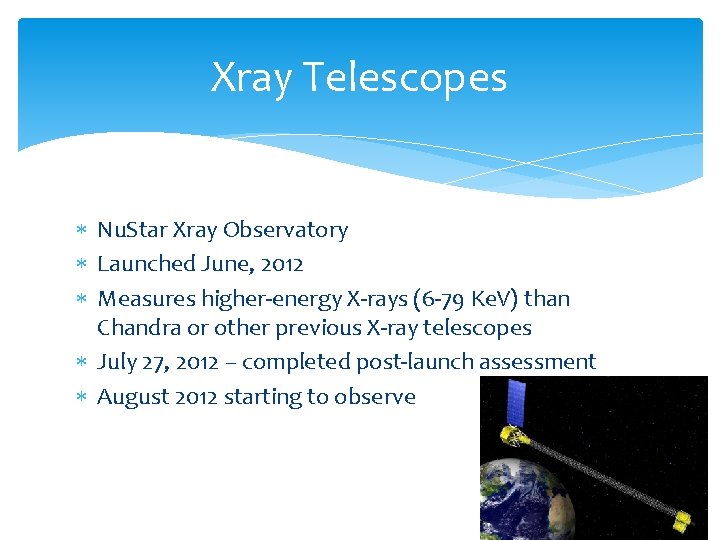
Xray Telescopes Nu. Star Xray Observatory Launched June, 2012 Measures higher-energy X-rays (6 -79 Ke. V) than Chandra or other previous X-ray telescopes July 27, 2012 – completed post-launch assessment August 2012 starting to observe
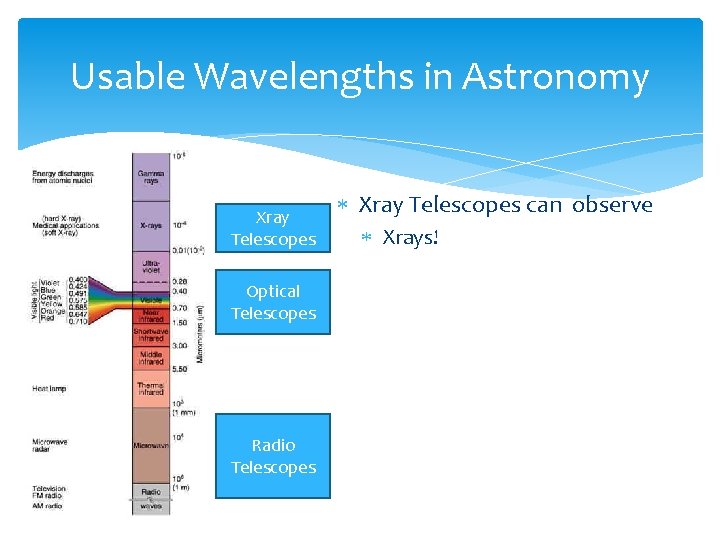
Usable Wavelengths in Astronomy Xray Telescopes Optical Telescopes Radio Telescopes Xray Telescopes can observe Xrays!
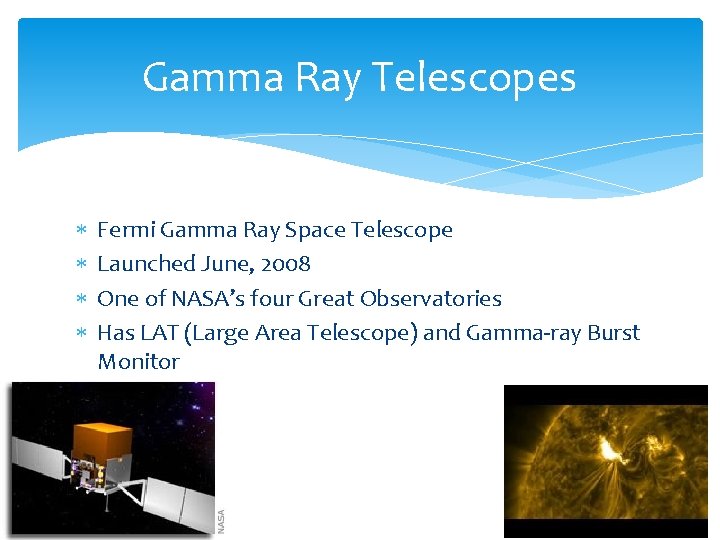
Gamma Ray Telescopes Fermi Gamma Ray Space Telescope Launched June, 2008 One of NASA’s four Great Observatories Has LAT (Large Area Telescope) and Gamma-ray Burst Monitor
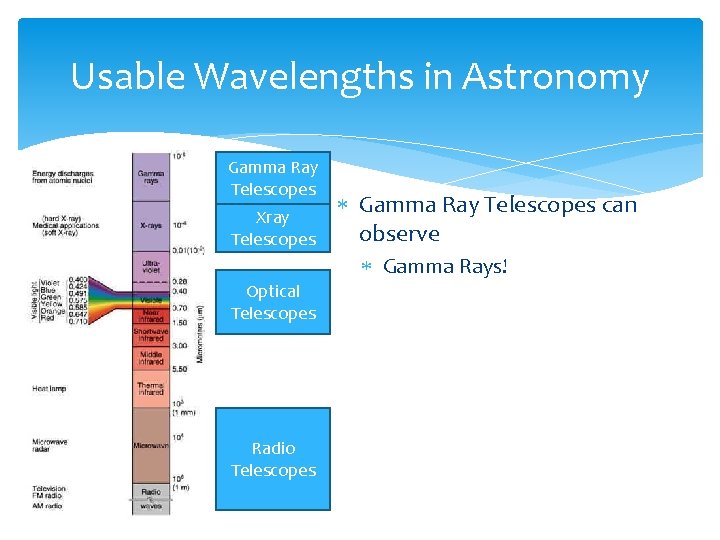
Usable Wavelengths in Astronomy Gamma Ray Telescopes Xray Telescopes Gamma Ray Telescopes can observe Gamma Rays! Optical Telescopes Radio Telescopes
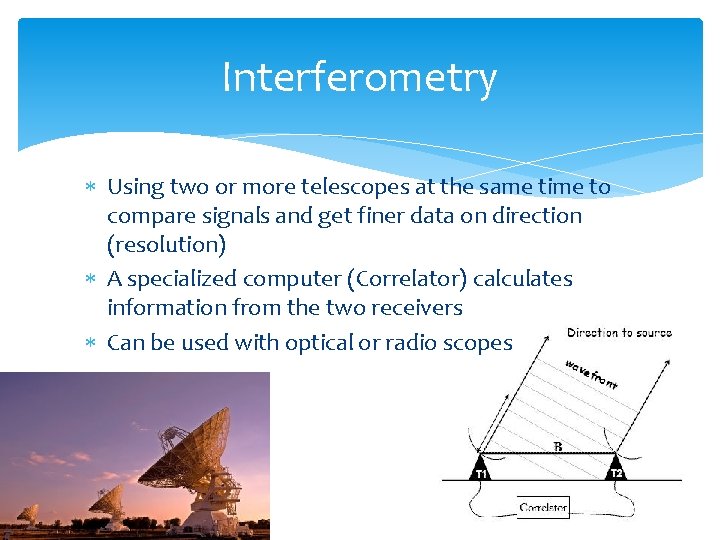
Interferometry Using two or more telescopes at the same time to compare signals and get finer data on direction (resolution) A specialized computer (Correlator) calculates information from the two receivers Can be used with optical or radio scopes
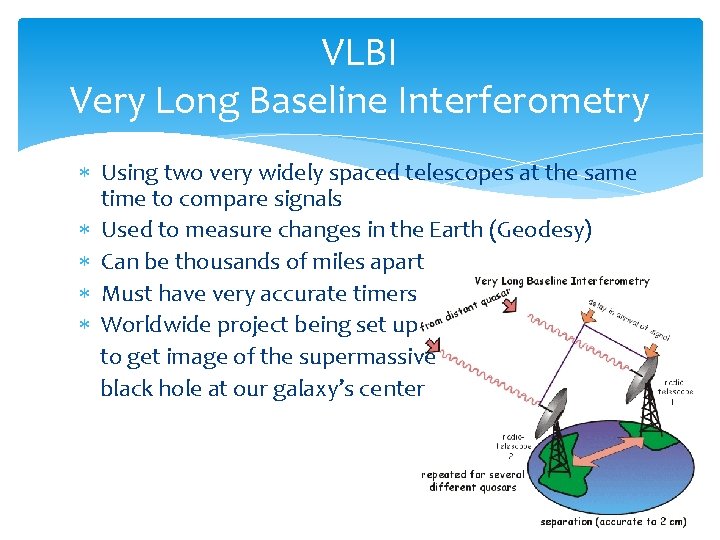
VLBI Very Long Baseline Interferometry Using two very widely spaced telescopes at the same time to compare signals Used to measure changes in the Earth (Geodesy) Can be thousands of miles apart Must have very accurate timers Worldwide project being set up to get image of the supermassive black hole at our galaxy’s center
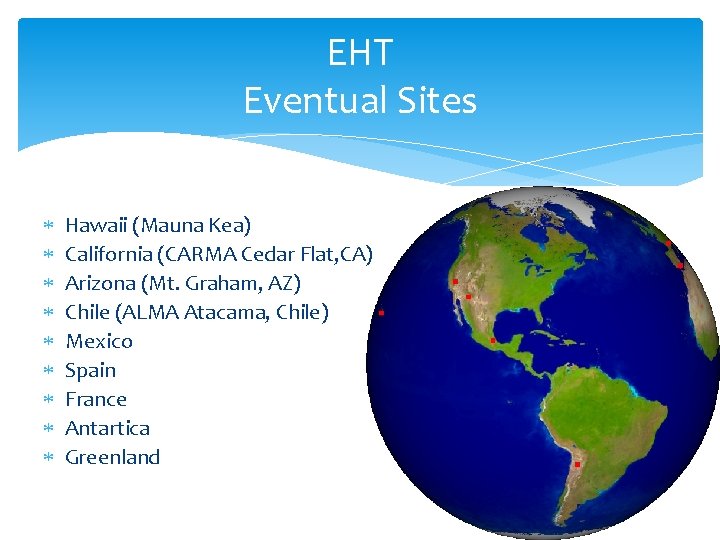
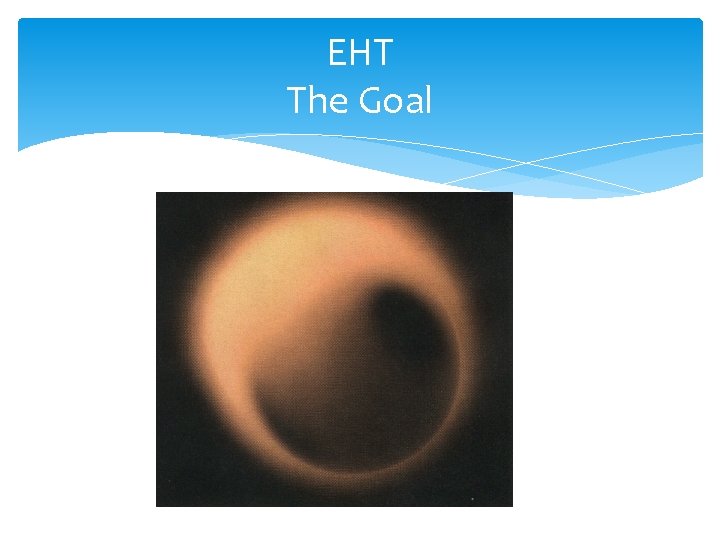
EHT Event Horizon Telescope Project coordinated by Haystack Observatory using radio telescopes around the world to create a network of sites/radio dishes to be able to resolve the Event Horizon of the supermassive black hole at the center of our galaxy, the Milky Way. Sagittarius A* (pronounced “A star”) is optically invisible due to clouds of dust around the galactic core Radio telescopes hope to take the first image of this object around 2016
EHT Event Horizon Telescope Have used radio telescopes in: Hawaii Arizona California Demonstrated the capability of the technology Now adding an additional site Atacama Desert, Chile (ALMA)
EHT Eventual Sites Hawaii (Mauna Kea) California (CARMA Cedar Flat, CA) Arizona (Mt. Graham, AZ) Chile (ALMA Atacama, Chile) Mexico Spain France Antartica Greenland
EHT The Goal