
Types of Application Integration Information Data Oriented IST
- Slides: 12
Types of Application Integration: Information (Data) Oriented IST 421
Information Systems are a network of heterogeneous information sources over which various complex business procedures are executed.
Integration Models There are four general categories to consider for integration: ◦ ◦ Information (data)-oriented Business process integration-oriented Service-oriented Portal-oriented
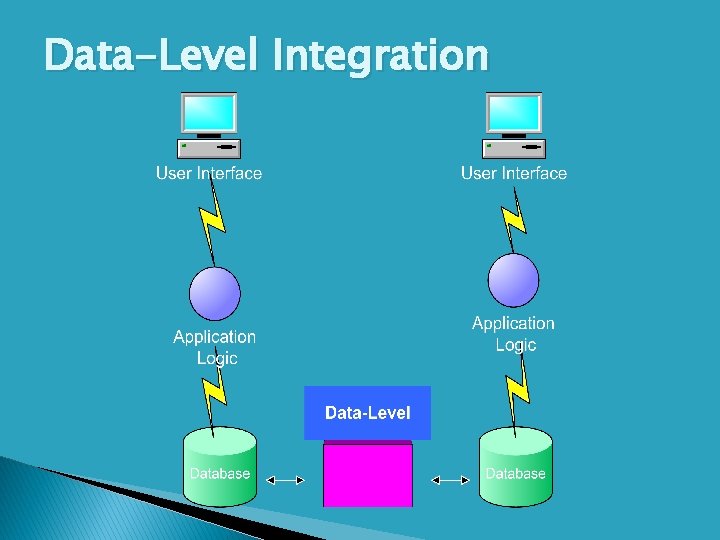
Data-Level Integration
Information-Oriented Problem domains: ◦ Moving data between traditional mainframe, fileoriented databases and relational databases ◦ Relational databases to object databases ◦ Multi-dimensional databases to mainframe databases ◦ Unstructured Content Integration Documents, audio, video & graphic files
Information-Oriented Source and Target systems produce and consume information Extract, Transform, and Load (ETL) tools Pattern follows: ◦ ◦ Database (SQL or JDBC) Application (API) User interface (Screen scraping) Embedded device (API type interface)
When to Use it Combine data from multiple sources for analysis and decision making Provide multiple applications with read access to a common source of information Allow data to be extracted from one source and reformatted and updated in another
Data-Level Integration Advantages: ◦ Tools and techniques currently exist ◦ Relatively easy and in wide use ◦ Requires no changes to the application logic or database structure ◦ Provides access to a wider range of simple data ◦ Allows data to be reused across other applications
Data-Level Integration Disadvantages: ◦ Need to rewrite business logic ◦ Need to understand application semantics between source and target systems
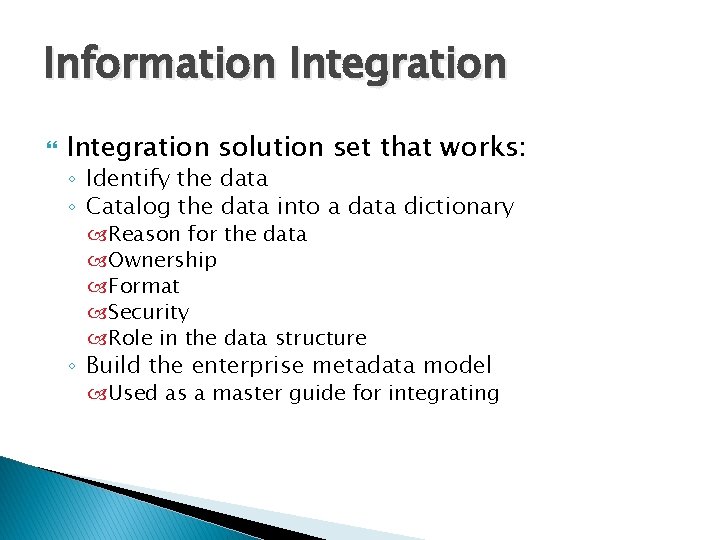
Information Integration solution set that works: ◦ Identify the data ◦ Catalog the data into a data dictionary Reason for the data Ownership Format Security Role in the data structure ◦ Build the enterprise metadata model Used as a master guide for integrating
Information Integration Maintain integrity issues Data latency ◦ Real time ◦ Near time ◦ One time
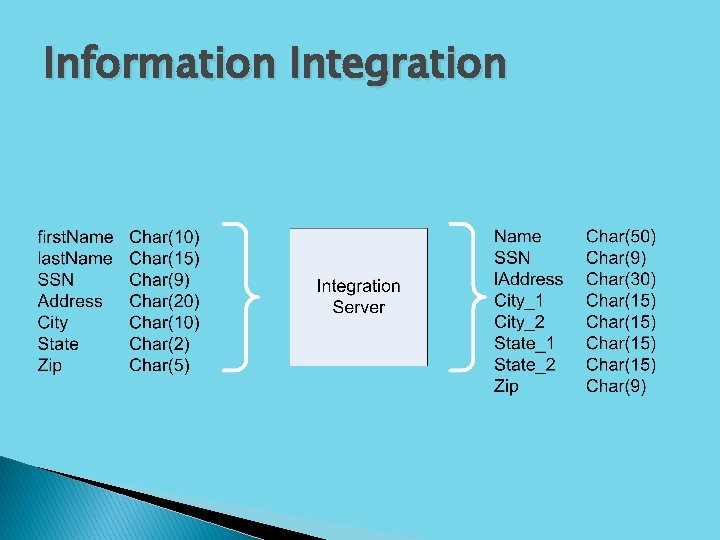
Information Integration