
Types and Values type a set of elements




- Slides: 33
Types and Values
type – a set of elements having common computational characteristics
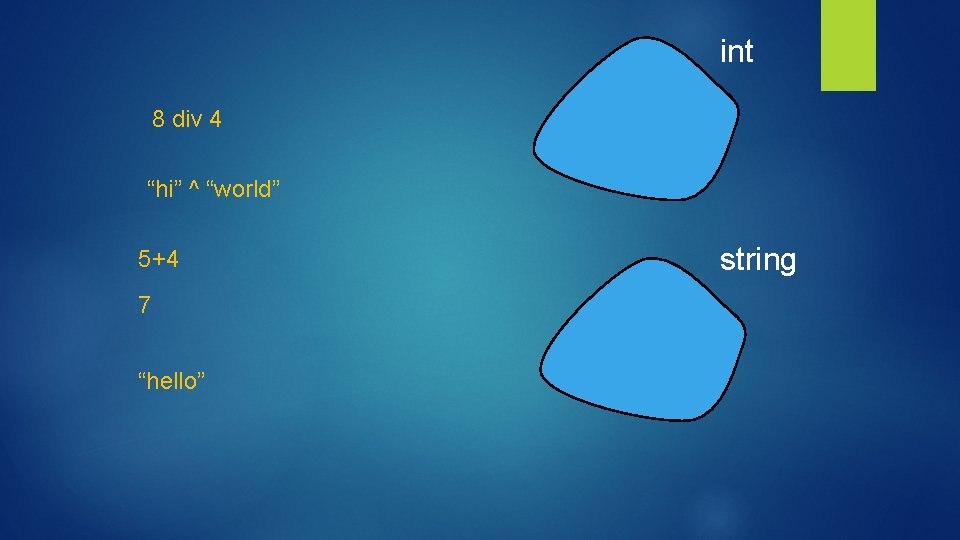
Types int string Various types corresponding to tuples
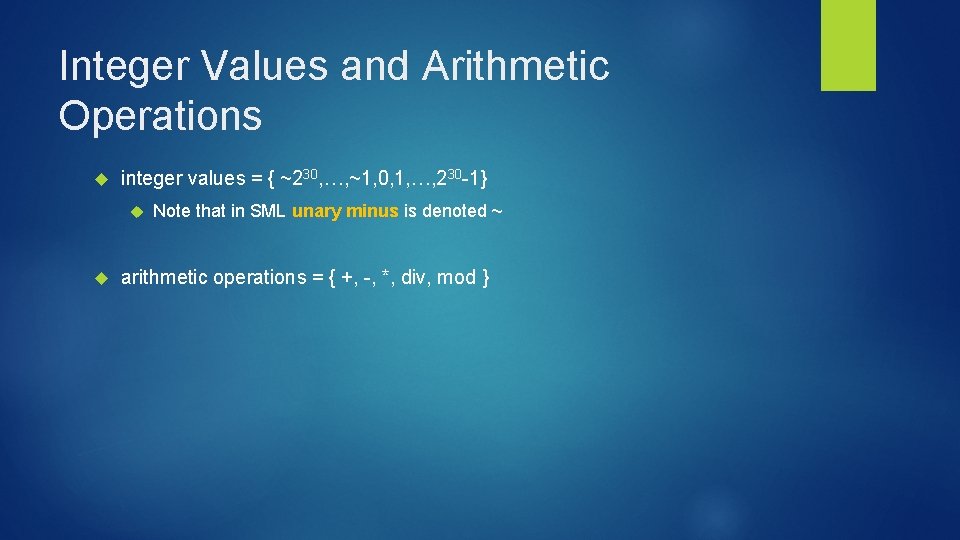
Integer Values and Arithmetic Operations integer values = { ~230, …, ~1, 0, 1, …, 230 -1} Note that in SML unary minus is denoted ~ arithmetic operations = { +, -, *, div, mod }
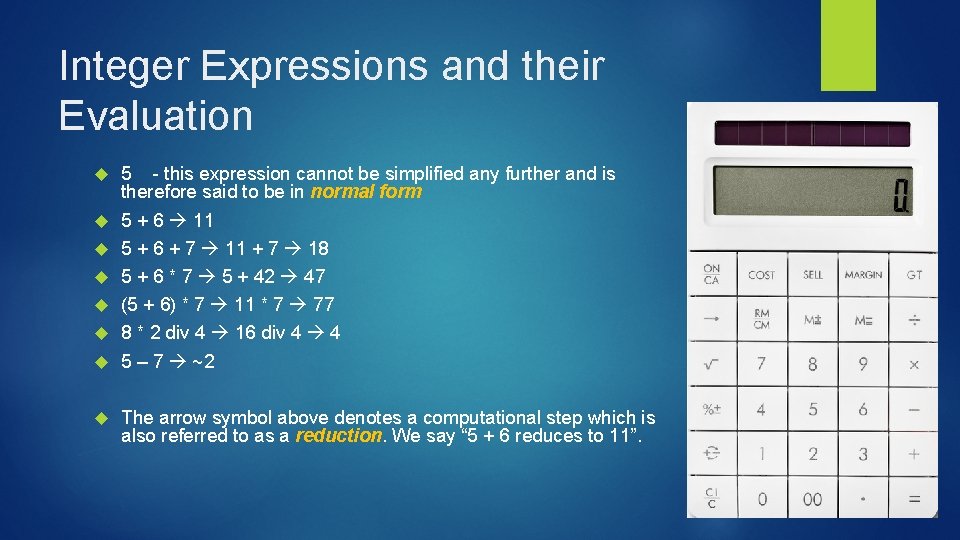
Integer Expressions and their Evaluation 5 - this expression cannot be simplified any further and is therefore said to be in normal form 5 + 6 11 5 + 6 + 7 11 + 7 18 5 + 6 * 7 5 + 42 47 (5 + 6) * 7 11 * 7 77 8 * 2 div 4 16 div 4 4 5 – 7 ~2 The arrow symbol above denotes a computational step which is also referred to as a reduction. We say “ 5 + 6 reduces to 11”.
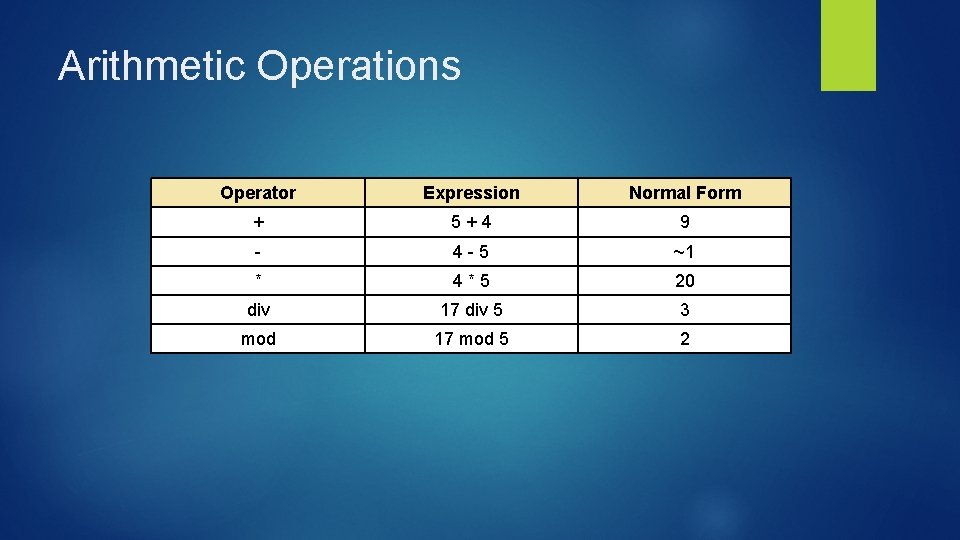
Arithmetic Operations Operator Expression Normal Form + 5 + 4 9 - 4 - 5 ~1 * 4 * 5 20 div 17 div 5 3 mod 17 mod 5 2
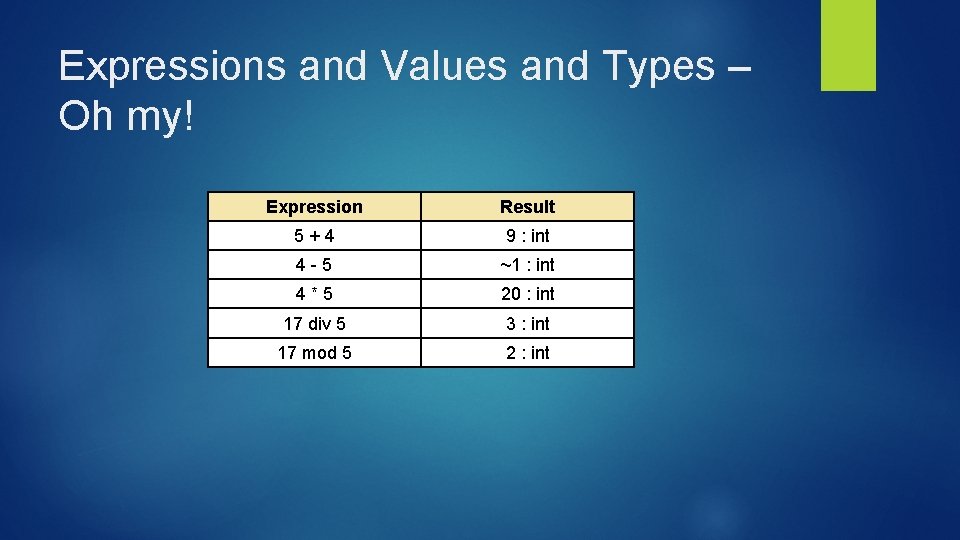
Expressions and Values and Types – Oh my! Expression Result 5 + 4 9 : int 4 - 5 ~1 : int 4 * 5 20 : int 17 div 5 3 : int 17 mod 5 2 : int
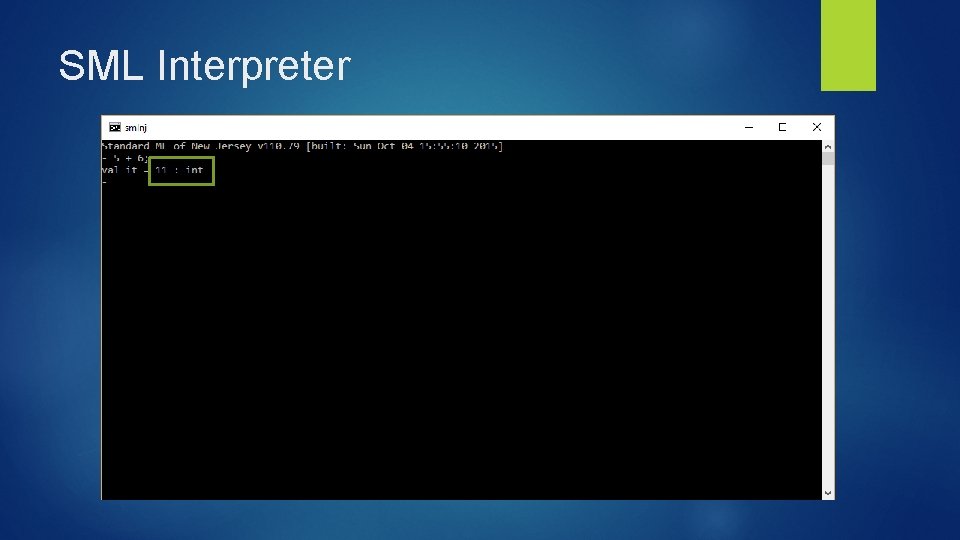
SML Interpreter
String values and Operations string values = { “”, “a”, …, some large string } string operation = { ^ }
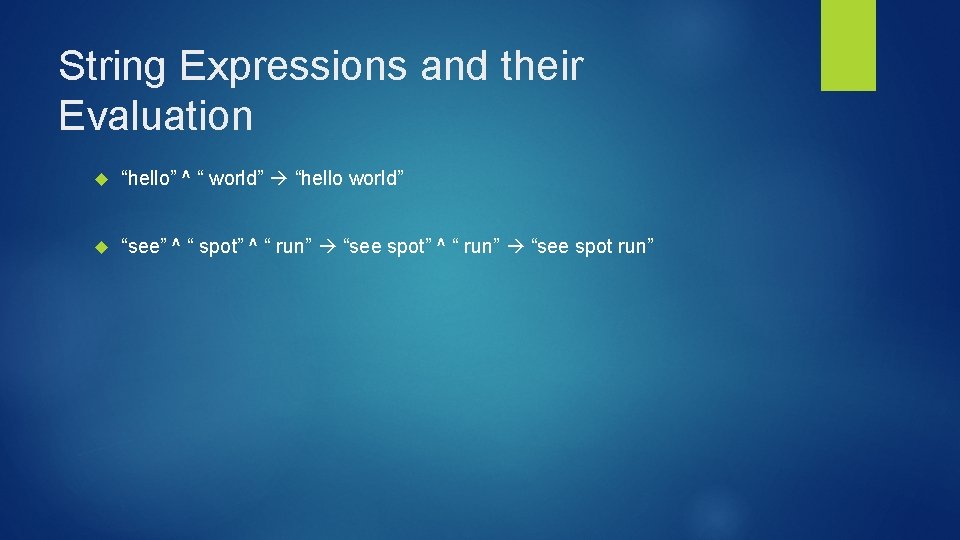
String Expressions and their Evaluation “hello” ^ “ world” “hello world” “see” ^ “ spot” ^ “ run” “see spot run”
String Operations Operator Expression Normal Form ^ “hello” ^ “ world” “hello world”
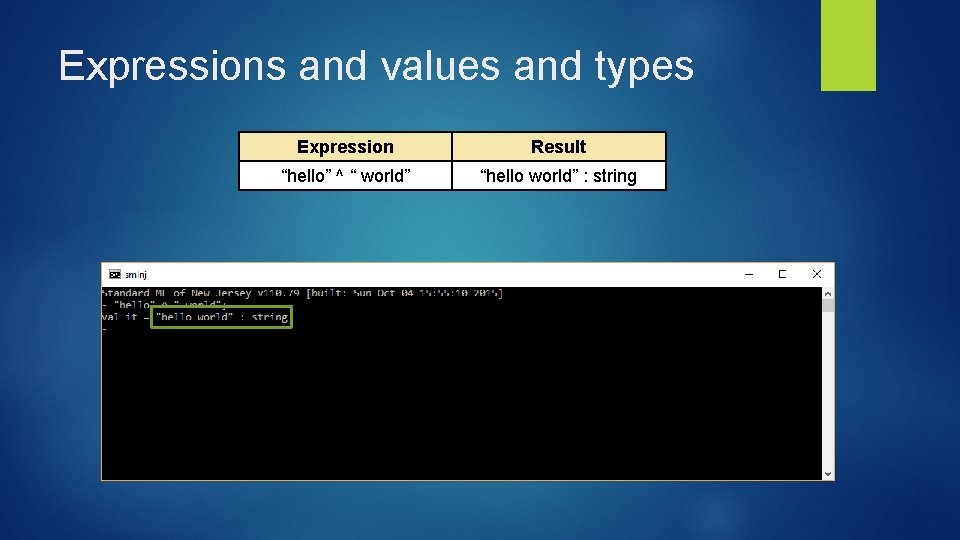
Expressions and values and types Expression Result “hello” ^ “ world” “hello world” : string
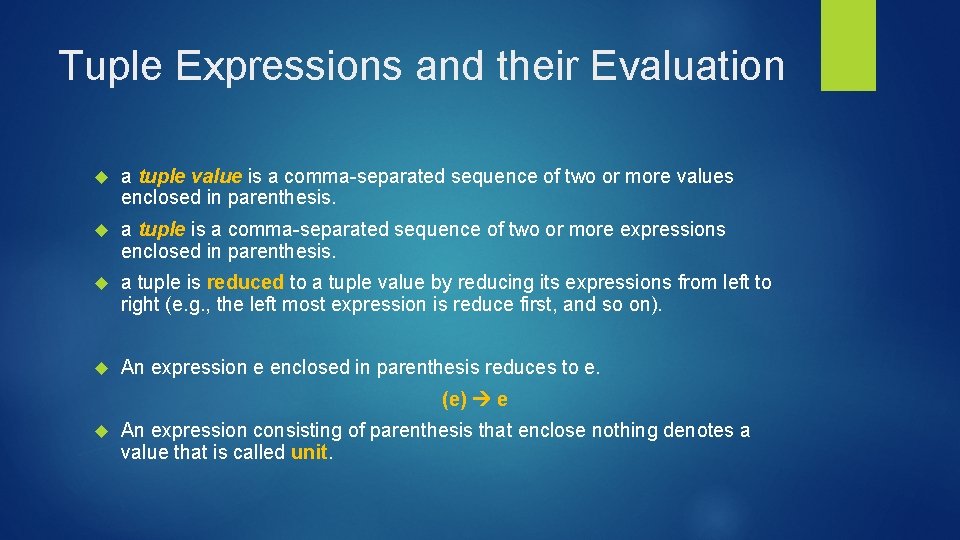
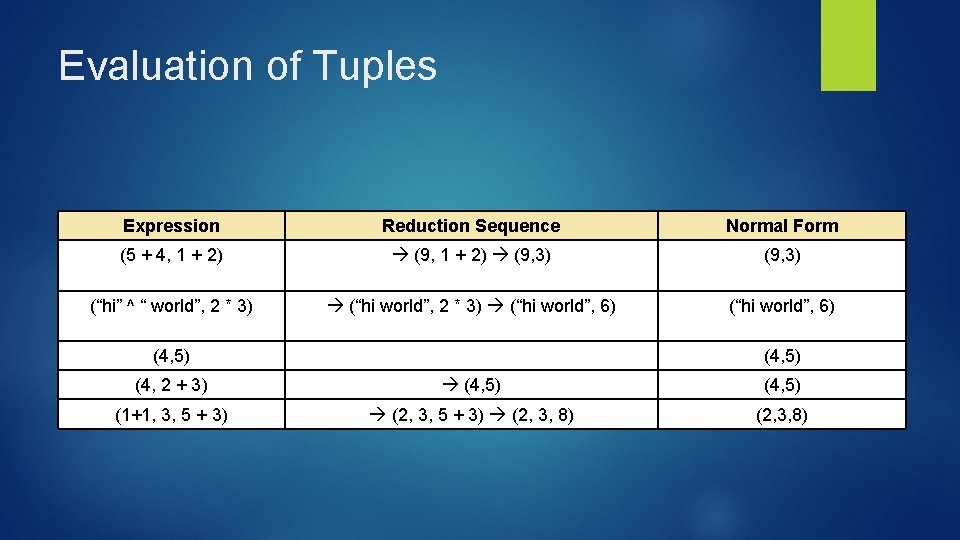
Tuple Expressions and their Evaluation a tuple value is a comma-separated sequence of two or more values enclosed in parenthesis. a tuple is a comma-separated sequence of two or more expressions enclosed in parenthesis. a tuple is reduced to a tuple value by reducing its expressions from left to right (e. g. , the left most expression is reduce first, and so on). An expression e enclosed in parenthesis reduces to e. (e) e An expression consisting of parenthesis that enclose nothing denotes a value that is called unit.
Evaluation of Tuples Expression Reduction Sequence Normal Form (5 + 4, 1 + 2) (9, 3) (“hi” ^ “ world”, 2 * 3) (“hi world”, 6) (4, 5) (4, 2 + 3) (4, 5) (1+1, 3, 5 + 3) (2, 3, 8)
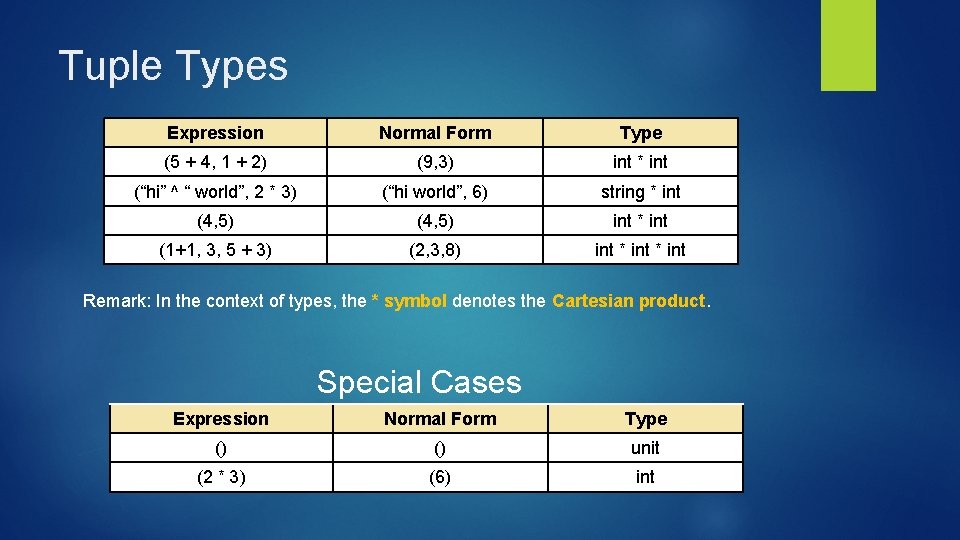
Tuple Types Expression Normal Form Type (5 + 4, 1 + 2) (9, 3) int * int (“hi” ^ “ world”, 2 * 3) (“hi world”, 6) string * int (4, 5) int * int (1+1, 3, 5 + 3) (2, 3, 8) int * int Remark: In the context of types, the * symbol denotes the Cartesian product. Special Cases Expression Normal Form Type () () unit (2 * 3) (6) int
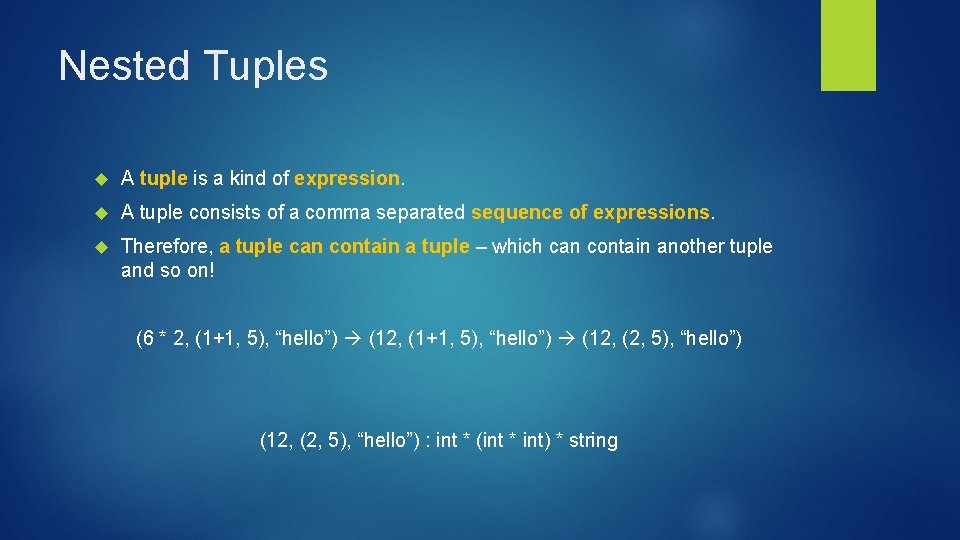
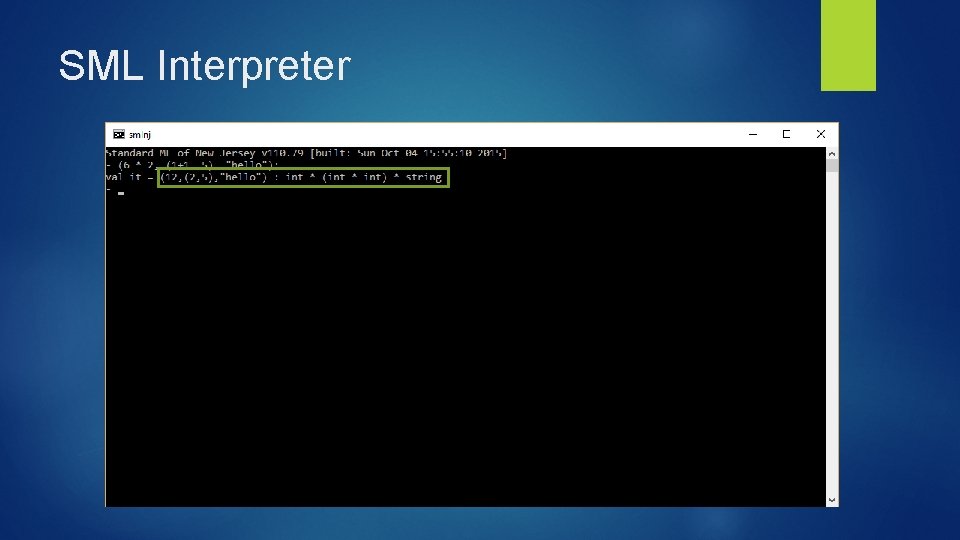
Nested Tuples A tuple is a kind of expression. A tuple consists of a comma separated sequence of expressions. Therefore, a tuple can contain a tuple – which can contain another tuple and so on! (6 * 2, (1+1, 5), “hello”) (12, (2, 5), “hello”) : int * (int * int) * string
SML Interpreter
Variables, Names, and Identifiers
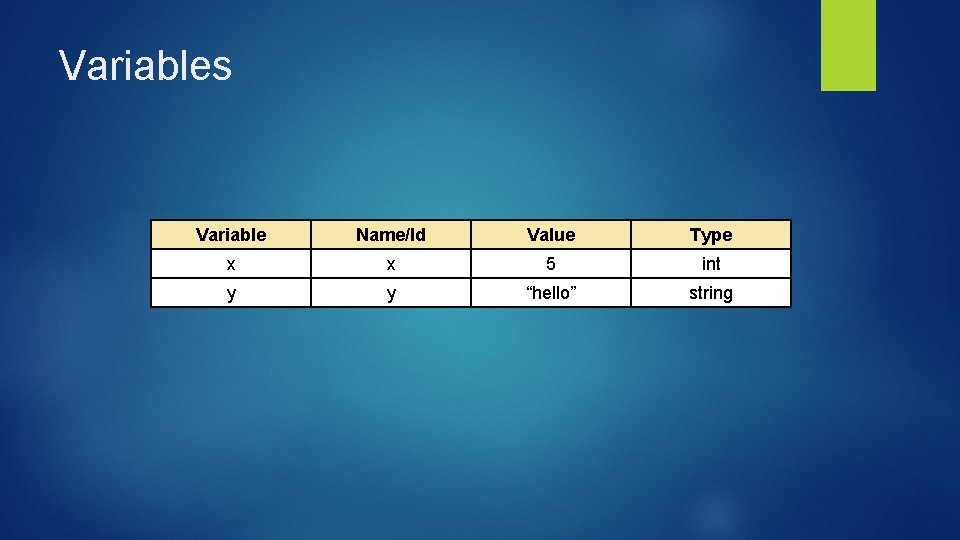
Variables In SML, a variable is a language construct which can be associated with (i. e. , bound to) a value and a type. A variable is bound to the result of a computation (i. e. , its normal form). In books on programming languages, the terms variable, name, and identifier (id) are often used loosely in an interchangeable manner. Conceptually, a variable represents a place where values (and types) can be stored. An identifier is how the value in a place can be referenced within a program.
Variables Variable Name/Id Value Type x x 5 int y y “hello” string
Function Names In Bricklayer Level 2, we are interested in declaring functions. Part of a function declaration involves giving a name to the function. The understanding of a function can be significantly improved by naming it appropriately. In order to do this, it helps to have an understanding of the rules constraining the choice of names (aka identifiers).
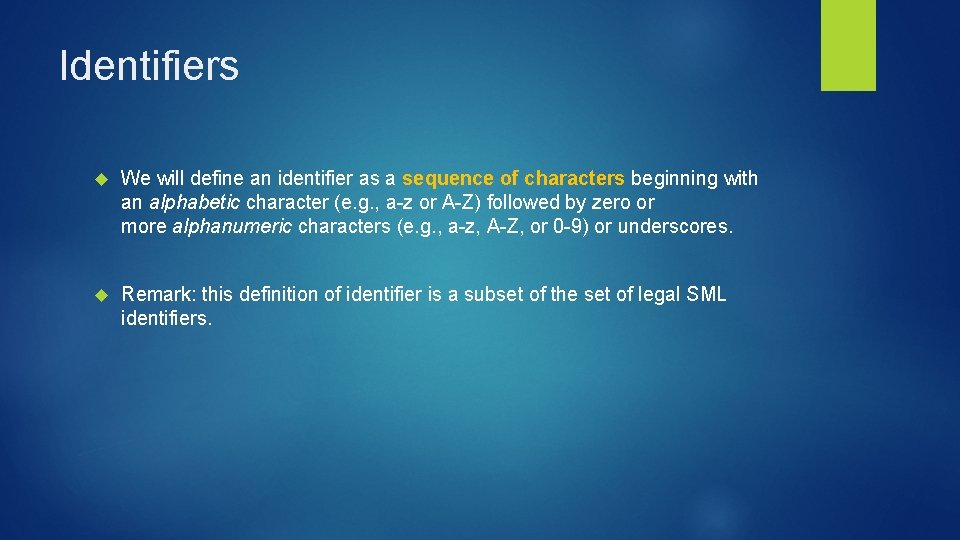
Identifiers We will define an identifier as a sequence of characters beginning with an alphabetic character (e. g. , a-z or A-Z) followed by zero or more alphanumeric characters (e. g. , a-z, A-Z, or 0 -9) or underscores. Remark: this definition of identifier is a subset of the set of legal SML identifiers.
Tokens and Spaces
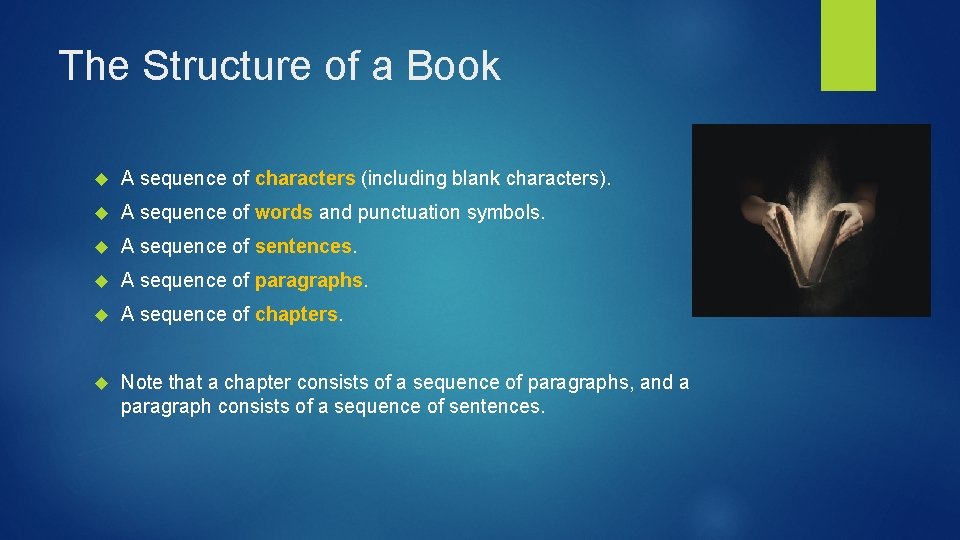
The Structure of a Book A sequence of characters (including blank characters). A sequence of words and punctuation symbols. A sequence of sentences. A sequence of paragraphs. A sequence of chapters. Note that a chapter consists of a sequence of paragraphs, and a paragraph consists of a sequence of sentences.
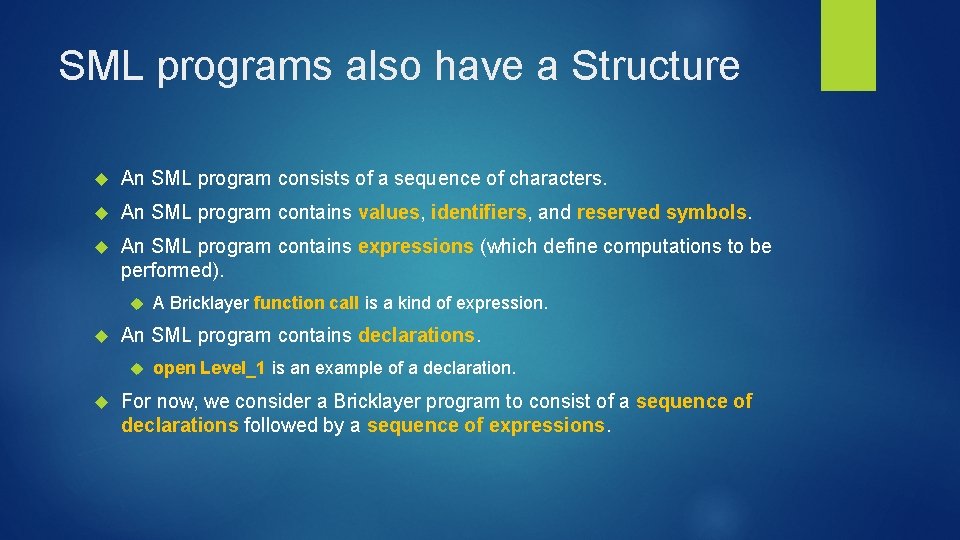
SML programs also have a Structure An SML program consists of a sequence of characters. An SML program contains values, identifiers, and reserved symbols. An SML program contains expressions (which define computations to be performed). An SML program contains declarations. A Bricklayer function call is a kind of expression. open Level_1 is an example of a declaration. For now, we consider a Bricklayer program to consist of a sequence of declarations followed by a sequence of expressions.
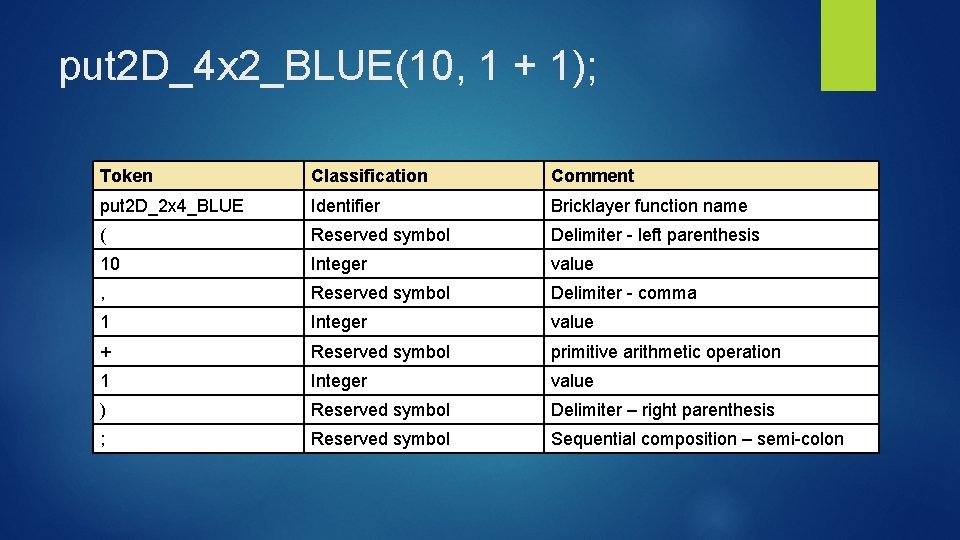
Lexical Analysis A sequence of characters can be converted into a sequence of tokens through a process called lexical analysis. Tokens correspond to values, identifiers, and reserved symbols. During lexical analysis white space is discarded.
put 2 D_4 x 2_BLUE(10, 1 + 1); Token Classification Comment put 2 D_2 x 4_BLUE Identifier Bricklayer function name ( Reserved symbol Delimiter - left parenthesis 10 Integer value , Reserved symbol Delimiter - comma 1 Integer value + Reserved symbol primitive arithmetic operation 1 Integer value ) Reserved symbol Delimiter – right parenthesis ; Reserved symbol Sequential composition – semi-colon
Type Systems
Type Systems In a strongly typed programming language, a type system classifies expressions according to their type (e. g. , int, string). Most (but not all) of this analysis can be done prior to executing a program (i. e. , at runtime). Analysis that is done prior to program execution is called static analysis. Analysis (or checks) that are performed during runtime is called dynamic analysis.
int 8 div 4 “hi” ^ “world” 5+4 7 “hello” string
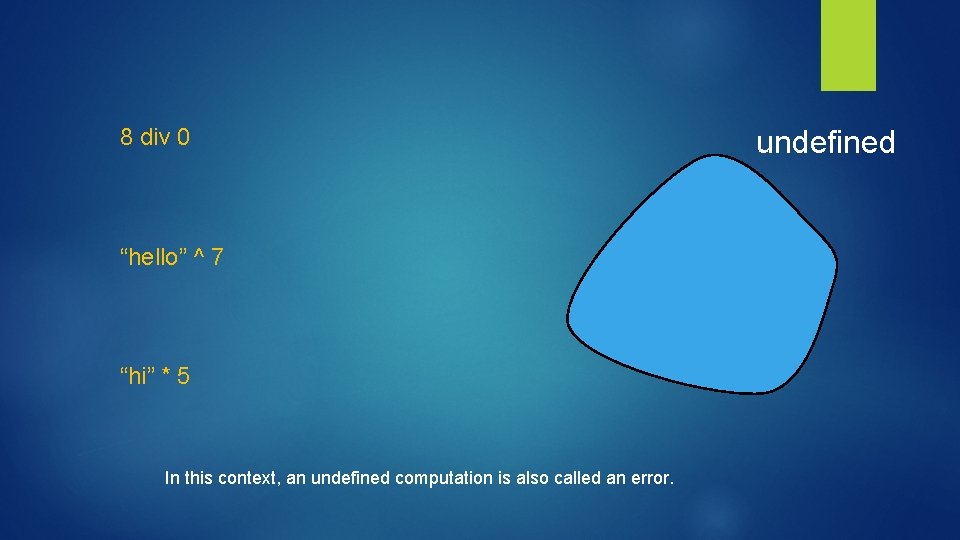
8 div 0 “hello” ^ 7 “hi” * 5 In this context, an undefined computation is also called an error. undefined
error 8 div 0 8 div x ? int
Limits of Static Analysis In general, determining the value of an expression lies beyond the limits of static analysis. Values are determined during program execution (i. e. , at runtime). To be complete, some checks in a type system must be performed at runtime. This slows down program execution.