
Types and Programming Languages Robert Harper In Honor
Types and Programming Languages Robert Harper In Honor of Dana S. Scott October, 2002 Scott. Fest 2002
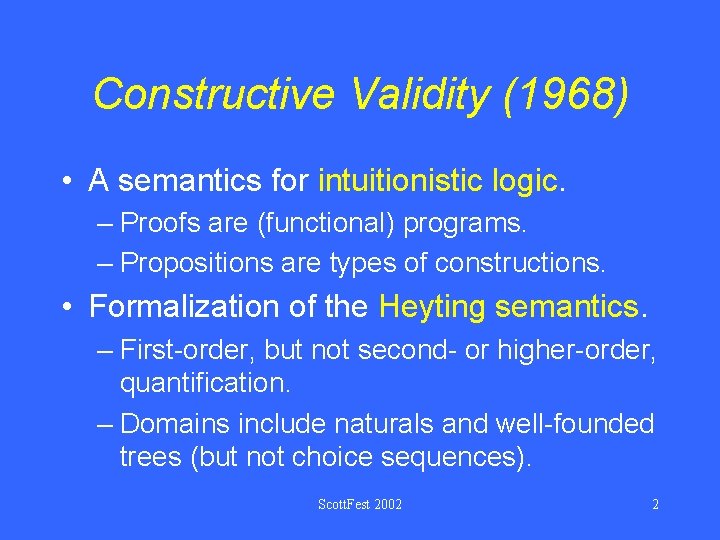
Constructive Validity (1968) • A semantics for intuitionistic logic. – Proofs are (functional) programs. – Propositions are types of constructions. • Formalization of the Heyting semantics. – First-order, but not second- or higher-order, quantification. – Domains include naturals and well-founded trees (but not choice sequences). Scott. Fest 2002 2
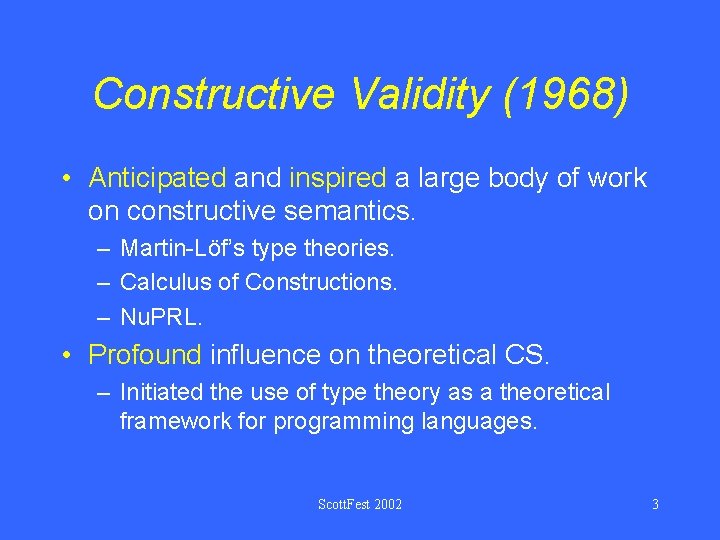
Constructive Validity (1968) • Anticipated and inspired a large body of work on constructive semantics. – Martin-Löf’s type theories. – Calculus of Constructions. – Nu. PRL. • Profound influence on theoretical CS. – Initiated the use of type theory as a theoretical framework for programming languages. Scott. Fest 2002 3
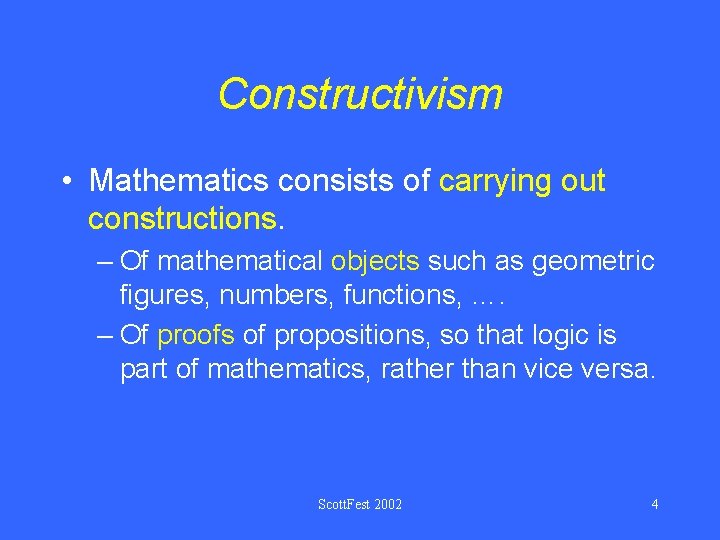
Constructivism • Mathematics consists of carrying out constructions. – Of mathematical objects such as geometric figures, numbers, functions, …. – Of proofs of propositions, so that logic is part of mathematics, rather than vice versa. Scott. Fest 2002 4
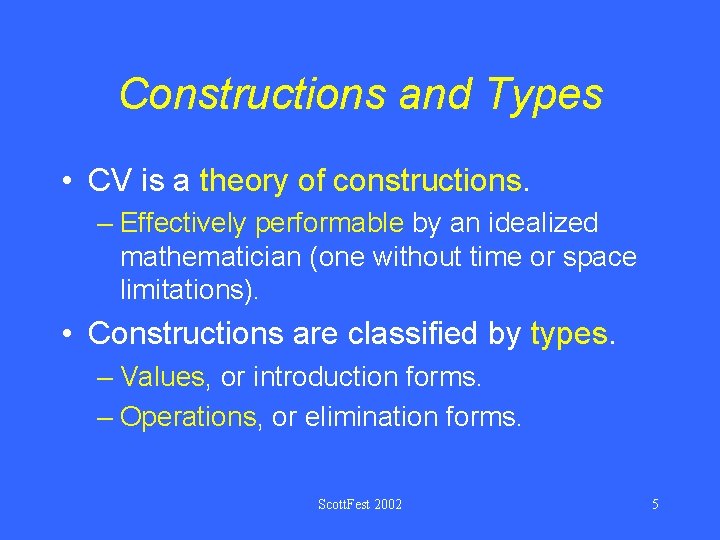
Constructions and Types • CV is a theory of constructions. – Effectively performable by an idealized mathematician (one without time or space limitations). • Constructions are classified by types. – Values, or introduction forms. – Operations, or elimination forms. Scott. Fest 2002 5
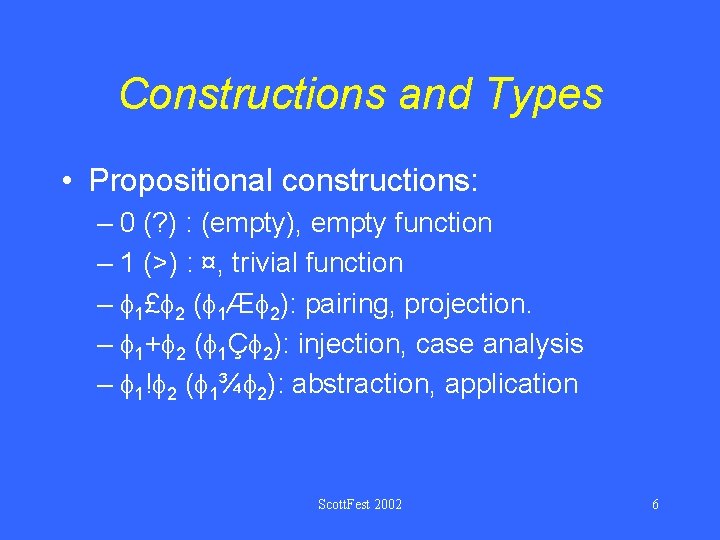
Constructions and Types • Propositional constructions: – 0 (? ) : (empty), empty function – 1 (>) : ¤, trivial function – 1£ 2 ( 1Æ 2): pairing, projection. – 1+ 2 ( 1Ç 2): injection, case analysis – 1! 2 ( 1¾ 2): abstraction, application Scott. Fest 2002 6
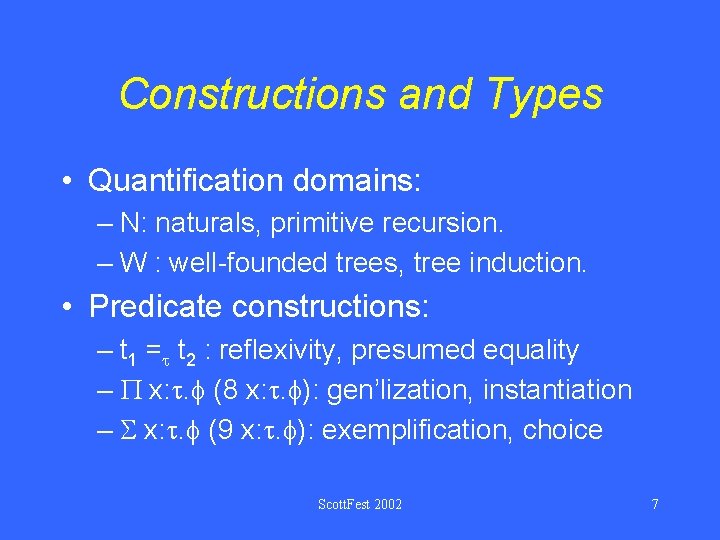
Constructions and Types • Quantification domains: – N: naturals, primitive recursion. – W : well-founded trees, tree induction. • Predicate constructions: – t 1 = t 2 : reflexivity, presumed equality – x: . (8 x: . ): gen’lization, instantiation – x: . (9 x: . ): exemplification, choice Scott. Fest 2002 7
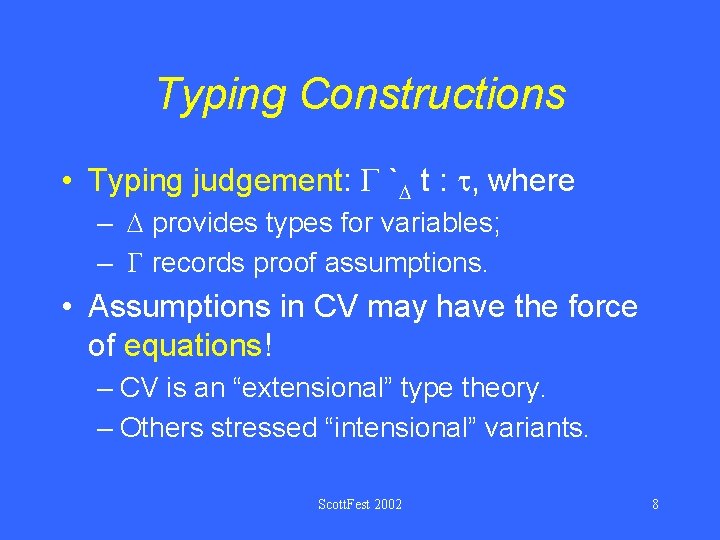
Typing Constructions • Typing judgement: ` t : , where – provides types for variables; – records proof assumptions. • Assumptions in CV may have the force of equations! – CV is an “extensional” type theory. – Others stressed “intensional” variants. Scott. Fest 2002 8
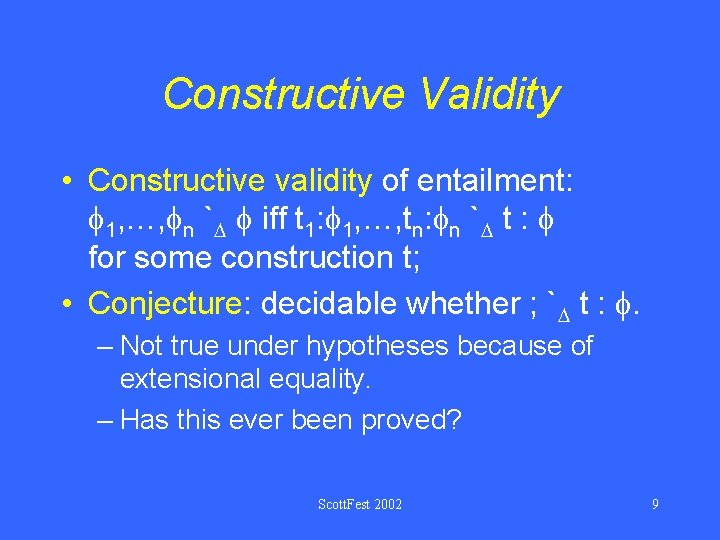
Constructive Validity • Constructive validity of entailment: 1, …, n ` iff t 1: 1, …, tn: n ` t : for some construction t; • Conjecture: decidable whether ; ` t : . – Not true under hypotheses because of extensional equality. – Has this ever been proved? Scott. Fest 2002 9
Types for Programs • Scott’s CV stresses types inspired by logic. – One type constructor for each form of proposition. – Plus types for the domains of quantification. • Constructions are pure functional programs. – Total functions of finite order. – Number and tree recursion. – Simple data structures (tuples, variants, finite sets, naturals, well-founded trees). Scott. Fest 2002 10
Types for Programs • Computer scientists stress programs. – Primary object of study (naturally!). – Types ensure good properties such as type safety, representation independence, invariants. • Scott’s CV suggests the use of types to codify design patterns. – Programming constructs are organized by type. – Programming languages are collections of types. Scott. Fest 2002 11
Types for Programs • How far can we push this idea? – Find logical type systems corresponding to new and known design patterns. • Logical type theory is the GUT of PL’s! – Higher-order logics for generics and abstraction. – Classical logic for non-local control. – Modal logics for meta-programming, effects (see Pfenning’s talk). – Sub-structural (linear, ordered, affine) logics for state change, data layout. Scott. Fest 2002 12
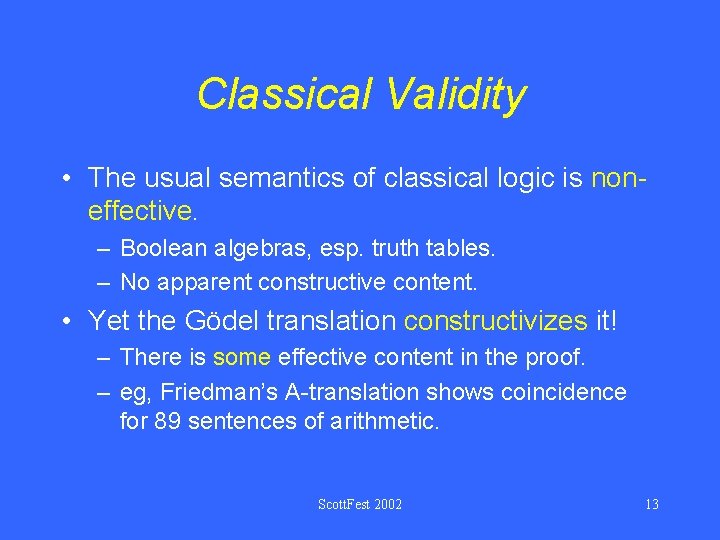
Classical Validity • The usual semantics of classical logic is noneffective. – Boolean algebras, esp. truth tables. – No apparent constructive content. • Yet the Gödel translation constructivizes it! – There is some effective content in the proof. – eg, Friedman’s A-translation shows coincidence for 89 sentences of arithmetic. Scott. Fest 2002 13
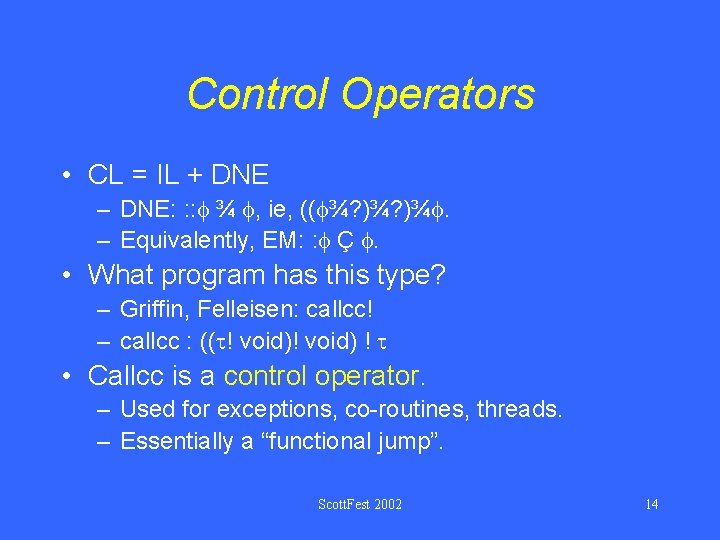
Control Operators • CL = IL + DNE – DNE: : : ¾ , ie, (( ¾? )¾. – Equivalently, EM: : Ç . • What program has this type? – Griffin, Felleisen: callcc! – callcc : (( ! void) ! • Callcc is a control operator. – Used for exceptions, co-routines, threads. – Essentially a “functional jump”. Scott. Fest 2002 14
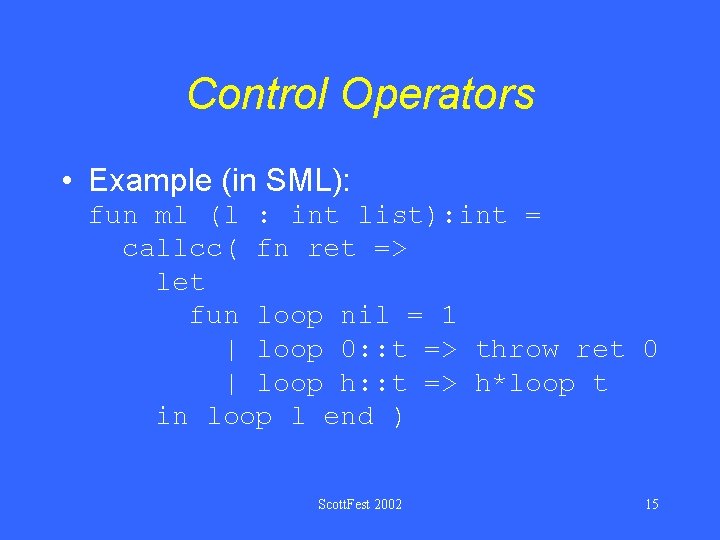
Control Operators • Example (in SML): fun ml (l : int list): int = callcc( fn ret => let fun loop nil = 1 | loop 0: : t => throw ret 0 | loop h: : t => h*loop t in loop l end ) Scott. Fest 2002 15
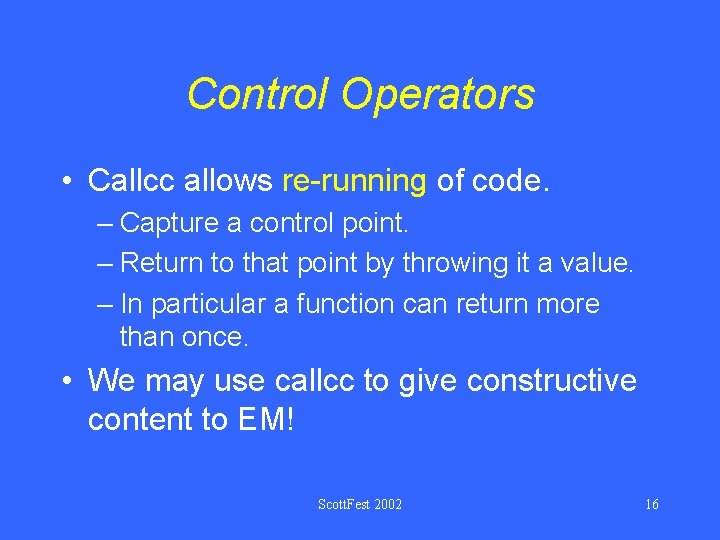
Control Operators • Callcc allows re-running of code. – Capture a control point. – Return to that point by throwing it a value. – In particular a function can return more than once. • We may use callcc to give constructive content to EM! Scott. Fest 2002 16
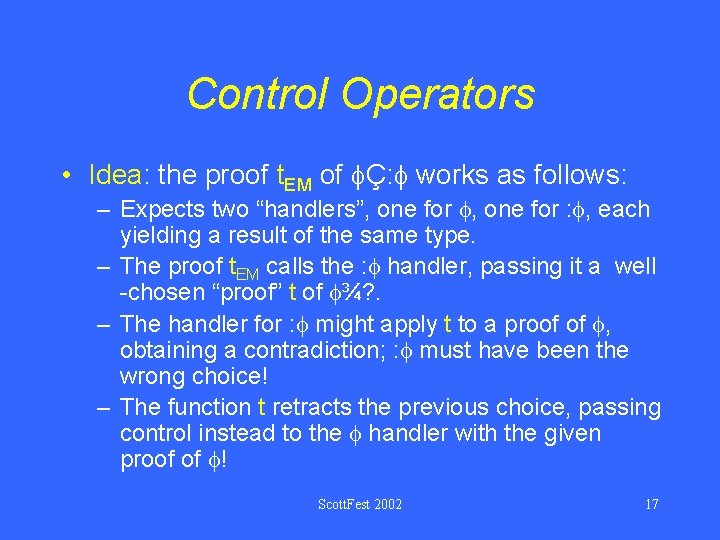
Control Operators • Idea: the proof t. EM of Ç: works as follows: – Expects two “handlers”, one for : , each yielding a result of the same type. – The proof t. EM calls the : handler, passing it a well -chosen “proof” t of ¾? . – The handler for : might apply t to a proof of , obtaining a contradiction; : must have been the wrong choice! – The function t retracts the previous choice, passing control instead to the handler with the given proof of ! Scott. Fest 2002 17
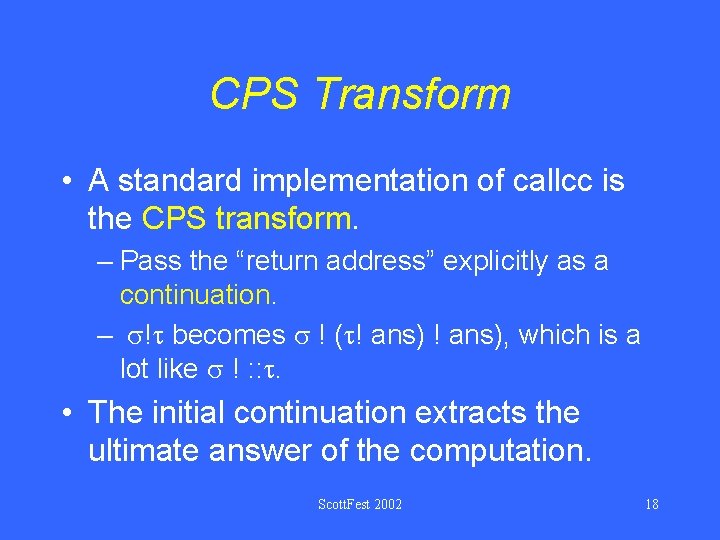
CPS Transform • A standard implementation of callcc is the CPS transform. – Pass the “return address” explicitly as a continuation. – ! becomes ! ( ! ans), which is a lot like ! : : . • The initial continuation extracts the ultimate answer of the computation. Scott. Fest 2002 18
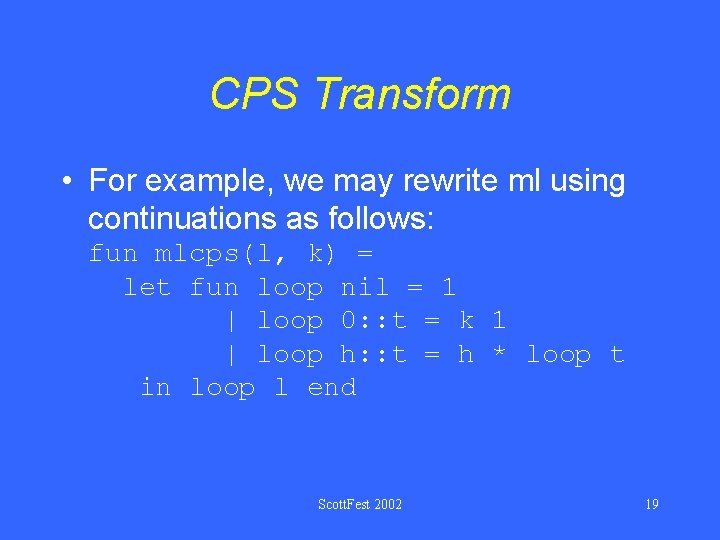
CPS Transform • For example, we may rewrite ml using continuations as follows: fun mlcps(l, k) = let fun loop nil = 1 | loop 0: : t = k 1 | loop h: : t = h * loop t in loop l end Scott. Fest 2002 19
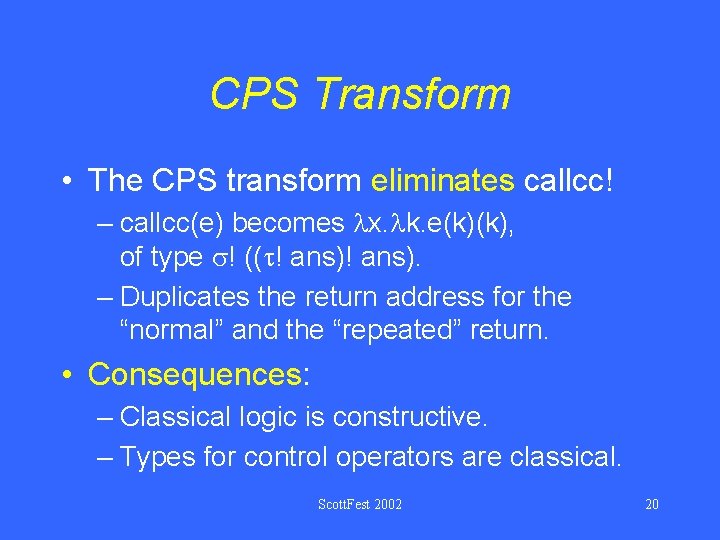
CPS Transform • The CPS transform eliminates callcc! – callcc(e) becomes lx. lk. e(k)(k), of type ! (( ! ans). – Duplicates the return address for the “normal” and the “repeated” return. • Consequences: – Classical logic is constructive. – Types for control operators are classical. Scott. Fest 2002 20
Second-Order Logic • Second-order types / propositions: – 8 . : generics (L. t), instances (t[ ]). – 9 . : packages, data abstraction. • Two independent discoveries: – Reynolds: polymorphism in programming. – Girard: proof theory of higher-order arithmetic. Scott. Fest 2002 21
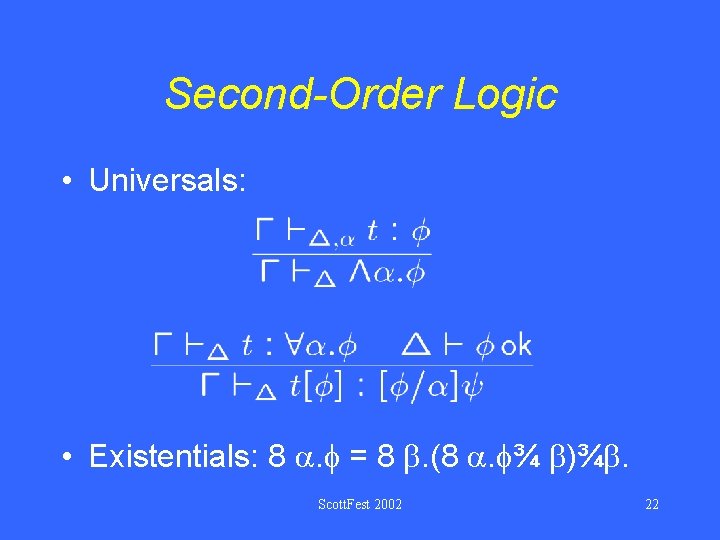
Second-Order Logic • Universals: • Existentials: 8 . = 8 . (8 . ¾ )¾. Scott. Fest 2002 22
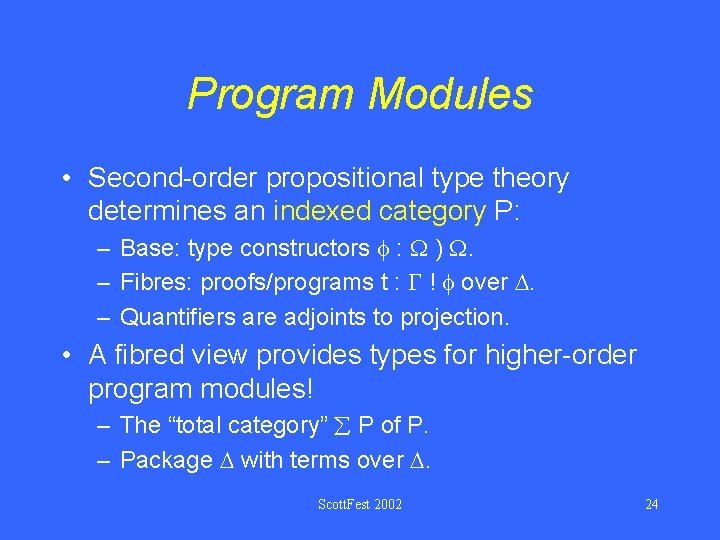
Program Modules • Second-order propositional type theory determines an indexed category P: – Base: type constructors : ) . – Fibres: proofs/programs t : ! over . – Quantifiers are adjoints to projection. • A fibred view provides types for higher-order program modules! – The “total category” P of P. – Package with terms over . Scott. Fest 2002 24
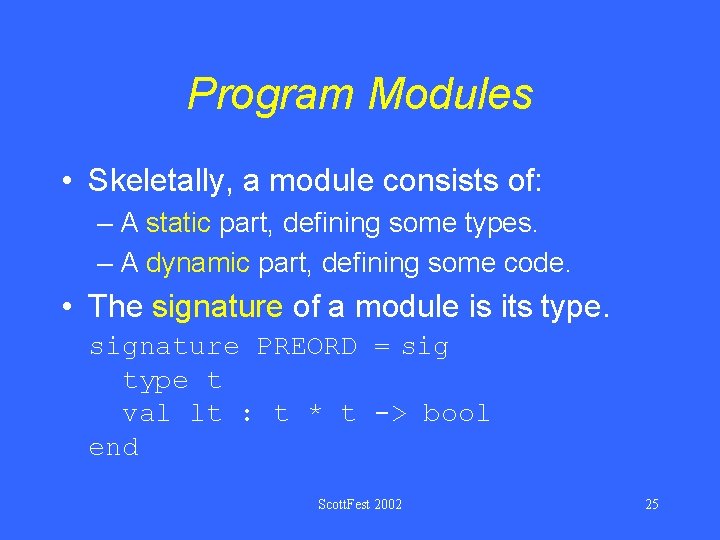
Program Modules • Skeletally, a module consists of: – A static part, defining some types. – A dynamic part, defining some code. • The signature of a module is its type. signature PREORD = sig type t val lt : t * t -> bool end Scott. Fest 2002 25
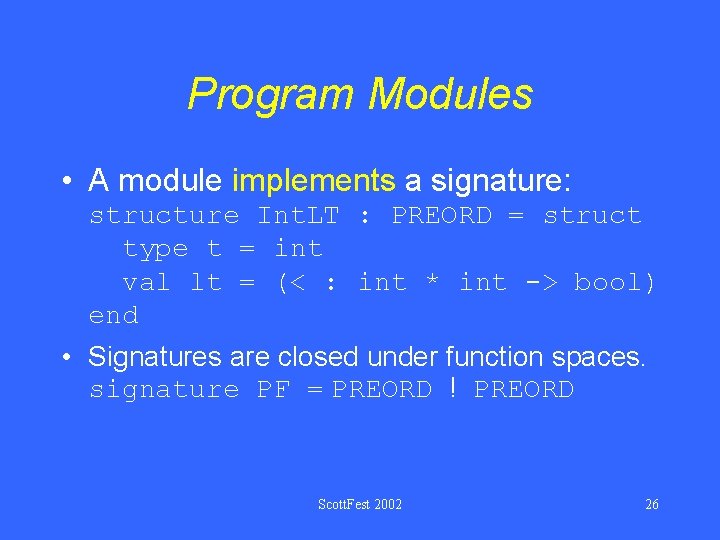
Program Modules • A module implements a signature: structure Int. LT : PREORD = struct type t = int val lt = (< : int * int -> bool) end • Signatures are closed under function spaces. signature PF = PREORD ! PREORD Scott. Fest 2002 26
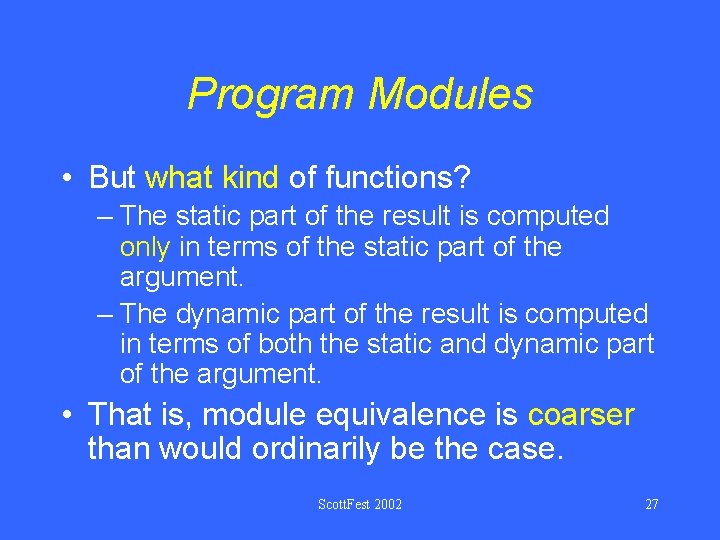
Program Modules • But what kind of functions? – The static part of the result is computed only in terms of the static part of the argument. – The dynamic part of the result is computed in terms of both the static and dynamic part of the argument. • That is, module equivalence is coarser than would ordinarily be the case. Scott. Fest 2002 27
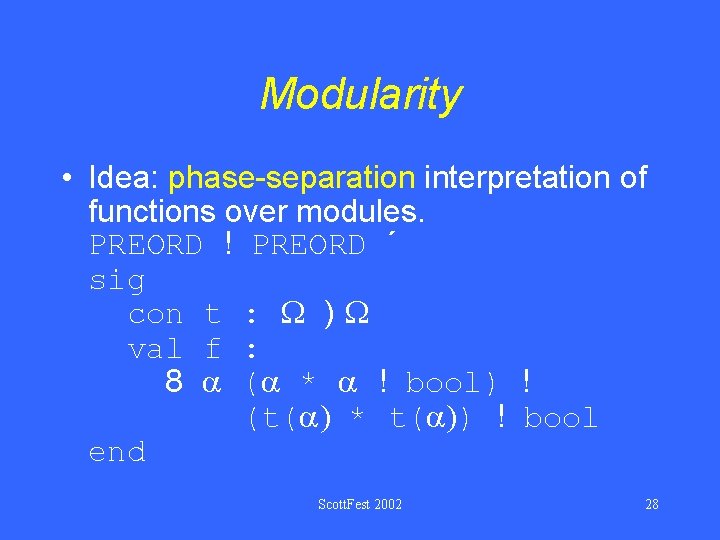
Modularity • Idea: phase-separation interpretation of functions over modules. PREORD ! PREORD ´ sig con t : ) val f : 8 ( * ! bool) ! (t( ) * t( )) ! bool end Scott. Fest 2002 28
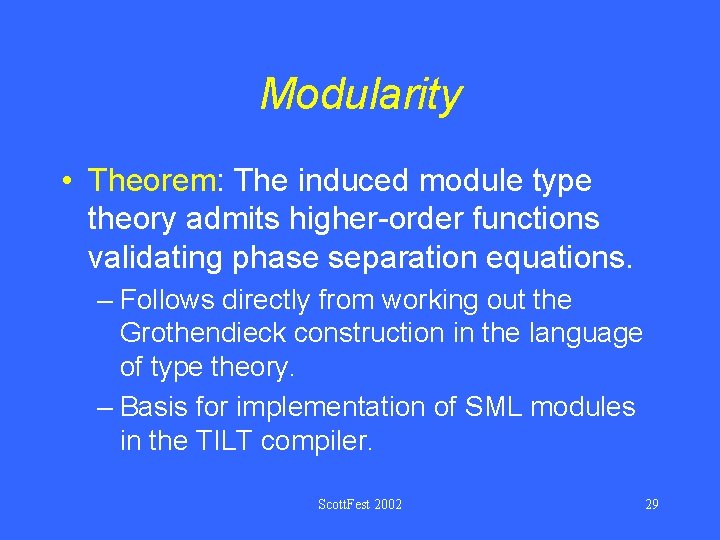
Modularity • Theorem: The induced module type theory admits higher-order functions validating phase separation equations. – Follows directly from working out the Grothendieck construction in the language of type theory. – Basis for implementation of SML modules in the TILT compiler. Scott. Fest 2002 29
Sub-structural Systems • Structural rules govern the use of variables in programs / proofs. – Contraction: duplication of variables. – Weakening: dropping a variable. – Permutation: re-ordering variables. • Intuitionistic type theory validates all three of these structural rules. Scott. Fest 2002 30
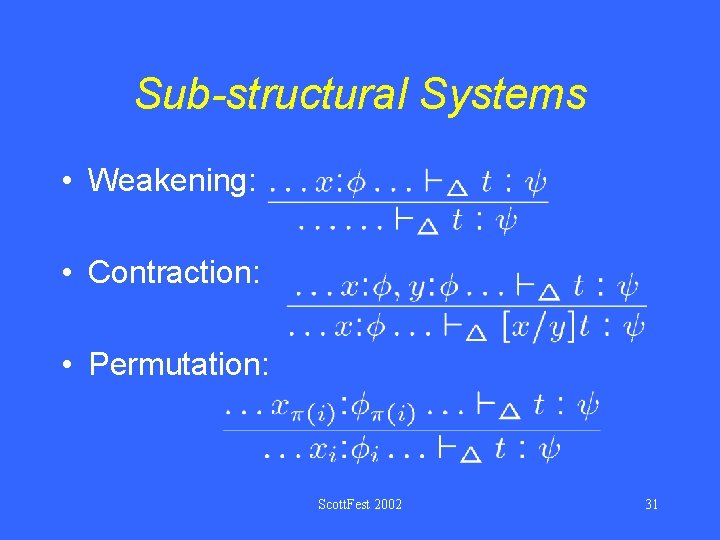
Sub-structural Systems • Weakening: • Contraction: • Permutation: Scott. Fest 2002 31
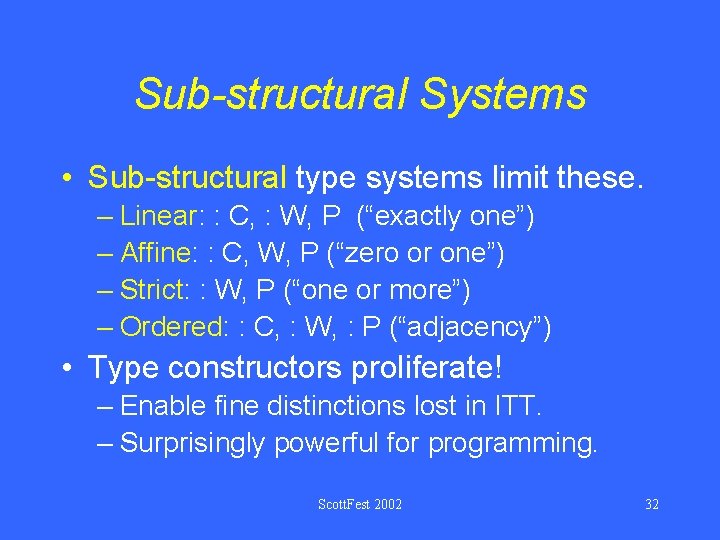
Sub-structural Systems • Sub-structural type systems limit these. – Linear: : C, : W, P (“exactly one”) – Affine: : C, W, P (“zero or one”) – Strict: : W, P (“one or more”) – Ordered: : C, : W, : P (“adjacency”) • Type constructors proliferate! – Enable fine distinctions lost in ITT. – Surprisingly powerful for programming. Scott. Fest 2002 32
Sub-structural Systems • Contraction requires garbage collection. – Many variables may “alias” the same data structure. – There is no “local” test for whether storage can be freed. – The collector performs a global scan to find all references. • All familiar languages admit contraction. Scott. Fest 2002 33
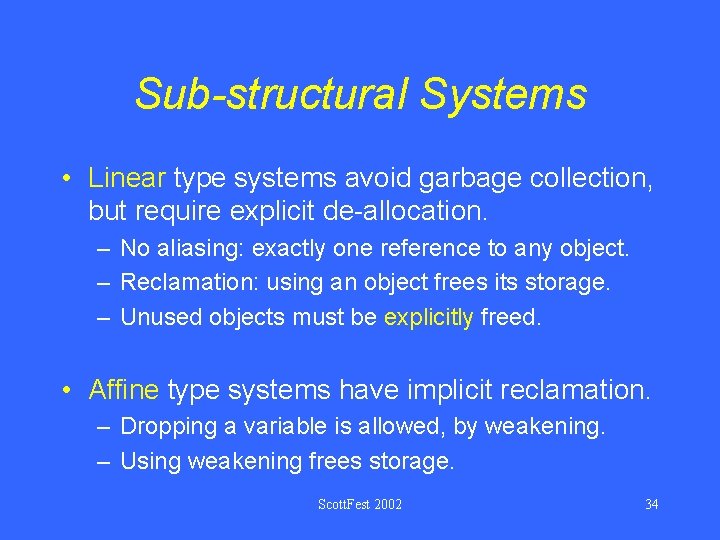
Sub-structural Systems • Linear type systems avoid garbage collection, but require explicit de-allocation. – No aliasing: exactly one reference to any object. – Reclamation: using an object frees its storage. – Unused objects must be explicitly freed. • Affine type systems have implicit reclamation. – Dropping a variable is allowed, by weakening. – Using weakening frees storage. Scott. Fest 2002 34
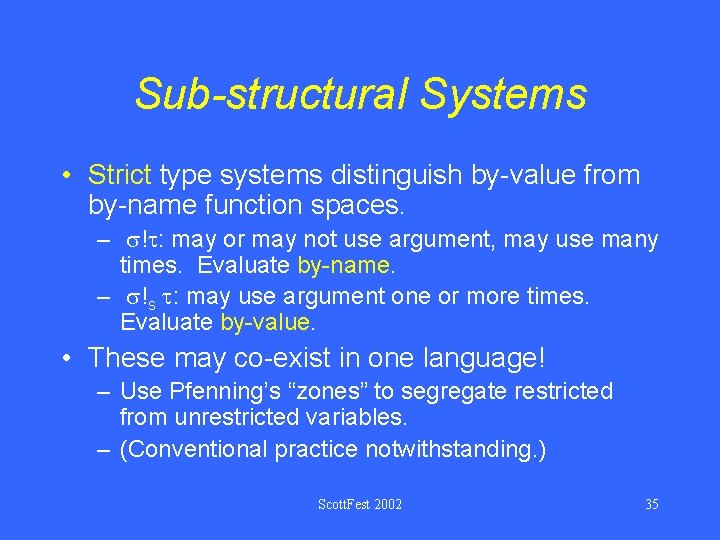
Sub-structural Systems • Strict type systems distinguish by-value from by-name function spaces. – ! : may or may not use argument, may use many times. Evaluate by-name. – !s : may use argument one or more times. Evaluate by-value. • These may co-exist in one language! – Use Pfenning’s “zones” to segregate restricted from unrestricted variables. – (Conventional practice notwithstanding. ) Scott. Fest 2002 35
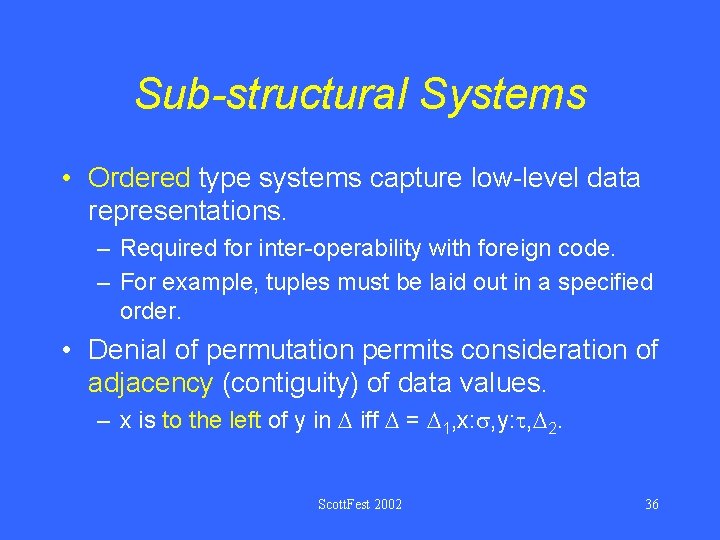
Sub-structural Systems • Ordered type systems capture low-level data representations. – Required for inter-operability with foreign code. – For example, tuples must be laid out in a specified order. • Denial of permutation permits consideration of adjacency (contiguity) of data values. – x is to the left of y in iff = 1, x: , y: , 2. Scott. Fest 2002 36
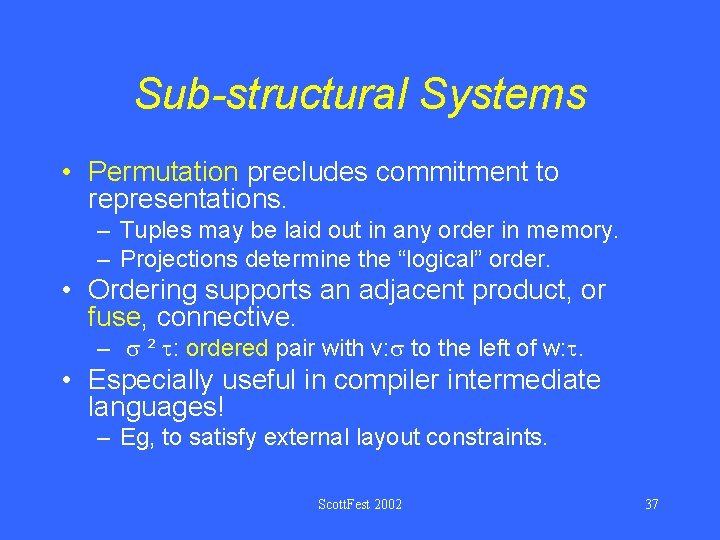
Sub-structural Systems • Permutation precludes commitment to representations. – Tuples may be laid out in any order in memory. – Projections determine the “logical” order. • Ordering supports an adjacent product, or fuse, connective. – ² : ordered pair with v: to the left of w: . • Especially useful in compiler intermediate languages! – Eg, to satisfy external layout constraints. Scott. Fest 2002 37
Other Directions • Modalities (see Pfenning’s talk). – Computational effects. – Meta-programming. – Mobility. • Dependencies. – Most PL work is based on type systems for propositional logics. – Type theories based on predicate logics are the subject of active research. Scott. Fest 2002 38
Summary • Scott’s CV initiated the type-theoretic study of programming languages. – Types codify programming patterns. – Type systems correspond to logical systems (and to categorical structure). • The implications of these ideas are still being understood! Scott. Fest 2002 39
Thanks, Dana! Scott. Fest 2002 40
- Slides: 39