
Types and Programming Languages Lecture 18 Simon Gay
- Slides: 25
Types and Programming Languages Lecture 18 Simon Gay Department of Computing Science University of Glasgow 2005/06 Types and Programming Languages Lecture 18 - Simon Gay
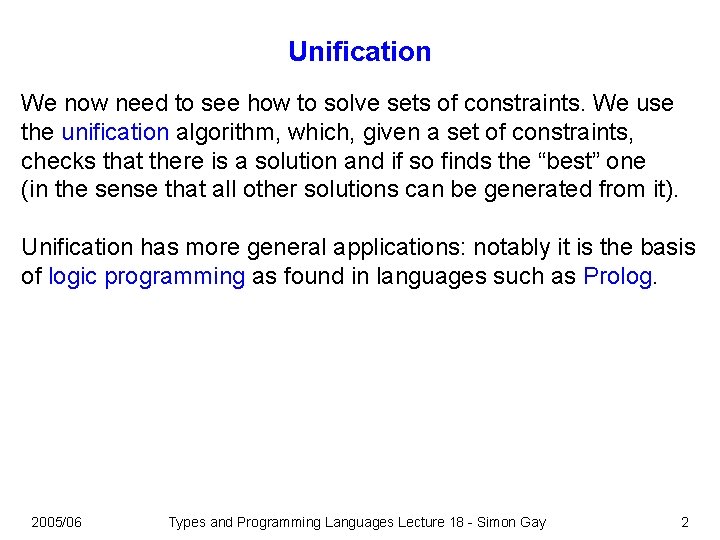
Unification We now need to see how to solve sets of constraints. We use the unification algorithm, which, given a set of constraints, checks that there is a solution and if so finds the “best” one (in the sense that all other solutions can be generated from it). Unification has more general applications: notably it is the basis of logic programming as found in languages such as Prolog. 2005/06 Types and Programming Languages Lecture 18 - Simon Gay 2
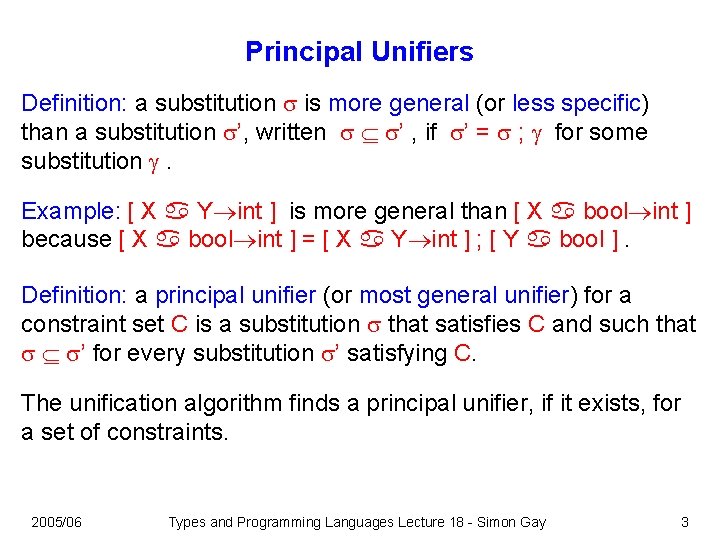
Principal Unifiers Definition: a substitution is more general (or less specific) than a substitution ’, written ’ , if ’ = ; for some substitution . Example: [ X Y int ] is more general than [ X bool int ] because [ X bool int ] = [ X Y int ] ; [ Y bool ]. Definition: a principal unifier (or most general unifier) for a constraint set C is a substitution that satisfies C and such that ’ for every substitution ’ satisfying C. The unification algorithm finds a principal unifier, if it exists, for a set of constraints. 2005/06 Types and Programming Languages Lecture 18 - Simon Gay 3
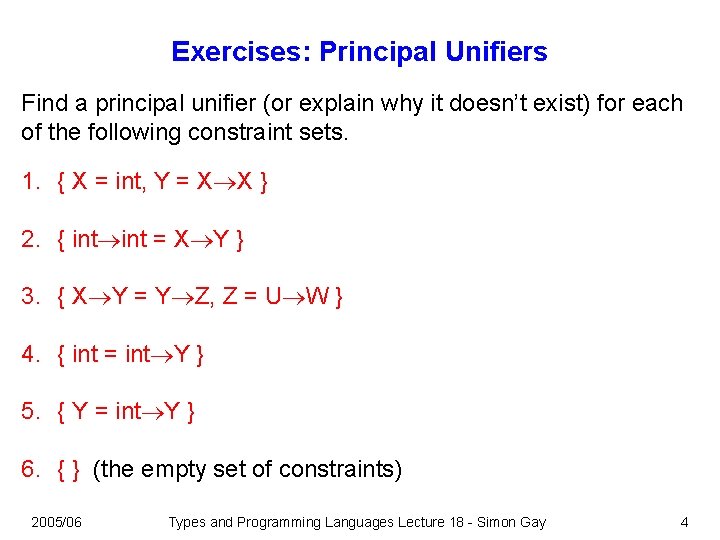
Exercises: Principal Unifiers Find a principal unifier (or explain why it doesn’t exist) for each of the following constraint sets. 1. { X = int, Y = X X } 2. { int = X Y } 3. { X Y = Y Z, Z = U W } 4. { int = int Y } 5. { Y = int Y } 6. { } (the empty set of constraints) 2005/06 Types and Programming Languages Lecture 18 - Simon Gay 4
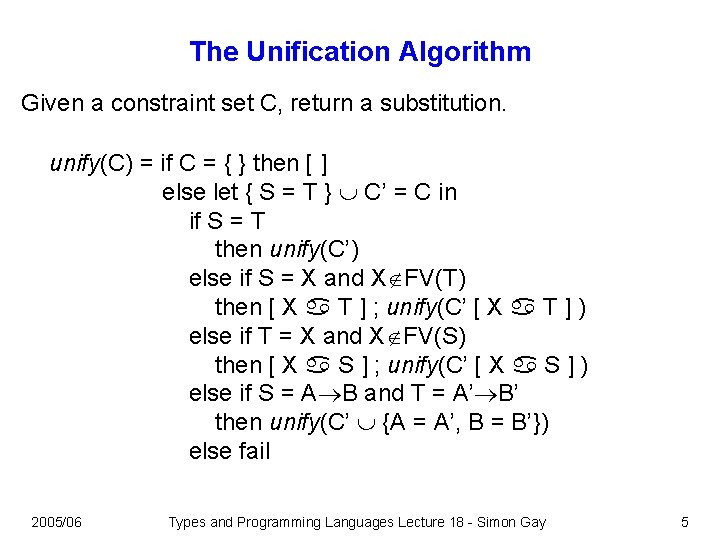
The Unification Algorithm Given a constraint set C, return a substitution. unify(C) = if C = { } then [ ] else let { S = T } C’ = C in if S = T then unify(C’) else if S = X and X FV(T) then [ X T ] ; unify(C’ [ X T ] ) else if T = X and X FV(S) then [ X S ] ; unify(C’ [ X S ] ) else if S = A B and T = A’ B’ then unify(C’ {A = A’, B = B’}) else fail 2005/06 Types and Programming Languages Lecture 18 - Simon Gay 5
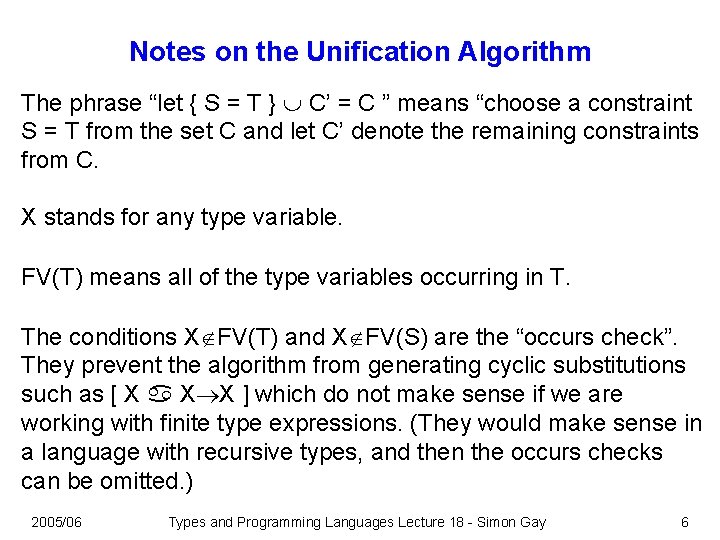
Notes on the Unification Algorithm The phrase “let { S = T } C’ = C ” means “choose a constraint S = T from the set C and let C’ denote the remaining constraints from C. X stands for any type variable. FV(T) means all of the type variables occurring in T. The conditions X FV(T) and X FV(S) are the “occurs check”. They prevent the algorithm from generating cyclic substitutions such as [ X X X ] which do not make sense if we are working with finite type expressions. (They would make sense in a language with recursive types, and then the occurs checks can be omitted. ) 2005/06 Types and Programming Languages Lecture 18 - Simon Gay 6
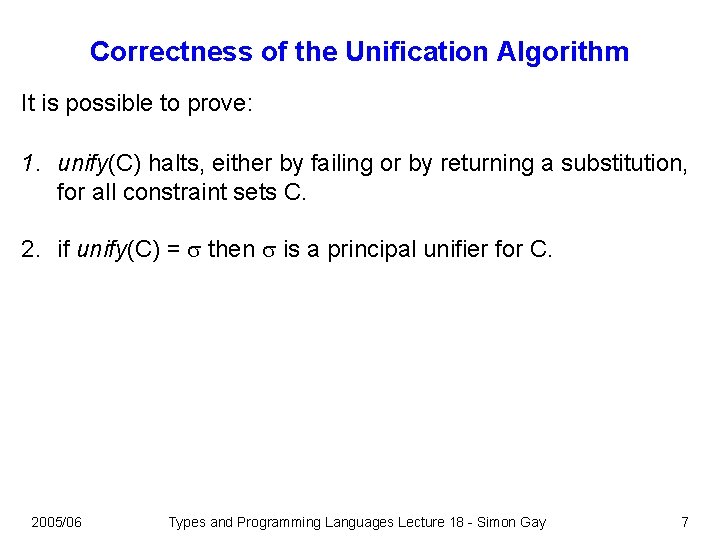
Correctness of the Unification Algorithm It is possible to prove: 1. unify(C) halts, either by failing or by returning a substitution, for all constraint sets C. 2. if unify(C) = then is a principal unifier for C. 2005/06 Types and Programming Languages Lecture 18 - Simon Gay 7
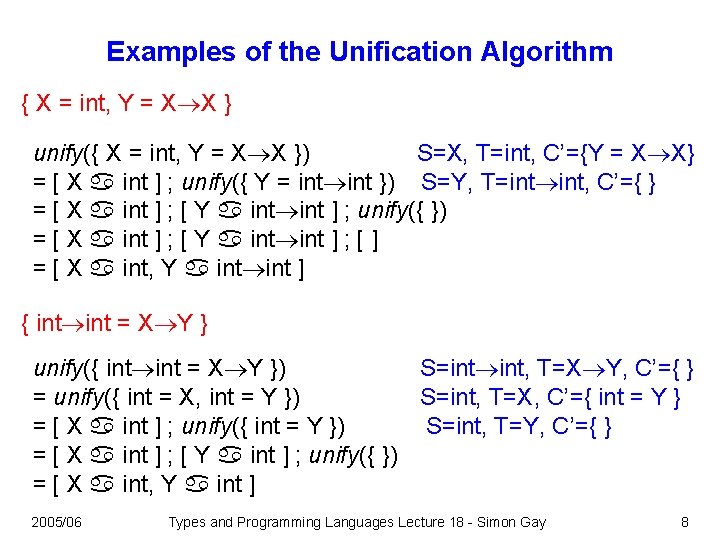
Examples of the Unification Algorithm { X = int, Y = X X } unify({ X = int, Y = X X }) S=X, T=int, C’={Y = X X} = [ X int ] ; unify({ Y = int }) S=Y, T=int int, C’={ } = [ X int ] ; [ Y int ] ; unify({ }) = [ X int ] ; [ Y int ] ; [ ] = [ X int, Y int ] { int = X Y } unify({ int = X Y }) S=int int, T=X Y, C’={ } = unify({ int = X, int = Y }) S=int, T=X, C’={ int = Y } = [ X int ] ; unify({ int = Y }) S=int, T=Y, C’={ } = [ X int ] ; [ Y int ] ; unify({ }) = [ X int, Y int ] 2005/06 Types and Programming Languages Lecture 18 - Simon Gay 8
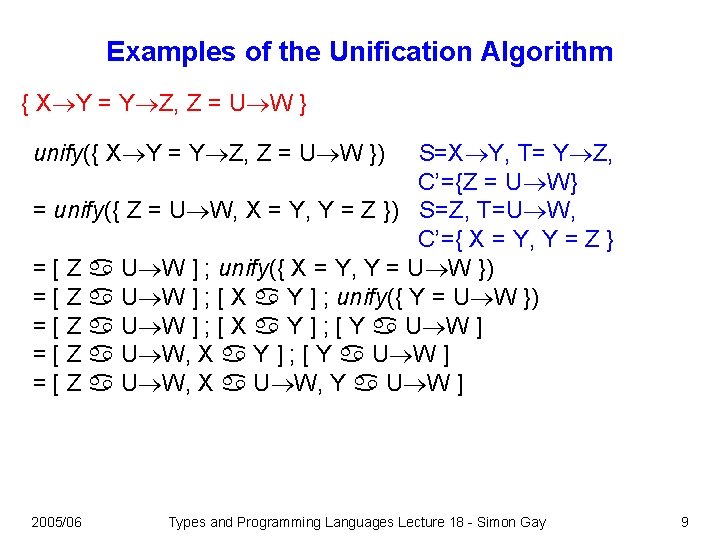
Examples of the Unification Algorithm { X Y = Y Z, Z = U W } unify({ X Y = Y Z, Z = U W }) S=X Y, T= Y Z, C’={Z = U W} = unify({ Z = U W, X = Y, Y = Z }) S=Z, T=U W, C’={ X = Y, Y = Z } = [ Z U W ] ; unify({ X = Y, Y = U W }) = [ Z U W ] ; [ X Y ] ; unify({ Y = U W }) = [ Z U W ] ; [ X Y ] ; [ Y U W ] = [ Z U W, X U W, Y U W ] 2005/06 Types and Programming Languages Lecture 18 - Simon Gay 9
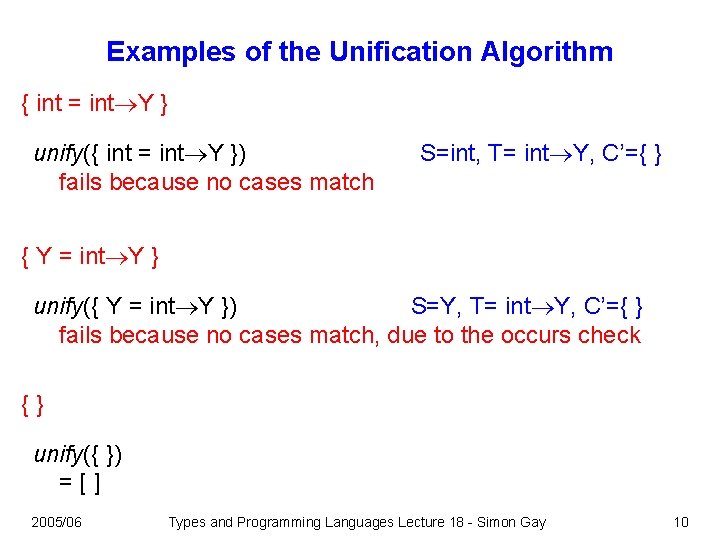
Examples of the Unification Algorithm { int = int Y } unify({ int = int Y }) fails because no cases match S=int, T= int Y, C’={ } { Y = int Y } unify({ Y = int Y }) S=Y, T= int Y, C’={ } fails because no cases match, due to the occurs check {} unify({ }) =[] 2005/06 Types and Programming Languages Lecture 18 - Simon Gay 10
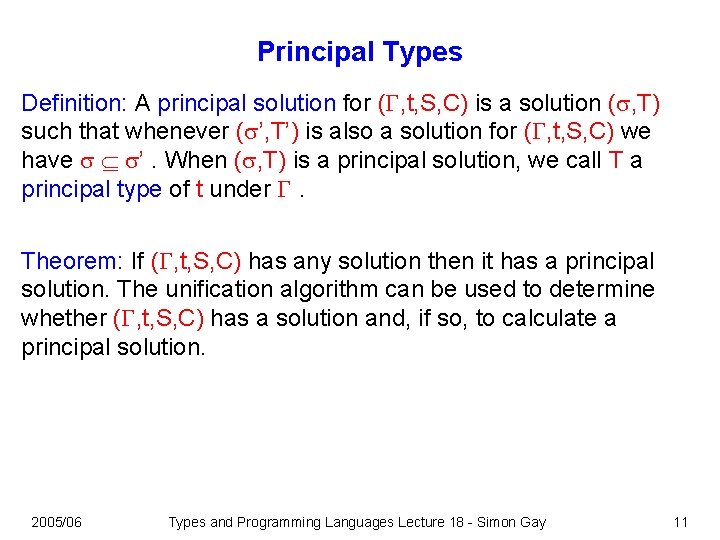
Principal Types Definition: A principal solution for ( , t, S, C) is a solution ( , T) such that whenever ( ’, T’) is also a solution for ( , t, S, C) we have ’. When ( , T) is a principal solution, we call T a principal type of t under . Theorem: If ( , t, S, C) has any solution then it has a principal solution. The unification algorithm can be used to determine whether ( , t, S, C) has a solution and, if so, to calculate a principal solution. 2005/06 Types and Programming Languages Lecture 18 - Simon Gay 11
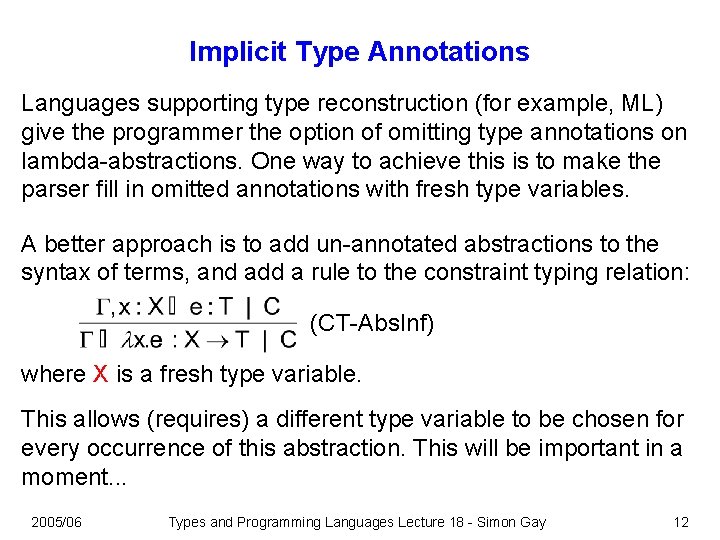
Implicit Type Annotations Languages supporting type reconstruction (for example, ML) give the programmer the option of omitting type annotations on lambda-abstractions. One way to achieve this is to make the parser fill in omitted annotations with fresh type variables. A better approach is to add un-annotated abstractions to the syntax of terms, and add a rule to the constraint typing relation: (CT-Abs. Inf) where X is a fresh type variable. This allows (requires) a different type variable to be chosen for every occurrence of this abstraction. This will be important in a moment. . . 2005/06 Types and Programming Languages Lecture 18 - Simon Gay 12
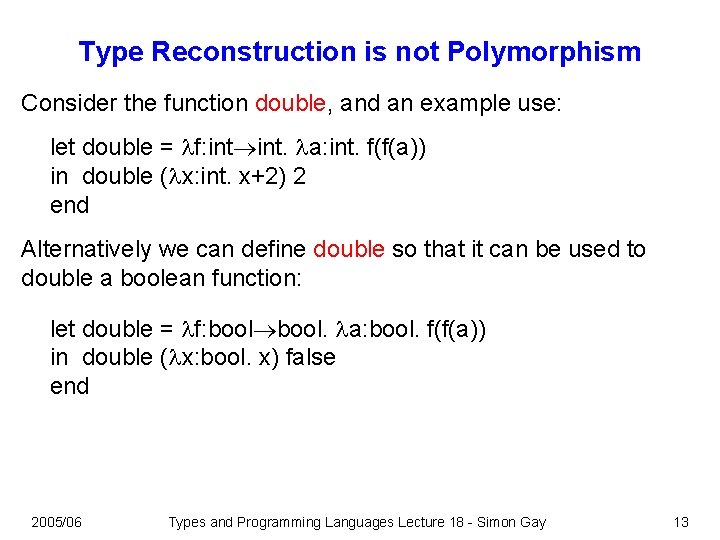
Type Reconstruction is not Polymorphism Consider the function double, and an example use: let double = f: int. a: int. f(f(a)) in double ( x: int. x+2) 2 end Alternatively we can define double so that it can be used to double a boolean function: let double = f: bool. a: bool. f(f(a)) in double ( x: bool. x) false end 2005/06 Types and Programming Languages Lecture 18 - Simon Gay 13
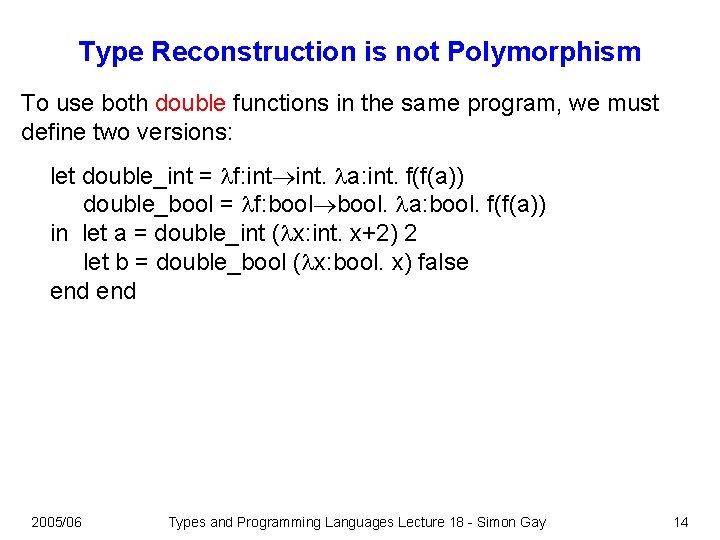
Type Reconstruction is not Polymorphism To use both double functions in the same program, we must define two versions: let double_int = f: int. a: int. f(f(a)) double_bool = f: bool. a: bool. f(f(a)) in let a = double_int ( x: int. x+2) 2 let b = double_bool ( x: bool. x) false end 2005/06 Types and Programming Languages Lecture 18 - Simon Gay 14
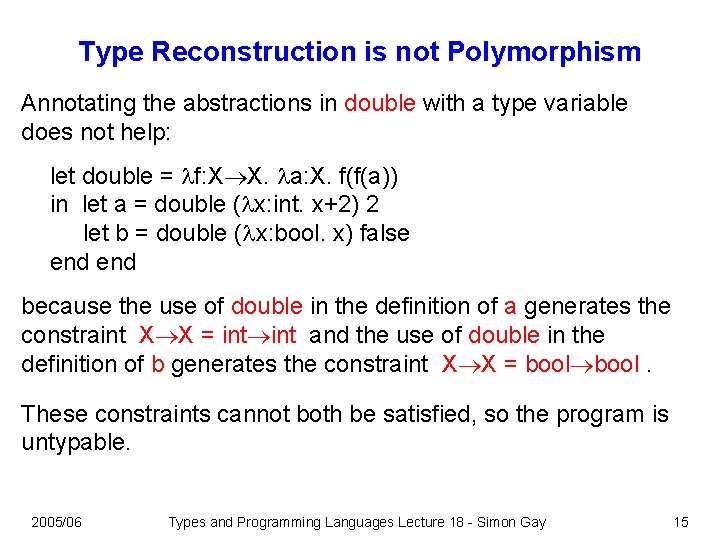
Type Reconstruction is not Polymorphism Annotating the abstractions in double with a type variable does not help: let double = f: X X. a: X. f(f(a)) in let a = double ( x: int. x+2) 2 let b = double ( x: bool. x) false end because the use of double in the definition of a generates the constraint X X = int and the use of double in the definition of b generates the constraint X X = bool. These constraints cannot both be satisfied, so the program is untypable. 2005/06 Types and Programming Languages Lecture 18 - Simon Gay 15
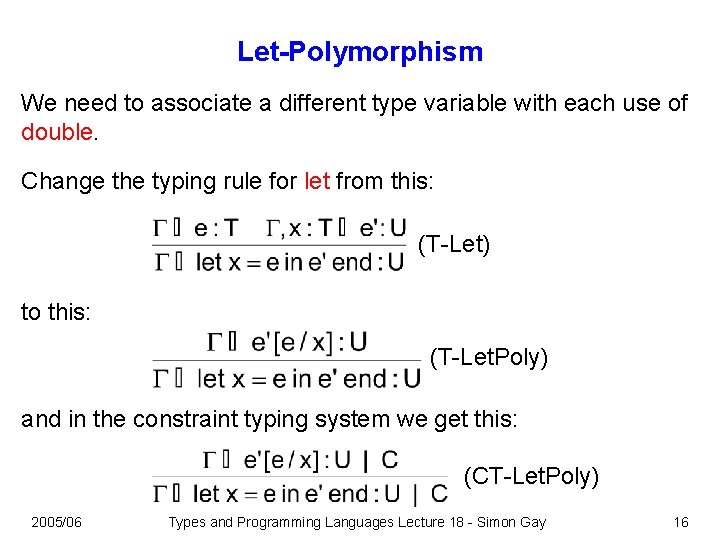
Let-Polymorphism We need to associate a different type variable with each use of double. Change the typing rule for let from this: (T-Let) to this: (T-Let. Poly) and in the constraint typing system we get this: (CT-Let. Poly) 2005/06 Types and Programming Languages Lecture 18 - Simon Gay 16
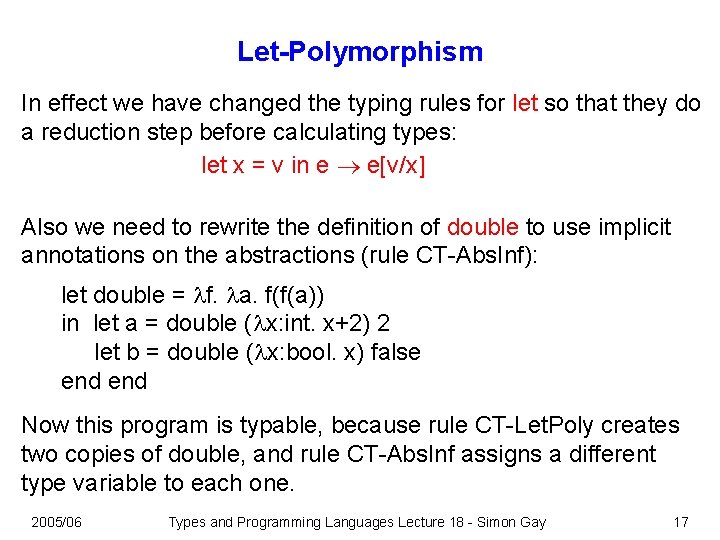
Let-Polymorphism In effect we have changed the typing rules for let so that they do a reduction step before calculating types: let x = v in e e[v/x] Also we need to rewrite the definition of double to use implicit annotations on the abstractions (rule CT-Abs. Inf): let double = f. a. f(f(a)) in let a = double ( x: int. x+2) 2 let b = double ( x: bool. x) false end Now this program is typable, because rule CT-Let. Poly creates two copies of double, and rule CT-Abs. Inf assigns a different type variable to each one. 2005/06 Types and Programming Languages Lecture 18 - Simon Gay 17
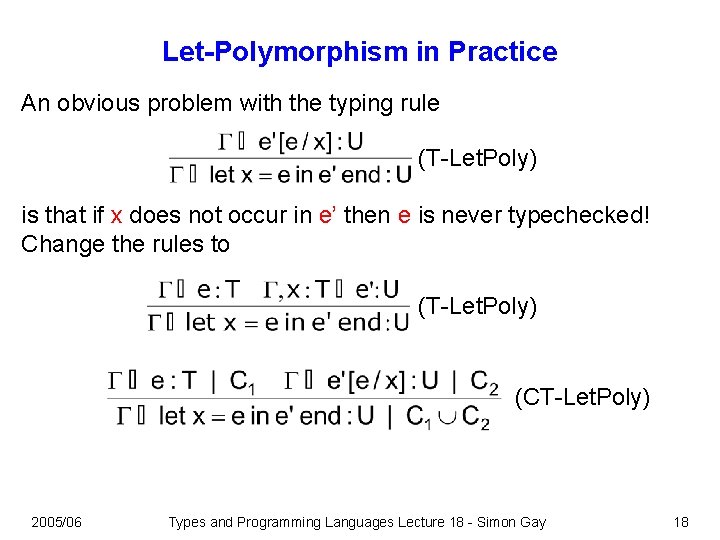
Let-Polymorphism in Practice An obvious problem with the typing rule (T-Let. Poly) is that if x does not occur in e’ then e is never typechecked! Change the rules to (T-Let. Poly) (CT-Let. Poly) 2005/06 Types and Programming Languages Lecture 18 - Simon Gay 18
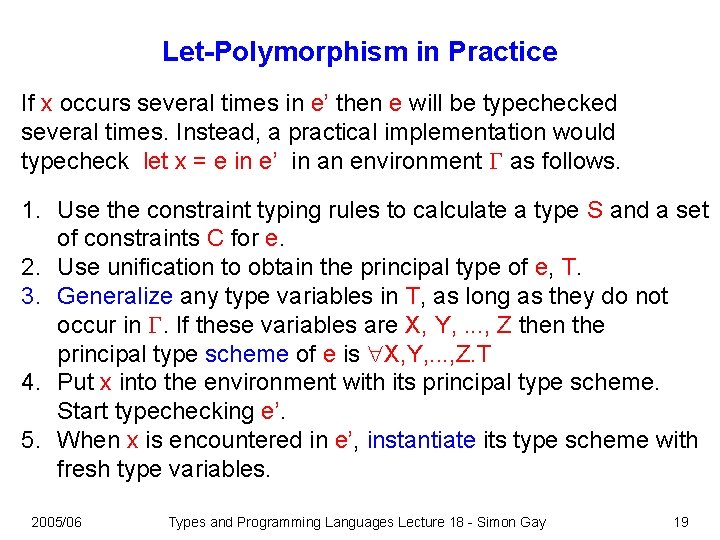
Let-Polymorphism in Practice If x occurs several times in e’ then e will be typechecked several times. Instead, a practical implementation would typecheck let x = e in e’ in an environment as follows. 1. Use the constraint typing rules to calculate a type S and a set of constraints C for e. 2. Use unification to obtain the principal type of e, T. 3. Generalize any type variables in T, as long as they do not occur in . If these variables are X, Y, . . . , Z then the principal type scheme of e is X, Y, . . . , Z. T 4. Put x into the environment with its principal type scheme. Start typechecking e’. 5. When x is encountered in e’, instantiate its type scheme with fresh type variables. 2005/06 Types and Programming Languages Lecture 18 - Simon Gay 19
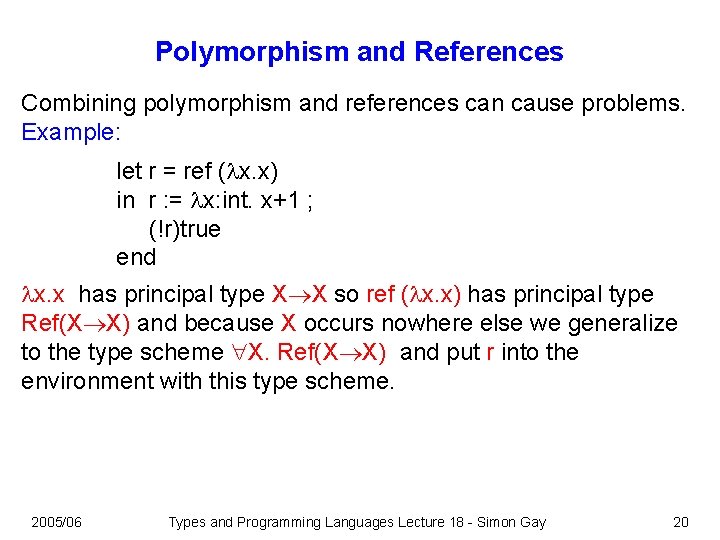
Polymorphism and References Combining polymorphism and references can cause problems. Example: let r = ref ( x. x) in r : = x: int. x+1 ; (!r)true end x. x has principal type X X so ref ( x. x) has principal type Ref(X X) and because X occurs nowhere else we generalize to the type scheme X. Ref(X X) and put r into the environment with this type scheme. 2005/06 Types and Programming Languages Lecture 18 - Simon Gay 20
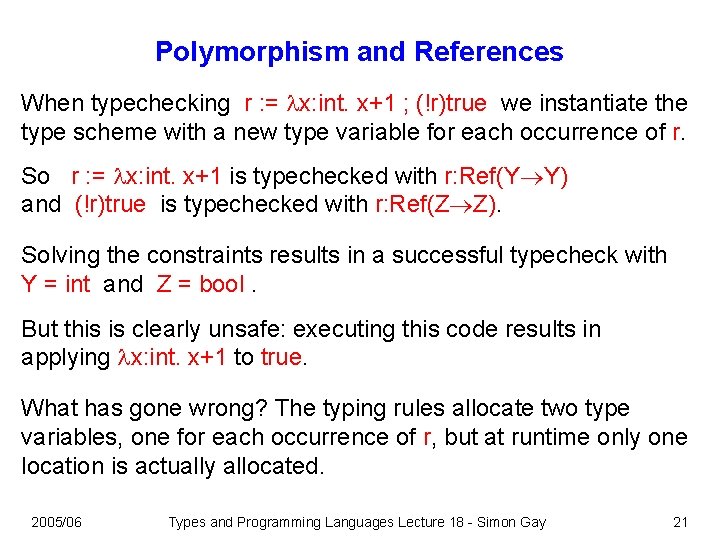
Polymorphism and References When typechecking r : = x: int. x+1 ; (!r)true we instantiate the type scheme with a new type variable for each occurrence of r. So r : = x: int. x+1 is typechecked with r: Ref(Y Y) and (!r)true is typechecked with r: Ref(Z Z). Solving the constraints results in a successful typecheck with Y = int and Z = bool. But this is clearly unsafe: executing this code results in applying x: int. x+1 to true. What has gone wrong? The typing rules allocate two type variables, one for each occurrence of r, but at runtime only one location is actually allocated. 2005/06 Types and Programming Languages Lecture 18 - Simon Gay 21
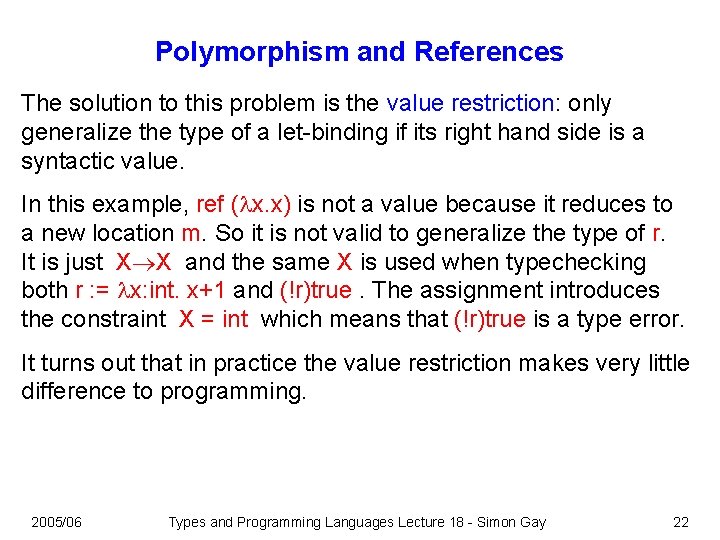
Polymorphism and References The solution to this problem is the value restriction: only generalize the type of a let-binding if its right hand side is a syntactic value. In this example, ref ( x. x) is not a value because it reduces to a new location m. So it is not valid to generalize the type of r. It is just X X and the same X is used when typechecking both r : = x: int. x+1 and (!r)true. The assignment introduces the constraint X = int which means that (!r)true is a type error. It turns out that in practice the value restriction makes very little difference to programming. 2005/06 Types and Programming Languages Lecture 18 - Simon Gay 22
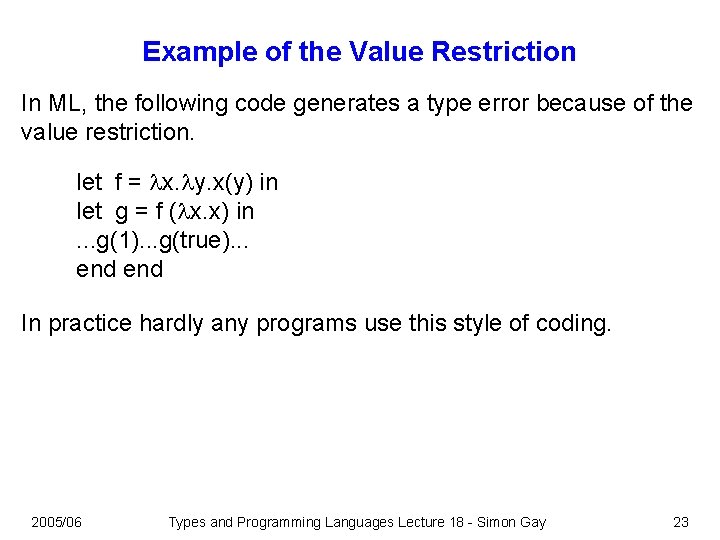
Example of the Value Restriction In ML, the following code generates a type error because of the value restriction. let f = x. y. x(y) in let g = f ( x. x) in. . . g(1). . . g(true). . . end In practice hardly any programs use this style of coding. 2005/06 Types and Programming Languages Lecture 18 - Simon Gay 23
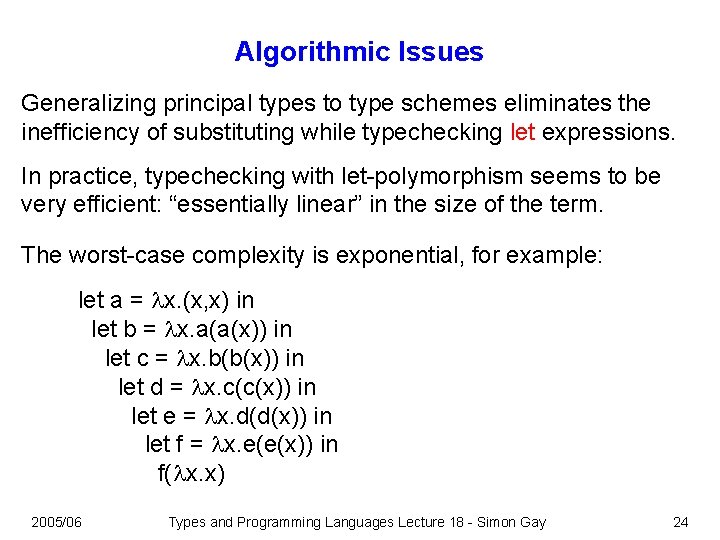
Algorithmic Issues Generalizing principal types to type schemes eliminates the inefficiency of substituting while typechecking let expressions. In practice, typechecking with let-polymorphism seems to be very efficient: “essentially linear” in the size of the term. The worst-case complexity is exponential, for example: let a = x. (x, x) in let b = x. a(a(x)) in let c = x. b(b(x)) in let d = x. c(c(x)) in let e = x. d(d(x)) in let f = x. e(e(x)) in f( x. x) 2005/06 Types and Programming Languages Lecture 18 - Simon Gay 24
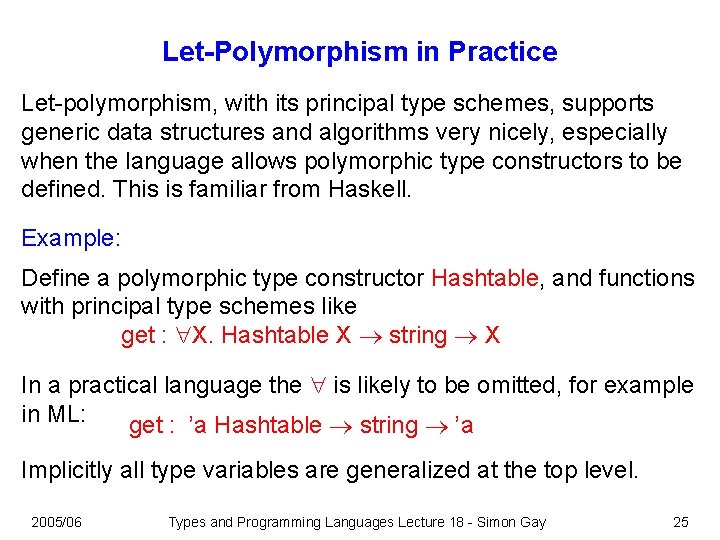
Let-Polymorphism in Practice Let-polymorphism, with its principal type schemes, supports generic data structures and algorithms very nicely, especially when the language allows polymorphic type constructors to be defined. This is familiar from Haskell. Example: Define a polymorphic type constructor Hashtable, and functions with principal type schemes like get : X. Hashtable X string X In a practical language the is likely to be omitted, for example in ML: get : ’a Hashtable string ’a Implicitly all type variables are generalized at the top level. 2005/06 Types and Programming Languages Lecture 18 - Simon Gay 25