
TYPES AND COMPONENTS OF COMPUTERS IGCSE 1 ICT




- Slides: 12
TYPES AND COMPONENTS OF COMPUTERS IGCSE 1 ICT Chapter 1
HARDWARE • Computer hardware is the collection of physical elements that constitutes a computer system. Computer hardware refers to the physical parts or components of a computer such as the monitor, mouse, keyboard, computer data storage, hard drive disk (HDD), system unit (graphic cards, sound cards, memory, motherboard and chips), etc. all of which are physical objects that can be touched. In contrast, software is instructions that can be stored and run by hardware.
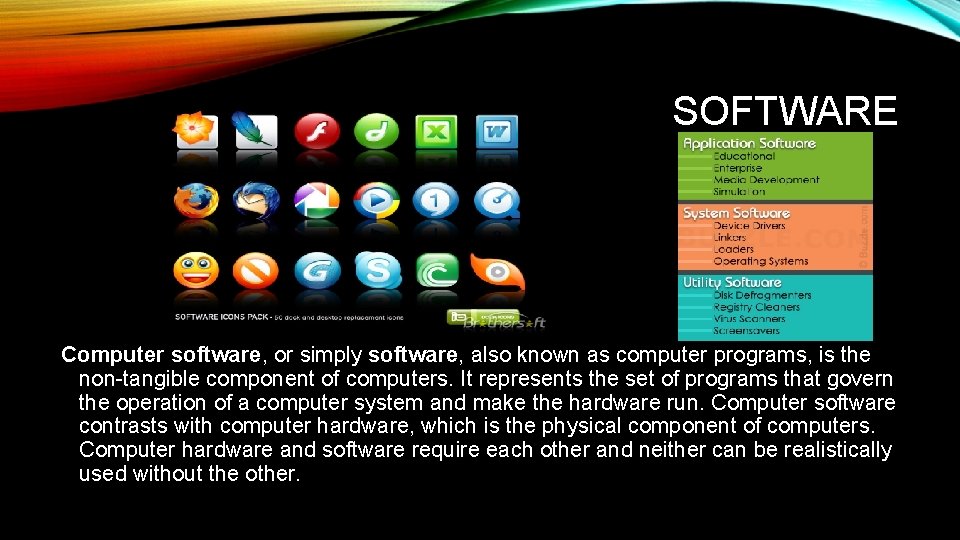
SOFTWARE Computer software, or simply software, also known as computer programs, is the non-tangible component of computers. It represents the set of programs that govern the operation of a computer system and make the hardware run. Computer software contrasts with computer hardware, which is the physical component of computers. Computer hardware and software require each other and neither can be realistically used without the other.
THE DIFFERENCE BETWEEN HARDWARE AND SOFTWARE Hardware is best described as a device that is physically connected to the computer or something that can be physically touched. Software is a general term used to describe a collection of computer programs, procedures, and documentation that perform some task on a computer system. • Computer hardware is any physical device, something that you are able to touch and software is a collection of instructions and code installed into the computer and cannot be touched.
THE MAIN COMPONENTS OF A GENERAL-PURPOSE COMPUTER Central Processing Unit (CPU or Processor): The CPU does mathematical operations for the computer. It can be loosely compared to the brain of a person. Memory (RAM): The RAM is short-term storage used by the process to store data for processes it is currently running. The data gets deleted from RAM shortly after it is used. This is similar to a person's short term memory. In computing, an input device is a peripheral (piece of computer hardware equipment) used to provide data and control signals to an information processing system such as a computer or other information appliance. Examples of input devices include keyboards, mouse, scanners, digital cameras and joystick.
• Output devices THE MAIN COMPONENTS OF A GENERAL-PURPOSE COMPUTER An output device is any piece of computer hardware equipment used to communicate the results of data processing carried out by an information processing system (such as a computer) which converts the electronically generated information into human-readable form. Secondary/backing storage Secondary storage refers to storage devices and media that are not constantly accessible by a computer system. Examples include external hard drives, portable flash drives, CDs, and DVDs. These devices and media must be either plugged in or inserted into a computer in order to be accessed by the system. Because secondary storage technology is not always connected to the computer, it is commonly used for backing up data.
OPERATING SYSTEM Graphic user interface (GUI) In computing, a graphical user interface (GUI, sometimes pronounced "gooey") is a type of interface that allows users to interact with electronic devices through graphical icons and visual indicators such as secondary notation, as opposed to text-based interfaces, typed command labels or text navigation. Command-line interface A command-line interface (CLI), also known as command-line user interface, console user interface, and character user interface (CUI), is a means of interacting with a computer program where the user (or client) issues commands to the program in the form of successive lines of text (command lines).
DIFFERENT TYPES OF COMPUTER Personal computer (PC) or desktop personal computer (PC) is a general-purpose computer, whose size, capabilities and original sale price makes it useful for individuals, and is intended to be operated directly by an end-user with no intervening computer operator.
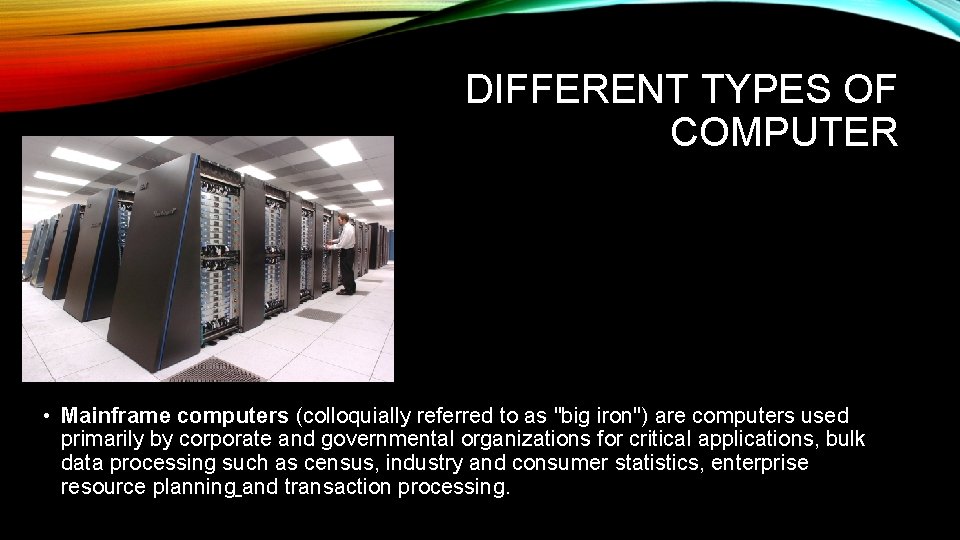
DIFFERENT TYPES OF COMPUTER • Mainframe computers (colloquially referred to as "big iron") are computers used primarily by corporate and governmental organizations for critical applications, bulk data processing such as census, industry and consumer statistics, enterprise resource planning and transaction processing.
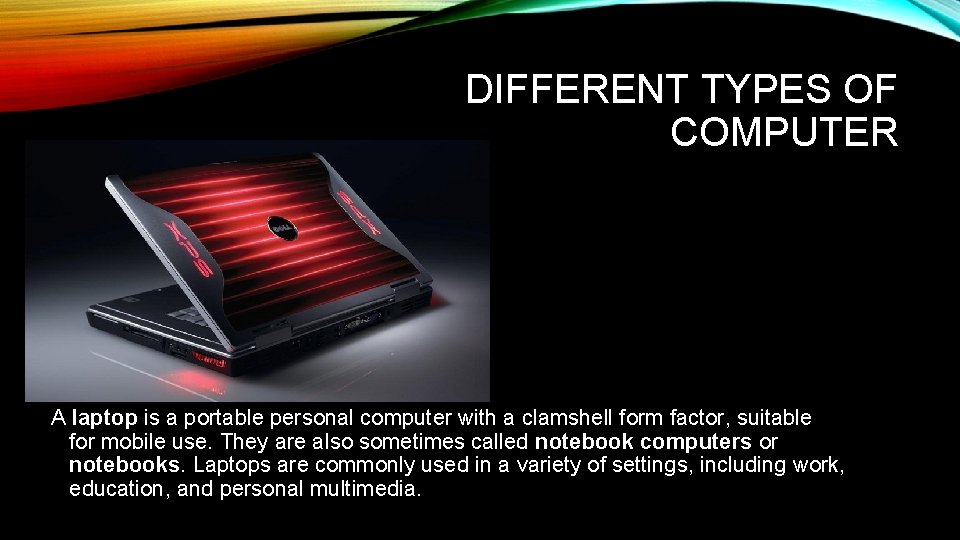
DIFFERENT TYPES OF COMPUTER A laptop is a portable personal computer with a clamshell form factor, suitable for mobile use. They are also sometimes called notebook computers or notebooks. Laptops are commonly used in a variety of settings, including work, education, and personal multimedia.
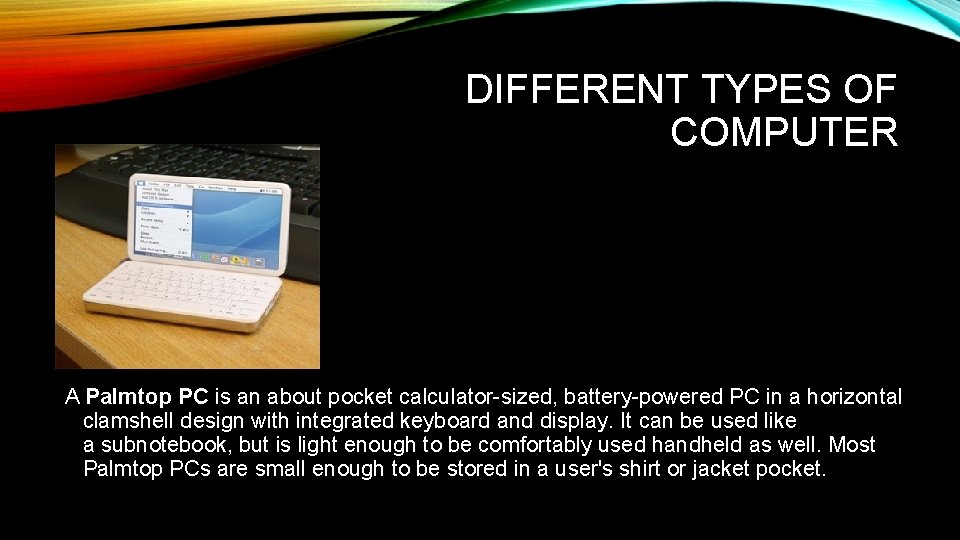
DIFFERENT TYPES OF COMPUTER A Palmtop PC is an about pocket calculator-sized, battery-powered PC in a horizontal clamshell design with integrated keyboard and display. It can be used like a subnotebook, but is light enough to be comfortably used handheld as well. Most Palmtop PCs are small enough to be stored in a user's shirt or jacket pocket.
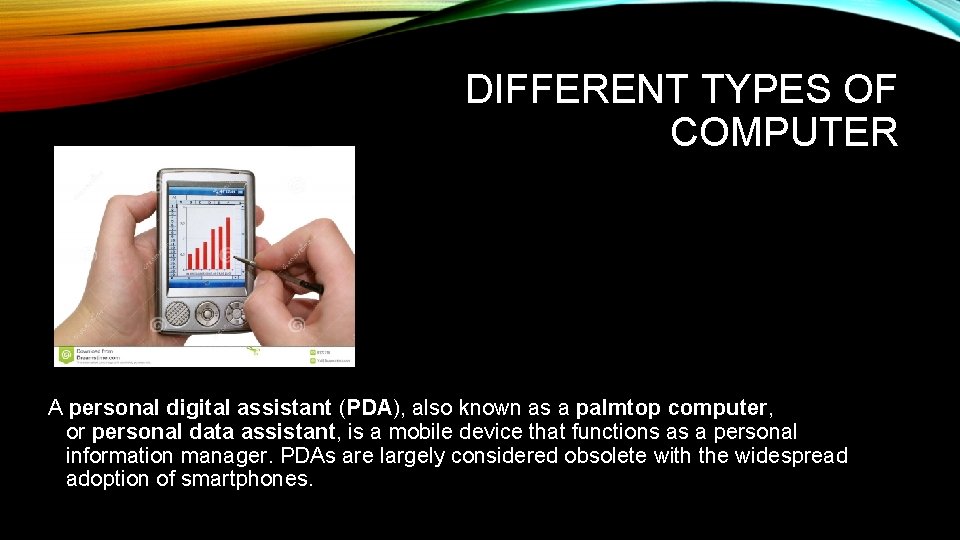
DIFFERENT TYPES OF COMPUTER A personal digital assistant (PDA), also known as a palmtop computer, or personal data assistant, is a mobile device that functions as a personal information manager. PDAs are largely considered obsolete with the widespread adoption of smartphones.