
Types A Type is a Set A type

- Slides: 15
Types (A Type is a Set) � A type is a (mathematical) set. All values of a type ▪ Are encoded into memory same way ▪ Use same collection of operations Some types support finite set of values ▪ Examples of this type? Some types support infinitely many values ▪ Example of this type? CSC 355 Programming Du Jour (Programming Languages & Paradigms) 1
Types What is a primitive type? ▪ Any type that a program can use but cannot define for itself What is a constructed type? ▪ ▪ Any thing program defines for it self e. g. , struct and class definitions, enumerations ML e. g. , type int. Pair = int * int; C++ e. g. , typedef int. Ptr = * int; Primitive types defined at ▪ Language specification time (i. e. , when lang. defined) ▪ Language implementation time (i. e. , when compiled/interpreted) ▪ Why? Allow different compilers to generate efficient machine language code for different processors CSC 355 Programming Du Jour (Programming Languages & Paradigms) 2
Types (cont’d) What is an enumeration? ▪ A collection of named constants ▪ Is this a primitive type or a constructed type? C: Ada: ML: enum coin {penny, nickel, dime, quarter}; type GENDER is (MALE, FEMALE); datatype day = M | Tu | W | Th | F | Sa | Su; ▪ A common representation is to treat the values of an enumeration as small integers as in C enum coin { penny = 1, nickel = 5, dime = 10, quarter = 25 }; int x = penny + nickel + dime; ▪ Representation may also be hidden as in ML ▪ Only equality is allowed fun is. Weekend x = (x = Sa orelse x = Su); CSC 355 Programming Du Jour (Programming Languages & Paradigms) 3
Types (cont’d) Tuples ▪ A tuple pair is a Cartesian product of two or more sets ▪ ML e. g. , type int. Pair = int * real; ▪ ML supports pure tuples like above and special types of tuples called record type or structure type C: ML: struct complex { double rp; double ip; }; type complex = { rp: real, ip: real}; fun getip (x : complex) = #ip x; ▪ What is the difference between tuple and a record type? ▪ Record types have named components CSC 355 Programming Du Jour (Programming Languages & Paradigms) 4
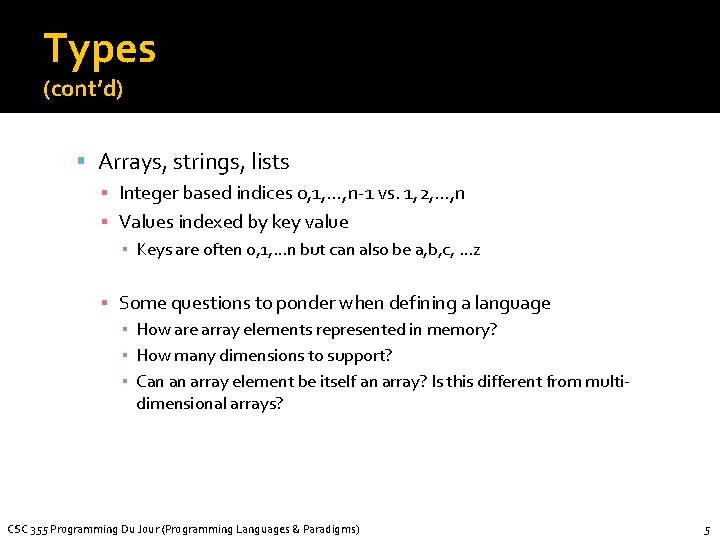
Types (cont’d) Arrays, strings, lists ▪ Integer based indices 0, 1, …, n-1 vs. 1, 2, …, n ▪ Values indexed by key value ▪ Keys are often 0, 1, …n but can also be a, b, c, …z ▪ Some questions to ponder when defining a language ▪ How are array elements represented in memory? ▪ How many dimensions to support? ▪ Can an array element be itself an array? Is this different from multidimensional arrays? CSC 355 Programming Du Jour (Programming Languages & Paradigms) 5
Types (cont’d) Unions ▪ Same memory location defined using two (or more) types. C: ML: union element { int i; float f; }; datatype element = I of int | F of real; What is the difference between tuples and Unions? ▪ One value is stored and has type equal to one of the types in the union Subtypes ▪ A subset of an existing type/set. ▪ Can usually support a superset of operations. Can you think of an example of a subtype in Java? CSC 355 Programming Du Jour (Programming Languages & Paradigms) 6
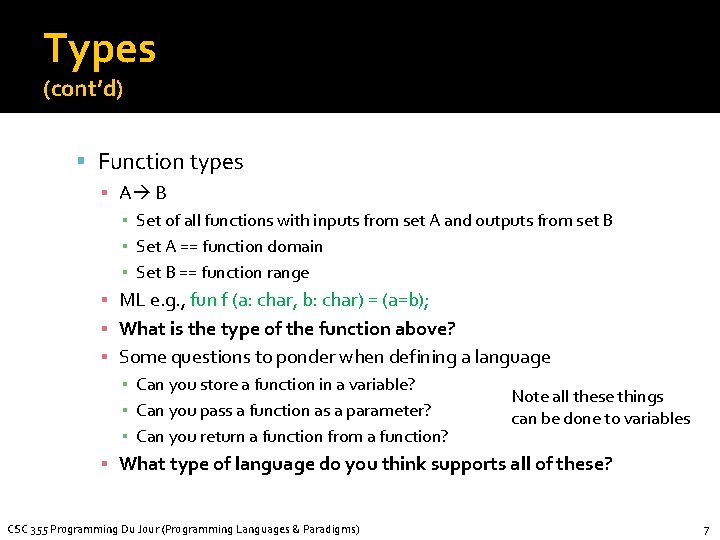
Types (cont’d) Function types ▪ A B ▪ Set of all functions with inputs from set A and outputs from set B ▪ Set A == function domain ▪ Set B == function range ▪ ML e. g. , fun f (a: char, b: char) = (a=b); ▪ What is the type of the function above? ▪ Some questions to ponder when defining a language ▪ Can you store a function in a variable? ▪ Can you pass a function as a parameter? ▪ Can you return a function from a function? Note all these things can be done to variables ▪ What type of language do you think supports all of these? CSC 355 Programming Du Jour (Programming Languages & Paradigms) 7
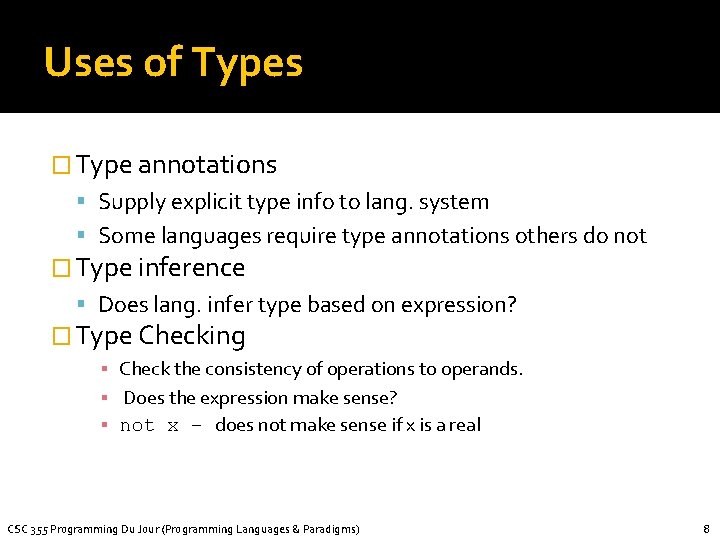
Uses of Types � Type annotations Supply explicit type info to lang. system Some languages require type annotations others do not � Type inference Does lang. infer type based on expression? � Type Checking ▪ Check the consistency of operations to operands. ▪ Does the expression make sense? ▪ not x – does not make sense if x is a real CSC 355 Programming Du Jour (Programming Languages & Paradigms) 8
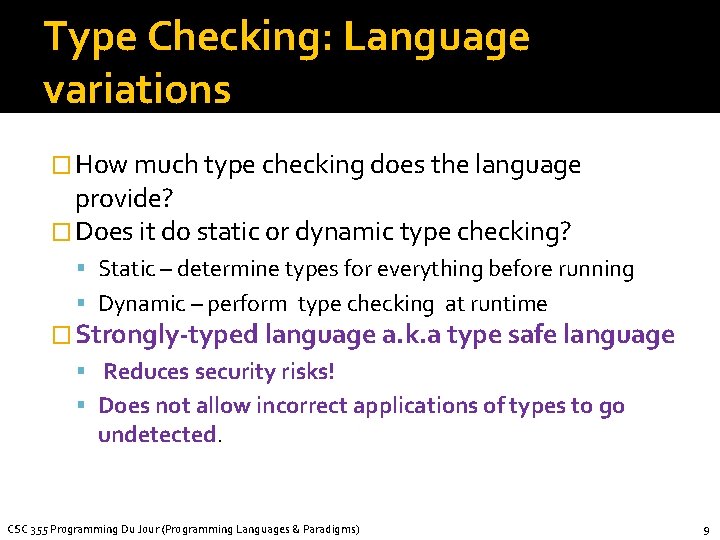
Type Checking: Language variations � How much type checking does the language provide? � Does it do static or dynamic type checking? Static – determine types for everything before running Dynamic – perform type checking at runtime � Strongly-typed language a. k. a type safe language Reduces security risks! Does not allow incorrect applications of types to go undetected. CSC 355 Programming Du Jour (Programming Languages & Paradigms) 9
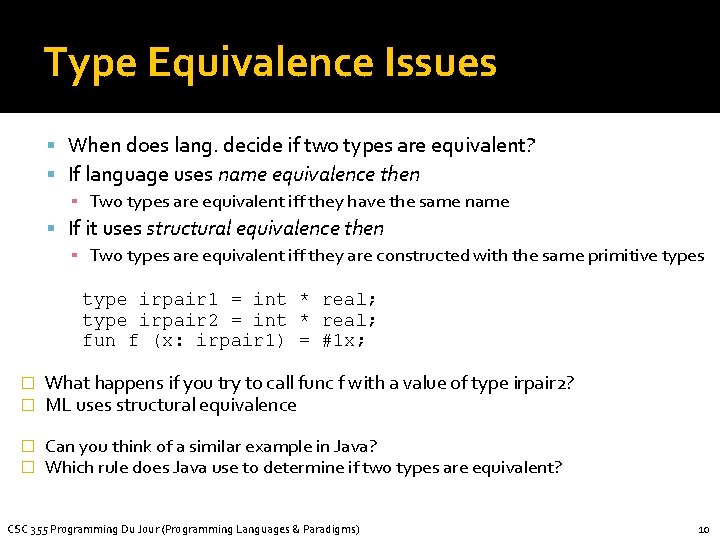
Type Equivalence Issues When does lang. decide if two types are equivalent? If language uses name equivalence then ▪ Two types are equivalent iff they have the same name If it uses structural equivalence then ▪ Two types are equivalent iff they are constructed with the same primitive types type irpair 1 = int * real; type irpair 2 = int * real; fun f (x: irpair 1) = #1 x; � � What happens if you try to call func f with a value of type irpair 2? ML uses structural equivalence � � Can you think of a similar example in Java? Which rule does Java use to determine if two types are equivalent? CSC 355 Programming Du Jour (Programming Languages & Paradigms) 10
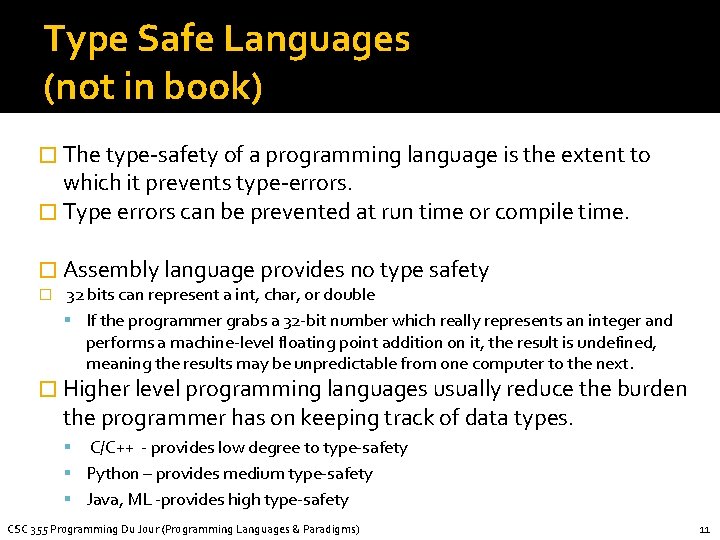
Type Safe Languages (not in book) � The type-safety of a programming language is the extent to which it prevents type-errors. � Type errors can be prevented at run time or compile time. � Assembly language provides no type safety � 32 bits can represent a int, char, or double If the programmer grabs a 32 -bit number which really represents an integer and performs a machine-level floating point addition on it, the result is undefined, meaning the results may be unpredictable from one computer to the next. � Higher level programming languages usually reduce the burden the programmer has on keeping track of data types. C/C++ - provides low degree to type-safety Python – provides medium type-safety Java, ML -provides high type-safety CSC 355 Programming Du Jour (Programming Languages & Paradigms) 11
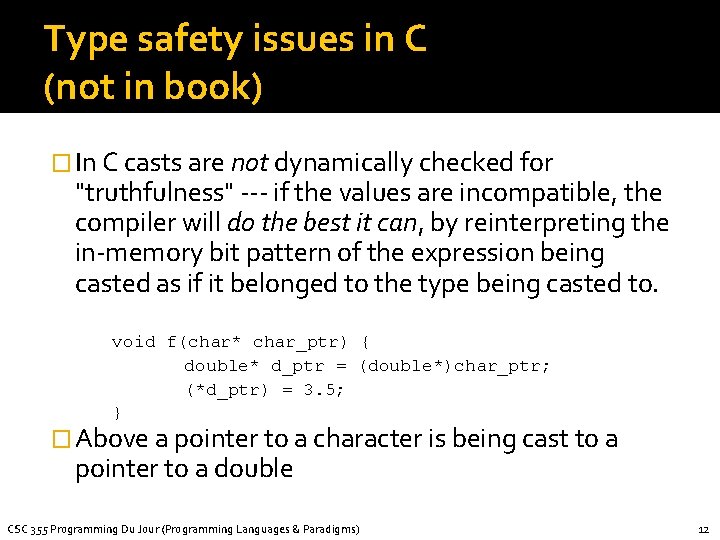
Type safety issues in C (not in book) � In C casts are not dynamically checked for "truthfulness" --- if the values are incompatible, the compiler will do the best it can, by reinterpreting the in-memory bit pattern of the expression being casted as if it belonged to the type being casted to. void f(char* char_ptr) { double* d_ptr = (double*)char_ptr; (*d_ptr) = 3. 5; } � Above a pointer to a character is being cast to a pointer to a double CSC 355 Programming Du Jour (Programming Languages & Paradigms) 12
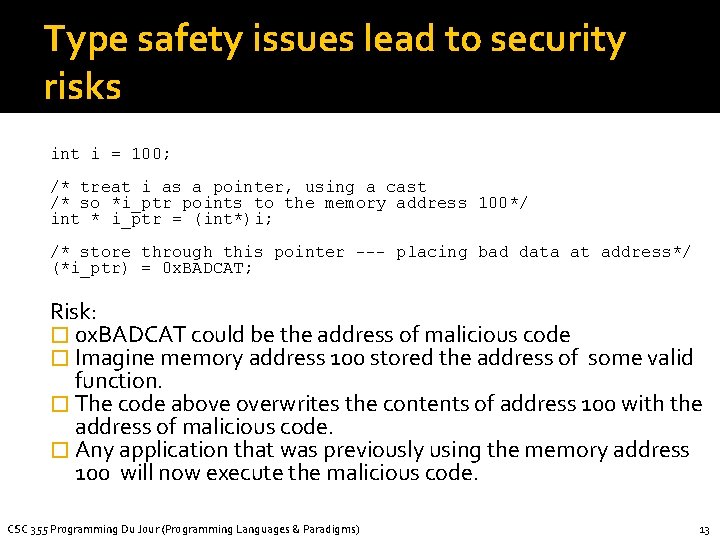
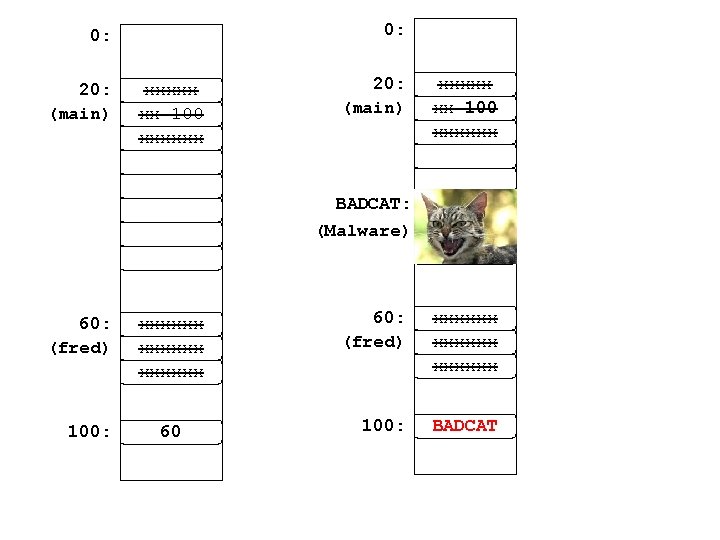
Type safety issues lead to security risks int i = 100; /* treat i as a pointer, using a cast /* so *i_ptr points to the memory address 100*/ int * i_ptr = (int*)i; /* store through this pointer --- placing bad data at address*/ (*i_ptr) = 0 x. BADCAT; Risk: � 0 x. BADCAT could be the address of malicious code � Imagine memory address 100 stored the address of some valid function. � The code above overwrites the contents of address 100 with the address of malicious code. � Any application that was previously using the memory address 100 will now execute the malicious code. CSC 355 Programming Du Jour (Programming Languages & Paradigms) 13
0: 0: 20: (main) xxxxx xx 100 xxxxxx BADCAT: (Malware) 60: (fred) 100: xxxxxx 60 60: (fred) xxxxxx 100: BADCAT
When to use type un-safe languages? � Are there any advantages to type un-safe languages like C or C++? Simplifies compilers job Produces efficient code Gives programmers explicit control over low level details. � Many experts believe that type un-safe languages like C and C++ should be used for only for low level routines and performance critical methods. CSC 355 Programming Du Jour (Programming Languages & Paradigms) 15