
Typed Lambda Calculus Adapted from Lectures by Profs
Typed Lambda Calculus Adapted from Lectures by Profs Aiken and Necula of Univ. of California at Berkeley CS 776 Prasad 1
Lecture Outline • Lambda Calculus – Review and examples • Simple types • Type checking • Comparison with OO type systems CS 776 Prasad 2
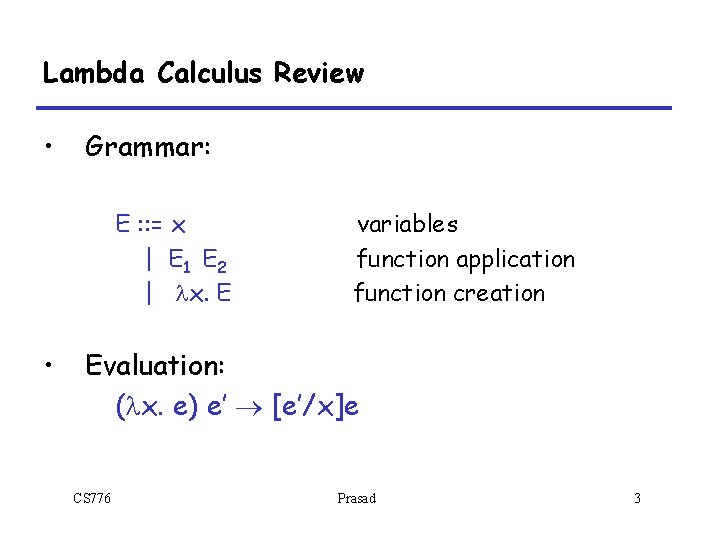
Lambda Calculus Review • Grammar: E : : = x | E 1 E 2 | lx. E • variables function application function creation Evaluation: (lx. e) e’ ® [e’/x]e CS 776 Prasad 3
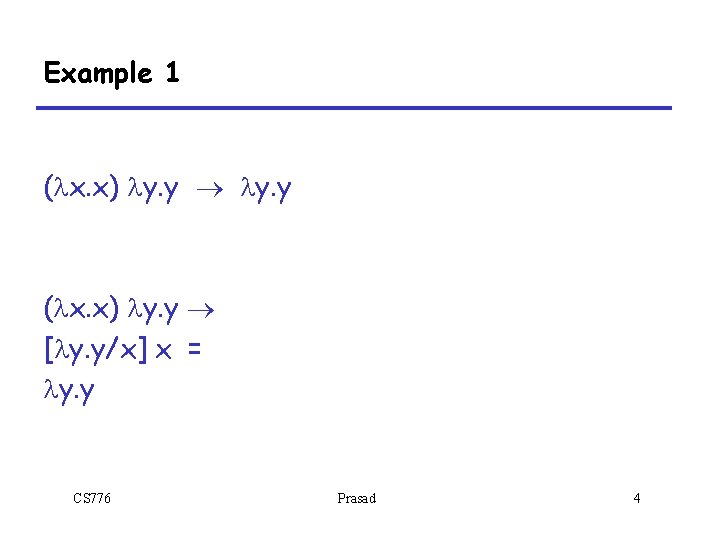
Example 1 (lx. x) ly. y ® ly. y (lx. x) ly. y ® [ly. y/x] x = ly. y CS 776 Prasad 4
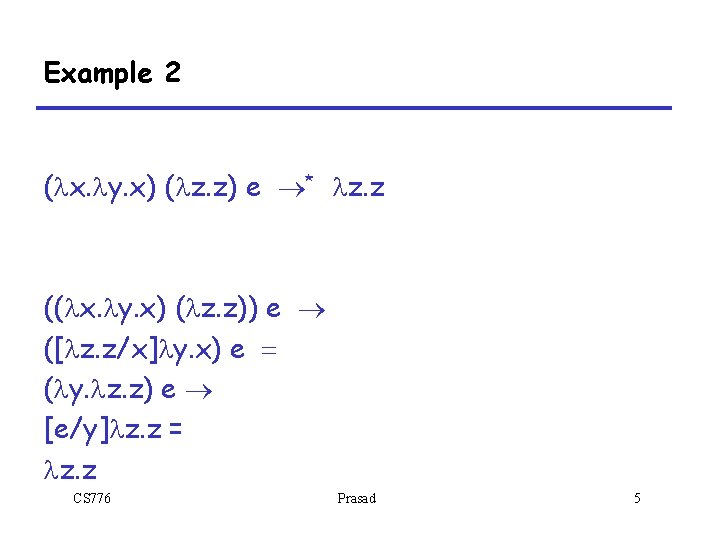
Example 2 (lx. ly. x) (lz. z) e ®* lz. z ((lx. ly. x) (lz. z)) e ® ([lz. z/x]ly. x) e = (ly. lz. z) e ® [e/y]lz. z = lz. z CS 776 Prasad 5
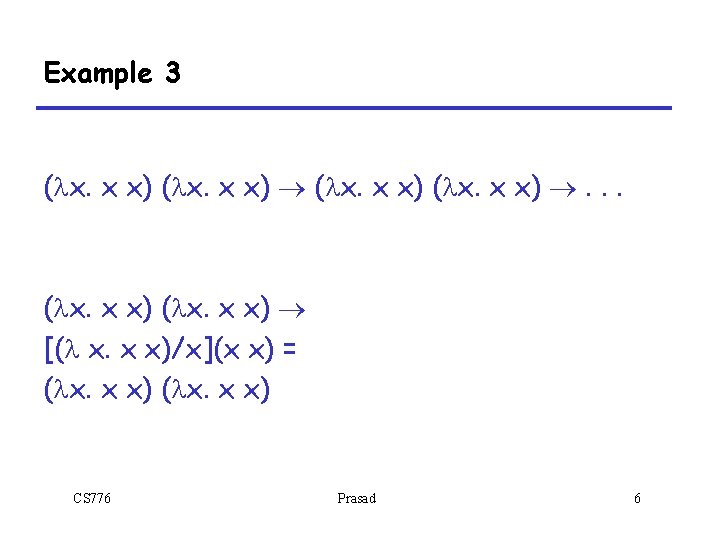
Example 3 (lx. x x) ®. . . (lx. x x) ® [(l x. x x)/x](x x) = (lx. x x) CS 776 Prasad 6
Question What programming errors can occur in lambda calculus? CS 776 Prasad 7
Notes • We can encode anything we like in lambda calculus – Booleans, integers, objects, if-then-else, recursion, . . . • But don’t forget that these are encodings – Akin to programming directly with 0’s and 1’s CS 776 Prasad 8
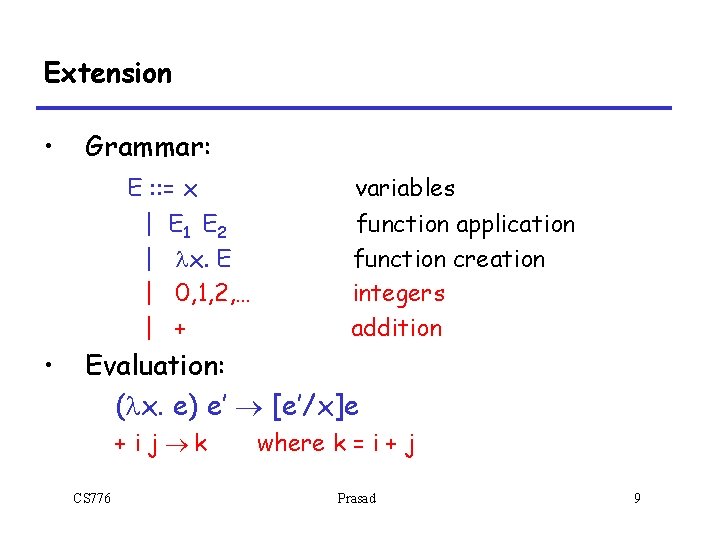
Extension • Grammar: E : : = x | E 1 E 2 | lx. E | 0, 1, 2, … | + • variables function application function creation integers addition Evaluation: (lx. e) e’ ® [e’/x]e +ij®k CS 776 where k = i + j Prasad 9
Digression • There is nothing magic about adding integers and + as constants to the lambda calculus • We could add any data types and operations we like • They can be encoded directly in lambda calculus anyway CS 776 Prasad 10
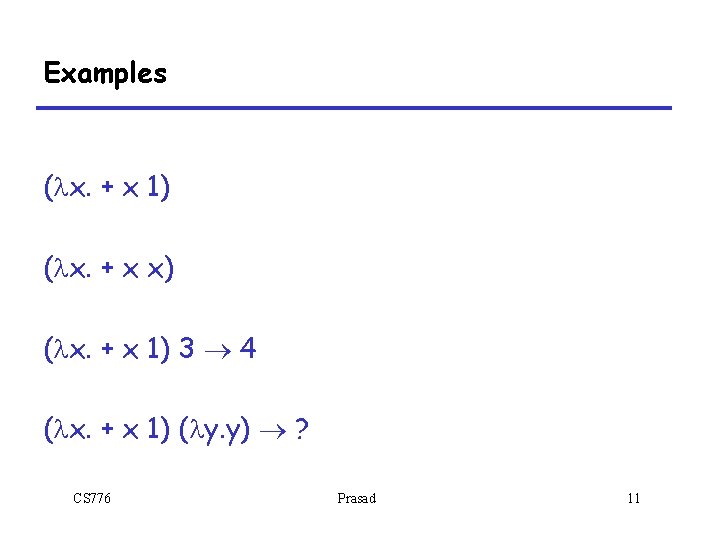
Examples (lx. + x 1) (lx. + x x) (lx. + x 1) 3 ® 4 (lx. + x 1) (ly. y) ® ? CS 776 Prasad 11
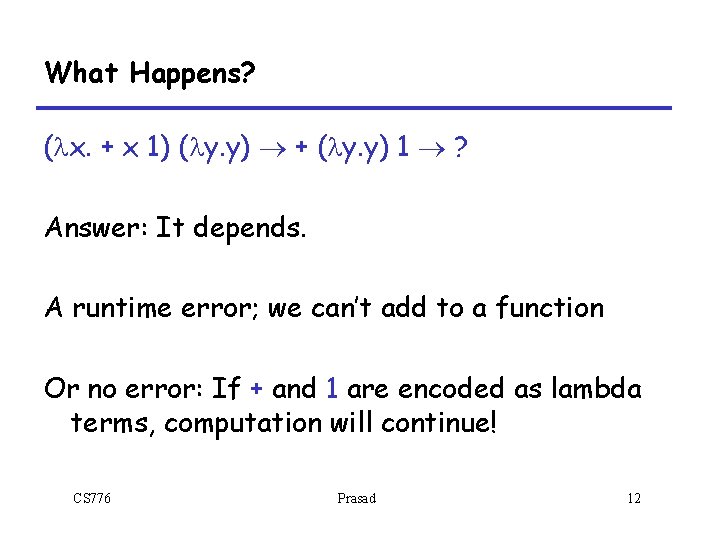
What Happens? (lx. + x 1) (ly. y) ® + (ly. y) 1 ® ? Answer: It depends. A runtime error; we can’t add to a function Or no error: If + and 1 are encoded as lambda terms, computation will continue! CS 776 Prasad 12

Notes • Assume 1, + are encoded as lambda terms • Nothing guarantees the encoding of 1 is used as an integer – E. g. , (1 lx. x) – Evaluation doesn’t know what the encodings are supposed to represent CS 776 Prasad 13
Back to the Future • We need to be able to restrict uses of values to appropriate operations • We need a type system! • Note that we’d like a type system whether or not + (ly. y) 1 causes a runtime error – Catching these errors before program execution is better CS 776 Prasad 14
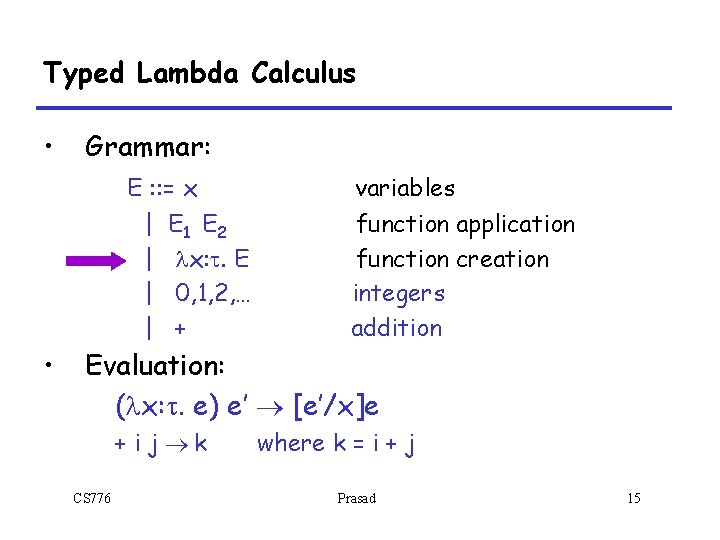
Typed Lambda Calculus • Grammar: E : : = x | E 1 E 2 | lx: t. E | 0, 1, 2, … | + • variables function application function creation integers addition Evaluation: (lx: t. e) e’ ® [e’/x]e +ij®k CS 776 where k = i + j Prasad 15
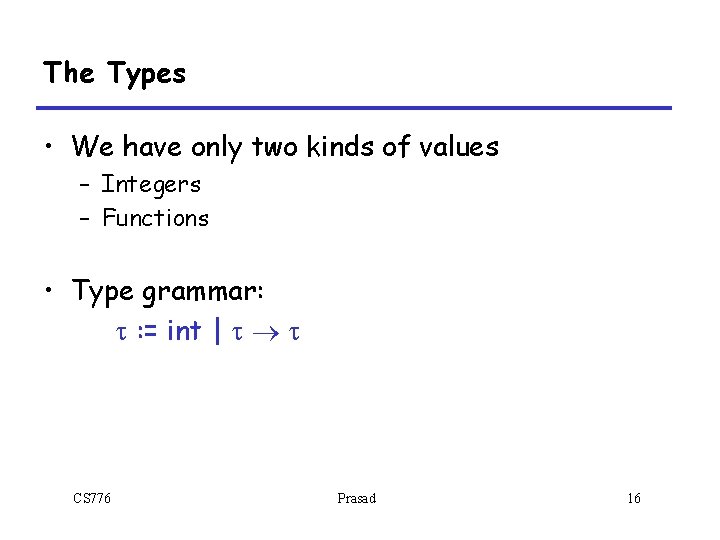
The Types • We have only two kinds of values – Integers – Functions • Type grammar: t : = int | t ® t CS 776 Prasad 16
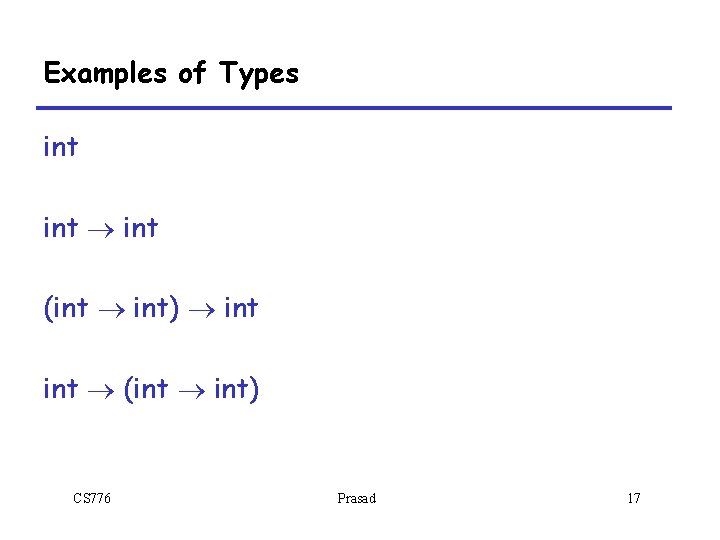
Examples of Types int ® int (int ® int) ® int ® (int ® int) CS 776 Prasad 17
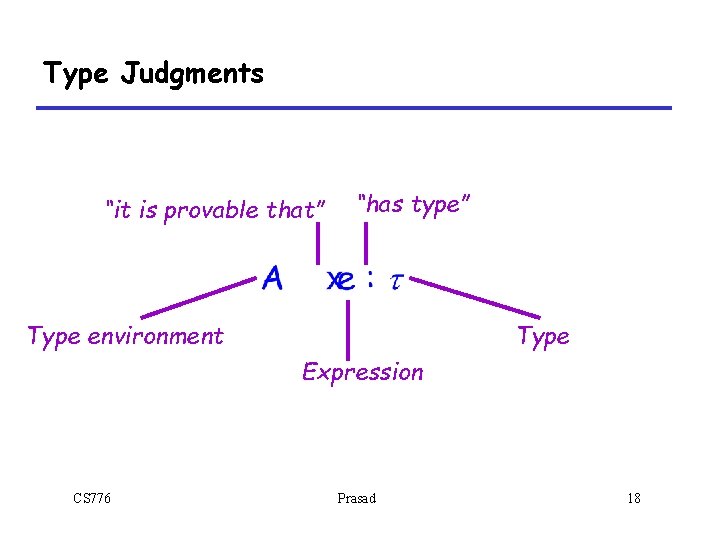
Type Judgments “it is provable that” “has type” Type environment Type Expression CS 776 Prasad 18
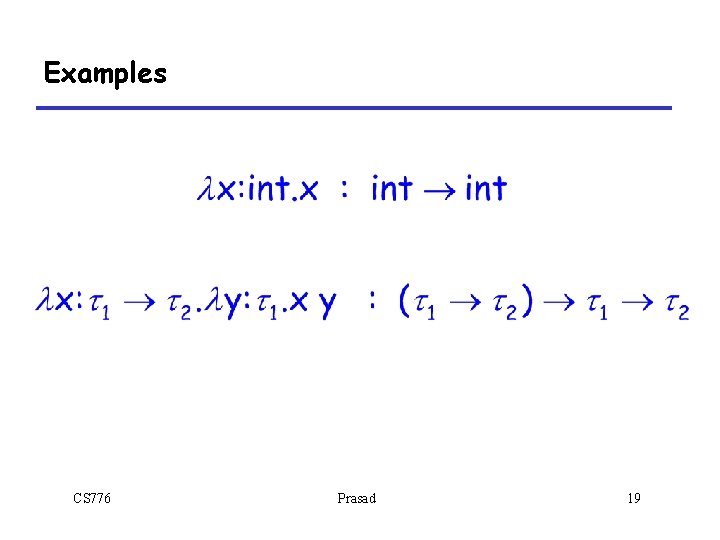
Examples CS 776 Prasad 19
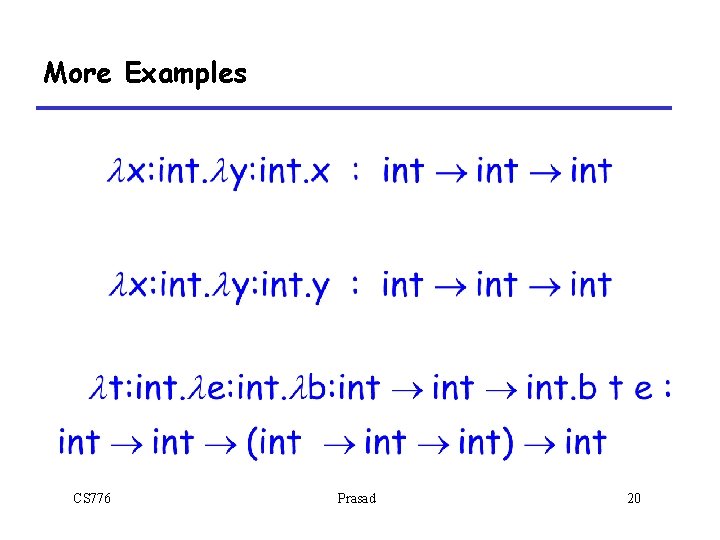
More Examples CS 776 Prasad 20
![Type Rule: Variables [Var] A variable has the type assumed in the type environment.](http://slidetodoc.com/presentation_image_h2/361e3b1ba0e17beea81cc0188413e01a/image-21.jpg "Type Rule: Variables [Var] A variable has the type assumed in the type environment.")
Type Rule: Variables [Var] A variable has the type assumed in the type environment. CS 776 Prasad 21
![Abstraction [Abs] A function has type t 1 ® t 2 if the function](http://slidetodoc.com/presentation_image_h2/361e3b1ba0e17beea81cc0188413e01a/image-22.jpg "Abstraction [Abs] A function has type t 1 ® t 2 if the function")
Abstraction [Abs] A function has type t 1 ® t 2 if the function body has type t 2 when we assume the argument has type t 1. CS 776 Prasad 22
![Application [App] Applying a function of type t 1 ® t 2 to an](http://slidetodoc.com/presentation_image_h2/361e3b1ba0e17beea81cc0188413e01a/image-23.jpg "Application [App] Applying a function of type t 1 ® t 2 to an")
Application [App] Applying a function of type t 1 ® t 2 to an argument of type t 1 gives a result of type t 2 CS 776 Prasad 23
![Integers [Int] An integer has type int CS 776 Prasad 24](http://slidetodoc.com/presentation_image_h2/361e3b1ba0e17beea81cc0188413e01a/image-24.jpg "Integers [Int] An integer has type int CS 776 Prasad 24")
Integers [Int] An integer has type int CS 776 Prasad 24
![Addition [Add] Adding two int’s produces an int CS 776 Prasad 25](http://slidetodoc.com/presentation_image_h2/361e3b1ba0e17beea81cc0188413e01a/image-25.jpg "Addition [Add] Adding two int’s produces an int CS 776 Prasad 25")
Addition [Add] Adding two int’s produces an int CS 776 Prasad 25
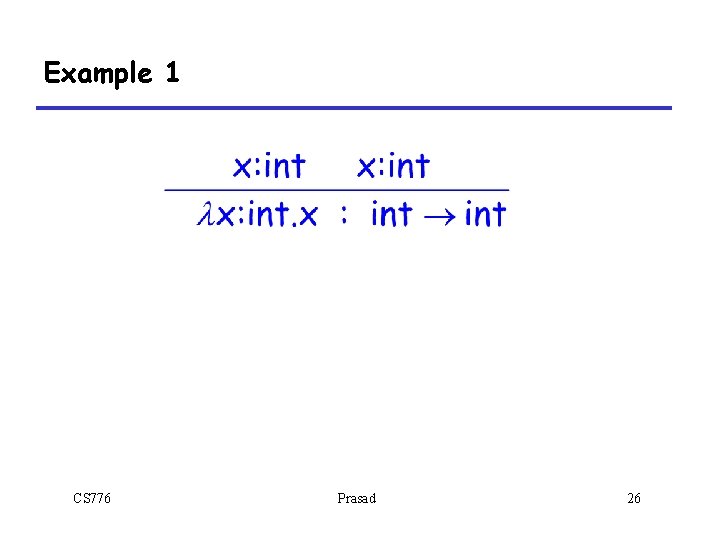
Example 1 CS 776 Prasad 26
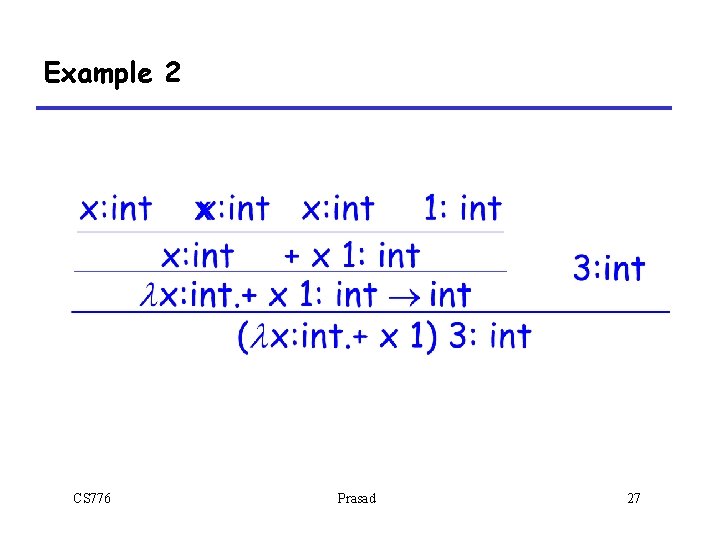
Example 2 CS 776 Prasad 27
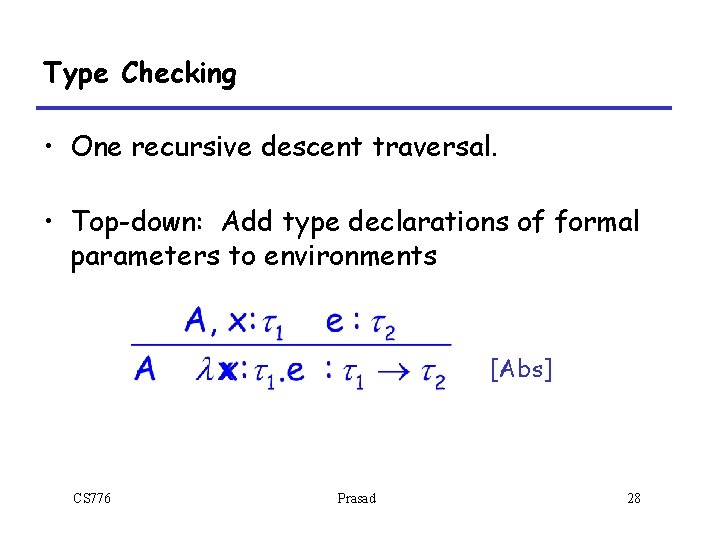
Type Checking • One recursive descent traversal. • Top-down: Add type declarations of formal parameters to environments [Abs] CS 776 Prasad 28
![Type Checking (Cont. ) • Bottom-up: Check that types match in applications [App] CS](http://slidetodoc.com/presentation_image_h2/361e3b1ba0e17beea81cc0188413e01a/image-29.jpg "Type Checking (Cont. ) • Bottom-up: Check that types match in applications [App] CS")
Type Checking (Cont. ) • Bottom-up: Check that types match in applications [App] CS 776 Prasad 29
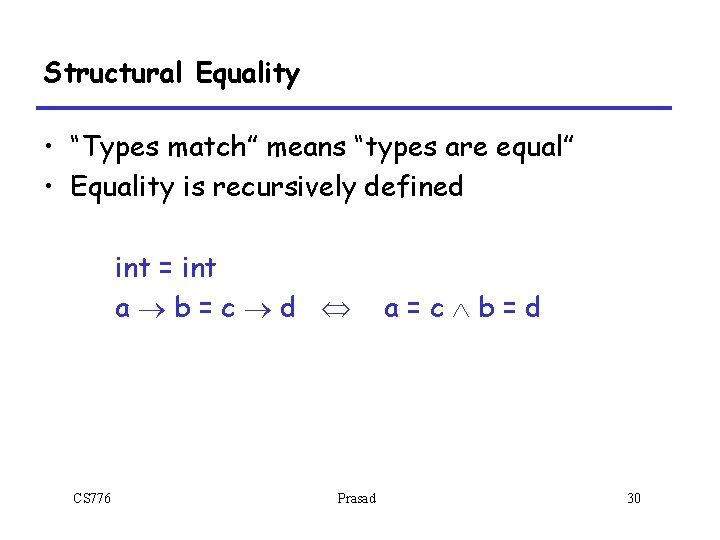
Structural Equality • “Types match” means “types are equal” • Equality is recursively defined int = int a®b=c®d Û CS 776 Prasad a=cÙb=d 30
Notes • In typed lambda calculus: – Types of all variables are declared – Types are structured (e. g. , int ® int) – Types are checked for equality • Many typed languages in this class – Nearly all typed languages before 1980 – FORTRAN, ALGOL, Pascal, C – Captures C typing except for casts & coercions CS 776 Prasad 31
Typed OO Languages • In many typed object-oriented languages – Types of all variables are declared – Types are non-structural (just names) • Declare all types and type relationships – Types are checked for subtyping relationships • What if type declarations are omitted? – A language with type inference CS 776 Prasad 32
Discussion What about structural types + subtyping? – Area of current research – Currently no consensus on the right way to combine C-like type systems with typical OO-like type systems CS 776 Prasad 33
- Slides: 33