
Type Your Name Here Student Name Instructions This
- Slides: 9
Type Your Name Here Student Name Instructions This Digital Interactive Notebook is designed to help you better understand World War II. It includes pages on vocabulary terms, people, and key events of this period. On each page you will see blue text boxes where you can type responses. Simply click in the box and begin typing to provide your response. You can also add your own text boxes by clicking on the text box icon ( ). You also will need to add images to various pages. You can do this by clicking on the “Image” icon ( ) or by going to “Insert > Image” in the menu. Each text box can also be resized using the borders so that each fits on your pages.
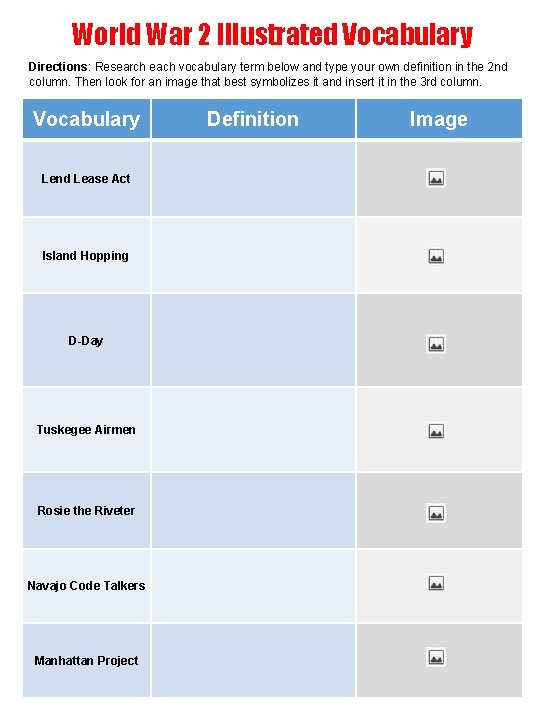
World War 2 Illustrated Vocabulary Directions: Research each vocabulary term below and type your own definition in the 2 nd column. Then look for an image that best symbolizes it and insert it in the 3 rd column. Vocabulary Lend Lease Act Island Hopping D-Day Tuskegee Airmen Rosie the Riveter Navajo Code Talkers Manhattan Project Definition Image
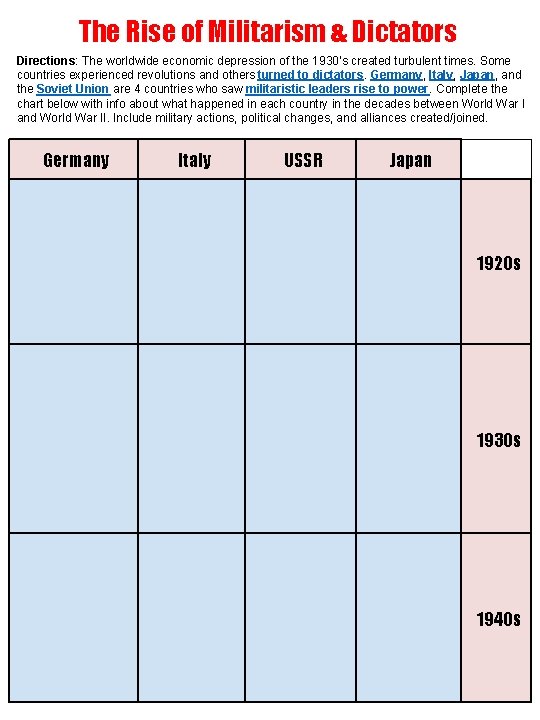
The Rise of Militarism & Dictators Directions: The worldwide economic depression of the 1930’s created turbulent times. Some countries experienced revolutions and others turned to dictators. Germany, Italy, Japan, and the Soviet Union are 4 countries who saw militaristic leaders rise to power. Complete the chart below with info about what happened in each country in the decades between World War I and World War II. Include military actions, political changes, and alliances created/joined. Germany Italy USSR Japan 1920 s 1930 s 1940 s
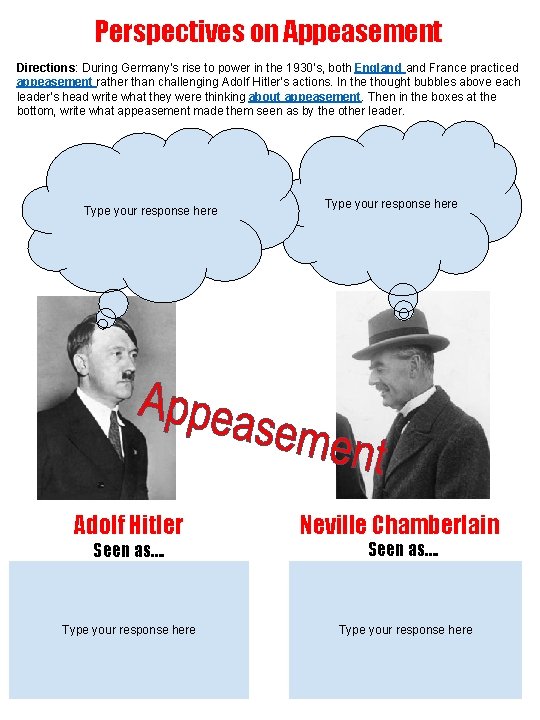
Perspectives on Appeasement Directions: During Germany’s rise to power in the 1930’s, both England France practiced appeasement rather than challenging Adolf Hitler’s actions. In the thought bubbles above each leader’s head write what they were thinking about appeasement. Then in the boxes at the bottom, write what appeasement made them seen as by the other leader. Type your response here Adolf Hitler Seen as…. Type your response here Neville Chamberlain Seen as…. Type your response here
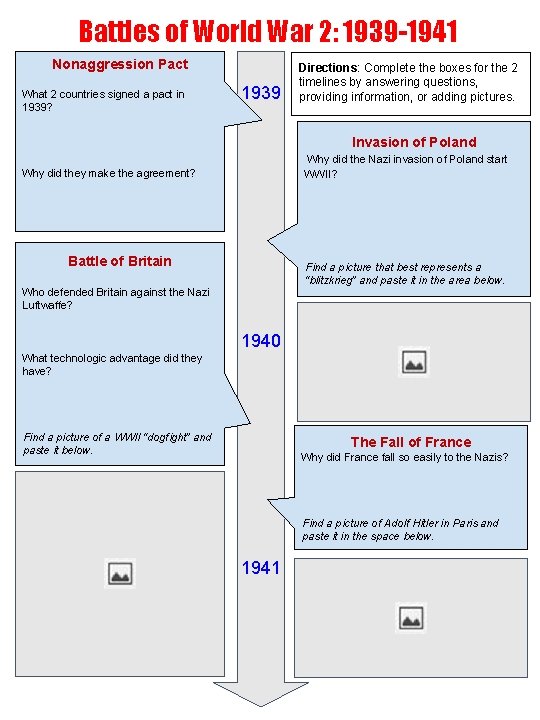
Battles of World War 2: 1939 -1941 Nonaggression Pact What 2 countries signed a pact in 1939? 1939 Directions: Complete the boxes for the 2 timelines by answering questions, providing information, or adding pictures. Invasion of Poland Why did the Nazi invasion of Poland start WWII? Why did they make the agreement? Battle of Britain Find a picture that best represents a “blitzkrieg” and paste it in the area below. Who defended Britain against the Nazi Luftwaffe? 1940 What technologic advantage did they have? Find a picture of a WWII “dogfight” and paste it below. The Fall of France Why did France fall so easily to the Nazis? Find a picture of Adolf Hitler in Paris and paste it in the space below. 1941
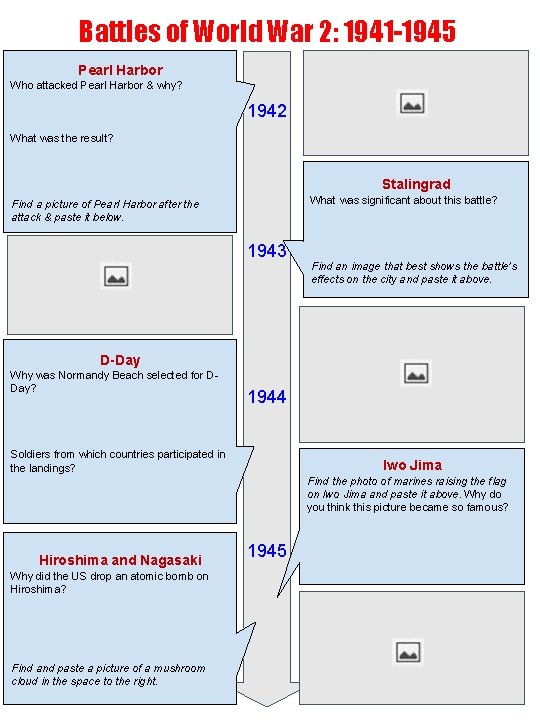
Battles of World War 2: 1941 -1945 Pearl Harbor Who attacked Pearl Harbor & why? 1942 What was the result? Stalingrad What was significant about this battle? Find a picture of Pearl Harbor after the attack & paste it below. 1943 Find an image that best shows the battle’s effects on the city and paste it above. D-Day Why was Normandy Beach selected for DDay? 1944 Soldiers from which countries participated in the landings? Iwo Jima Find the photo of marines raising the flag on Iwo Jima and paste it above. Why do you think this picture became so famous? Hiroshima and Nagasaki Why did the US drop an atomic bomb on Hiroshima? Find and paste a picture of a mushroom cloud in the space to the right. 1945
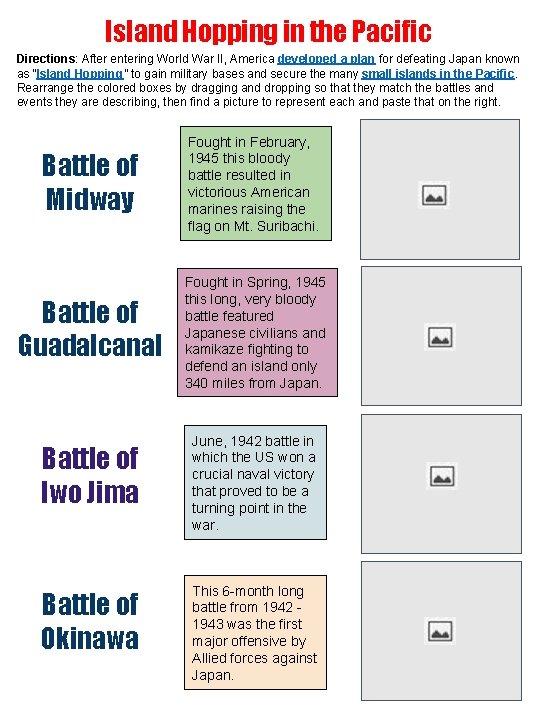
Island Hopping in the Pacific Directions: After entering World War II, America developed a plan for defeating Japan known as “Island Hopping” to gain military bases and secure the many small islands in the Pacific. Rearrange the colored boxes by dragging and dropping so that they match the battles and events they are describing, then find a picture to represent each and paste that on the right. Battle of Midway Fought in February, 1945 this bloody battle resulted in victorious American marines raising the flag on Mt. Suribachi. Battle of Guadalcanal Fought in Spring, 1945 this long, very bloody battle featured Japanese civilians and kamikaze fighting to defend an island only 340 miles from Japan. Battle of Iwo Jima Battle of Okinawa June, 1942 battle in which the US won a crucial naval victory that proved to be a turning point in the war. This 6 -month long battle from 1942 1943 was the first major offensive by Allied forces against Japan.
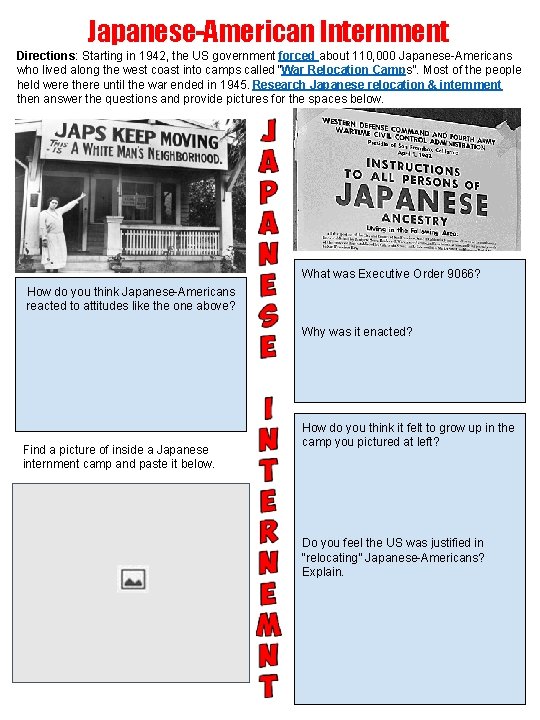
Japanese-American Internment Directions: Starting in 1942, the US government forced about 110, 000 Japanese-Americans who lived along the west coast into camps called “War Relocation Camps”. Most of the people held were there until the war ended in 1945. Research Japanese relocation & internment then answer the questions and provide pictures for the spaces below. What was Executive Order 9066? How do you think Japanese-Americans reacted to attitudes like the one above? Why was it enacted? Find a picture of inside a Japanese internment camp and paste it below. How do you think it felt to grow up in the camp you pictured at left? Do you feel the US was justified in “relocating” Japanese-Americans? Explain.
The Bombing of Hiroshima & Nagasaki Directions: After the Manhattan Project successfully created and tested an atomic bomb, President Truman authorized its use on 2 Japanese cities. Analyze the article, pictures, and videos about the bombing here then complete the boxes and add pictures to the right. The Decision Why was the decision made to use the atomic bomb on Japan? Dropping Fat Man & Little Boy Why was Hiroshima chosen as the bombing site? Describe what happened to the city after the bomb hit. The After Effects Describe some of the long-term effects the atomic bombs had on the people, cities, and government of Japan.