
TYPE PREFERENCES Carl Jung l Choleric l Sanguine















- Slides: 47
TYPE PREFERENCES
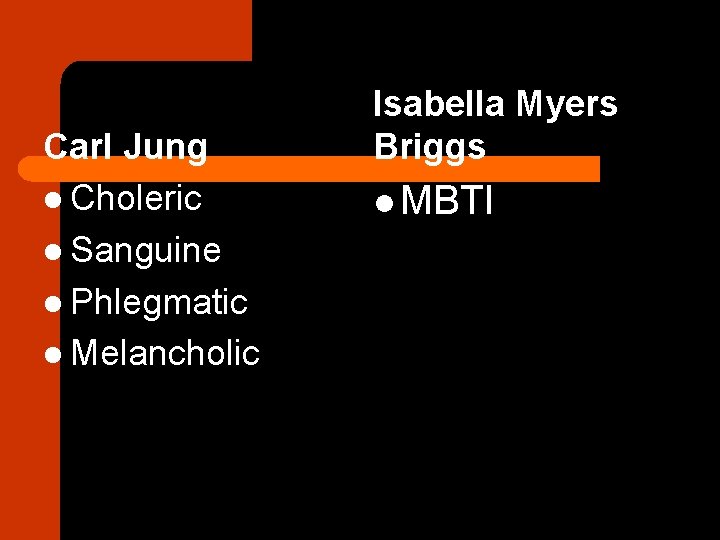
Carl Jung l Choleric l Sanguine l Phlegmatic l Melancholic Isabella Myers Briggs l MBTI
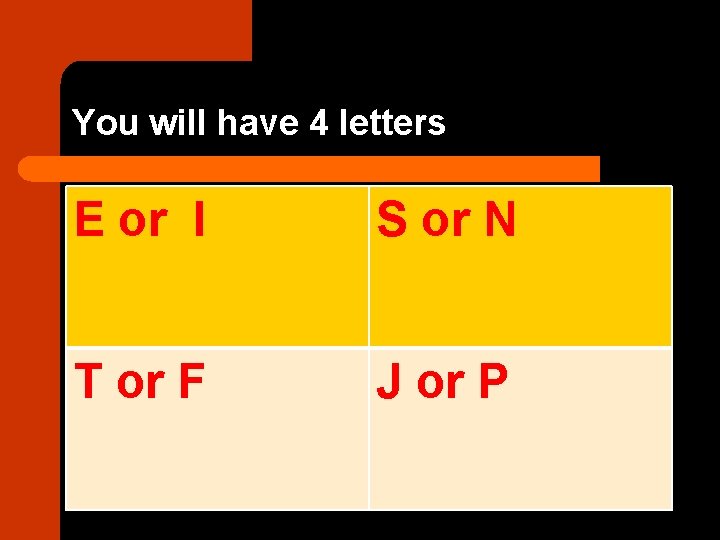
You will have 4 letters E or I S or N T or F J or P
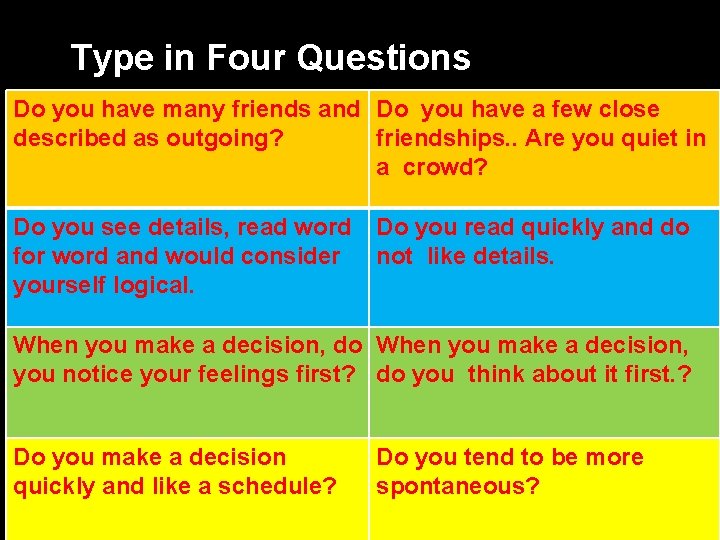
Type in Four Questions Do you have many friends and Do you have a few close described as outgoing? friendships. . Are you quiet in a crowd? Do you see details, read word for word and would consider yourself logical. Do you read quickly and do not like details. When you make a decision, do When you make a decision, you notice your feelings first? do you think about it first. ? Do you make a decision quickly and like a schedule? Do you tend to be more spontaneous?
YOU ARE… l EXTRAVERT – INTROVERT Where you get your energy l SENSORS INTIUTIVE - How you take in information l THINKING - How you make decisions l JUDGING PERCEIVING -How you structure your world FEELING
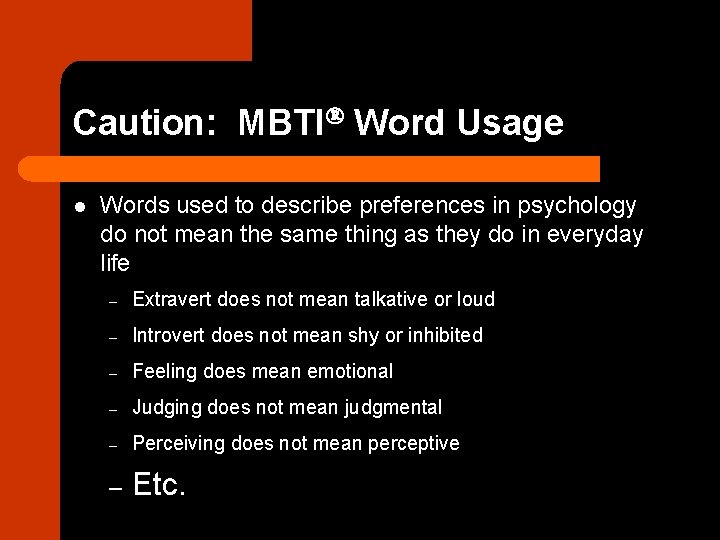
Caution: MBTI Word Usage l Words used to describe preferences in psychology do not mean the same thing as they do in everyday life – Extravert does not mean talkative or loud – Introvert does not mean shy or inhibited – Feeling does mean emotional – Judging does not mean judgmental – Perceiving does not mean perceptive – Etc.
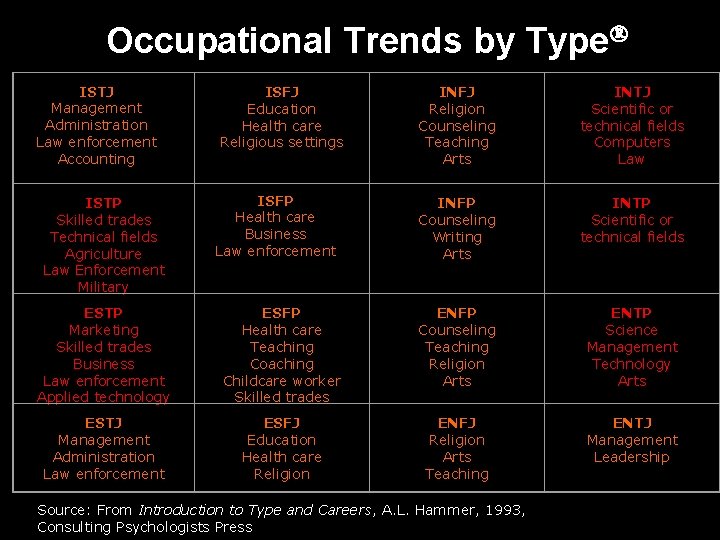
Occupational Trends by Type ISTJ Management Administration Law enforcement Accounting ISTP Skilled trades Technical fields Agriculture Law Enforcement Military ISFJ Education Health care Religious settings ISFP Health care Business Law enforcement ESTP Marketing Skilled trades Business Law enforcement Applied technology ESFP Health care Teaching Coaching Childcare worker Skilled trades ESTJ Management Administration Law enforcement ESFJ Education Health care Religion INFJ Religion Counseling Teaching Arts INTJ Scientific or technical fields Computers Law INFP Counseling Writing Arts ENFP Counseling Teaching Religion Arts ENFJ Religion Arts Teaching Source: From Introduction to Type and Careers, A. L. Hammer, 1993, Consulting Psychologists Press INTP Scientific or technical fields ENTP Science Management Technology Arts ENTJ Management Leadership
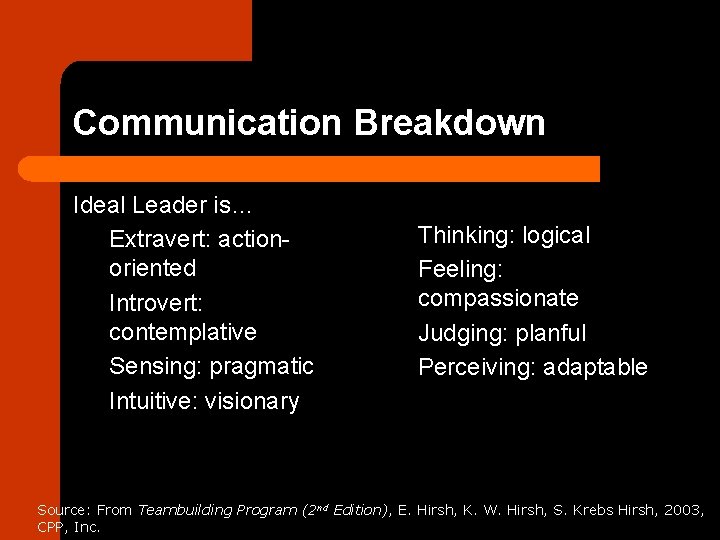
Communication Breakdown Ideal Leader is… Extravert: actionoriented Introvert: contemplative Sensing: pragmatic Intuitive: visionary Thinking: logical Feeling: compassionate Judging: planful Perceiving: adaptable Source: From Teambuilding Program (2 nd Edition), E. Hirsh, K. W. Hirsh, S. Krebs Hirsh, 2003, CPP, Inc.
Innate Preferences l Exercise: – Write your name
What is your E – I preference? l Exercise – When you are going to a large party, what do you do? – What do you consider a large party or group?
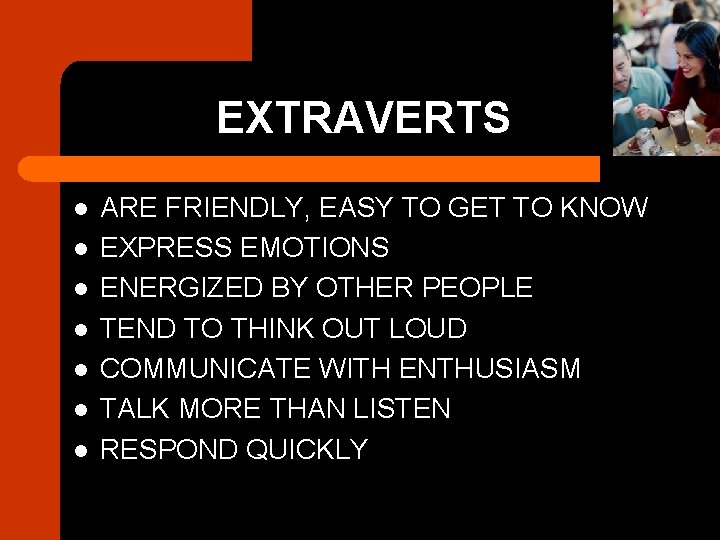
EXTRAVERTS l l l l ARE FRIENDLY, EASY TO GET TO KNOW EXPRESS EMOTIONS ENERGIZED BY OTHER PEOPLE TEND TO THINK OUT LOUD COMMUNICATE WITH ENTHUSIASM TALK MORE THAN LISTEN RESPOND QUICKLY
INTROVERTS l l l l ENERGIZED BY SPENDING TIME ALONE THINK THINGS THROUGH INSIDE THEIR HEAD ARE MORE PRIVATE, SHARE PERSONAL INFORMATION WITH A SELECT FEW LISTEN MORE THAN TALK KEEP THEIR ENTHUSIASM TO THEMSELVES TAKE TIME TO RESPOND AVOID BEING THE CENTER OF ATTENTION
What is your S-N preference? l Exercise – How did you decide whom to support?
SENSORS l l l TRUST WHAT IS CERTAIN AND CONCRETE LIKE NEW IDEAS ONLY IF THEY HAVE PRACTICAL APPLICATION VALUE REALISM AND COMMON SENSE PRESENT INFORMATION IN A STEP BY STEP MANNER ORIENTED TO THE PRESENT GIVE DETAILED DESCRIPTIONS
INTUITIVES l l l LIKE NEW IDEAS AND CONCEPTS LIKE TO LEARN NEW SKILLS TEND TO BE GENERAL AND FIGURATIVE PRESENT INFORMATION THROUGH LEAPS, IN A ROUNDABOUT MANNER ORIENTED TO THE FUTURE
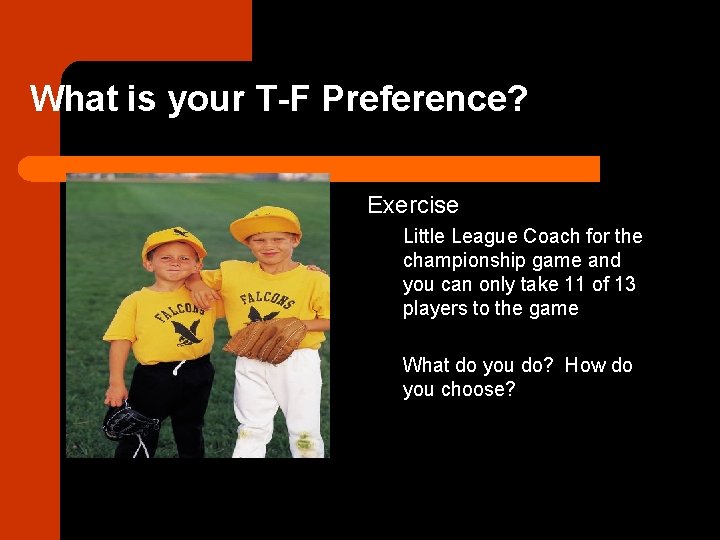
What is your T-F Preference? Exercise Little League Coach for the championship game and you can only take 11 of 13 players to the game What do you do? How do you choose?
THINKERS l l l STEP BACK, APPLY INPERSONAL ANALYSIS TO PROBLEMS VALUE LOGIC, JUSTICE AND FAIRNESS NATURALLY SEE FLAWS CONSIDER IT MORE IMPORTANT TO BE TRUTHFUL THAN TACTFUL ARE TASK ORIENTED
FEELERS l l l STEP FORWARD, CONSIDER EFFECT OF ACTION ON OTHERS VALUE EMPATHY AND HARMONY NATURALLY LIKE TO PLEASE OTHERS CONSIDER IT MORE IMPORTANT TO BE TACTFUL AS WELL AS TRUTHFUL BELIEVE ANY FEELING IS VALID WANT TO BE APPRECIATED
What is your J-P Preference? Exercise Sending you on a vacation $5, 000 What do you do? How do you go about it?
JUDGERS l l l ARE HAPPIEST AFTER DECISIONS HAVE BEEN MADE HAVE A WORK ETHIC, WORK FIRST, PLAY LATER SET GOALS ARE PRODUCT ORIENTED, WANT TO COMPLETE TASKS TAKE DEADLINES SERIOUSLY
PERCEIVERS l l l ARE HAPPIEST LEAVING THEIR OPTIONS OPEN HAVE A PLAY ETHIC, ENJOY NOW, FINISH THE JOB LATER CHANGE GOALS ARE PROCESS ORIENTED, HOW THE TASK IS COMPLETED SEE TIME AS A RENEWABLE RESOURCE, NO DEADLINES LIKE TO START PROJECTS
MBTI in cartoons
SJ THE GUARDIANS Keirsey describes the SJ group's primary objective as "Security Seeking". The SJ grouping includes the types: l ESTJ - "The Supervisors" l ISTJ - "The Inspectors" l ESFJ - "The Providers" l ISFJ - "The Protectors"
NT THE RATIONALS l l Keirsey describes the NT group's primary objective as "Knowledge Seeking". The NT grouping includes the types: ENTJ - "The Field marshals" INTJ - "The Masterminds" ENTP - "The Inventors" INTP - "The Architects"
NF THE IDEALISTS l l Keirsey describes the NF group's primary objective as "Identity Seeking". The NF grouping includes the types: ENFJ - "The Teachers" INFJ - "The Counselors" ENFP - "The Champions" INFP - "The Healers"
SP THE ARTISANS Keirsey describes the SP group's primary objective as "Sensation Seeking". The SP grouping includes the types: l ESTP - "The Promoters" l ISTP - "The Crafters" l ESFP - "The Performers" l ISFP - "The Composers"
The Ideal Leader l l Extravert-actionoriented Introvert – contemplative Sensing- pragmatic Intuitive-visionary l l Thinking-logical Feelingcompassionate Judging-planful Perceivingadaptable
ISTJ For ISTJs the dominant quality in their lives is an abiding sense of responsibility for doing what needs to be done in the here-and-now. Their realism, organizing abilities, and command of the facts lead to their completing tasks thoroughly and with great attention to detail. Logical pragmatists at heart, ISTJs make decisions based on their experience and with an eye to efficiency in all things. ISTJs are intensely committed to people and to the organizations of which they are a part; they take their work seriously and believe others should do so as well.
ISFJ For ISFJs the dominant quality in their lives is an abiding respect and sense of personal responsibility for doing what needs to be done in the here-and-now. Actions that are of practical help to others are of particular importance to ISFJs. Their realism, organizing abilities, and command of the facts lead to their thorough attention in completing tasks. ISFJs bring an aura of quiet warmth, caring, and dependability to all that they do; they take their work seriously and believe others should do so as well.
INFJ For INFJs the dominant quality in their lives is their attention to the inner world of possibilities, ideas, and symbols. Knowing by way of insight is paramount for INFJs, and they often manifest a deep concern for people and relationships as well. INFJs often have deep interests in creative expression as well as issues of spirituality and human development. While the energy and attention of INFJs are naturally drawn to the inner world of ideas and insights, what people often first encounter with INFJs is their drive for closure and for the application of their ideas to people's concerns.
INTJ For INTJs the dominant force in their lives is their attention to the inner world of possibilities, symbols, abstractions, images, and thoughts. Insight in conjunction with logical analysis is the essence of their approach to the world; they think systemically. Ideas are the substance of life for INTJs and they have a driving need to understand, to know, and to demonstrate competence in their areas of interest. INTJs inherently trust their insights, and with their task-orientation will work intensely to make their visions into realities.
ISTP For ISTPs the driving force in their lives is to understand how things and phenomena in the real world work so they can make the best and most effective use of them. ISTPs are logical and realistic people, and they are natural troubleshooters. When not actively solving a problem, ISTPs are quiet and analytical observers of their environment, and they naturally look for the underlying sense to any facts they have gathered. ISTPs do often pursue variety and even excitement in their hands-on experiences. Although they do have a spontaneous, even playful side, what people often first encounter with them is their detached pragmatism.
ISFP For ISFPs the dominant quality in their lives is a deep-felt caring for living things, combined with a quietly playful and sometimes adventurous approach to life and all its experiences. ISFPs typically show their caring in very practical ways, since they often prefer action to words. Their warmth and concern are generally not expressed openly, and what people often first encounter with ISFPs is their quiet adaptability, realism, and "free spirit" spontaneity.
INFP For INFPs the dominant quality in their lives is a deep-felt caring and idealism about people. They experience this intense caring most often in their relationships with others, but they may also experience it around ideas, projects, or any involvement they see as important. INFPs are often skilled communicators, and they are naturally drawn to ideas that embody a concern for human potential. INFPs live in the inner world of values and ideals, but what people often first encounter with the INFP in the outer world is their adaptability and concern for possibilities.
INTP For INTPs the driving force in their lives is to understand whatever phenomenon is the focus of their attention. They want to make sense of the world -- as a concept -- and they often enjoy opportunities to be creative. INTPs are logical, analytical, and detached in their approach to the world; they naturally question and critique ideas and events as they strive for understanding. INTPs usually have little need to control the outer world, or to bring order to it, and they often appear very flexible and adaptable in their lifestyle.
ESTP For ESTPs the dominant quality in their lives is their enthusiastic attention to the outer world of hands-on and real-life experiences. ESTPs are excited by continuous involvement in new activities and in the pursuit of new challenges. ESTPs tend to be logical and analytical in their approach to life, and they have an acute sense of how objects, events, and people in the world work. ESTPs are typically energetic and adaptable realists, who prefer to experience and accept life rather than to judge or organize it.
ESFP For ESFPs the dominant quality in their lives is their enthusiastic attention to the outer world of hands-on and real-life experiences. ESFPs are excited by continuous involvement in new activities and new relationships. ESFPs also have a deep concern for people, and they show their caring in warm and pragmatic gestures of helping. ESFPs are typically energetic and adaptable realists, who prefer to experience and accept life rather than to judge or organize it.
ENFP For ENFPs the dominant quality in their lives is their attention to the outer world of possibilities; they are excited by continuous involvement in anything new, whether it be new ideas, new people, or new activities. Though ENFPs thrive on what is possible and what is new, they also experience a deep concern for people as well. Thus, they are especially interested in possibilities for people. ENFPs are typically energetic, enthusiastic people who lead spontaneous and adaptable lives.
ENTP For ENTPs the driving quality in their lives is their attention to the outer world of possibilities; they are excited by continuous involvement in anything new, whether it be new ideas, new people, or new activities. They look for patterns and meaning in the world, and they often have a deep need to analyze, to understand, and to know the nature of things. ENTPs are typically energetic, enthusiastic people who lead spontaneous and adaptable lives.
ESTJ For ESTJs the driving force in their lives is their need to analyze and bring into logical order the outer world of events, people, and things. ESTJs like to organize anything that comes into their domain, and they will work energetically to complete tasks so they can quickly move from one to the next. Sensing orients their thinking to current facts and realities, and thus gives their thinking a pragmatic quality. ESTJs take their responsibilities seriously and believe others should do so as well.
ESFJ For ESFJs the dominant quality in their lives is an active and intense caring about people and a strong desire to bring harmony into their relationships. ESFJs bring an aura of warmth to all that they do, and they naturally move into action to help others, to organize the world around them, and to get things done. Sensing orients their feeling to current facts and realities, and thus gives their feeling a hands-on pragmatic quality. ESFJs take their work seriously and believe others should as well.
ENFJ For ENFJs the dominant quality in their lives is an active and intense caring about people and a strong desire to bring harmony into their relationships. ENFJs are openly expressive and empathic people who bring an aura of warmth to all that they do. Intuition orients their feeling to the new and to the possible, thus ENFJs often enjoy working to manifest a humanitarian vision, or helping others develop their potential. ENFJs naturally and conscientiously move into action to care for others, to organize the world around them, and to get things done.
ENTJ For ENTJs the driving force in their lives is their need to analyze and bring into logical order the outer world of events, people, and things. ENTJs are natural leaders who build conceptual models that serve as plans for strategic action. Intuition orients their thinking to the future, and gives their thinking an abstract quality. ENTJs will actively pursue and direct others in the pursuit of goals they have set, and they prefer a world that is structured and organized.
SUCCESS… l l l Feed Your Strengths! Make sure you have opportunities to have new experiences to feel your quest of understanding the world. Face Your Weaknesses! Realize and accept that some traits are strengths and some are weaknesses. By facing your weaknesses, you can overcome them and they will have less power over you. Express Your Feelings. Don’t let anger get bottled up inside you. If you have strong feelings, sort them out and express them, or they may become destructive! Make Decisions. Don't be afraid to have an opinion. You need to know how you feel about things in order to be effective. Smile at Criticism. Try to see disagreement and discord as an opportunity for growth, because that’s exactly what it is. Try not to become overly defensive towards criticism; try to hear it and judge it objectively.
SUCCESS l l l Be Aware of Others. Remember that there are 15 other personality types out there who see things differently than you see them. Most of your problems with other people are easier to deal with if you try to understand the other person's perspective. Be Aware of Yourself. Don't stint your own needs for the sake of others too much. Realise you are an important focus. If you do not fulfil your own needs, how will continue to be effective and how will others know you are true to your beliefs? Be Accountable for Yourself. Don’t waste mental energy finding blame in other’s behaviour, or in identifying yourself as a victim. You have more control over your life than any other person has. Assume the Best. Don't distress yourself by assuming the worst. Remember that a positive attitude creates positive situations. When in Doubt, Ask Questions! Don't assume that the lack of feedback is the same thing as negative feedback. If you need feedback and don't have any, ask for it.
RECOMMENDED READING l l Please Understand Me II, Temperament, Character, and Intelligence, by David Keirsey, Prometheus Nemesis Book Company, 1998. Keirsey has developed a theory of character temperaments which at times complements traditional personality type theory, and at times "goes it's own way". This book describes his theories, and gives portraits of the 16 personality types. You will also find a copy of the "Keirsey Temperament Sorter" with this book, which is Keirsey's attempt to determine Personality Type. An excellent introduction to type theories Psychological Types, C. G. Jung, H. G. Baynes (translator). Bollingen Series, Princeton U. P. , 1971. This interesting book covers Carl Jung's theories, which are the foundation of modern Personality Type theory Do What You Are: Discover the Perfect Career For You Through the Secrets of Personality Type. Barbara Barron-Tieger and Paul D. Tieger. Little Brown & Co, 1995. This book is a great reference for people who are searching for a suitable career. The Personality Page Library (online)
The Gospels and Type v v Mark; eye-witness version of Jesus’s story, loosely organized, full of vivid details and physical action, as if thrown together by a man of impulsive ARTISAN character. Matthew; historical or traditional account of Jesus, and is likely the work of a GUARDIAN (Matthew was a customs house official and tax collector) Luke; is a scholarly explication of the Jesus story, written in a technical and classical style, probably the work of a RATIONAL (Luke was the most learned of the Gospel writers, with a broad Graeco-Roman education, and was also thought to be a trained physician) John; wholly spiritual interpretation of the story, full of symbolism and metaphor, miracles and mysterious meanings, written to inspire faith in Jesus as the supernatural Son of God, and unmistakably penned by a soulful, even mystical IDEALIST D. Keirsey