
Type of Question Paper Marks of Exam Time
- Slides: 1
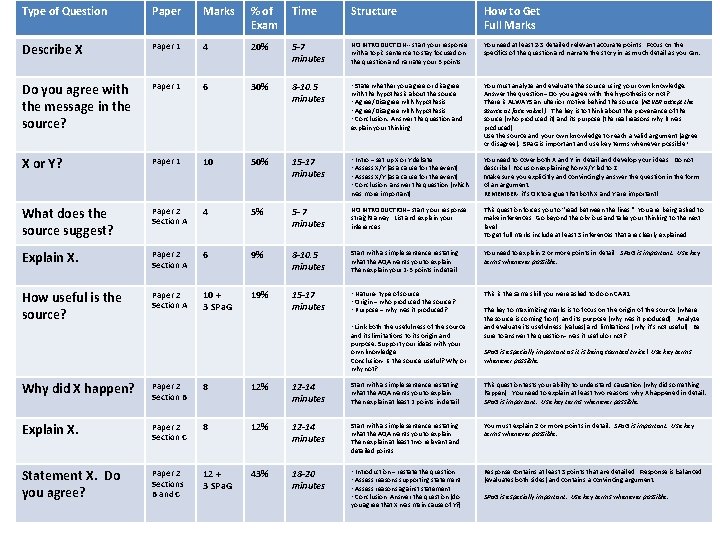
Type of Question Paper Marks % of Exam Time Structure How to Get Full Marks Describe X Paper 1 4 20% 5 -7 minutes NO INTRODUCTION-- start your response with a topic sentence to stay focused on the question and narrate your 3 points. You need at least 2 -3 detailed relevant accurate points. Focus on the specifics of the question and narrate the story in as much detail as you can. Do you agree with the message in the source? Paper 1 6 30% 8 -10. 5 minutes • State whether you agree or disagree You must analyze and evaluate the source using your own knowledge. Answer the question– Do you agree with the hypothesis or not? There is ALWAYS an ulterior motive behind the source (NEVER accept the source at face value!). The key is to think about the provenance of the source (who produced it) and its purpose (the real reasons why it was produced). Use the source and your own knowledge to reach a valid argument (agree or disagree). SPa. G is important and use key terms whenever possible! X or Y? Paper 1 10 50% 15 -17 minutes • Intro – set up X or Y debate • Assess X/Y (as a cause for the event) • Conclusion- answer the question (which You need to cover both X and Y in detail and develop your ideas. Do not describe! Focus on explaining how X/Y led to Z. Make sure you explicitly and convincingly answer the question in the form of an argument. REMEMBER- it’s OK to argue that both X and Y are important! with the hypothesis about the source • Agree/Disagree with hypothesis • Conclusion: Answer the question and explain your thinking was more important) What does the source suggest? Paper 2 Section A 4 5% 5 - 7 minutes NO INTRODUCTION– start your response straight away. List and explain your inferences. This question forces you to “read between the lines. ” You are being asked to make inferences. Go beyond the obvious and take your thinking to the next level. To get full marks include at least 3 inferences that are clearly explained. Explain X. Paper 2 Section A 6 9% 8 -10. 5 minutes Start with a simple sentence restating what the AQA wants you to explain. Then explain your 2 -3 points in detail. You need to explain 2 or more points in detail. SPa. G is important. Use key terms whenever possible. How useful is the source? Paper 2 Section A 10 + 3 SPa. G 19% 15 -17 minutes • Nature- type of source • Origin – who produced the source? • Purpose – why was it produced? This is the same skill you were asked to do on CA #1. • Link both the usefulness of the source and its limitations to its origin and purpose. Support your ideas with your own knowledge. Conclusion- Is the source useful? Why or why not? The key to maximizing marks is to focus on the origin of the source (where the source is coming from) and its purpose (why was it produced). Analyze and evaluate its usefulness (values) and limitations (why it’s not useful). Be sure to answer the question– was it useful or not? SPa. G is especially important as it is being counted twice! Use key terms whenever possible. Why did X happen? Paper 2 Section B 8 12% 12 -14 minutes Start with a simple sentence restating what the AQA wants you to explain. Then explain at least 2 points in detail. This question tests your ability to understand causation (why did something happen). You need to explain at least two reasons why X happened in detail. SPa. G is important. Use key terms whenever possible. Explain X. Paper 2 Section C 8 12% 12 -14 minutes Start with a simple sentence restating what the AQA wants you to explain. Then explain at least two relevant and detailed points. You must explain 2 or more points in detail. SPa. G is important. Use key terms whenever possible. Statement X. Do you agree? Paper 2 Sections B and C 12 + 3 SPa. G 43% 18 -20 minutes • Introduction – restate the question. • Assess reasons supporting statement • Assess reasons against statement • Conclusion- Answer the question (do Response contains at least 3 points that are detailed. Response is balanced (evaluates both sides) and contains a convincing argument. you agree that X was main cause of Y? ) SPa. G is especially important. Use key terms whenever possible.