
TYPE EQUIVALENCE 1 Coercion 2 Casting 3 Conversion
![#include<stdio. h> void main(void) { int number; char type[8]; NESTED “IFELSE” C EXAMPLE scanf("%d",](https://slidetodoc.com/presentation_image/558d2948a8d08b2a9820f8c3828fe62b/image-19.jpg "#include<stdio. h> void main(void) { int number; char type[8]; NESTED “IFELSE” C EXAMPLE scanf(\"%d\",")
- Slides: 26
TYPE EQUIVALENCE 1) Coercion 2) Casting 3) Conversion
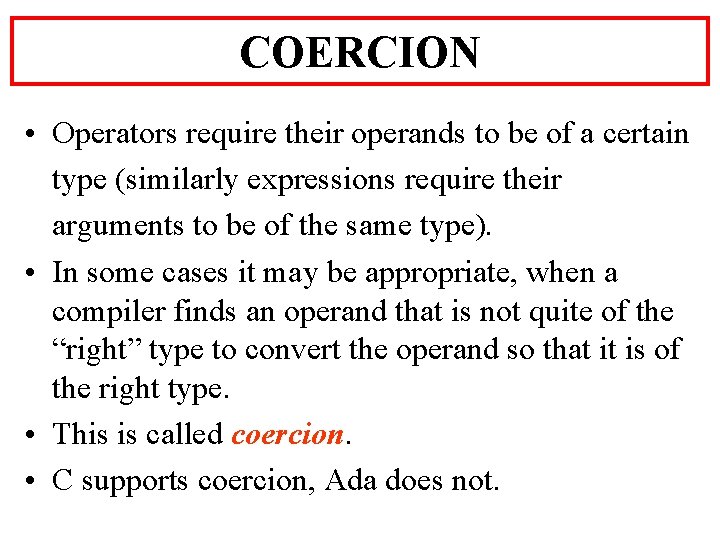
COERCION • Operators require their operands to be of a certain type (similarly expressions require their arguments to be of the same type). • In some cases it may be appropriate, when a compiler finds an operand that is not quite of the “right” type to convert the operand so that it is of the right type. • This is called coercion. • C supports coercion, Ada does not.
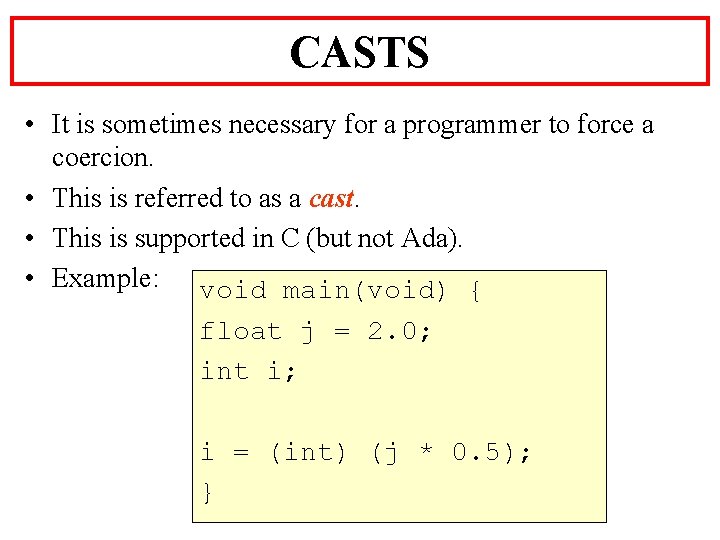
CASTS • It is sometimes necessary for a programmer to force a coercion. • This is referred to as a cast. • This is supported in C (but not Ada). • Example: void main(void) { float j = 2. 0; int i; i = (int) (j * 0. 5); }
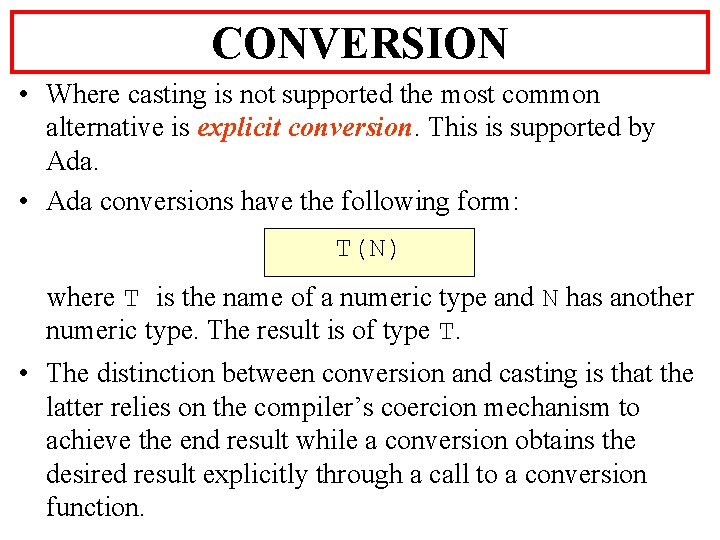
CONVERSION • Where casting is not supported the most common alternative is explicit conversion. This is supported by Ada. • Ada conversions have the following form: T(N) where T is the name of a numeric type and N has another numeric type. The result is of type T. • The distinction between conversion and casting is that the latter relies on the compiler’s coercion mechanism to achieve the end result while a conversion obtains the desired result explicitly through a call to a conversion function.
COMP 205 IMPERATIVE LANGUAGES 10. PROGRAM CONSTRUCTS 1 (SELECTION) 1. Program Statements 2. Assignment 3. Sequences 4. Selection a) If statements b) Case statements
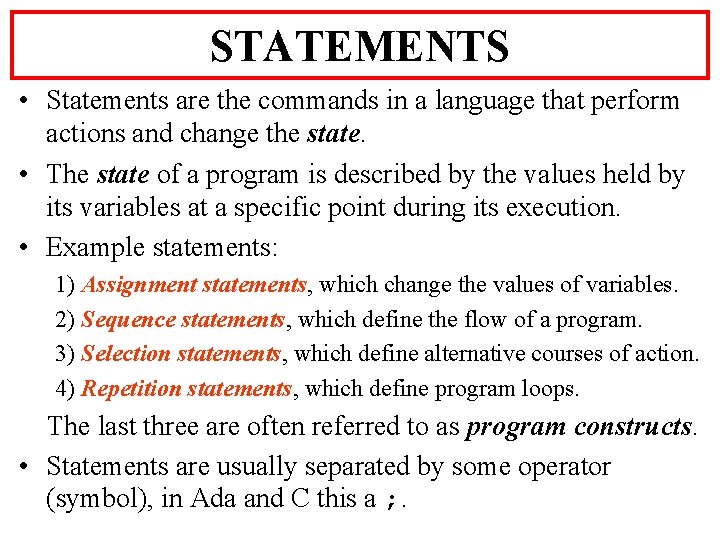
STATEMENTS • Statements are the commands in a language that perform actions and change the state. • The state of a program is described by the values held by its variables at a specific point during its execution. • Example statements: 1) Assignment statements, which change the values of variables. 2) Sequence statements, which define the flow of a program. 3) Selection statements, which define alternative courses of action. 4) Repetition statements, which define program loops. The last three are often referred to as program constructs. • Statements are usually separated by some operator (symbol), in Ada and C this a ; .
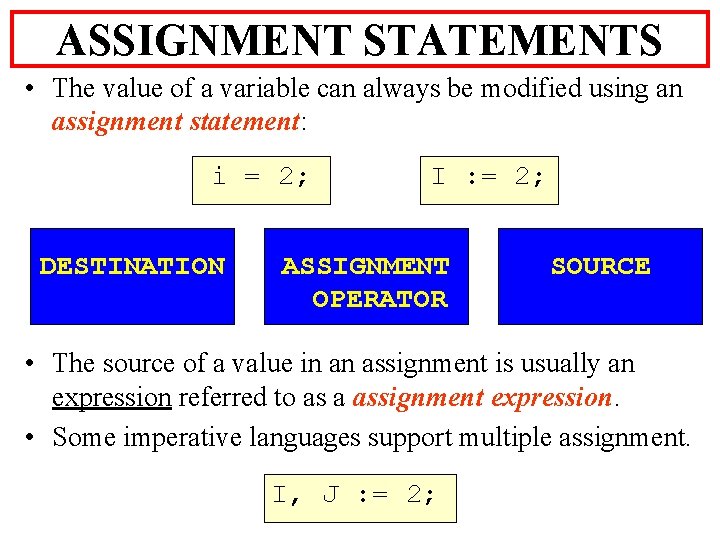
ASSIGNMENT STATEMENTS • The value of a variable can always be modified using an assignment statement: i = 2; DESTINATION I : = 2; ASSIGNMENT OPERATOR SOURCE • The source of a value in an assignment is usually an expression referred to as a assignment expression. • Some imperative languages support multiple assignment. I, J : = 2;
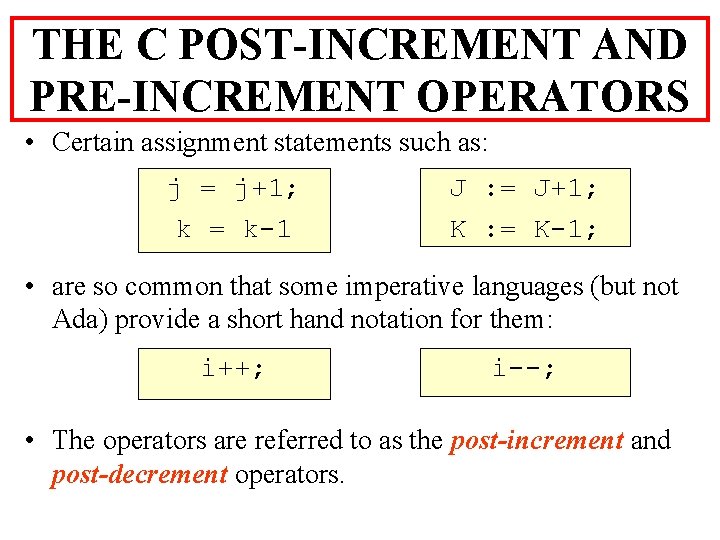
THE C POST-INCREMENT AND PRE-INCREMENT OPERATORS • Certain assignment statements such as: j = j+1; k = k-1 J : = J+1; K : = K-1; • are so common that some imperative languages (but not Ada) provide a short hand notation for them: i++; i--; • The operators are referred to as the post-increment and post-decrement operators.
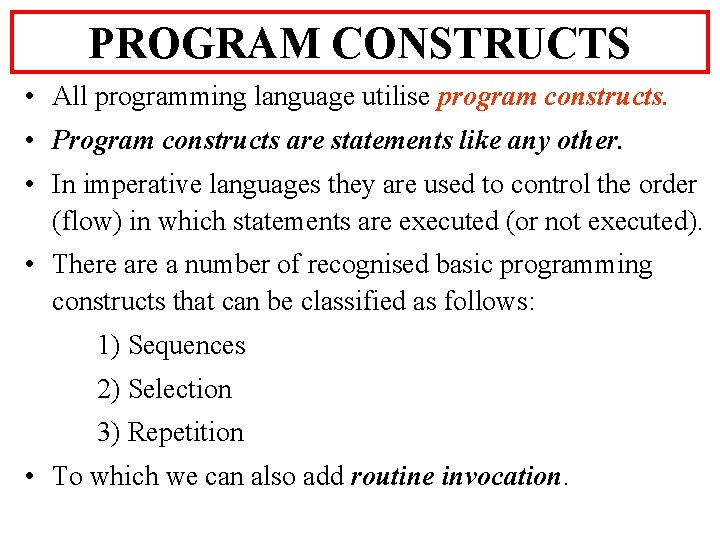
PROGRAM CONSTRUCTS • All programming language utilise program constructs. • Program constructs are statements like any other. • In imperative languages they are used to control the order (flow) in which statements are executed (or not executed). • There a number of recognised basic programming constructs that can be classified as follows: 1) Sequences 2) Selection 3) Repetition • To which we can also add routine invocation.
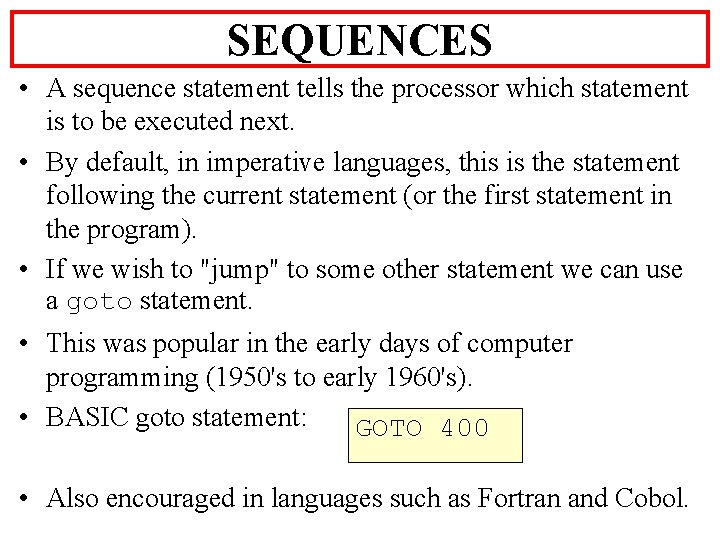
SEQUENCES • A sequence statement tells the processor which statement is to be executed next. • By default, in imperative languages, this is the statement following the current statement (or the first statement in the program). • If we wish to "jump" to some other statement we can use a goto statement. • This was popular in the early days of computer programming (1950's to early 1960's). • BASIC goto statement: GOTO 400 • Also encouraged in languages such as Fortran and Cobol.
GOTO STATEMENT CONSIDERED HARMFULL (Dijkstra 1968) • goto statements make it difficult to determine the state of variables at a given point during processing. As a result errors are often obscure and difficult to locate. • For this reason some imperative languages, for example Modula-2, have abandoned the goto statement. • However there are still some legitimate reasons why a goto may be desirable, for example to facilitate error handling or to terminate a deeply nested sequence of loops. • Both Ada and C support a goto statement but it is best avoided.
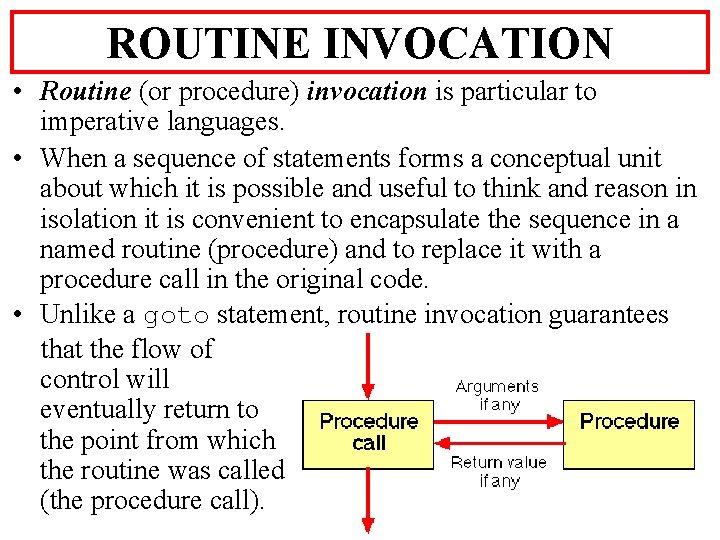
ROUTINE INVOCATION • Routine (or procedure) invocation is particular to imperative languages. • When a sequence of statements forms a conceptual unit about which it is possible and useful to think and reason in isolation it is convenient to encapsulate the sequence in a named routine (procedure) and to replace it with a procedure call in the original code. • Unlike a goto statement, routine invocation guarantees that the flow of control will eventually return to the point from which the routine was called (the procedure call).
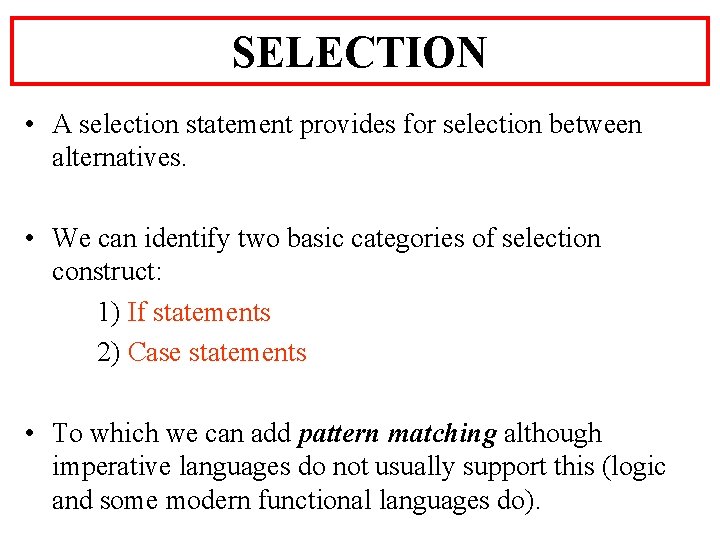
SELECTION • A selection statement provides for selection between alternatives. • We can identify two basic categories of selection construct: 1) If statements 2) Case statements • To which we can add pattern matching although imperative languages do not usually support this (logic and some modern functional languages do).
IF-ELSE SELECTION STATEMENTS
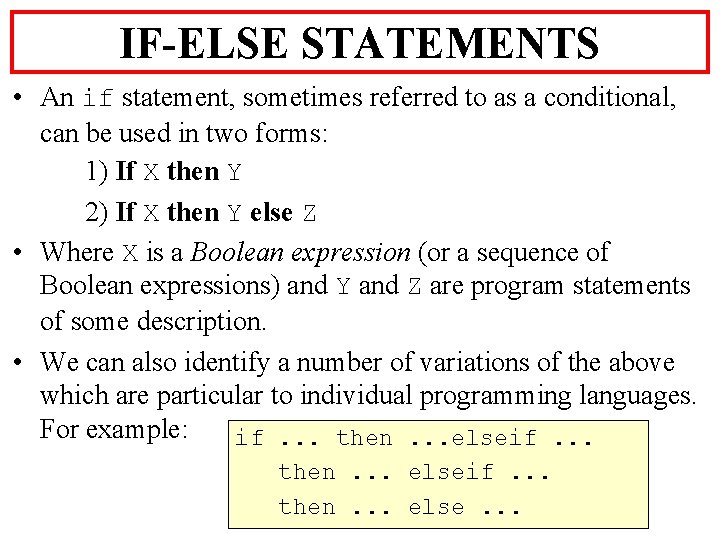
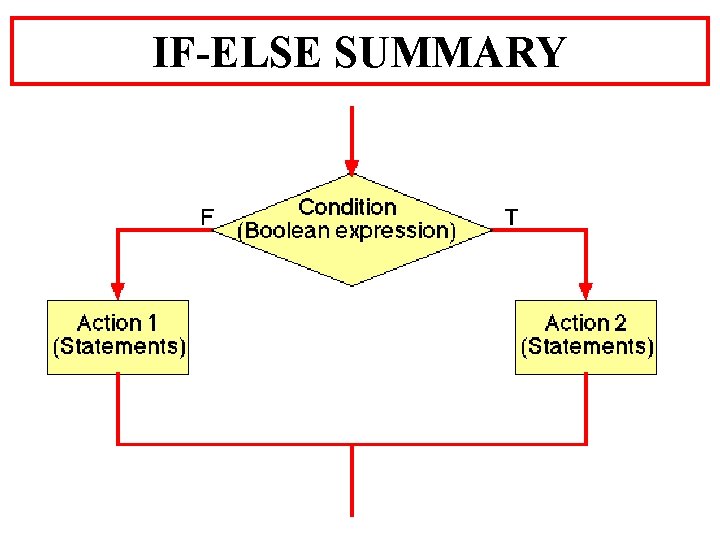
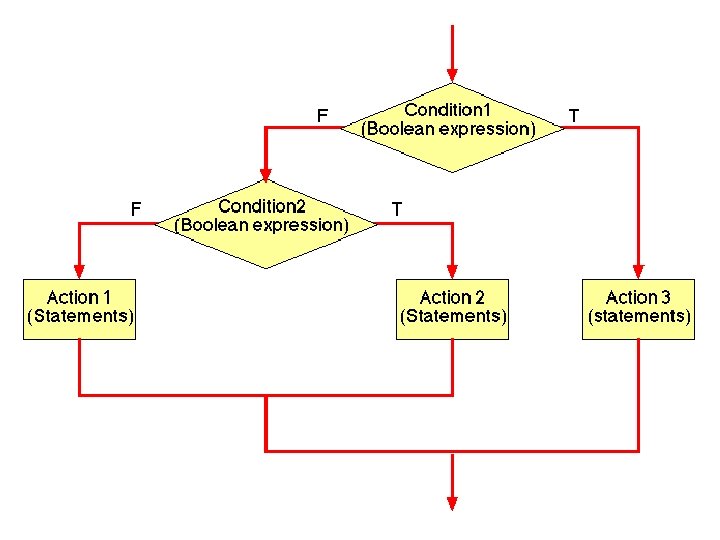
IF-ELSE STATEMENTS • An if statement, sometimes referred to as a conditional, can be used in two forms: 1) If X then Y 2) If X then Y else Z • Where X is a Boolean expression (or a sequence of Boolean expressions) and Y and Z are program statements of some description. • We can also identify a number of variations of the above which are particular to individual programming languages. For example: if. . . then. . . elseif. . . then. . . else. . .
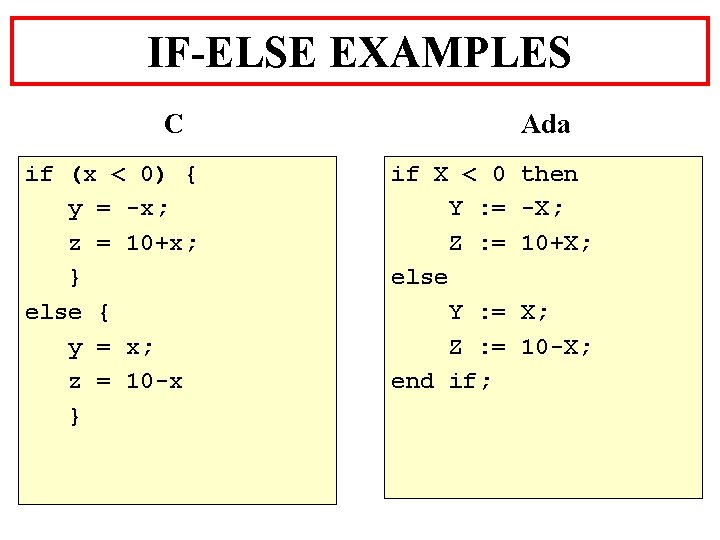
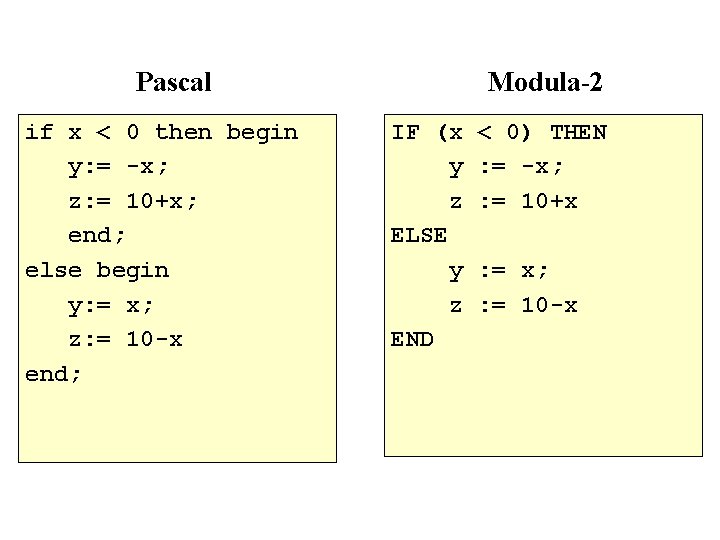
IF-ELSE EXAMPLES C if (x < 0) { y = -x; z = 10+x; } else { y = x; z = 10 -x } Ada if X < 0 Y : = Z : = else Y : = Z : = end if; then -X; 10+X; X; 10 -X;
Pascal if x < 0 then begin y: = -x; z: = 10+x; end; else begin y: = x; z: = 10 -x end; Modula-2 IF (x y z ELSE y z END < 0) THEN : = -x; : = 10+x : = x; : = 10 -x
IF-ELSE SUMMARY
#include<stdio. h> void main(void) { int number; char type[8]; NESTED “IFELSE” C EXAMPLE scanf("%d", &number); if (number < 100) { if (number < 10) strcpy(type, "small"); else strcpy(type, "medium"); } else strcpy(type, "large"); printf("%d is %sn", number, type); }
CASE SELECTION STATEMENTS
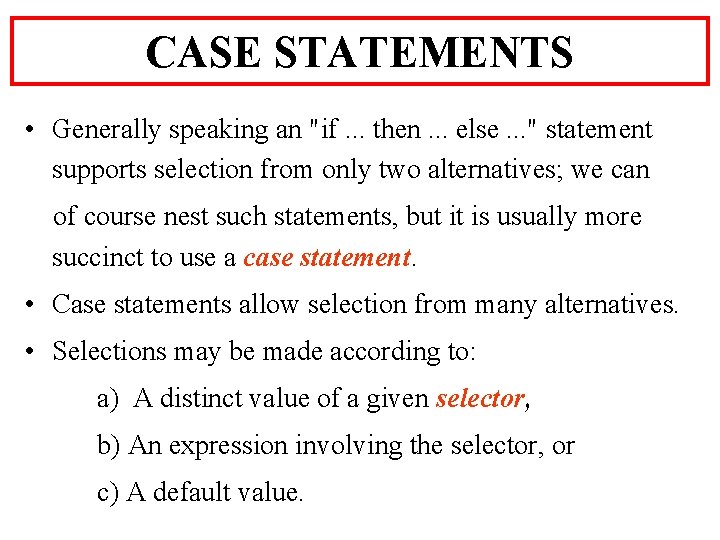
CASE STATEMENTS • Generally speaking an "if. . . then. . . else. . . " statement supports selection from only two alternatives; we can of course nest such statements, but it is usually more succinct to use a case statement. • Case statements allow selection from many alternatives. • Selections may be made according to: a) A distinct value of a given selector, b) An expression involving the selector, or c) A default value.
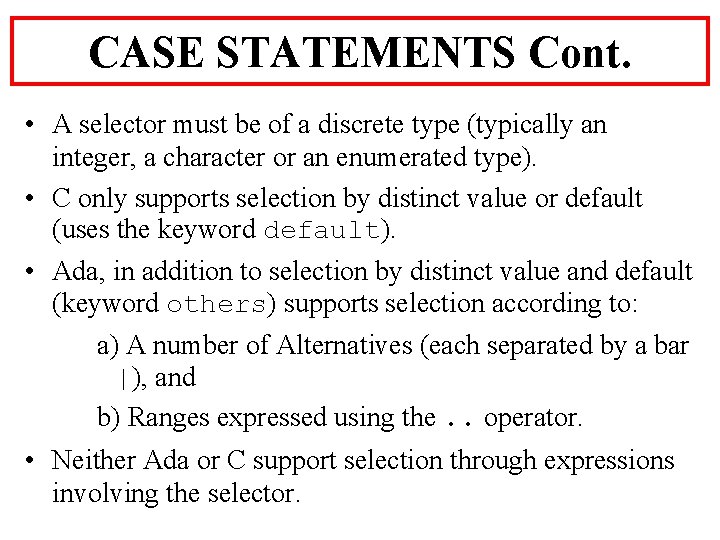
CASE STATEMENTS Cont. • A selector must be of a discrete type (typically an integer, a character or an enumerated type). • C only supports selection by distinct value or default (uses the keyword default). • Ada, in addition to selection by distinct value and default (keyword others) supports selection according to: a) A number of Alternatives (each separated by a bar |), and b) Ranges expressed using the. . operator. • Neither Ada or C support selection through expressions involving the selector.
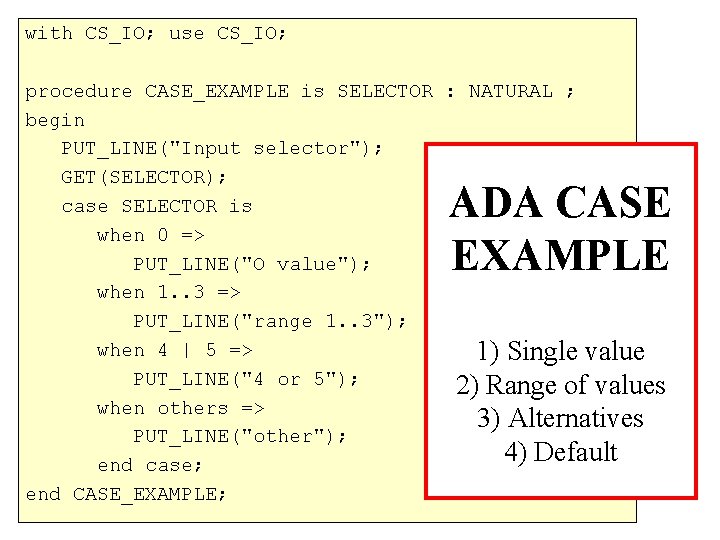
with CS_IO; use CS_IO; procedure CASE_EXAMPLE is SELECTOR : NATURAL ; begin PUT_LINE("Input selector"); GET(SELECTOR); case SELECTOR is when 0 => PUT_LINE("O value"); when 1. . 3 => PUT_LINE("range 1. . 3"); when 4 | 5 => 1) Single value PUT_LINE("4 or 5"); 2) Range of values when others => 3) Alternatives PUT_LINE("other"); 4) Default end case; end CASE_EXAMPLE; ADA CASE EXAMPLE
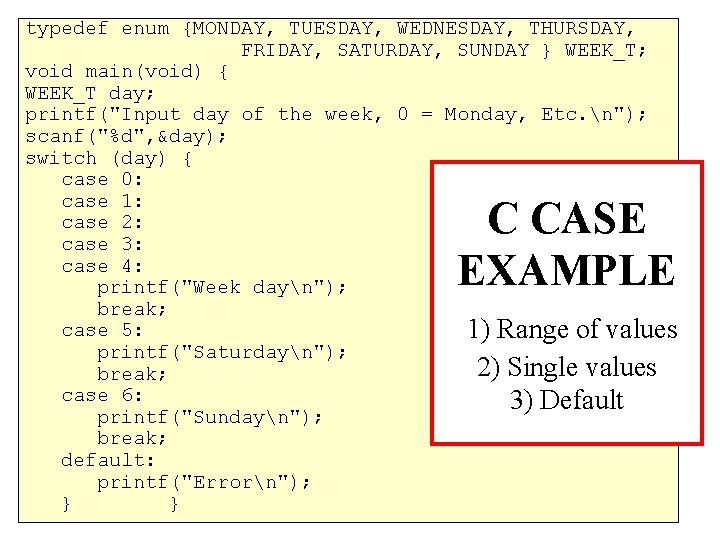
typedef enum {MONDAY, TUESDAY, WEDNESDAY, THURSDAY, FRIDAY, SATURDAY, SUNDAY } WEEK_T; void main(void) { WEEK_T day; printf("Input day of the week, 0 = Monday, Etc. n"); scanf("%d", &day); switch (day) { case 0: case 1: case 2: case 3: case 4: printf("Week dayn"); break; case 5: 1) Range of values printf("Saturdayn"); 2) Single values break; case 6: 3) Default printf("Sundayn"); break; default: printf("Errorn"); } } C CASE EXAMPLE
SUMMARY 1. Sequences 2. Selection a) If statements b) Case statements