
TwoWay Acoustic Window using Wave Field Synthesis Timo

- Slides: 19
Two-Way Acoustic Window using Wave Field Synthesis Timo Haapsaari Laboratory of Acoustics and Audio Signal Processing April 10, 2007
Outline n Aims of the project n System description n Wave Field Synthesis n Acoustic echo canceller n Performance analysis n Results of listening tests n Conclusion 2
Aims of the project n What is a virtual acoustic window? 3
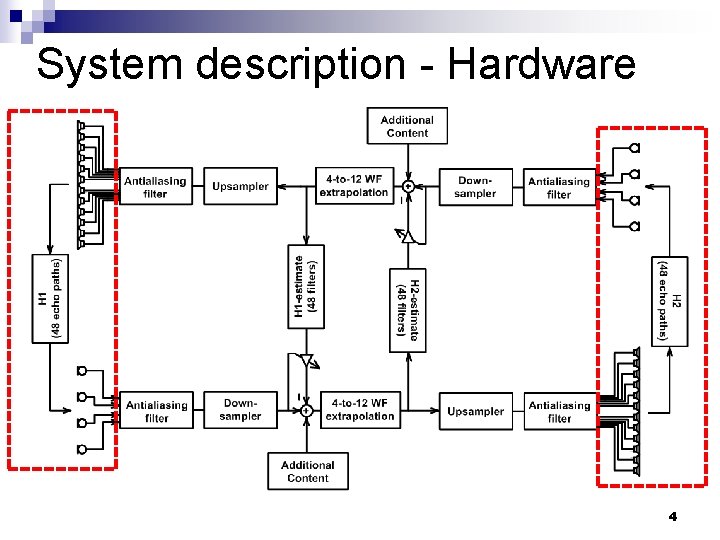
System description - Hardware 4
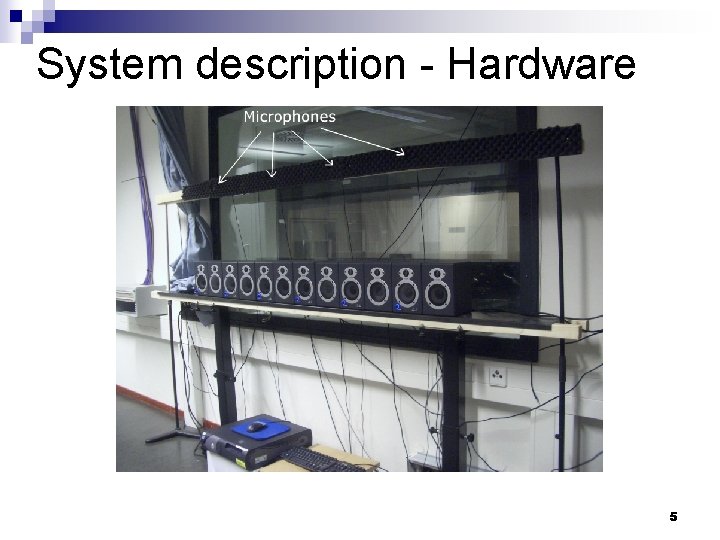
System description - Hardware 5
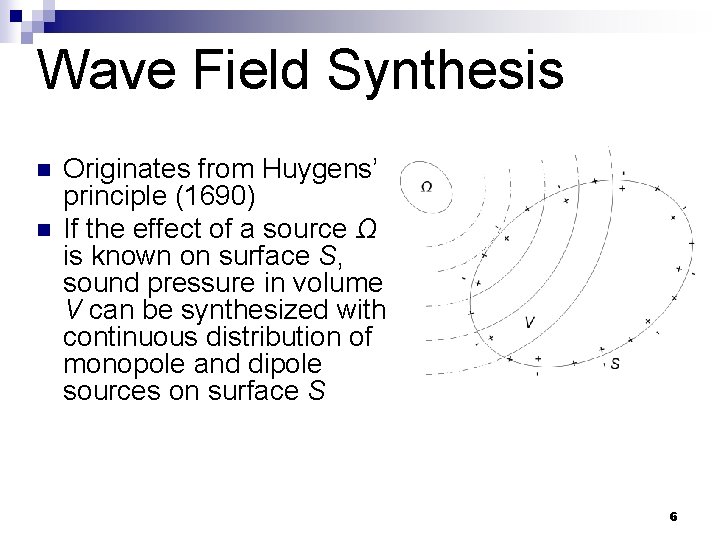
Wave Field Synthesis n n Originates from Huygens’ principle (1690) If the effect of a source Ω is known on surface S, sound pressure in volume V can be synthesized with continuous distribution of monopole and dipole sources on surface S 6
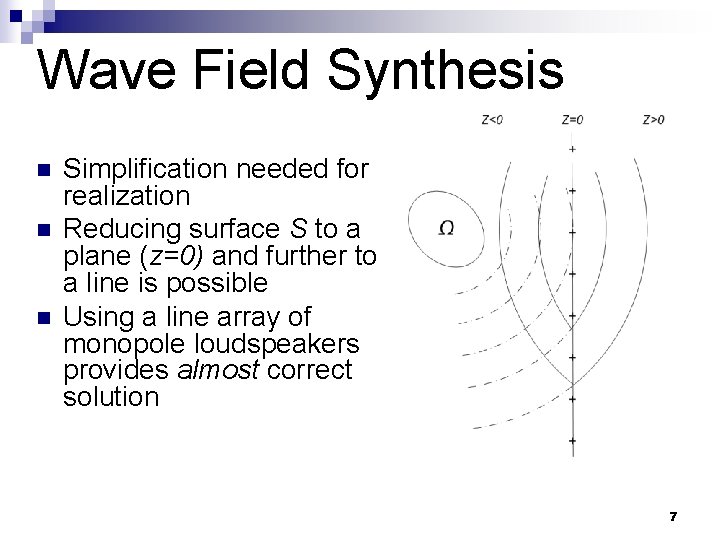
Wave Field Synthesis n n n Simplification needed for realization Reducing surface S to a plane (z=0) and further to a line is possible Using a line array of monopole loudspeakers provides almost correct solution 7
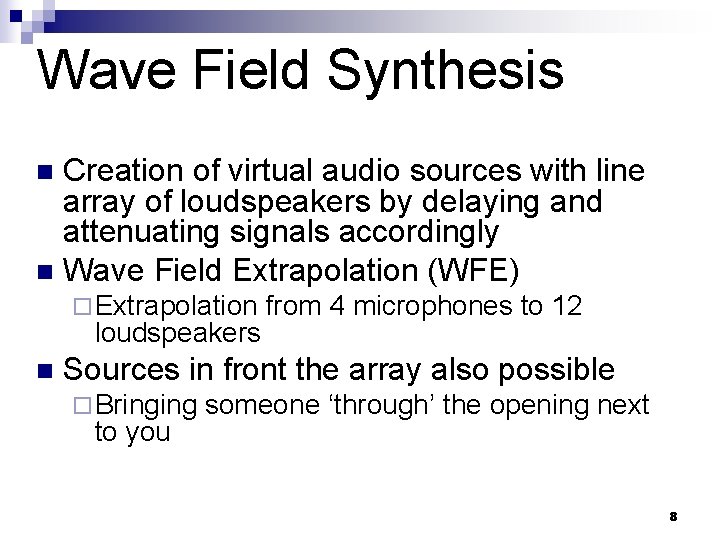
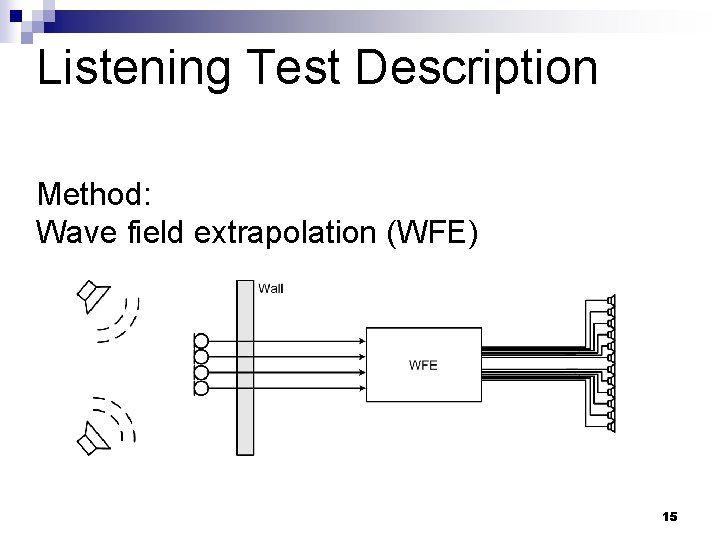
Wave Field Synthesis Creation of virtual audio sources with line array of loudspeakers by delaying and attenuating signals accordingly n Wave Field Extrapolation (WFE) n ¨ Extrapolation loudspeakers n from 4 microphones to 12 Sources in front the array also possible ¨ Bringing to you someone ‘through’ the opening next 8
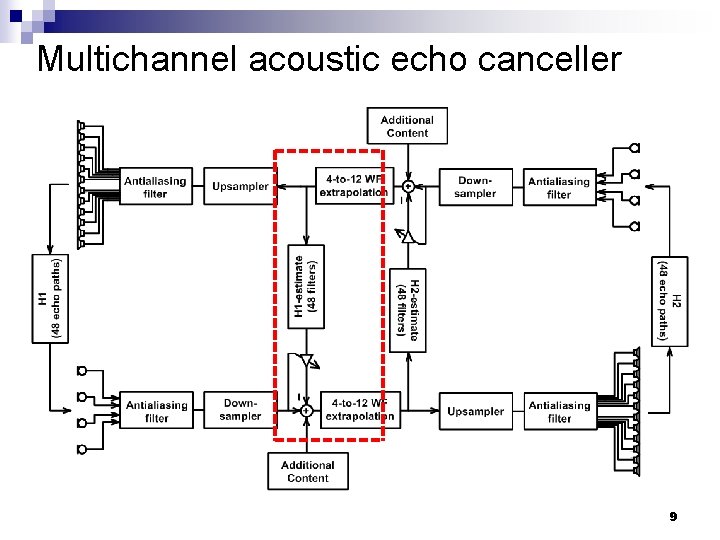
Multichannel acoustic echo canceller 9
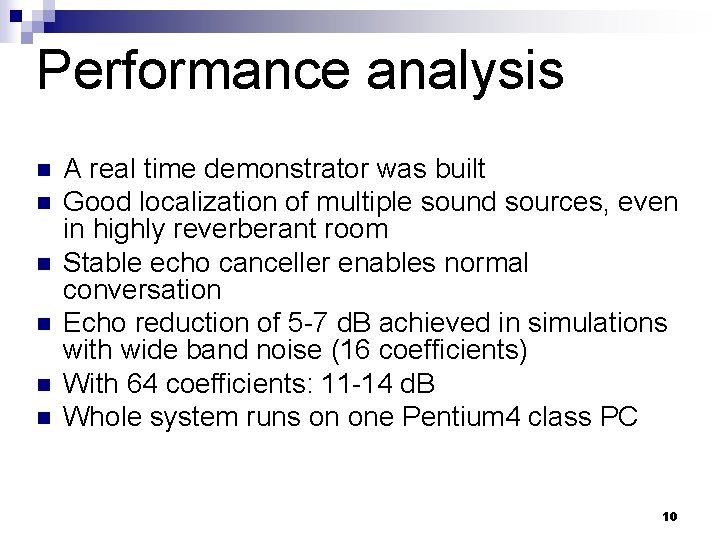
Performance analysis n n n A real time demonstrator was built Good localization of multiple sound sources, even in highly reverberant room Stable echo canceller enables normal conversation Echo reduction of 5 -7 d. B achieved in simulations with wide band noise (16 coefficients) With 64 coefficients: 11 -14 d. B Whole system runs on one Pentium 4 class PC 10
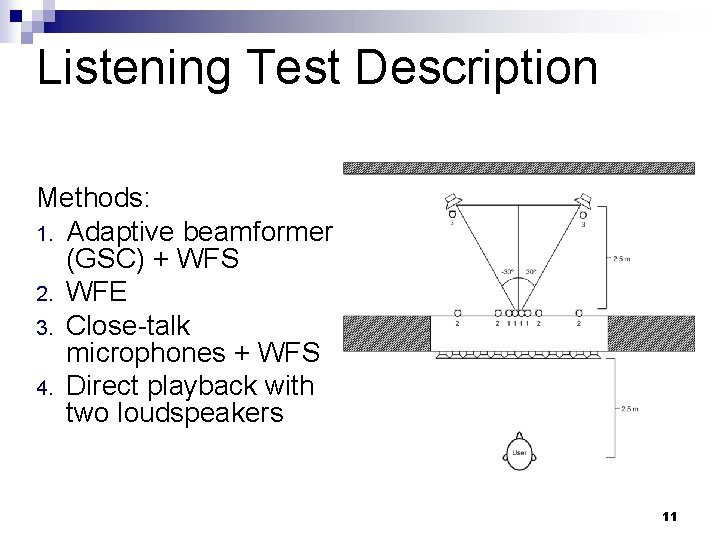
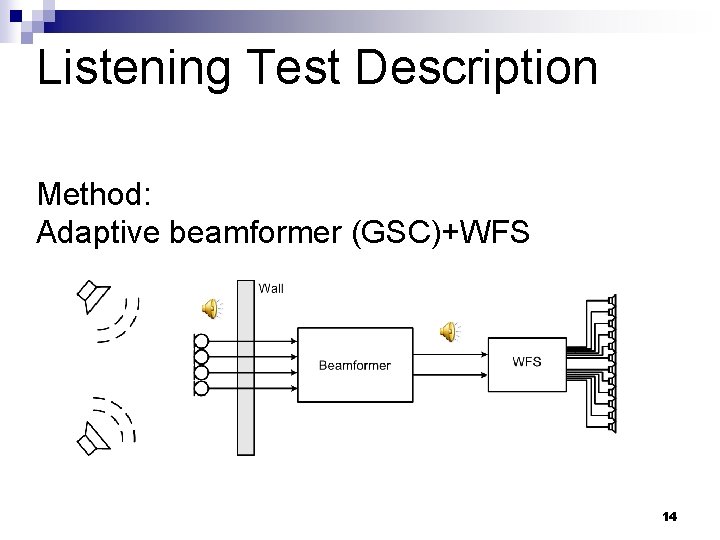
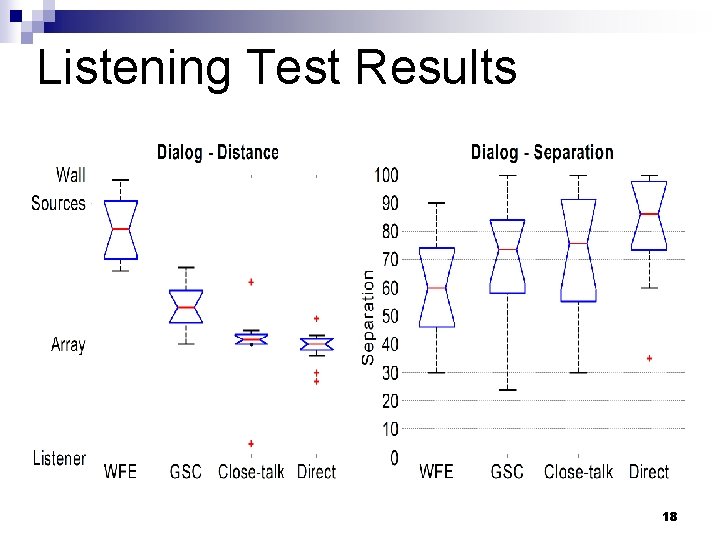
Listening Test Description Methods: 1. Adaptive beamformer (GSC) + WFS 2. WFE 3. Close-talk microphones + WFS 4. Direct playback with two loudspeakers 11
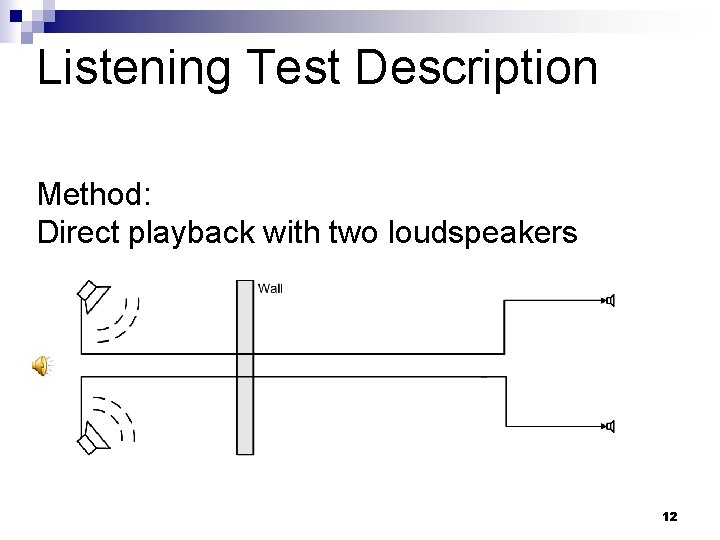
Listening Test Description Method: Direct playback with two loudspeakers 12
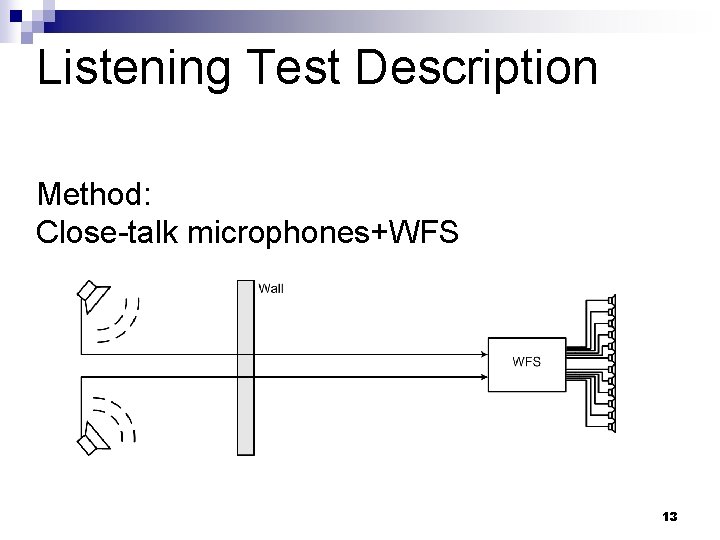
Listening Test Description Method: Close-talk microphones+WFS 13
Listening Test Description Method: Adaptive beamformer (GSC)+WFS 14
Listening Test Description Method: Wave field extrapolation (WFE) 15
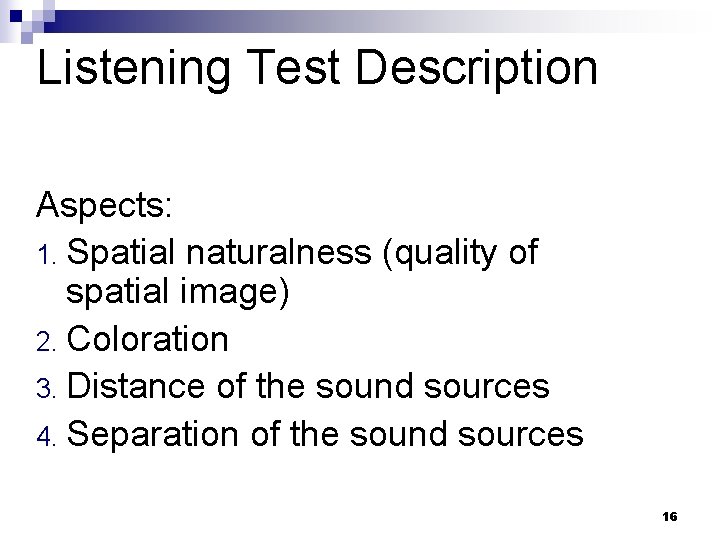
Listening Test Description Aspects: 1. Spatial naturalness (quality of spatial image) 2. Coloration 3. Distance of the sound sources 4. Separation of the sound sources 16
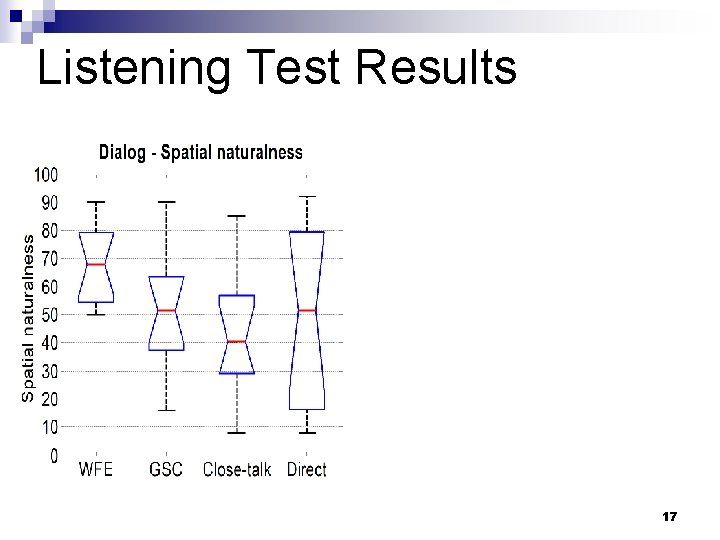
Listening Test Results 17
Listening Test Results 18
Conclusions n New aspects to communications system Opening to an another space ¨ Real spatial sound ¨ Persistent communication ¨ n Viable solution for home-to-home conversation ¨ n With flush-mounted or panel speakers no visible equipment Room for improvement with echo canceller Computational load ¨ Longer filters, system specific equalization ¨ Other solutions, e. g. frequency shifter ¨ n WFE offers clear potential for usability in acoustic opening 19