
TwoPhoton Laser Fabrication of MicroNano 3 D Structures
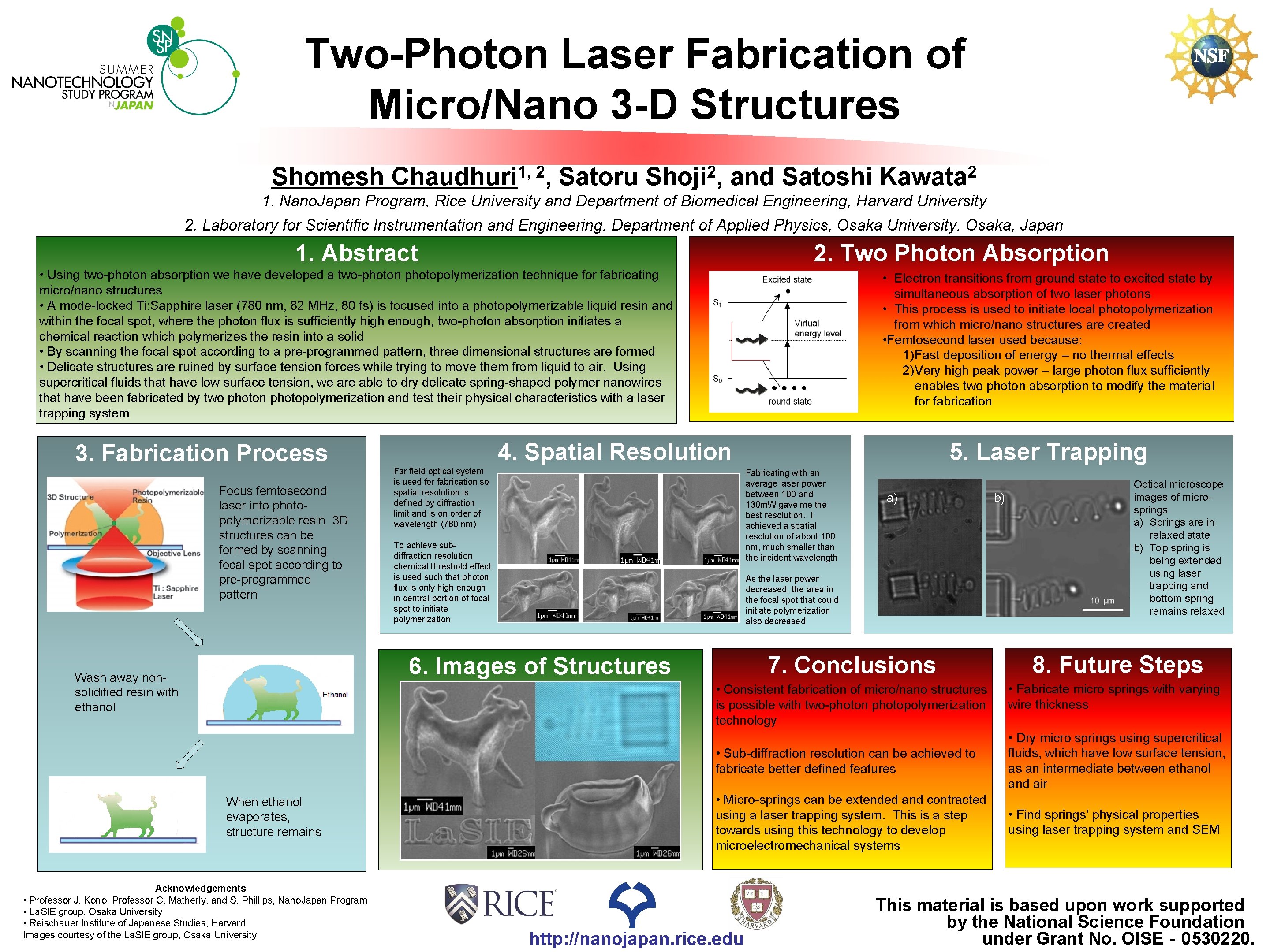
Two-Photon Laser Fabrication of Micro/Nano 3 -D Structures Shomesh 1, 2 Chaudhuri , Satoru 2 Shoji , and Satoshi 2 Kawata 1. Nano. Japan Program, Rice University and Department of Biomedical Engineering, Harvard University 2. Laboratory for Scientific Instrumentation and Engineering, Department of Applied Physics, Osaka University, Osaka, Japan 1. Abstract 2. Two Photon Absorption • Using two-photon absorption we have developed a two-photon photopolymerization technique for fabricating micro/nano structures • A mode-locked Ti: Sapphire laser (780 nm, 82 MHz, 80 fs) is focused into a photopolymerizable liquid resin and within the focal spot, where the photon flux is sufficiently high enough, two-photon absorption initiates a chemical reaction which polymerizes the resin into a solid • By scanning the focal spot according to a pre-programmed pattern, three dimensional structures are formed • Delicate structures are ruined by surface tension forces while trying to move them from liquid to air. Using supercritical fluids that have low surface tension, we are able to dry delicate spring-shaped polymer nanowires that have been fabricated by two photon photopolymerization and test their physical characteristics with a laser trapping system 3. Fabrication Process Focus femtosecond laser into photopolymerizable resin. 3 D structures can be formed by scanning focal spot according to pre-programmed pattern • Electron transitions from ground state to excited state by simultaneous absorption of two laser photons • This process is used to initiate local photopolymerization from which micro/nano structures are created • Femtosecond laser used because: 1)Fast deposition of energy – no thermal effects 2)Very high peak power – large photon flux sufficiently enables two photon absorption to modify the material for fabrication 4. Spatial Resolution Far field optical system is used for fabrication so spatial resolution is defined by diffraction limit and is on order of wavelength (780 nm) Fabricating with an average laser power between 100 and 130 m. W gave me the best resolution. I achieved a spatial resolution of about 100 nm, much smaller than the incident wavelength To achieve subdiffraction resolution chemical threshold effect is used such that photon flux is only high enough in central portion of focal spot to initiate polymerization When ethanol evaporates, structure remains Acknowledgements • Professor J. Kono, Professor C. Matherly, and S. Phillips, Nano. Japan Program • La. SIE group, Osaka University • Reischauer Institute of Japanese Studies, Harvard Images courtesy of the La. SIE group, Osaka University a) As the laser power decreased, the area in the focal spot that could initiate polymerization also decreased b) Optical microscope images of microsprings a) Springs are in relaxed state b) Top spring is being extended using laser trapping and bottom spring remains relaxed 7. Conclusions 8. Future Steps • Consistent fabrication of micro/nano structures is possible with two-photon photopolymerization technology • Fabricate micro springs with varying wire thickness 6. Images of Structures Wash away nonsolidified resin with ethanol 5. Laser Trapping • Sub-diffraction resolution can be achieved to fabricate better defined features • Dry micro springs using supercritical fluids, which have low surface tension, as an intermediate between ethanol and air • Micro-springs can be extended and contracted using a laser trapping system. This is a step towards using this technology to develop microelectromechanical systems • Find springs’ physical properties using laser trapping system and SEM http: //nanojapan. rice. edu This material is based upon work supported by the National Science Foundation under Grant No. OISE‐ 0530220.
- Slides: 1