
TwoPhase Simplex Method from a presentation at the




- Slides: 60
Two-Phase Simplex Method from a presentation at the Fuqua School of Business MIT and James Orlin © 2003 Rev. 1. 4 by M. Miccio on December 17, 2014 file Simplex 3_AMII_05 b_gr 1
Today’s Lecture The simplex algorithm with constraints of type = OR ≥ l The big M method l The "artificial objective" w l MIT and James Orlin © 2003 2
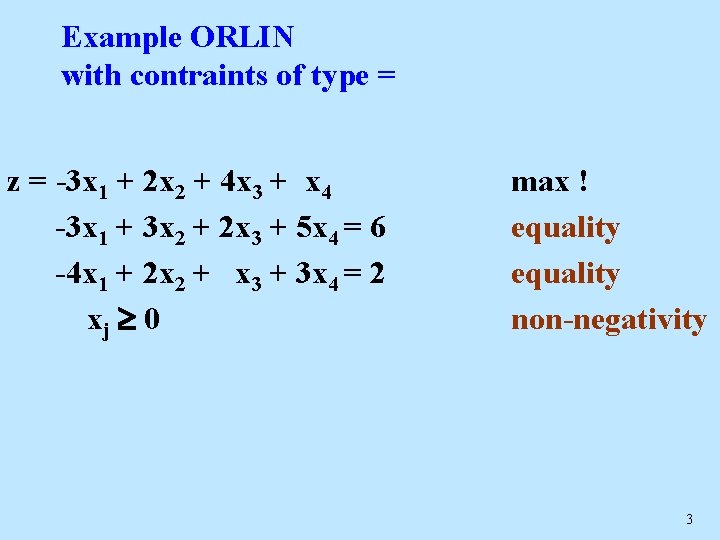
Example ORLIN with contraints of type = z = -3 x 1 + 2 x 2 + 4 x 3 + x 4 -3 x 1 + 3 x 2 + 2 x 3 + 5 x 4 = 6 -4 x 1 + 2 x 2 + x 3 + 3 x 4 = 2 xj 0 max ! equality non-negativity 3
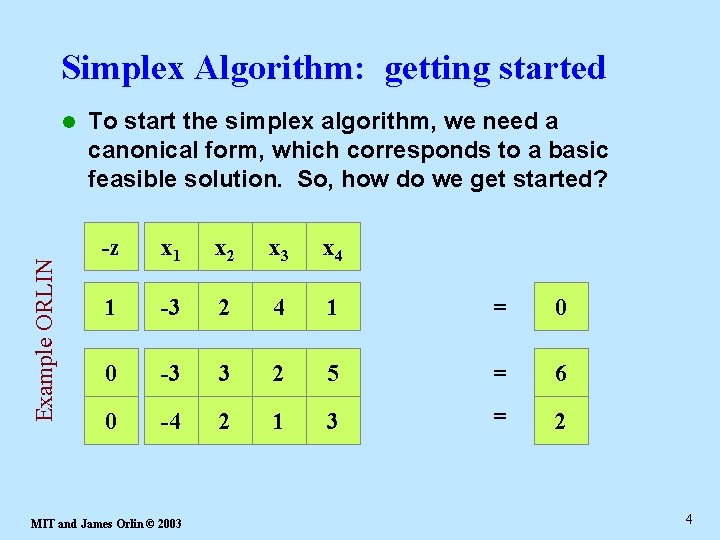
Simplex Algorithm: getting started Example ORLIN l To start the simplex algorithm, we need a canonical form, which corresponds to a basic feasible solution. So, how do we get started? -z x 1 x 2 x 3 x 4 1 -3 2 4 1 = 0 0 -3 3 21 5 = 6 0 -4 2 1 3 = 2 MIT and James Orlin © 2003 4
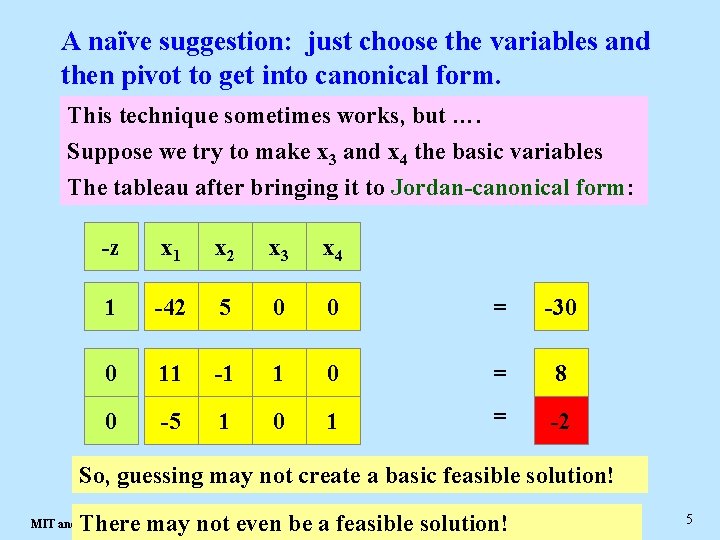
A naïve suggestion: just choose the variables and then pivot to get into canonical form. This technique sometimes works, but …. Suppose we try to make x 3 and x 4 the basic variables The tableau after bringing it to Jordan-canonical form: -z x 1 x 2 x 3 x 4 1 -42 -3 25 04 01 = -30 0 0 11 -3 -1 3 12 05 = 86 0 -5 -4 21 01 13 = -2 2 So, guessing may not create a basic feasible solution! There may not even be a feasible solution! MIT and James Orlin © 2003 5
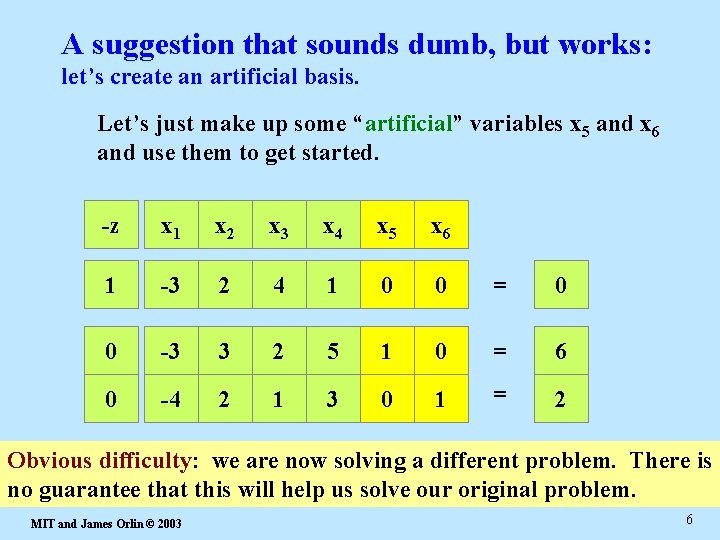
A suggestion that sounds dumb, but works: let’s create an artificial basis. Let’s just make up some “artificial” variables x 5 and x 6 and use them to get started. -z x 1 x 2 x 3 x 4 x 5 x 6 1 -3 2 4 1 0 0 = 0 0 -3 3 21 5 1 0 = 6 0 -4 2 1 3 0 1 = 2 Obvious difficulty: we are now solving a different problem. There is no guarantee that this will help us solve our original problem. MIT and James Orlin © 2003 6
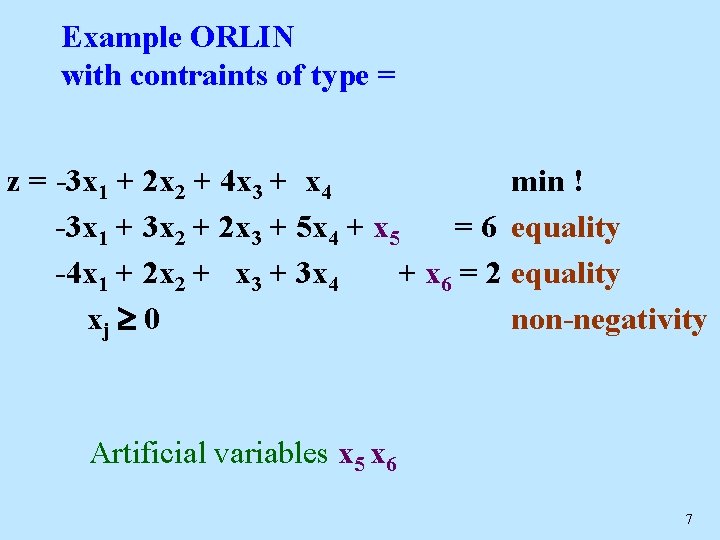
Example ORLIN with contraints of type = z = -3 x 1 + 2 x 2 + 4 x 3 + x 4 min ! -3 x 1 + 3 x 2 + 2 x 3 + 5 x 4 + x 5 = 6 equality -4 x 1 + 2 x 2 + x 3 + 3 x 4 + x 6 = 2 equality xj 0 non-negativity Artificial variables x 5 x 6 7
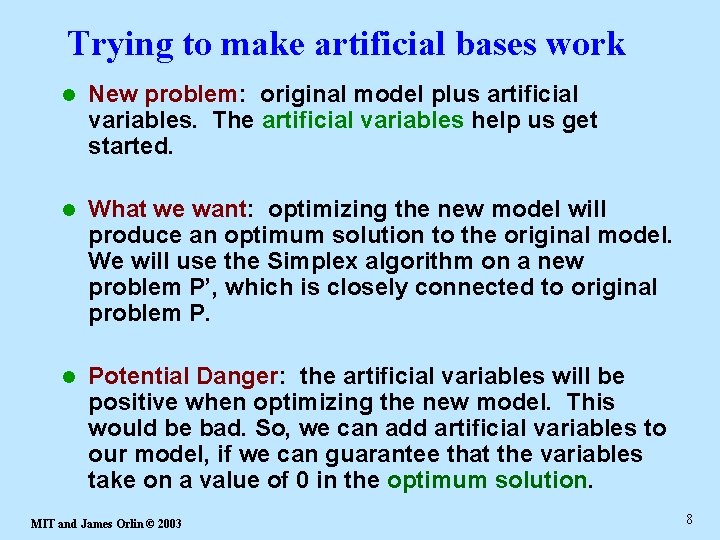
Trying to make artificial bases work l New problem: original model plus artificial variables. The artificial variables help us get started. l What we want: optimizing the new model will produce an optimum solution to the original model. We will use the Simplex algorithm on a new problem P’, which is closely connected to original problem P. l Potential Danger: the artificial variables will be positive when optimizing the new model. This would be bad. So, we can add artificial variables to our model, if we can guarantee that the variables take on a value of 0 in the optimum solution. MIT and James Orlin © 2003 8
Today’s Lecture The simplex algorithm with contraints of type = OR ≥ l The big M method l The "artificial objective" w l MIT and James Orlin © 2003 9
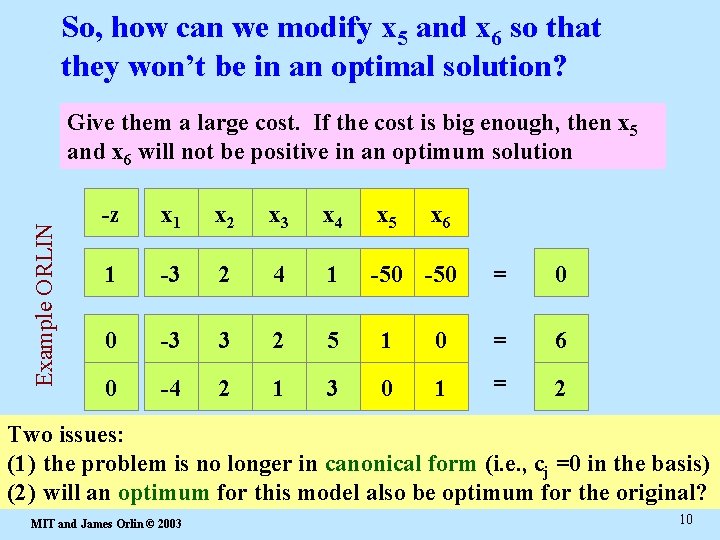
So, how can we modify x 5 and x 6 so that they won’t be in an optimal solution? Example ORLIN Give them a large cost. If the cost is big enough, then x 5 and x 6 will not be positive in an optimum solution -z x 1 x 2 x 3 x 4 x 5 x 6 1 -3 2 4 1 -50 0 -3 3 21 5 1 0 -4 2 1 3 0 = 0 0 = 6 1 = 2 Two issues: (1) the problem is no longer in canonical form (i. e. , cj =0 in the basis) (2) will an optimum for this model also be optimum for the original? MIT and James Orlin © 2003 10
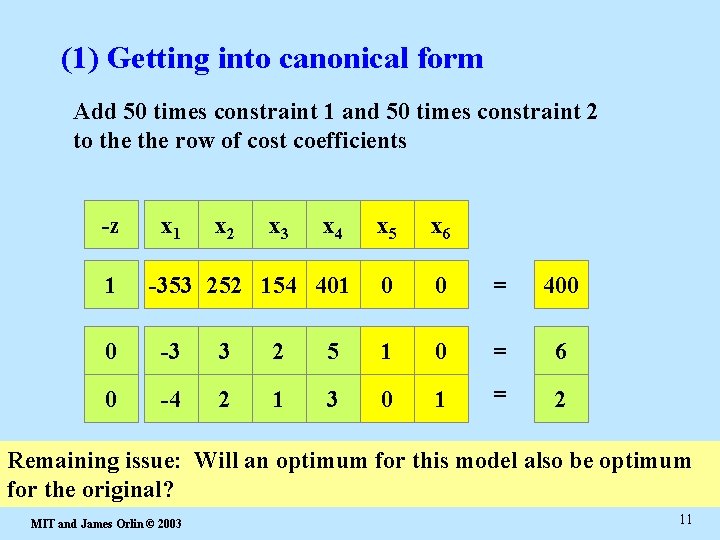
(1) Getting into canonical form Add 50 times constraint 1 and 50 times constraint 2 to the row of cost coefficients -z 1 x 2 x 3 x 4 x 5 x 6 -353 -3 252 2 154 4 401 1 -50 0 = 400 0 0 -3 3 21 5 1 0 = 6 0 -4 2 1 3 0 1 = 2 Remaining issue: Will an optimum for this model also be optimum for the original? MIT and James Orlin © 2003 11
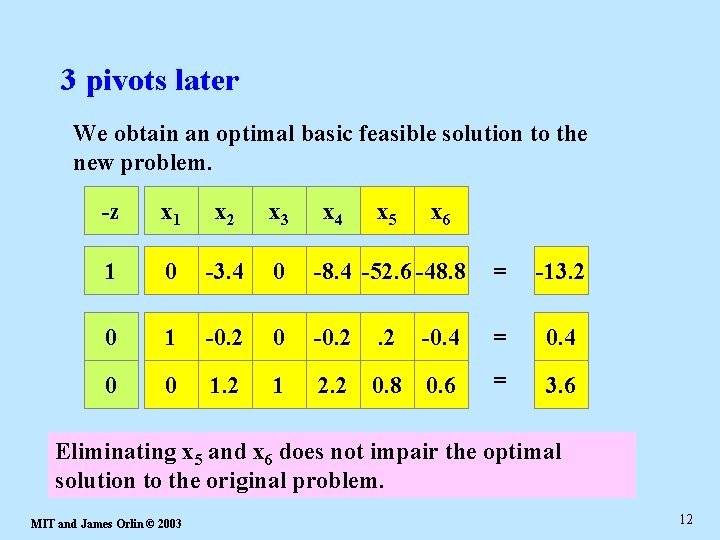
3 pivots later We obtain an optimal basic feasible solution to the new problem. -z x 1 x 2 x 3 x 4 x 5 x 6 1 -3 0 -3. 4 2 04 -8. 4 1 -52. 6 -50 -48. 8 -50 = -13. 2 0 0 -3 1 -0. 2 3 021 -0. 2 5 . 2 1 -0. 4 0 = 0. 4 6 0 -4 0 1. 2 2 1 2. 2 3 0. 8 0 0. 6 1 = 3. 6 2 Eliminating x 5 and x 6 does not impair the optimal solution to the original problem. MIT and James Orlin © 2003 12
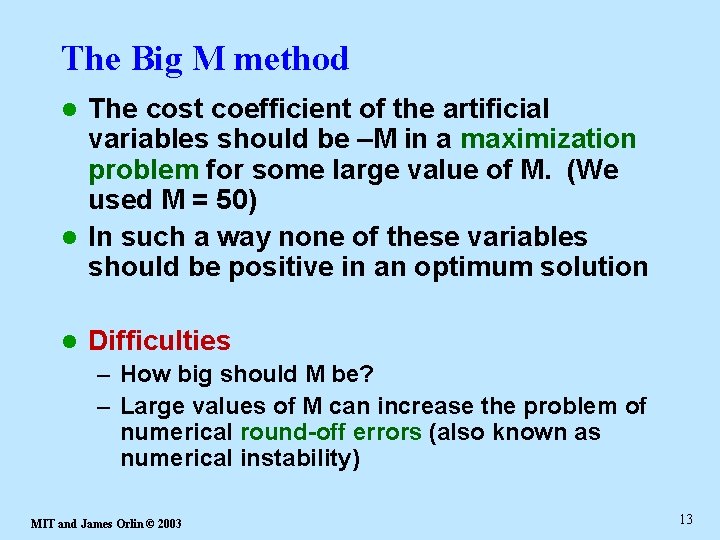
The Big M method The cost coefficient of the artificial variables should be –M in a maximization problem for some large value of M. (We used M = 50) l In such a way none of these variables should be positive in an optimum solution l l Difficulties – How big should M be? – Large values of M can increase the problem of numerical round-off errors (also known as numerical instability) MIT and James Orlin © 2003 13
Today’s Lecture The simplex algorithm with contraints of type = OR ≥ l The big M method l The Phase 1 method with the "artificial objective" w l MIT and James Orlin © 2003 14
An alternative approach: The Phase 1 method l Recall: Any basic feasible solution would get the simplex method started l We add artificial variables, and then focus entirely on obtaining a basic feasible solution with the artificial variables l We add an "artificial objective" w ("Forma di Inammissibilità"), which is the sum of all the artificial variables l The modified linear program with this "artificial objective" w is called the Phase I problem l We can then start the simplex algorithm with the first basic feasible solution we have found MIT and James Orlin © 2003 15
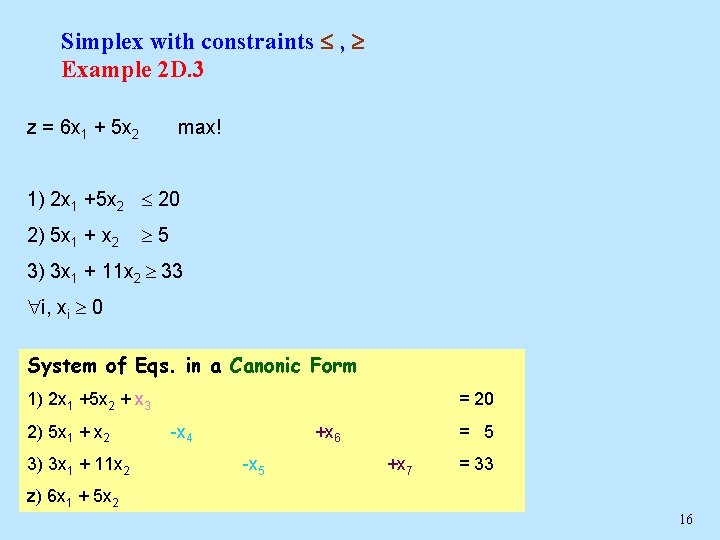
Simplex with constraints , Example 2 D. 3 z = 6 x 1 + 5 x 2 max! 1) 2 x 1 +5 x 2 20 2) 5 x 1 + x 2 5 3) 3 x 1 + 11 x 2 33 i, xi 0 System of Eqs. in a Canonic Form 1) 2 x 1 +5 x 2 + x 3 2) 5 x 1 + x 2 3) 3 x 1 + 11 x 2 = 20 -x 4 +x 6 -x 5 = 5 +x 7 = 33 z) 6 x 1 + 5 x 2 16
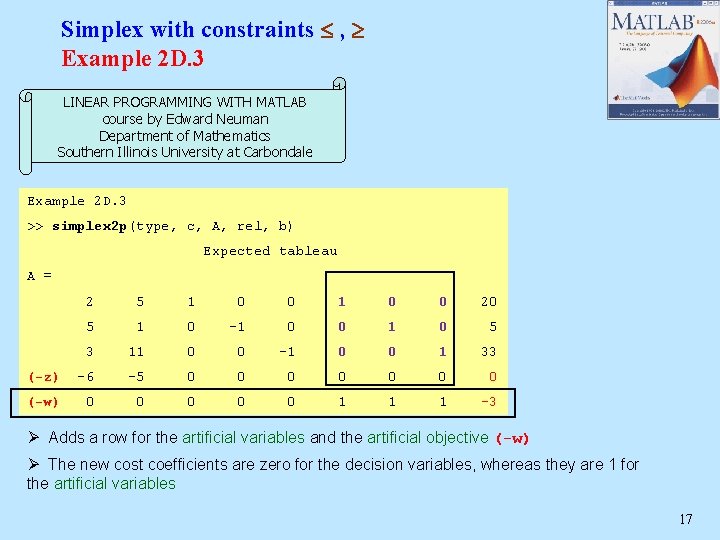
Simplex with constraints , Example 2 D. 3 LINEAR PROGRAMMING WITH MATLAB course by Edward Neuman Department of Mathematics Southern Illinois University at Carbondale Example 2 D. 3 >> simplex 2 p(type, c, A, rel, b) Expected tableau A = 2 5 1 0 0 20 5 1 0 -1 0 0 1 0 5 3 11 0 0 -1 0 0 1 33 (-z) -6 -5 0 0 0 0 (-w) 0 0 0 1 1 1 -3 Ø Adds a row for the artificial variables and the artificial objective (-w) Ø The new cost coefficients are zero for the decision variables, whereas they are 1 for the artificial variables 17
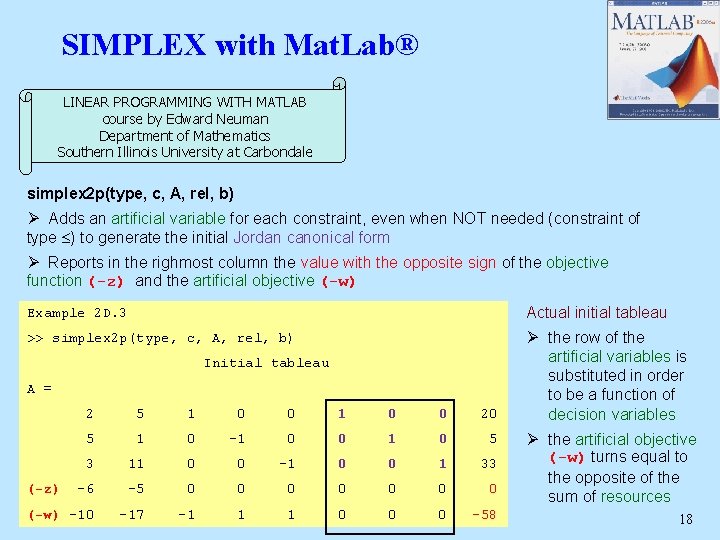
SIMPLEX with Mat. Lab® LINEAR PROGRAMMING WITH MATLAB course by Edward Neuman Department of Mathematics Southern Illinois University at Carbondale simplex 2 p(type, c, A, rel, b) Ø Adds an artificial variable for each constraint, even when NOT needed (constraint of type ) to generate the initial Jordan canonical form Ø Reports in the righmost column the value with the opposite sign of the objective function (-z) and the artificial objective (-w) Example 2 D. 3 Actual initial tableau >> simplex 2 p(type, c, A, rel, b) Ø the row of the artificial variables is substituted in order to be a function of decision variables Initial tableau A = 2 5 1 0 0 20 5 1 0 -1 0 0 1 0 5 3 11 0 0 -1 0 0 1 33 -6 -5 0 0 0 0 (-w) -10 -17 -1 1 1 0 0 0 -58 (-z) Ø the artificial objective (-w) turns equal to the opposite of the sum of resources 18
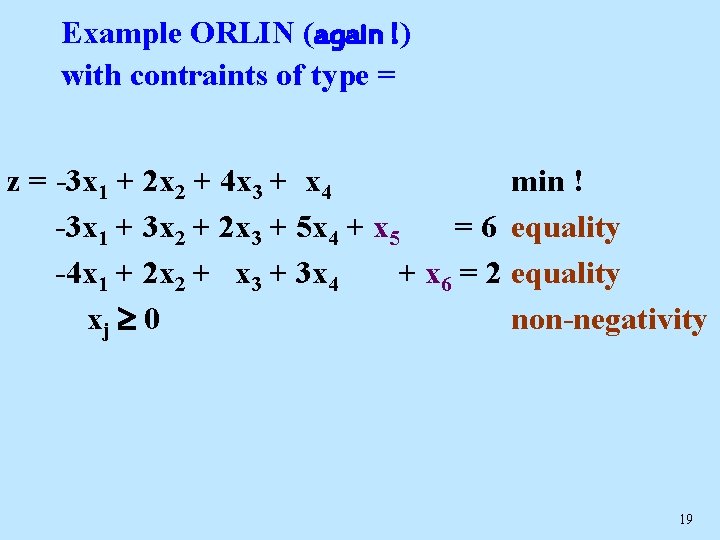
Example ORLIN (again !) with contraints of type = z = -3 x 1 + 2 x 2 + 4 x 3 + x 4 min ! -3 x 1 + 3 x 2 + 2 x 3 + 5 x 4 + x 5 = 6 equality -4 x 1 + 2 x 2 + x 3 + 3 x 4 + x 6 = 2 equality xj 0 non-negativity 19
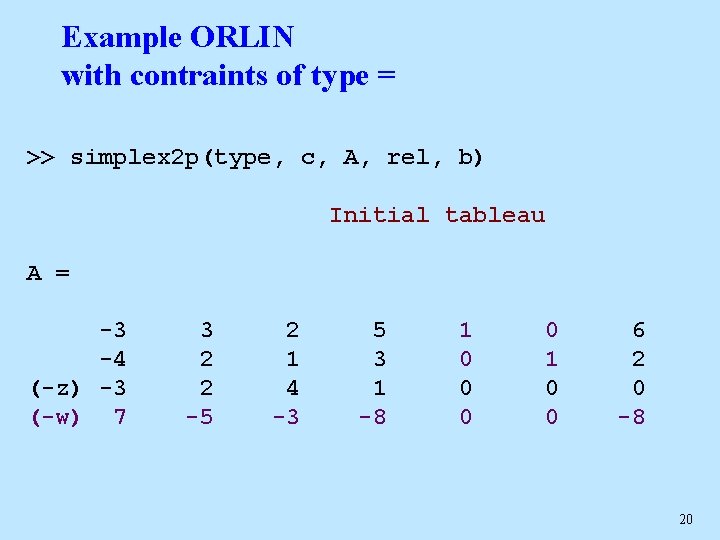
Example ORLIN with contraints of type = >> simplex 2 p(type, c, A, rel, b) Initial tableau A = -3 -4 (-z) -3 (-w) 7 3 2 2 -5 2 1 4 -3 5 3 1 -8 1 0 0 6 2 0 -8 20
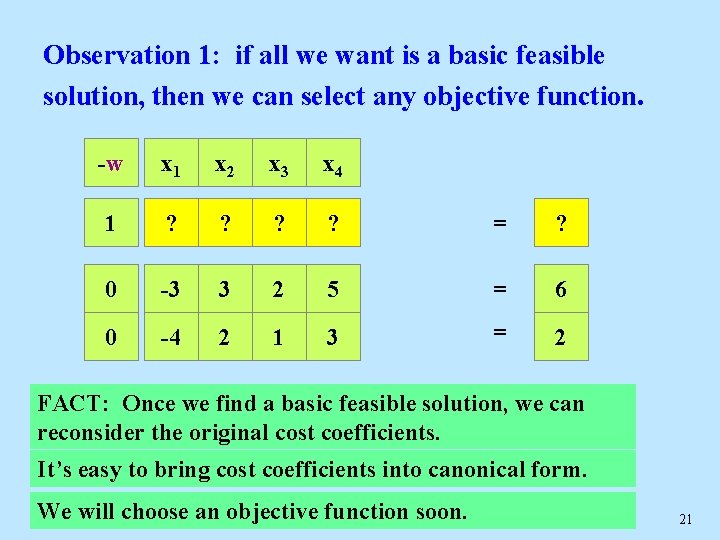
Observation 1: if all we want is a basic feasible solution, then we can select any objective function. -w x 1 x 2 x 3 x 4 1 -3 ? 2? ? 4 ? 1 = ? 0 0 -3 3 21 5 = 6 0 -4 2 1 3 = 2 FACT: Once we find a basic feasible solution, we can reconsider the original cost coefficients. It’s easy to bring cost coefficients into canonical form. We will choose an objective function soon. MIT and James Orlin © 2003 21
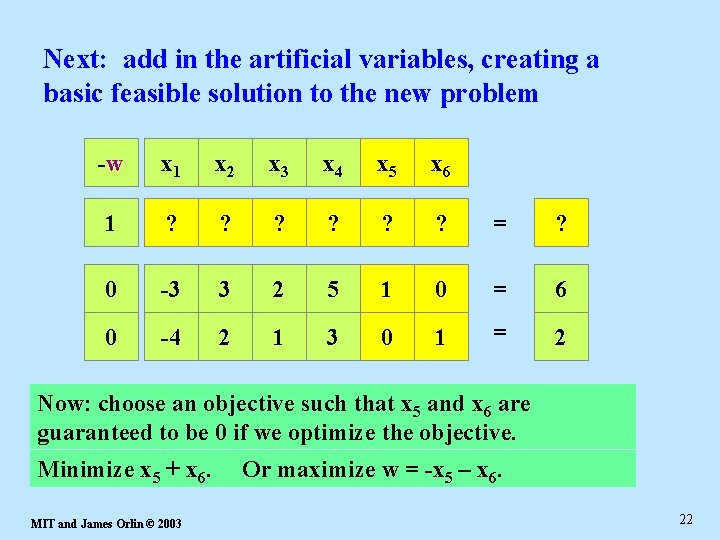
Next: add in the artificial variables, creating a basic feasible solution to the new problem -w x 1 x 2 x 3 x 4 x 5 x 6 1 -3 ? 2? ? 4 ? 1 ? ? = ? 0 0 -3 3 21 5 1 0 = 6 0 -4 2 1 3 0 1 = 2 Now: choose an objective such that x 5 and x 6 are guaranteed to be 0 if we optimize the objective. Minimize x 5 + x 6. MIT and James Orlin © 2003 Or maximize w = -x 5 – x 6. 22
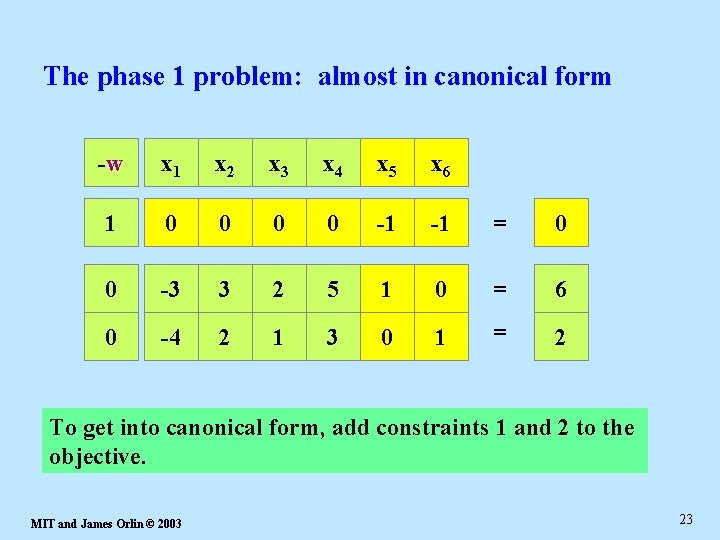
The phase 1 problem: almost in canonical form -w x 1 x 2 x 3 x 4 x 5 x 6 1 -3 0 20 04 01 -1 -1 = 0 0 -3 3 21 5 1 0 = 6 0 -4 2 1 3 0 1 = 2 To get into canonical form, add constraints 1 and 2 to the objective. MIT and James Orlin © 2003 23
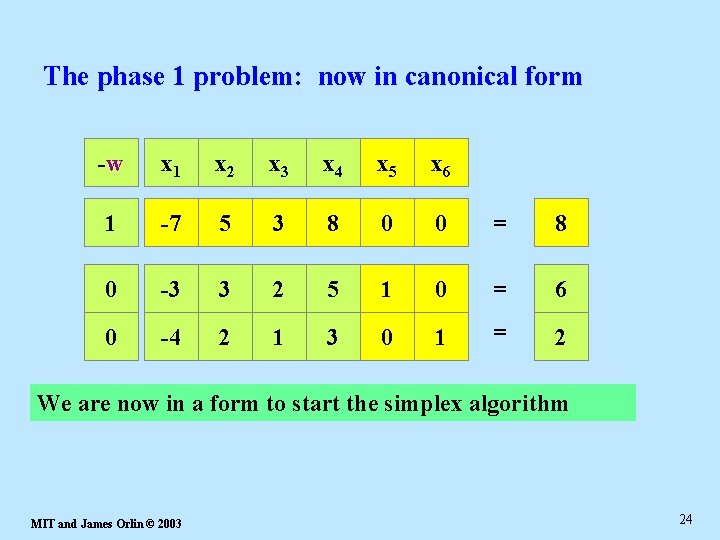
The phase 1 problem: now in canonical form -w x 1 x 2 x 3 x 4 x 5 x 6 1 -3 -7 25 34 81 0 0 = 80 0 -3 3 21 5 1 0 = 6 0 -4 2 1 3 0 1 = 2 We are now in a form to start the simplex algorithm MIT and James Orlin © 2003 24
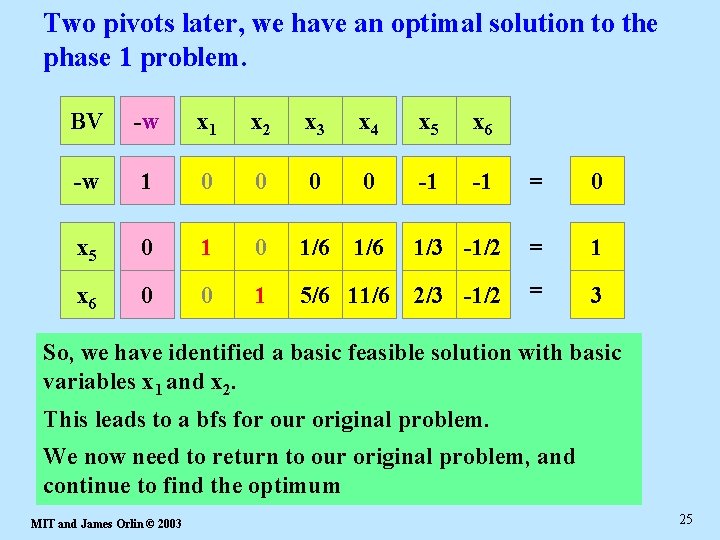
Two pivots later, we have an optimal solution to the phase 1 problem. BV -w x 1 x 2 x 3 x 4 x 5 x 6 -w 1 -7 0 5 0 03 08 -1 0 x 5 0 -3 1 3 0 1/6 21 1/6 5 x 6 0 -4 0 2 1 = 08 1/3 1 -1/2 0 = 16 5/6 1 11/6 3 2/3 0 -1/2 1 = 32 So, we have identified a basic feasible solution with basic variables x 1 and x 2. This leads to a bfs for our original problem. We now need to return to our original problem, and continue to find the optimum MIT and James Orlin © 2003 25
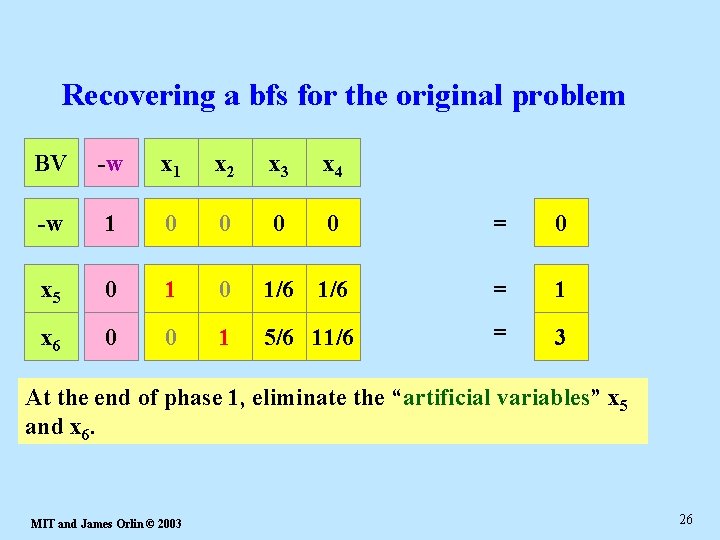
Recovering a bfs for the original problem BV -w x 1 x 2 x 3 x 4 x 5 x 6 -w 1 -7 0 05 03 08 -1 0 x 5 0 -3 1 03 1/6 21 1/6 5 x 6 0 -4 0 12 = 08 1/3 1 -1/2 0 = 16 5/6 1 11/6 3 2/3 0 -1/2 1 = 32 At the end of phase 1, eliminate the “artificial variables” x 5 and x 6. MIT and James Orlin © 2003 26
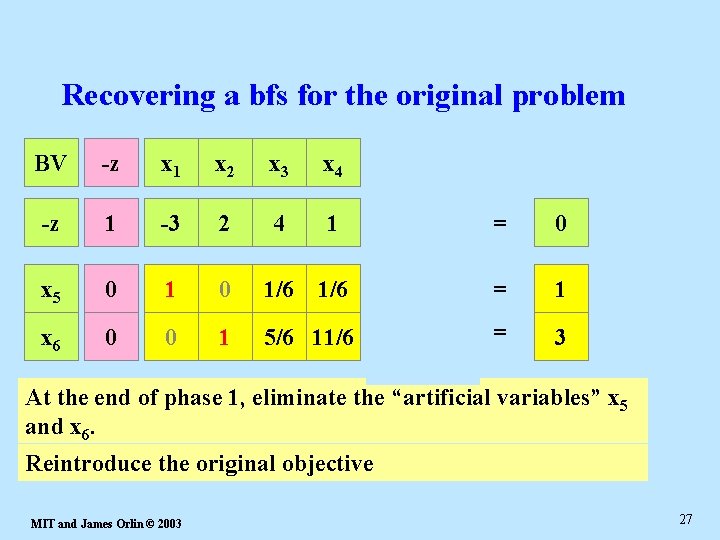
Recovering a bfs for the original problem BV -w -z x 1 x 2 x 3 x 4 x 5 x 6 -w -z 1 -7 0 -3 502 403 108 -1 0 x 5 0 -3 1 03 1/6 21 1/6 5 x 6 0 -4 0 12 = 08 1/3 1 -1/2 0 = 16 5/6 1 11/6 3 2/3 0 -1/2 1 = 32 At the end of phase 1, eliminate the “artificial variables” x 5 and x 6. Reintroduce the original objective MIT and James Orlin © 2003 27
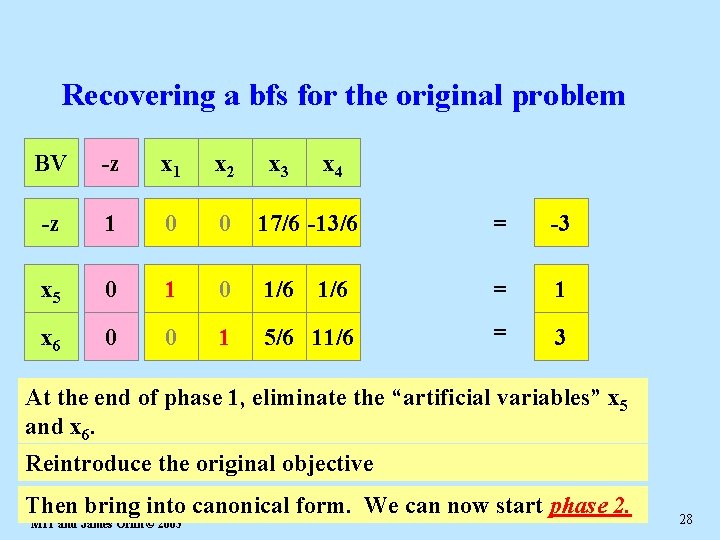
Recovering a bfs for the original problem BV -w -z x 1 x 2 -w -z 1 -7 0 -3 052 x 5 0 -3 1 x 6 0 -4 0 x 3 x 4 x 5 x 6 17/6 403 -13/6 108 -1 0 03 1/6 21 1/6 5 12 = -3 08 1/3 1 -1/2 0 = 16 5/6 1 11/6 3 2/3 0 -1/2 1 = 32 At the end of phase 1, eliminate the “artificial variables” x 5 and x 6. Reintroduce the original objective Then bring into canonical form. We can now start phase 2. MIT and James Orlin © 2003 28
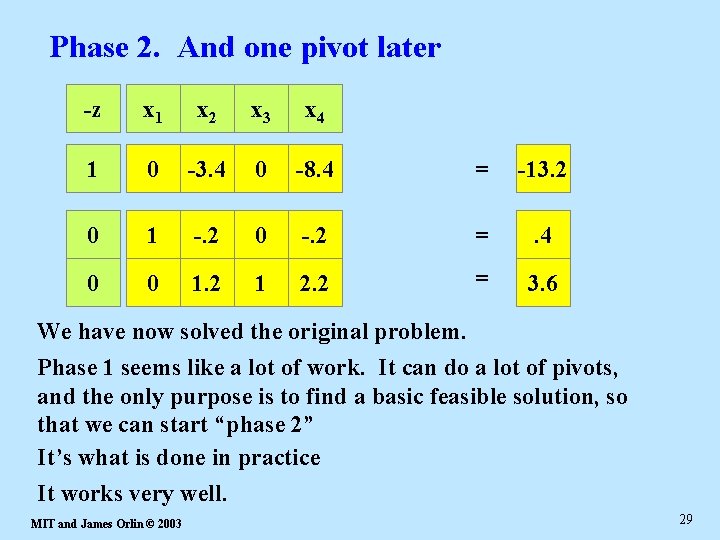
Phase 2. And one pivot later -z x 1 x 2 x 3 x 4 1 -3 0 -3. 4 2 4 0 -8. 4 1 = -13. 2 0 0 -3 1 -. 2 3 1 2 0 -. 2 5 = . 4 6 0 -4 0 1. 2 2 1 2. 2 3 = 3. 6 2 We have now solved the original problem. Phase 1 seems like a lot of work. It can do a lot of pivots, and the only purpose is to find a basic feasible solution, so that we can start “phase 2” It’s what is done in practice It works very well. MIT and James Orlin © 2003 29
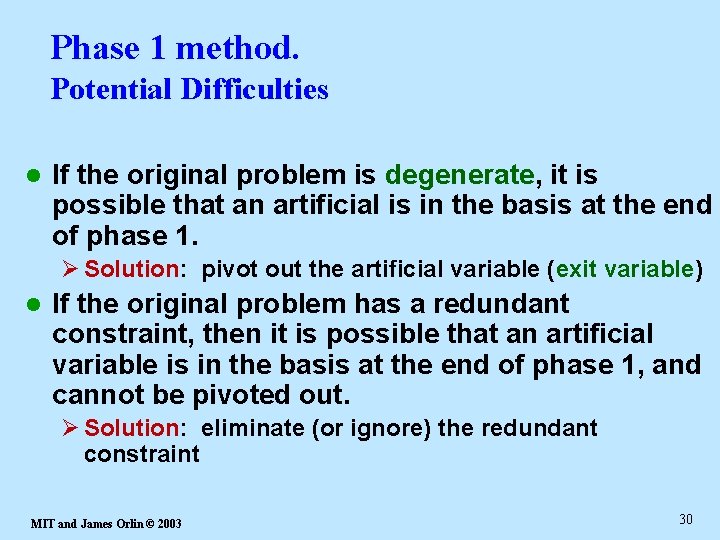
Phase 1 method. Potential Difficulties l If the original problem is degenerate, it is possible that an artificial is in the basis at the end of phase 1. Ø Solution: pivot out the artificial variable (exit variable) l If the original problem has a redundant constraint, then it is possible that an artificial variable is in the basis at the end of phase 1, and cannot be pivoted out. Ø Solution: eliminate (or ignore) the redundant constraint MIT and James Orlin © 2003 30
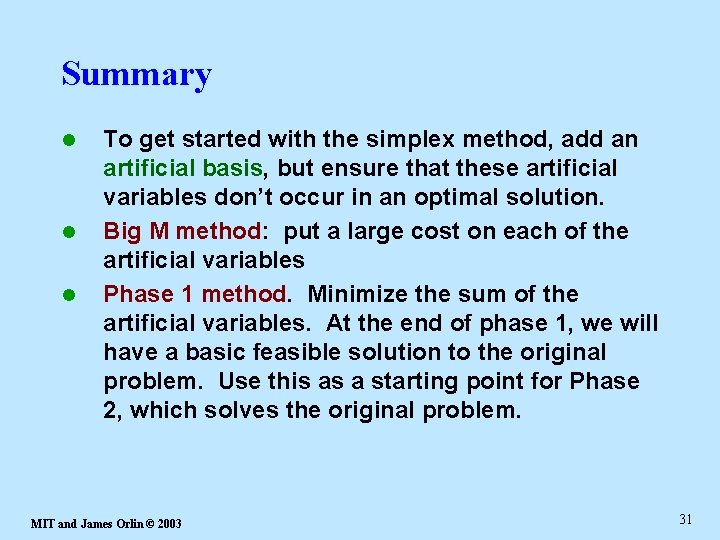
Summary l l l To get started with the simplex method, add an artificial basis, but ensure that these artificial variables don’t occur in an optimal solution. Big M method: put a large cost on each of the artificial variables Phase 1 method. Minimize the sum of the artificial variables. At the end of phase 1, we will have a basic feasible solution to the original problem. Use this as a starting point for Phase 2, which solves the original problem. MIT and James Orlin © 2003 31
The following are extra slides MIT and James Orlin © 2003 32
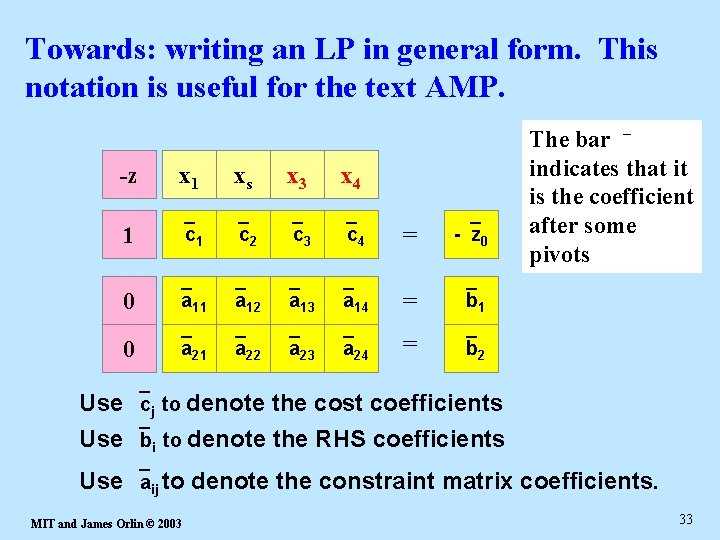
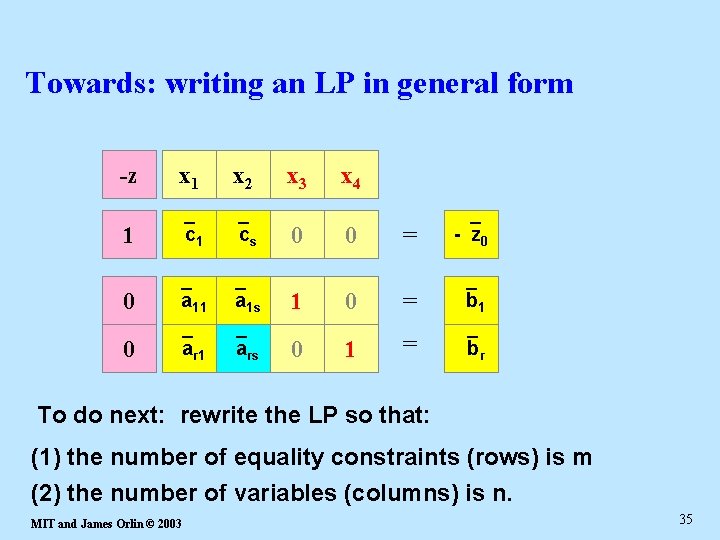
Towards: writing an LP in general form. This notation is useful for the text AMP. -z x 1 xs x 3 x 4 1 c -31 c 22 c 03 c 04 = - z 00 0 a -311 a 312 a 113 a 014 = b 61 0 a -421 a 222 a 023 a 124 = b 22 The bar − indicates that it is the coefficient after some pivots Use cj to denote the cost coefficients Use bi to denote the RHS coefficients Use aij to denote the constraint matrix coefficients. MIT and James Orlin © 2003 33
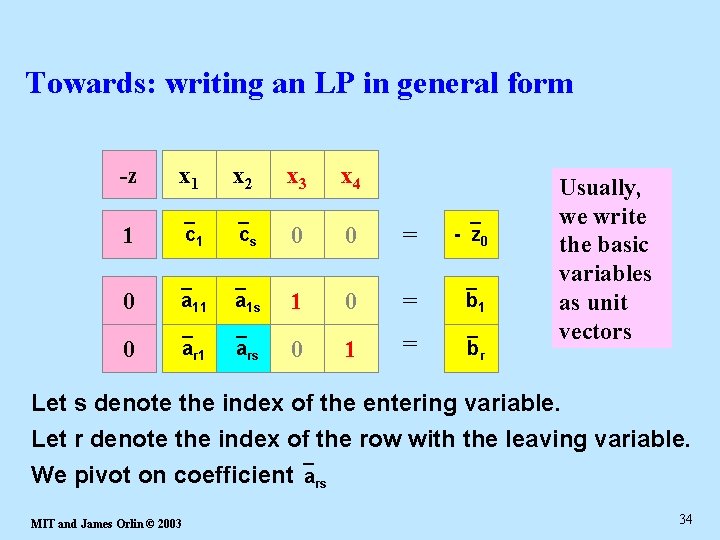
Towards: writing an LP in general form -z x 1 x 2 x 3 x 4 1 c -31 c 2 s 2 0 0 = - z 00 0 a -311 a 31 s 12 1 0 = b 61 0 a -421 22 s r 1 a 22 rs 0 1 = b 2 2 r Usually, we write the basic variables as unit vectors Let s denote the index of the entering variable. Let r denote the index of the row with the leaving variable. We pivot on coefficient ars MIT and James Orlin © 2003 34
Towards: writing an LP in general form -z x 1 x 2 x 3 x 4 1 c -31 c 2 s 2 0 0 = - z 00 0 a -311 a 31 s 12 1 0 = b 61 0 a -421 22 s r 1 a 22 rs 0 1 = b 2 2 r To do next: rewrite the LP so that: (1) the number of equality constraints (rows) is m (2) the number of variables (columns) is n. MIT and James Orlin © 2003 35
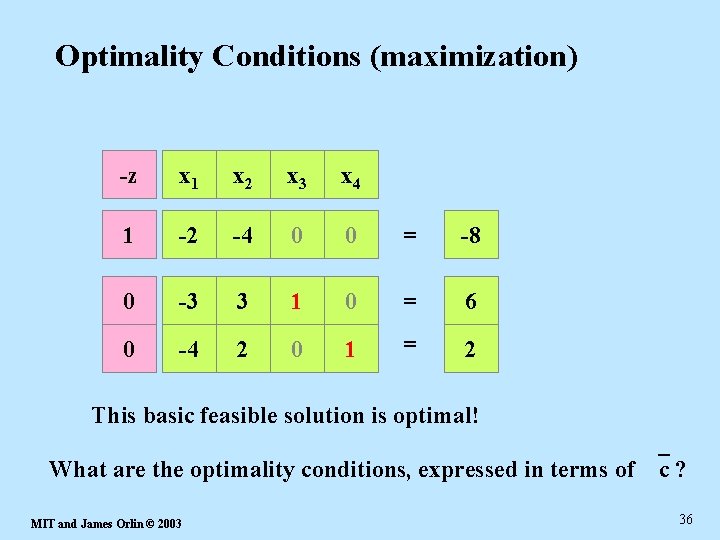
Optimality Conditions (maximization) -z x 1 x 2 x 3 x 4 1 -2 -4 0 0 = -8 0 -3 3 1 0 = 6 0 -4 2 0 1 = 2 This basic feasible solution is optimal! What are the optimality conditions, expressed in terms of c ? MIT and James Orlin © 2003 36
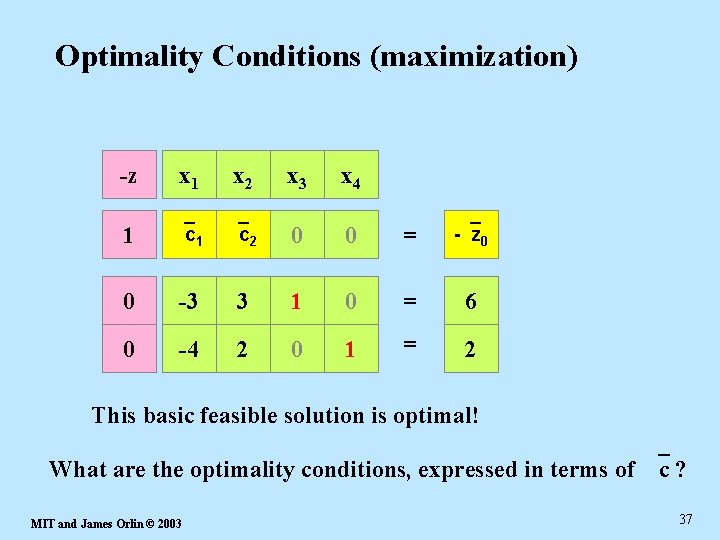
Optimality Conditions (maximization) -z x 1 x 2 x 3 x 4 1 c -21 c -42 0 0 = - z -80 0 -3 3 1 0 = 6 0 -4 2 0 1 = 2 This basic feasible solution is optimal! What are the optimality conditions, expressed in terms of c ? MIT and James Orlin © 2003 37
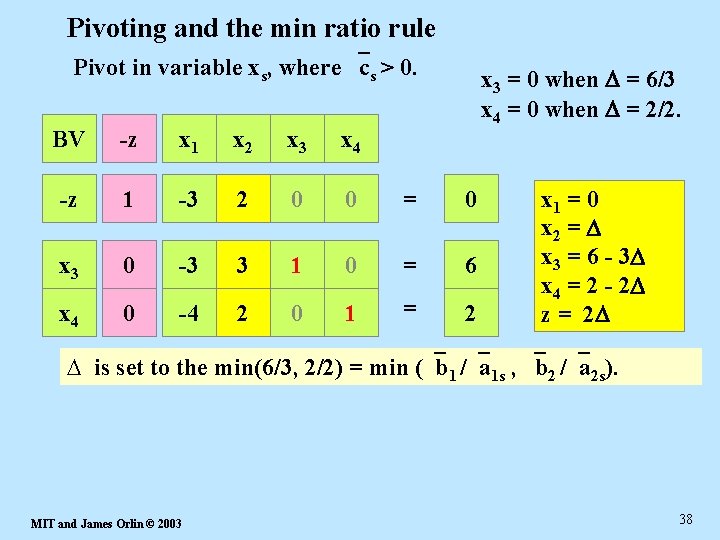
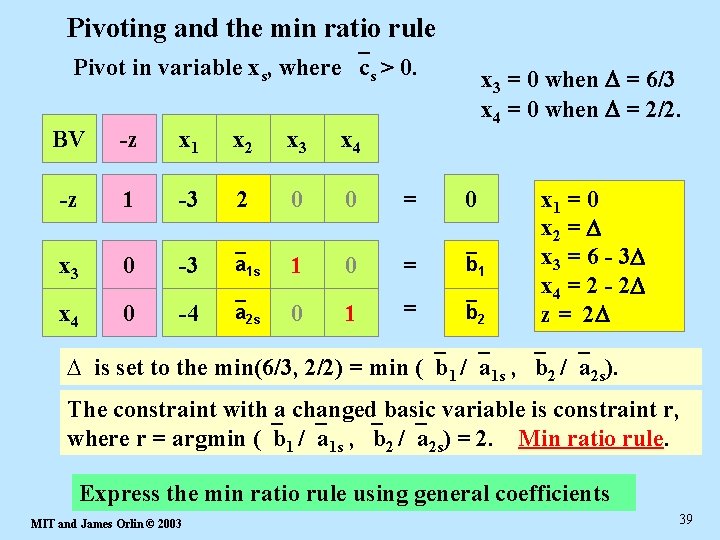
Pivoting and the min ratio rule Pivot in variable xs, where cs > 0. x 3 = 0 when D = 6/3 x 4 = 0 when D = 2/2. BV -z x 1 x 2 x 3 x 4 -z 1 -3 2 0 0 = 0 x 3 0 -3 3 1 0 = 6 x 4 0 -4 2 0 1 = 2 x 1 = 0 x 2 = D x 3 = 6 - 3 D x 4 = 2 - 2 D z = 2 D D is set to the min(6/3, 2/2) = min ( b 1 / a 1 s , b 2 / a 2 s). MIT and James Orlin © 2003 38
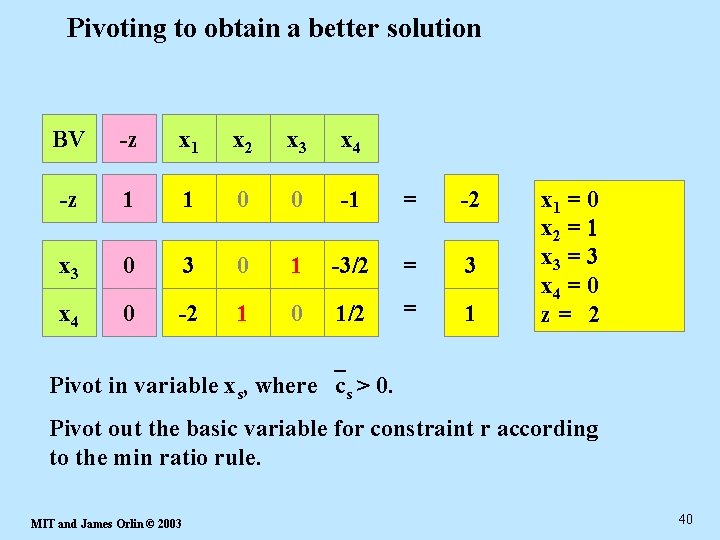
Pivoting and the min ratio rule Pivot in variable xs, where cs > 0. x 3 = 0 when D = 6/3 x 4 = 0 when D = 2/2. BV -z x 1 x 2 x 3 x 4 -z 1 -3 2 0 0 = 0 x 3 0 -3 a 31 s 1 0 = b 61 x 4 0 -4 a 22 s 0 1 = b 22 x 1 = 0 x 2 = D x 3 = 6 - 3 D x 4 = 2 - 2 D z = 2 D D is set to the min(6/3, 2/2) = min ( b 1 / a 1 s , b 2 / a 2 s). The constraint with a changed basic variable is constraint r, where r = argmin ( b 1 / a 1 s , b 2 / a 2 s) = 2. Min ratio rule. Express the min ratio rule using general coefficients MIT and James Orlin © 2003 39
Pivoting to obtain a better solution BV -z x 1 x 2 x 3 x 4 -z 1 -3 1 02 0 -1 0 = -2 0 x 3 0 -3 3 03 1 -3/2 0 = 36 x 4 0 -4 -2 12 0 1/2 1 = 12 x 1 = 0 x 2 = 1 x 3 = 3 x 4 = 0 z= 2 Pivot in variable xs, where cs > 0. Pivot out the basic variable for constraint r according to the min ratio rule. MIT and James Orlin © 2003 40
MIT and James Orlin © 2003 41
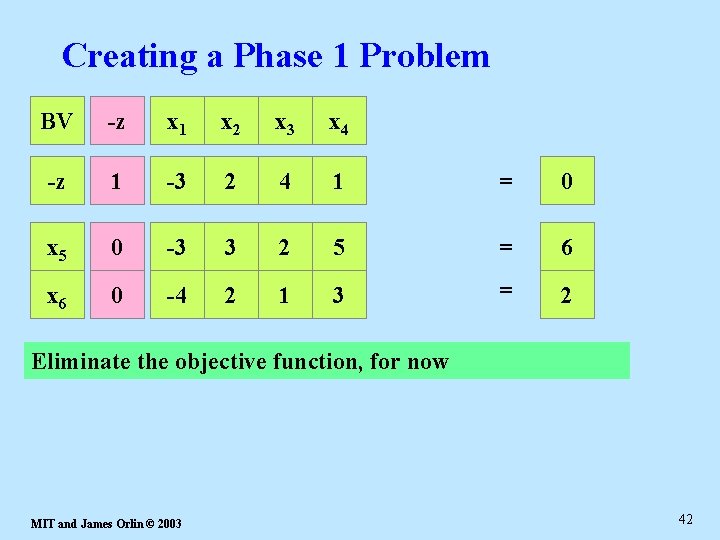
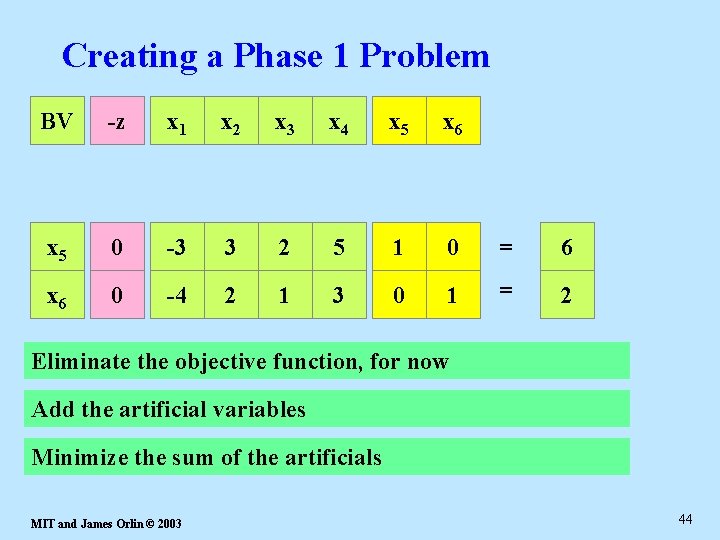
Creating a Phase 1 Problem BV -z x 1 x 2 x 3 x 4 -z 1 -3 2 4 1 = 0 x 5 0 -3 3 21 5 = 6 x 6 0 -4 2 1 3 = 2 Eliminate the objective function, for now MIT and James Orlin © 2003 42
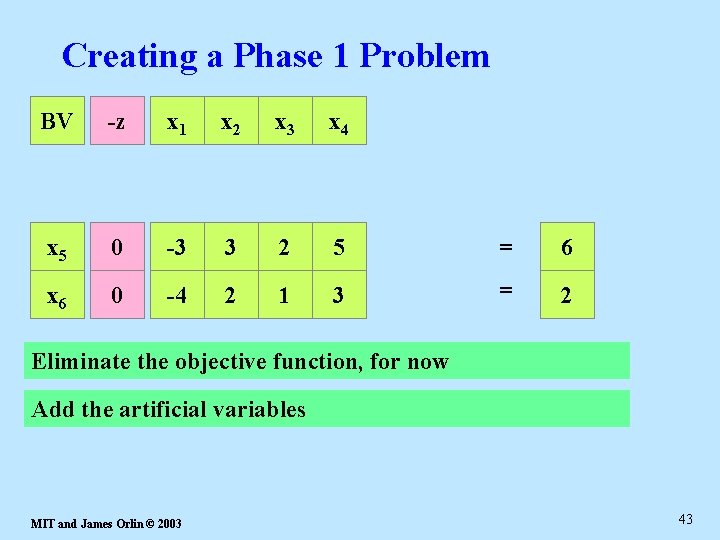
Creating a Phase 1 Problem BV -z x 1 x 2 x 3 x 4 -z 1 -3 2 4 1 = 0 x 5 0 -3 3 21 5 = 6 x 6 0 -4 2 1 3 = 2 Eliminate the objective function, for now Add the artificial variables MIT and James Orlin © 2003 43
Creating a Phase 1 Problem BV -z x 1 x 2 x 3 x 4 x 5 -z 1 -3 2 4 1 x 5 0 -3 3 21 5 1 x 6 0 -4 2 1 3 0 x 6 = 0 0 = 6 1 = 2 Eliminate the objective function, for now Add the artificial variables Minimize the sum of the artificials MIT and James Orlin © 2003 44
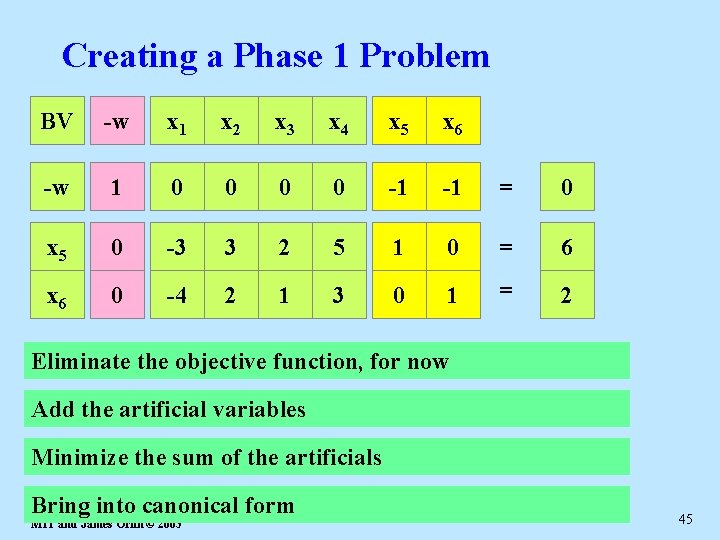
Creating a Phase 1 Problem BV -w -z x 1 x 2 x 3 x 4 x 5 x 6 -z -w 11 -3 0 20 40 10 -1 -1 = = 00 x 5 0 -3 3 21 5 1 0 = 6 x 6 0 -4 2 1 3 0 1 = 2 Eliminate the objective function, for now Add the artificial variables Minimize the sum of the artificials Bring into canonical form MIT and James Orlin © 2003 45
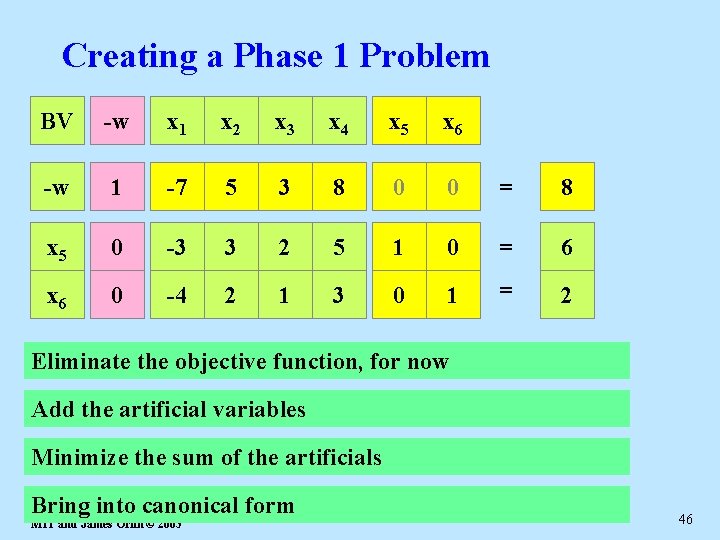
Creating a Phase 1 Problem BV -w -z x 1 x 2 x 3 x 4 x 5 x 6 -z -w 11 -3 -7 0 520 430 180 0 -1 = = 080 x 5 0 -3 3 21 5 1 0 = 6 x 6 0 -4 2 1 3 0 1 = 2 Eliminate the objective function, for now Add the artificial variables Minimize the sum of the artificials Bring into canonical form MIT and James Orlin © 2003 46
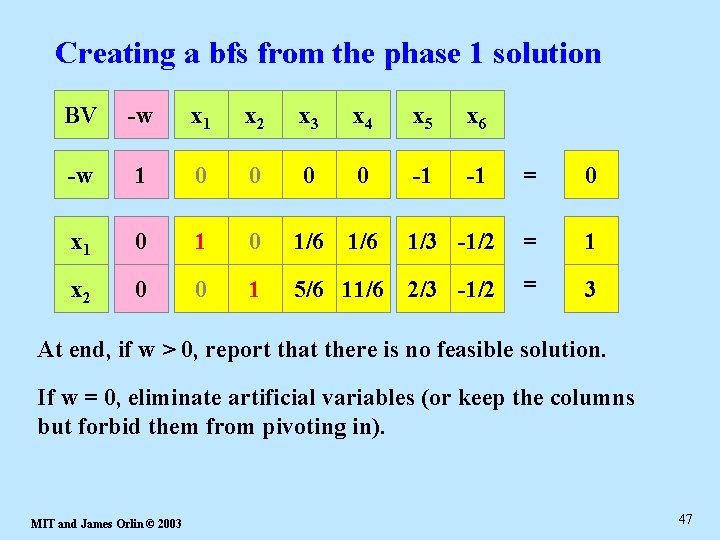
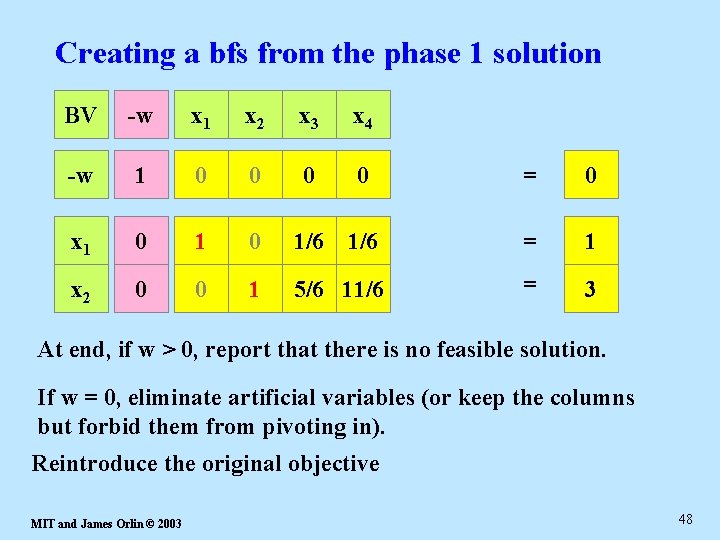
Creating a bfs from the phase 1 solution BV -w x 1 x 2 x 3 x 4 x 5 x 6 -w 1 -7 0 5 0 03 08 -1 0 x 1 0 -3 1 3 0 1/6 21 1/6 5 x 2 0 -4 0 2 1 = 08 1/3 1 -1/2 0 = 16 5/6 1 11/6 3 2/3 0 -1/2 1 = 32 At end, if w > 0, report that there is no feasible solution. If w = 0, eliminate artificial variables (or keep the columns but forbid them from pivoting in). MIT and James Orlin © 2003 47
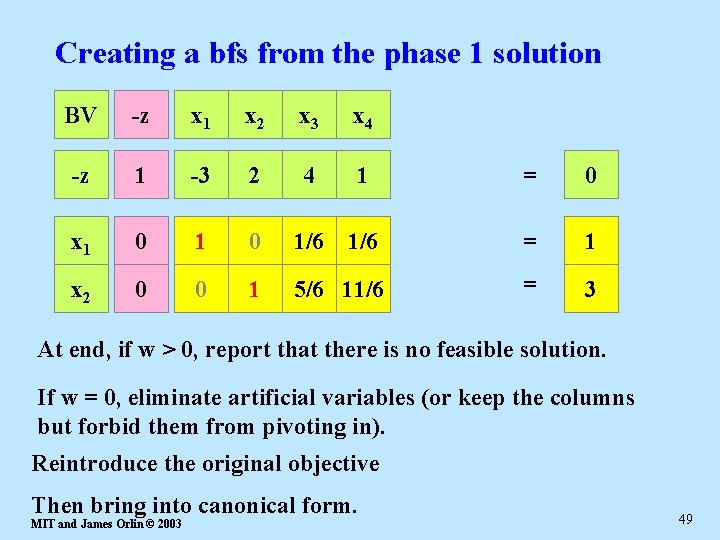
Creating a bfs from the phase 1 solution BV -w x 1 x 2 x 3 x 4 x 5 x 6 -w 1 -7 0 5 0 03 08 -1 0 x 1 0 -3 1 3 0 1/6 21 1/6 5 x 2 0 -4 0 2 1 = 08 1/3 1 -1/2 0 = 16 5/6 1 11/6 3 2/3 0 -1/2 1 = 32 At end, if w > 0, report that there is no feasible solution. If w = 0, eliminate artificial variables (or keep the columns but forbid them from pivoting in). Reintroduce the original objective MIT and James Orlin © 2003 48
Creating a bfs from the phase 1 solution BV -w -z x 1 x 2 x 3 x 4 x 5 x 6 -w -z 1 -7 0 -3 02 5 403 108 -1 0 x 1 0 -3 1 3 0 1/6 21 1/6 5 x 2 0 -4 0 2 1 = 08 1/3 1 -1/2 0 = 16 5/6 1 11/6 3 2/3 0 -1/2 1 = 32 At end, if w > 0, report that there is no feasible solution. If w = 0, eliminate artificial variables (or keep the columns but forbid them from pivoting in). Reintroduce the original objective Then bring into canonical form. MIT and James Orlin © 2003 49
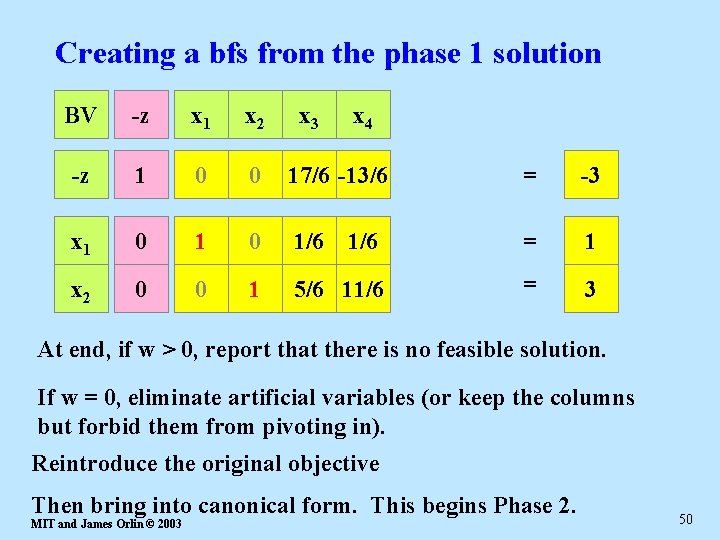
Creating a bfs from the phase 1 solution BV -w -z x 1 x 2 -w -z 1 -7 0 -3 52 0 x 1 0 -3 1 x 2 0 -4 0 x 3 x 4 x 5 x 6 17/6 403 -13/6 108 -1 0 3 0 1/6 21 1/6 5 2 1 = -3 08 1/3 1 -1/2 0 = 16 5/6 1 11/6 3 2/3 0 -1/2 1 = 32 At end, if w > 0, report that there is no feasible solution. If w = 0, eliminate artificial variables (or keep the columns but forbid them from pivoting in). Reintroduce the original objective Then bring into canonical form. This begins Phase 2. MIT and James Orlin © 2003 50
MIT and James Orlin © 2003 51
Phase 1: obtaining an initial bfs l We know how to obtain an optimal bfs if we are given an initial bfs. l To create an initial bfs for problem P, we will use the simplex algorithm on problem P’, which is closely connected to P. MIT and James Orlin © 2003 52
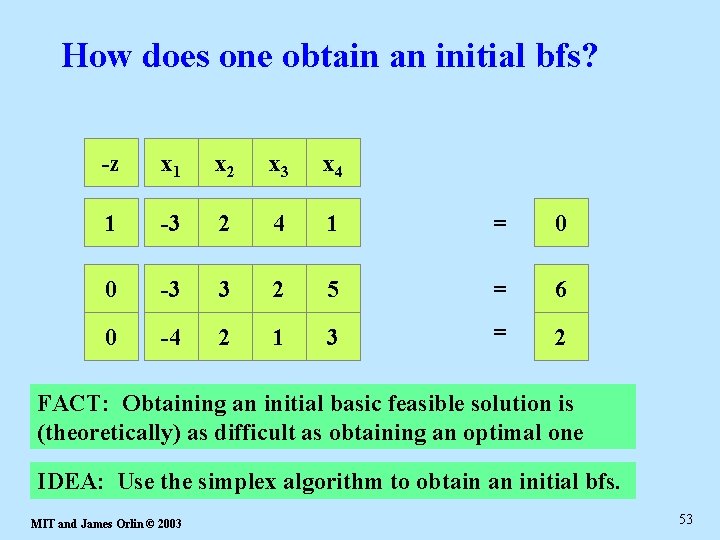
How does one obtain an initial bfs? -z x 1 x 2 x 3 x 4 1 -3 2 4 1 = 0 0 -3 3 21 5 = 6 0 -4 2 1 3 = 2 FACT: Obtaining an initial basic feasible solution is (theoretically) as difficult as obtaining an optimal one IDEA: Use the simplex algorithm to obtain an initial bfs. MIT and James Orlin © 2003 53
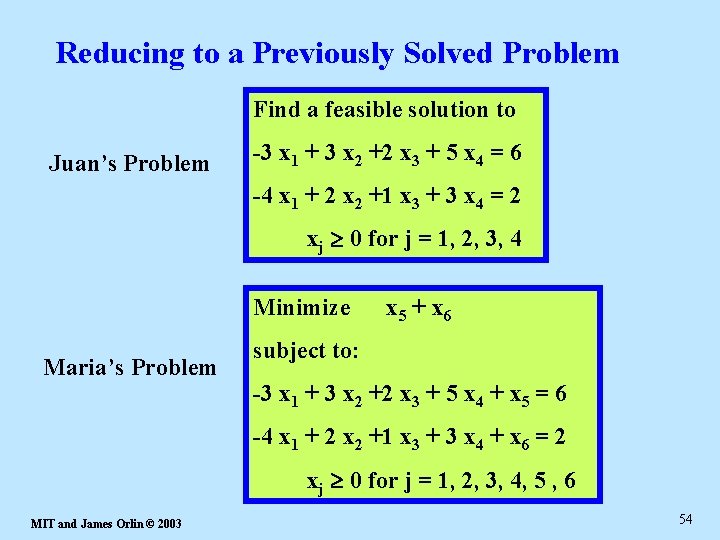
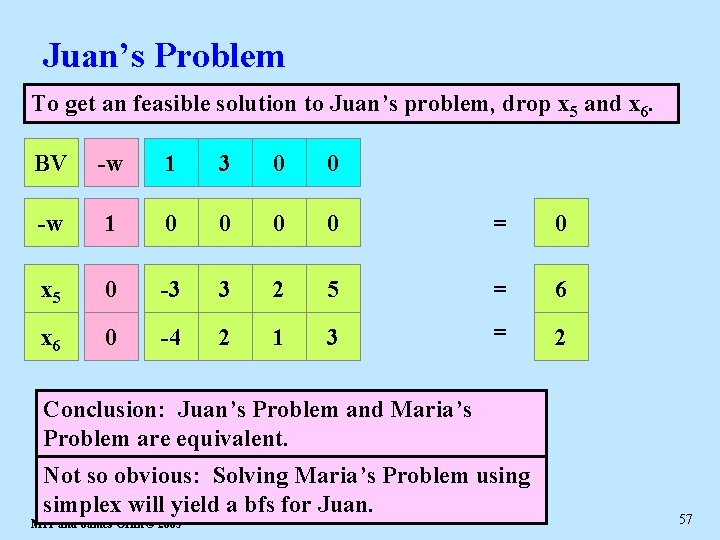
Reducing to a Previously Solved Problem Find a feasible solution to Juan’s Problem -3 x 1 + 3 x 2 +2 x 3 + 5 x 4 = 6 -4 x 1 + 2 x 2 +1 x 3 + 3 x 4 = 2 xj 0 for j = 1, 2, 3, 4 Minimize Maria’s Problem x 5 + x 6 subject to: -3 x 1 + 3 x 2 +2 x 3 + 5 x 4 + x 5 = 6 -4 x 1 + 2 x 2 +1 x 3 + 3 x 4 + x 6 = 2 xj 0 for j = 1, 2, 3, 4, 5 , 6 MIT and James Orlin © 2003 54
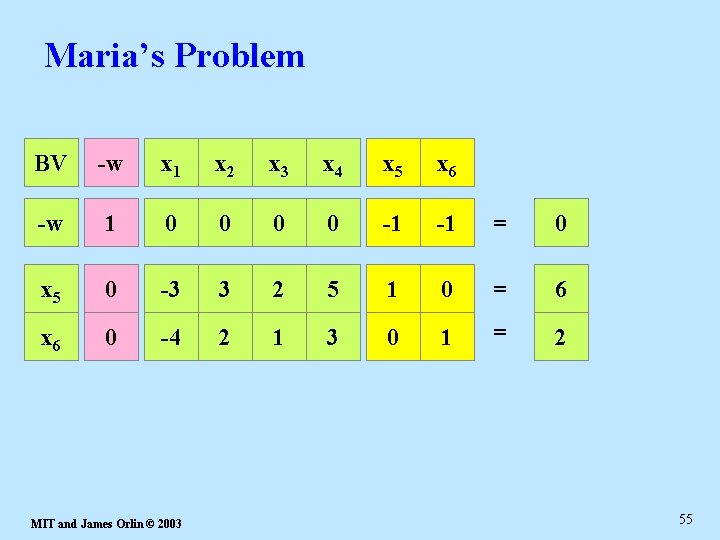
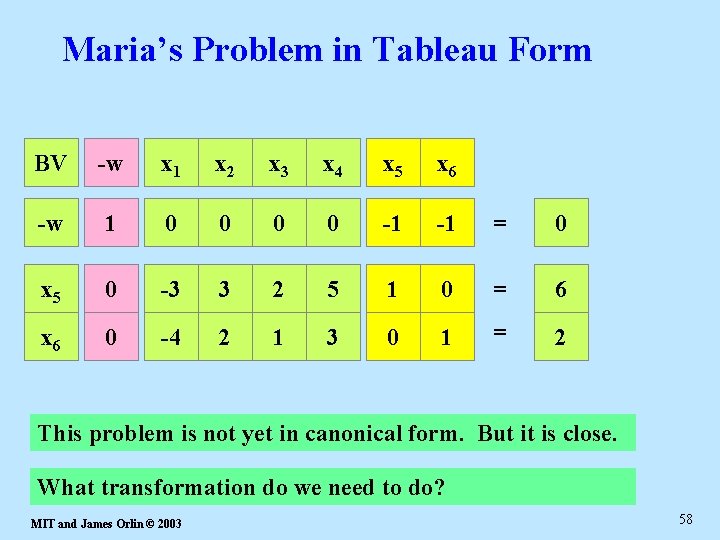
Maria’s Problem BV -w x 1 x 2 x 3 x 4 x 5 x 6 -w 1 0 0 -1 -1 = 0 x 5 0 -3 3 21 5 1 0 = 6 x 6 0 -4 2 1 3 0 1 = 2 MIT and James Orlin © 2003 55
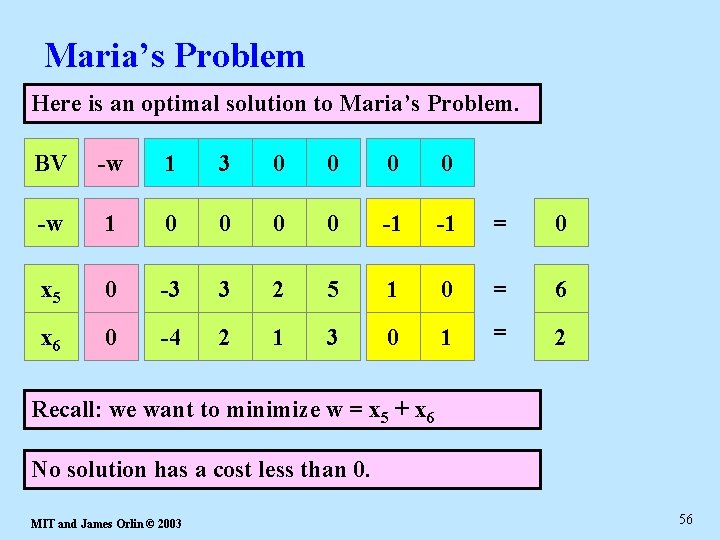
Maria’s Problem Here is an optimal solution to Maria’s Problem. BV -w x 11 x 32 x 03 x 04 x 05 x 06 -w 1 0 0 -1 -1 = 0 x 5 0 -3 3 21 5 1 0 = 6 x 6 0 -4 2 1 3 0 1 = 2 Recall: we want to minimize w = x 5 + x 6 No solution has a cost less than 0. MIT and James Orlin © 2003 56
Juan’s Problem To get an feasible solution to Juan’s problem, drop x 5 and x 6. BV -w x 11 x 32 x 03 x 04 x 05 x 06 -w 1 0 0 -1 -1 = 0 x 5 0 -3 3 21 5 1 0 = 6 x 6 0 -4 2 1 3 0 1 = 2 Conclusion: Juan’s Problem and Maria’s Problem are equivalent. Not so obvious: Solving Maria’s Problem using simplex will yield a bfs for Juan. MIT and James Orlin © 2003 57
Maria’s Problem in Tableau Form BV -w x 1 x 2 x 3 x 4 x 5 x 6 -w 1 0 0 -1 -1 = 0 x 5 0 -3 3 21 5 1 0 = 6 x 6 0 -4 2 1 3 0 1 = 2 This problem is not yet in canonical form. But it is close. What transformation do we need to do? MIT and James Orlin © 2003 58
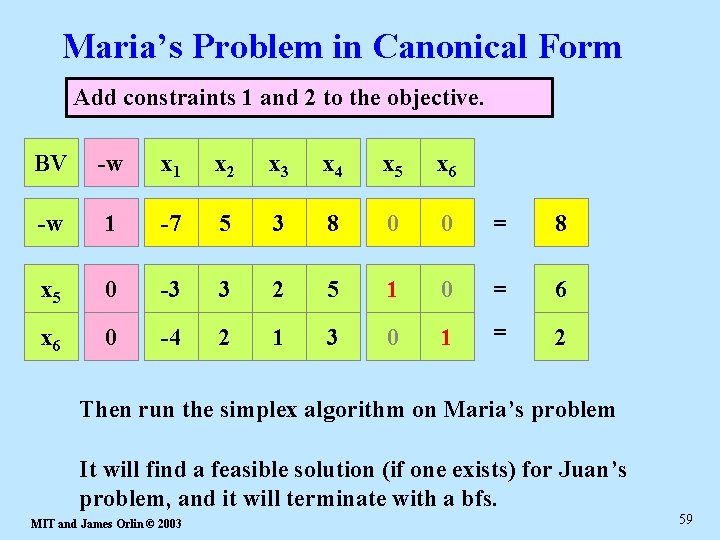
Maria’s Problem in Canonical Form Add constraints 1 and 2 to the objective. BV -w x 1 x 2 x 3 x 4 x 5 x 6 -w 1 -7 0 50 30 80 -1 0 = 80 x 5 0 -3 3 21 5 1 0 = 6 x 6 0 -4 2 1 3 0 1 = 2 Then run the simplex algorithm on Maria’s problem It will find a feasible solution (if one exists) for Juan’s problem, and it will terminate with a bfs. MIT and James Orlin © 2003 59
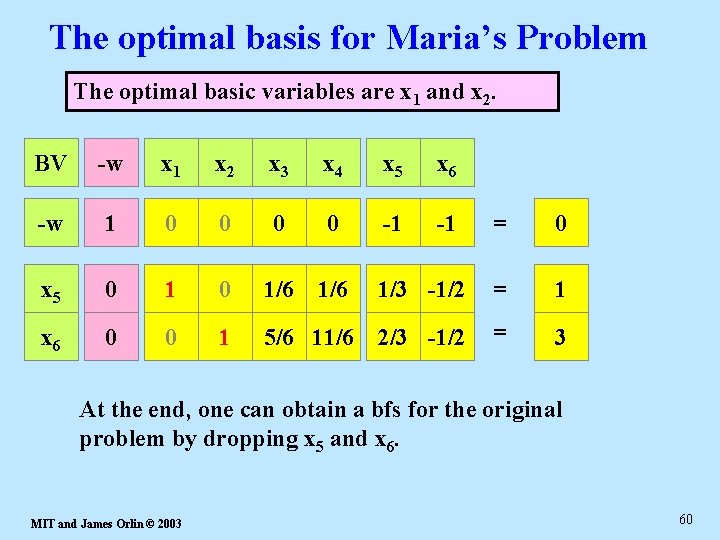
The optimal basis for Maria’s Problem The optimal basic variables are x 1 and x 2. BV -w x 1 x 2 x 3 x 4 x 5 x 6 -w 1 -7 0 05 03 08 -1 0 x 5 0 -3 1 03 1/6 21 1/6 5 x 6 0 -4 0 12 = 08 1/3 1 -1/2 0 = 16 5/6 1 11/6 3 2/3 0 -1/2 1 = 32 At the end, one can obtain a bfs for the original problem by dropping x 5 and x 6. MIT and James Orlin © 2003 60