
TWOPHASE ANNULAR FLOW IN A VERTICALLY MOUNTED VENTURI

- Slides: 19
TWO-PHASE ANNULAR FLOW IN A VERTICALLY MOUNTED VENTURI FLOW METER G. Monni, M. De Salve, B. Panella Politecnico di Torino, C. so Duca degli Abruzzi 24, 10129 Torino grazia. monni@polito. it HEFAT 2014 10 th International Conference on Heat Transfer, Fluid Mechanics and Thermodynamics 14 – 16 July 2014 Orlando, Florida
Outline � � � � Context Objective Experimental Facility and Test Matrix Venturi Flow Meter (VFM) Experimental Results VFM Modeling Two-Phase Flow Mass Flow Rates Estimation Conclusions HEFAT 2014 14 – 16 July 2014 - Orlando, Florida 2
Context � Experimental Facility for thermal-hydraulic simulation of innovative small and medium size PWR SPES 3 � Measurement of the mixture mass flow rate instruments and methodologies to evaluate different two- phase flow parameters need to be developed � Typically a set of instruments (Spool Piece - SP) must be installed: each instrument of the SP has to be sensitive to the different properties of the flow (momentum, velocity, density, void fraction, etc. . ) � Different number of instruments can be coupled in a SP HEFAT 2014 14 – 16 July 2014 - Orlando, Florida 3
Objectives Analysis of the response of a Venturi Flow Meter (VFM) in two-phase flow To develop a methodology for the signals interpretation and a “model of the instrument” for the phases mass flow rate estimation The SP is tested in a vertical test section for air-water flow at very high void fraction The model and the results are presented and discussed HEFAT 2014 14 – 16 July 2014 - Orlando, Florida 4
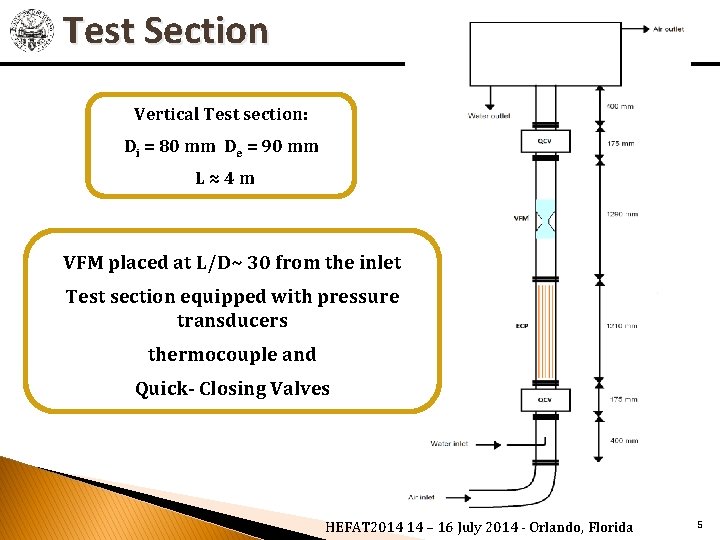
Test Section Vertical Test section: Di = 80 mm De = 90 mm L≈4 m VFM placed at L/D~ 30 from the inlet Test section equipped with pressure transducers thermocouple and Quick- Closing Valves HEFAT 2014 14 – 16 July 2014 - Orlando, Florida 5
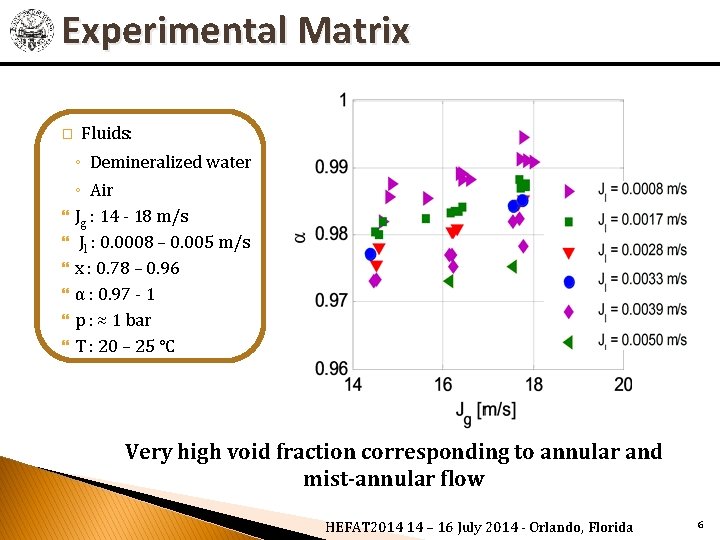
Experimental Matrix � Fluids: ◦ Demineralized water ◦ Air Jg : 14 - 18 m/s Jl : 0. 0008 – 0. 005 m/s x : 0. 78 – 0. 96 α : 0. 97 - 1 p : ≈ 1 bar T : 20 – 25 °C Very high void fraction corresponding to annular and mist-annular flow HEFAT 2014 14 – 16 July 2014 - Orlando, Florida 6
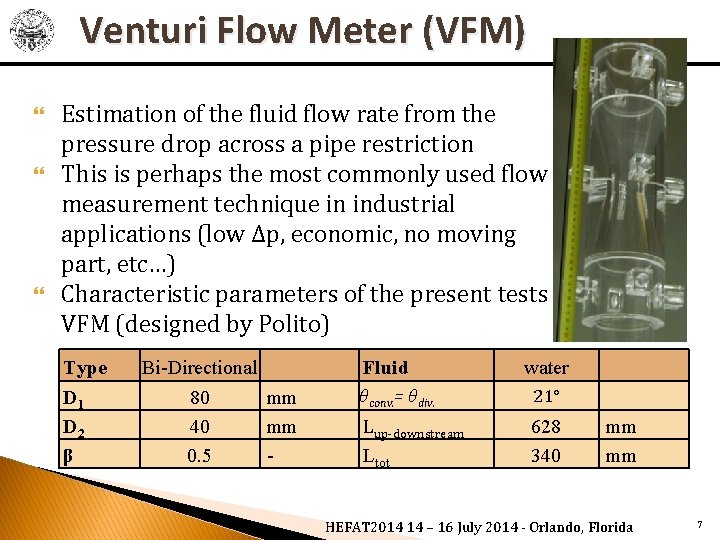
Venturi Flow Meter (VFM) Estimation of the fluid flow rate from the pressure drop across a pipe restriction This is perhaps the most commonly used flow measurement technique in industrial applications (low Δp, economic, no moving part, etc…) Characteristic parameters of the present tests VFM (designed by Polito) Type D 1 D 2 β Bi-Directional 80 40 0. 5 Fluid mm mm - water θconv. = θdiv. 21° Lup-downstream Ltot 628 340 mm mm HEFAT 2014 14 – 16 July 2014 - Orlando, Florida 7
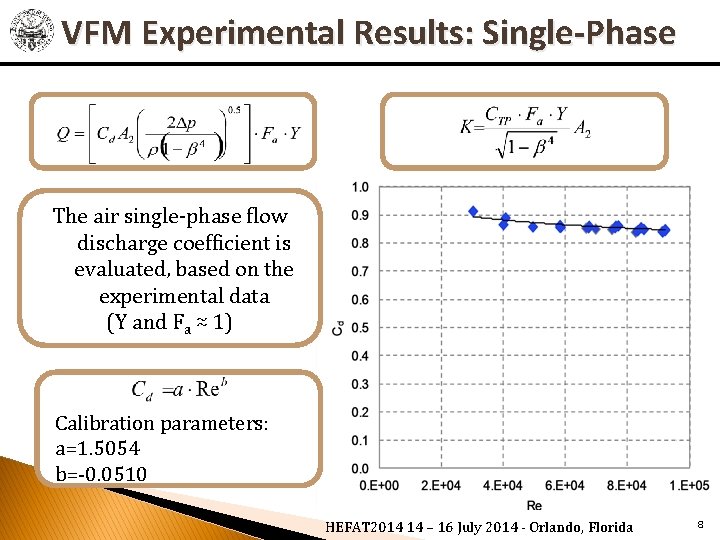
VFM Experimental Results: Single-Phase The air single-phase flow discharge coefficient is evaluated, based on the experimental data (Y and Fa ≈ 1) Calibration parameters: a=1. 5054 b=-0. 0510 HEFAT 2014 14 – 16 July 2014 - Orlando, Florida 8
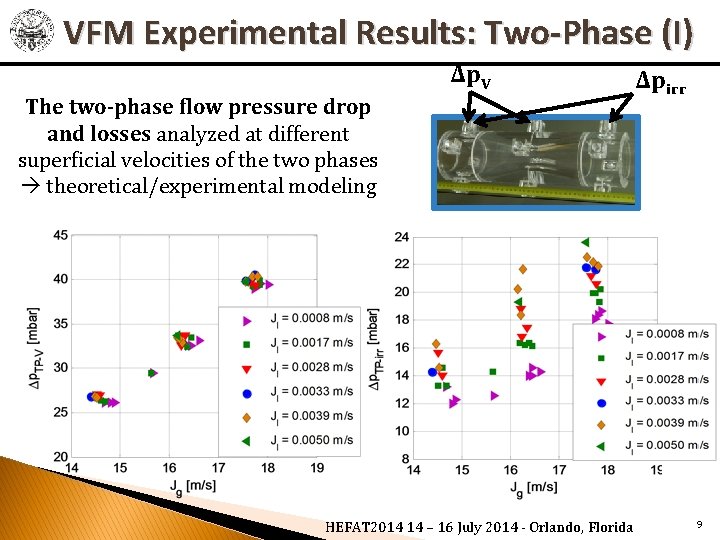
VFM Experimental Results: Two-Phase (I) Δp. V The two-phase flow pressure drop and losses analyzed at different superficial velocities of the two phases theoretical/experimental modeling HEFAT 2014 14 – 16 July 2014 - Orlando, Florida Δpirr 9
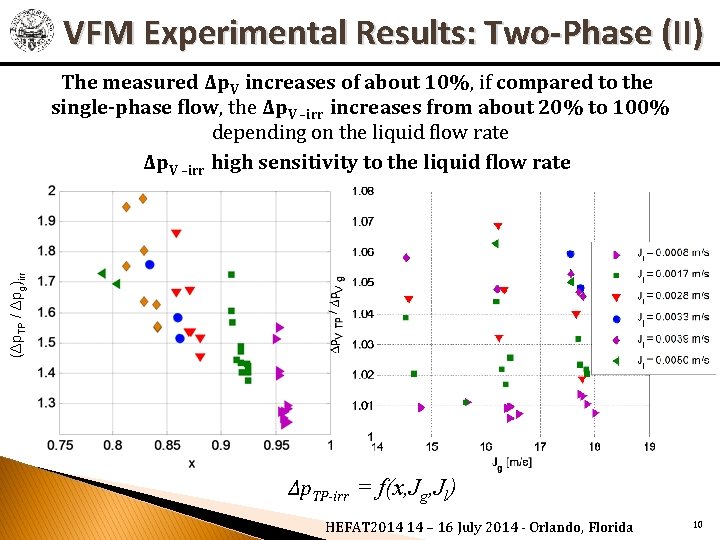
VFM Experimental Results: Two-Phase (II) (Δp. TP / Δpg)irr The measured Δp. V increases of about 10%, if compared to the single-phase flow, the Δp. V –irr increases from about 20% to 100% depending on the liquid flow rate Δp. V –irr high sensitivity to the liquid flow rate Δp. TP-irr = f(x, Jg, Jl) HEFAT 2014 14 – 16 July 2014 - Orlando, Florida 10
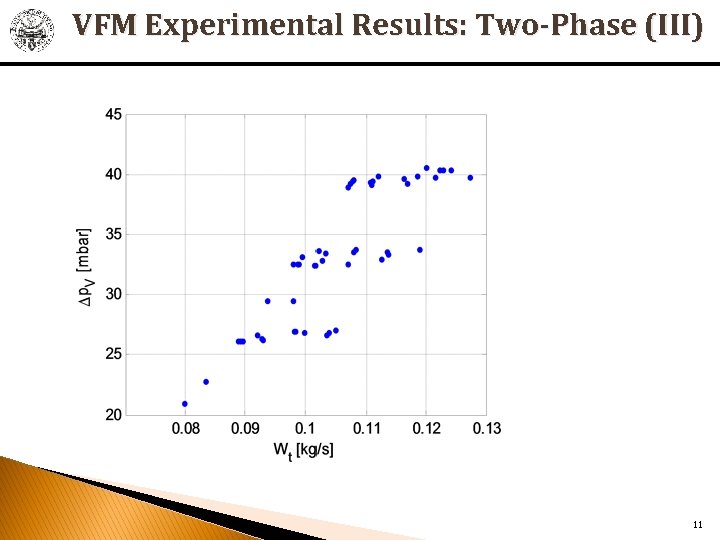
VFM Experimental Results: Two-Phase (III) 11
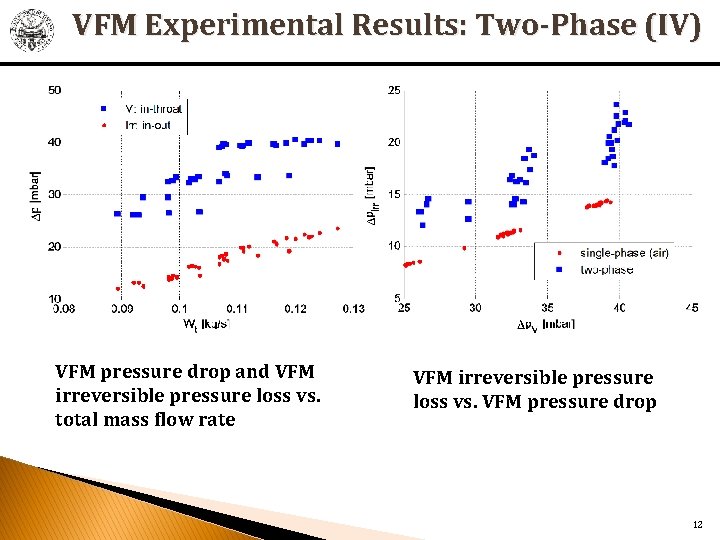
VFM Experimental Results: Two-Phase (IV) VFM pressure drop and VFM irreversible pressure loss vs. total mass flow rate VFM irreversible pressure loss vs. VFM pressure drop 12
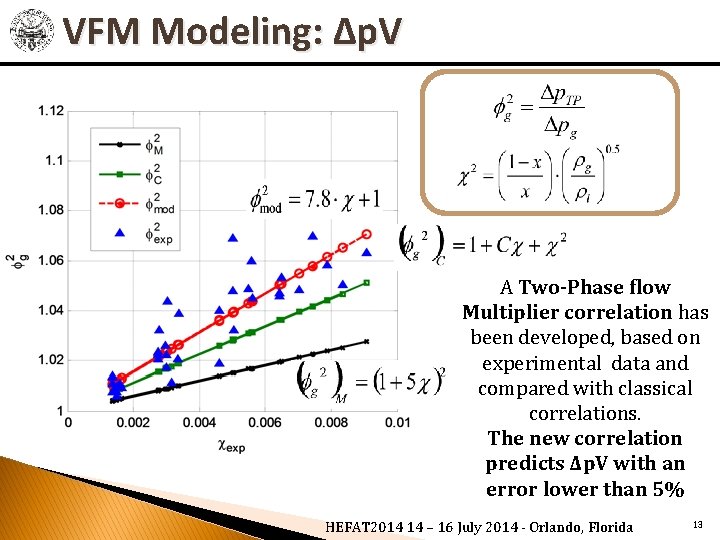
VFM Modeling: Δp. V A Two-Phase flow Multiplier correlation has been developed, based on experimental data and compared with classical correlations. The new correlation predicts Δp. V with an error lower than 5% HEFAT 2014 14 – 16 July 2014 - Orlando, Florida 13
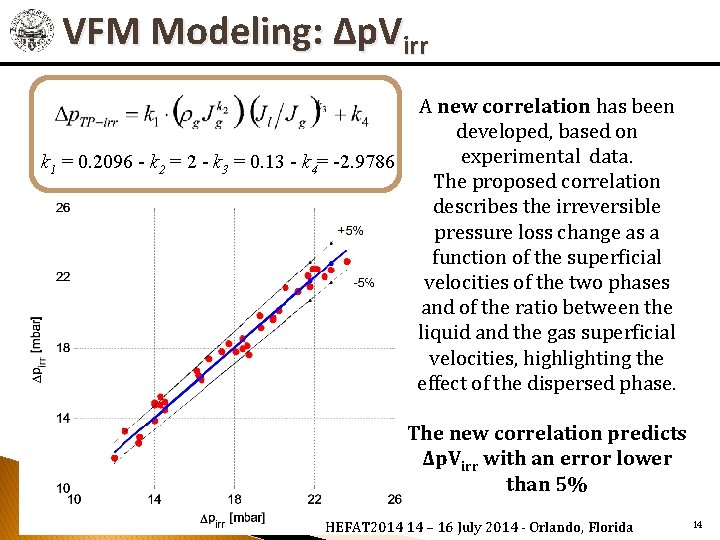
VFM Modeling: Δp. Virr k 1 = 0. 2096 - k 2 = 2 - k 3 = 0. 13 - k 4= -2. 9786 A new correlation has been developed, based on experimental data. The proposed correlation describes the irreversible pressure loss change as a function of the superficial velocities of the two phases and of the ratio between the liquid and the gas superficial velocities, highlighting the effect of the dispersed phase. The new correlation predicts Δp. Virr with an error lower than 5% HEFAT 2014 14 – 16 July 2014 - Orlando, Florida 14
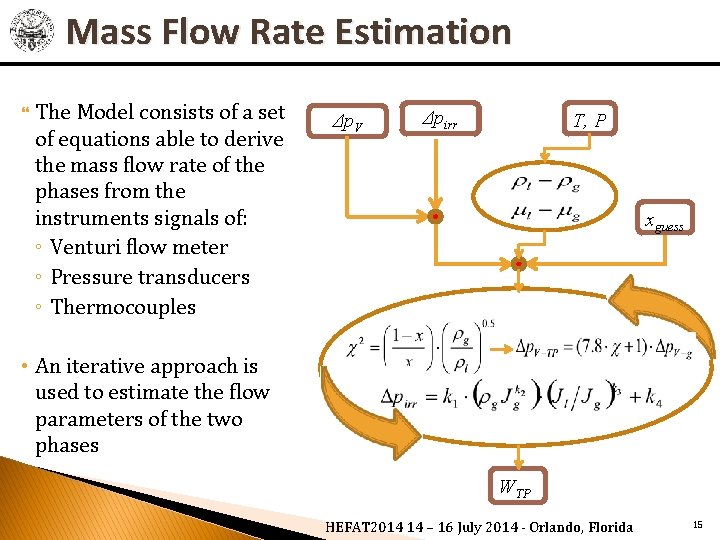
Mass Flow Rate Estimation The Model consists of a set of equations able to derive the mass flow rate of the phases from the instruments signals of: ◦ Venturi flow meter ◦ Pressure transducers ◦ Thermocouples Δp. V Δpirr T, P xguess • An iterative approach is used to estimate the flow parameters of the two phases WTP HEFAT 2014 14 – 16 July 2014 - Orlando, Florida 15
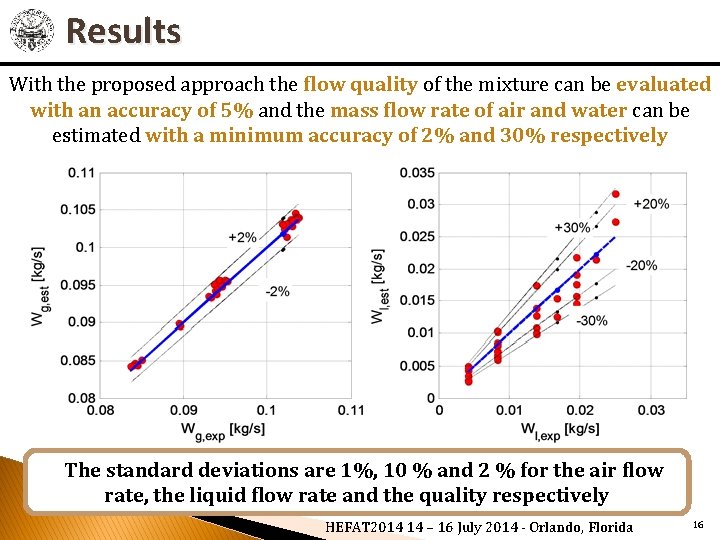
Results With the proposed approach the flow quality of the mixture can be evaluated with an accuracy of 5% and the mass flow rate of air and water can be estimated with a minimum accuracy of 2% and 30% respectively The standard deviations are 1%, 10 % and 2 % for the air flow rate, the liquid flow rate and the quality respectively HEFAT 2014 14 – 16 July 2014 - Orlando, Florida 16
Conclusions In the present research work, the experimental investigation of a vertical upward annular two-phase flow by a Venturi Flow Meter (VFM) has been performed. The dependence of the pressure drops, evaluated between the VFM inlet and throat sections and between the inlet and outlet sections, on the characteristic flow parameters (flow velocities, quality and void fraction) have been analyzed and discussed. Correlations describing the relation between velocities and VFM pressure drops have been proposed for the two pressure drops components. For both correlations the error is lower than 5%. HEFAT 2014 14 – 16 July 2014 - Orlando, Florida 17
Conclusions � The analysis of the VFM irreversible pressure losses shows that important information can be derived concerning the effect of the liquid dispersed phase � The proposed correlation describes the irreversible pressure loss change as a function of the flow rate of the two -phases, highlighting the effect of the dispersed phase. �A model for the estimation of the mass flow rate of the two phases from the instrument signals has been developed: it allows the evaluation of the flow quality with an accuracy of 5% and the estimation of the mass flow rate of air and water with an error of 1% and 10% respectively HEFAT 2014 14 – 16 July 2014 - Orlando, Florida 18
Thank you for your kind attention HEFAT 2014 14 – 16 July 2014 - Orlando, Florida 19