
TWOFISH ENCRYPTION ALGORITHM CS 627 Cryptology Fall 2004
- Slides: 21
TWOFISH ENCRYPTION ALGORITHM CS– 627: Cryptology Fall 2004 Horatiu Paul Stancu
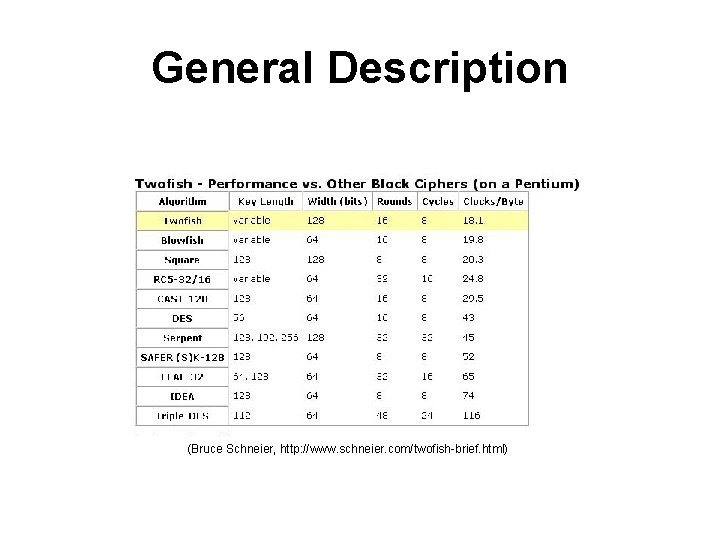
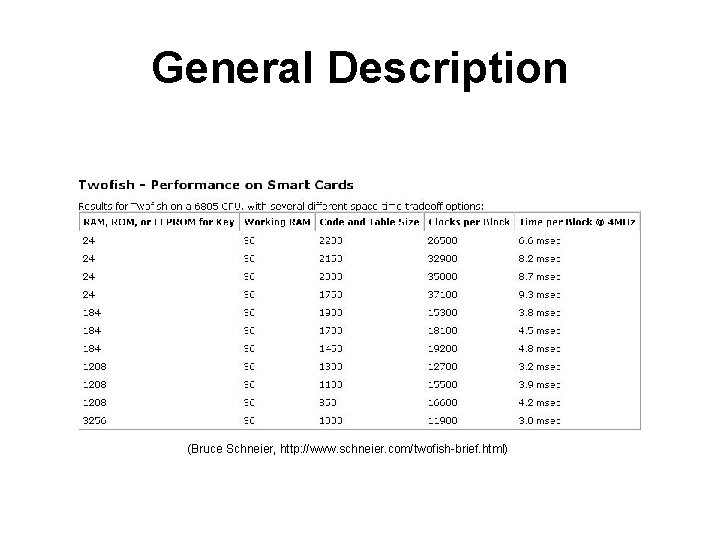
General Description • • • 128 -bit block 128, 192, or 256 -bit key 16 rounds Works in all standard modes Encrypts data in: – 18 clocks/byte on a Pentium – 16. 1 clocks/byte on a Pentium Pro
General Description (Bruce Schneier, http: //www. schneier. com/twofish-brief. html)
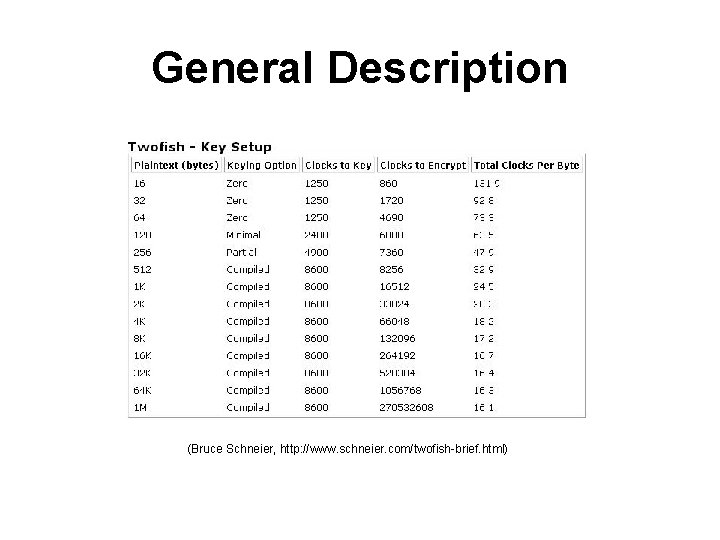
General Description (Bruce Schneier, http: //www. schneier. com/twofish-brief. html)
General Description (Bruce Schneier, http: //www. schneier. com/twofish-brief. html)
General Description Main Advantages: • • Extensively cryptanalyzed Unpatented Uncopyrighted Free
Twofish Design Goals • • A 128 -bit symmetric block cipher. Key lengths of 128 bits, 192 bits, and 256 bits. No weak keys. Efficiency, both on the Intel Pentium Pro and other software and hardware platforms. • Flexible design: e. g. , accept additional key lengths; be implementable on a wide variety of platforms and applications; and be suitable for a stream cipher, hash function, and MAC. • Simple design, both to facilitate ease of analysis and ease of implementation.
Twofish Design Goals • Encrypt data in less than 500 clock cycles per block on an Intel Pentium, Pentium Pro, and Pentium II, for a fully optimized version of the algorithm. • Be capable of setting up a 128 -bit key (for optimal encryption speed) in less than the time required to encrypt 32 blocks on a Pentium, Pentium Pro, and Pentium II. • Encrypt data in less than 5000 clock cycles per block on a Pentium, Pentium Pro, and Pentium II with no key setup time.
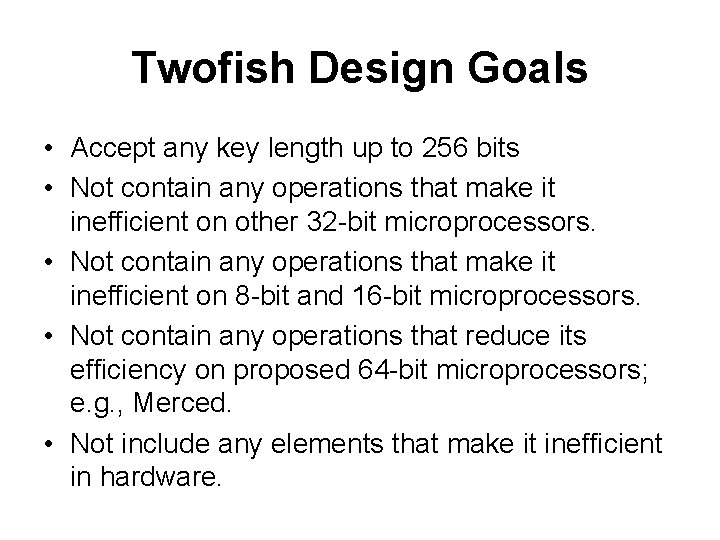
Twofish Design Goals • Accept any key length up to 256 bits • Not contain any operations that make it inefficient on other 32 -bit microprocessors. • Not contain any operations that make it inefficient on 8 -bit and 16 -bit microprocessors. • Not contain any operations that reduce its efficiency on proposed 64 -bit microprocessors; e. g. , Merced. • Not include any elements that make it inefficient in hardware.
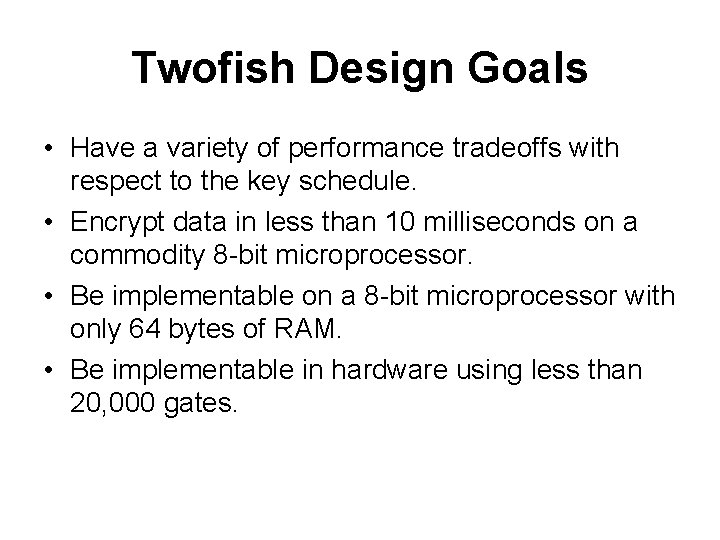
Twofish Design Goals • Have a variety of performance tradeoffs with respect to the key schedule. • Encrypt data in less than 10 milliseconds on a commodity 8 -bit microprocessor. • Be implementable on a 8 -bit microprocessor with only 64 bytes of RAM. • Be implementable in hardware using less than 20, 000 gates.
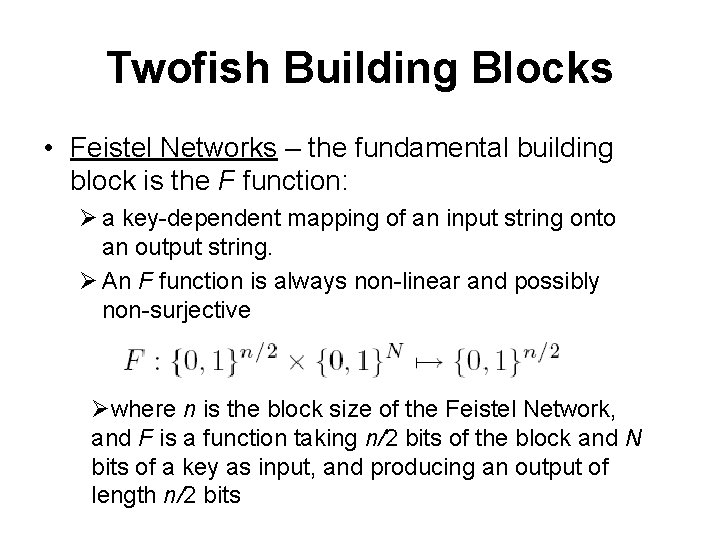
Twofish Building Blocks • Feistel Networks – the fundamental building block is the F function: Ø a key-dependent mapping of an input string onto an output string. Ø An F function is always non-linear and possibly non-surjective Øwhere n is the block size of the Feistel Network, and F is a function taking n/2 bits of the block and N bits of a key as input, and producing an output of length n/2 bits
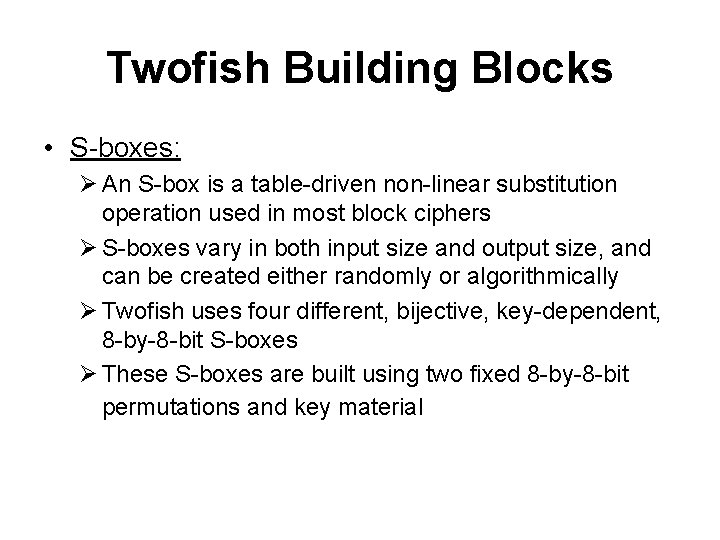
Twofish Building Blocks • S-boxes: Ø An S-box is a table-driven non-linear substitution operation used in most block ciphers Ø S-boxes vary in both input size and output size, and can be created either randomly or algorithmically Ø Twofish uses four different, bijective, key-dependent, 8 -by-8 -bit S-boxes Ø These S-boxes are built using two fixed 8 -by-8 -bit permutations and key material
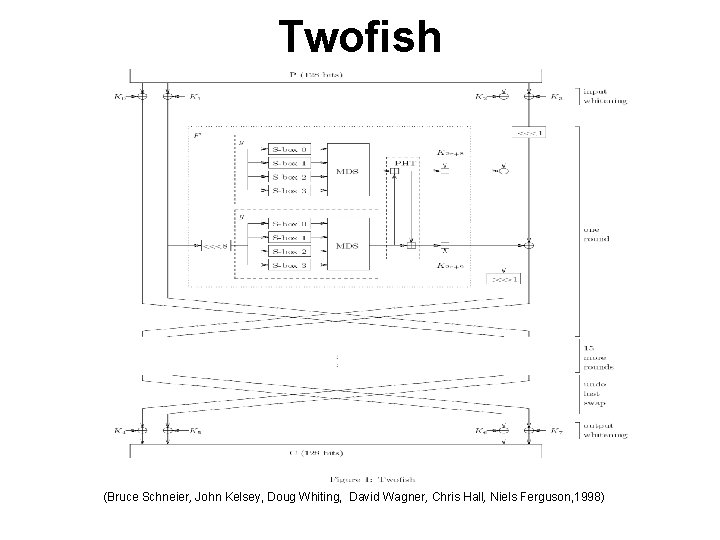
Twofish • Twofish uses a 16 -round Feistel-like structure with additional whitening of the input and output • The only non-Feistel elements are the 1 -bit rotates • The rotations can be moved into the F function to create a pure Feistel structure, but this requires an additional rotation of the words just before the output whitening step • The plaintext is split into four 32 -bit words. In the input whitening step, these are XORed with four key words. This is followed by sixteen rounds
Twofish (Bruce Schneier, John Kelsey, Doug Whiting, David Wagner, Chris Hall, Niels Ferguson, 1998)
Twofish • In each round, the two words on the left are used as input to the g functions - one of them is rotated by 8 bits first. • The g function consists of four byte-wide keydependent S-boxes, followed by a linear mixing step based on an MDS matrix • The results of the two g functions are combined using a Pseudo-Hadamard Transform (PHT), and two keywords are added • These two results are then XORed into the words on the right (one of which is rotated left by 1 bit first, the other is rotated right afterwards)
Twofish • The left and right halves are then swapped for the next round • After all the rounds, the swap of the last round is reversed, and the four words are XORed with four more key words to produce the ciphertext • the 16 bytes of plaintext p 0……… p 15 are first split into 4 words P 0, …, P 3 of 32 bits each using the little-endian convention
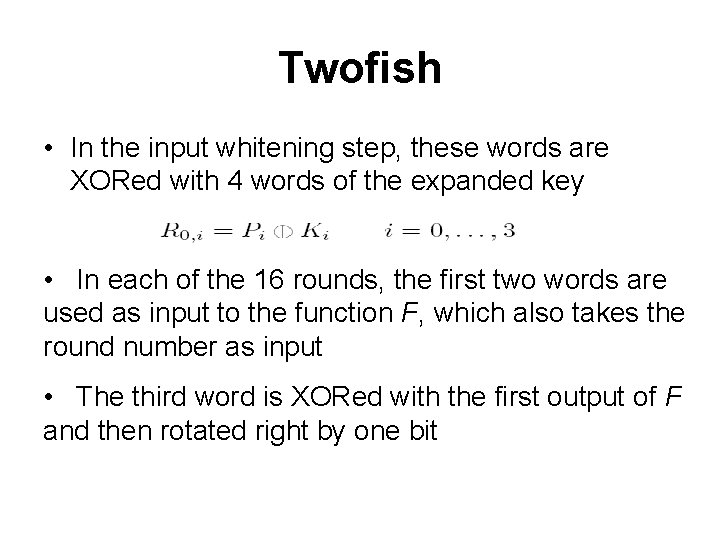
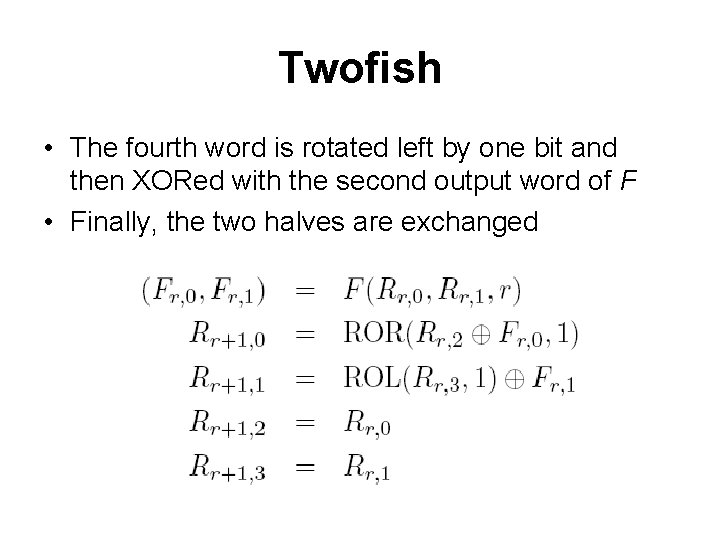
Twofish • In the input whitening step, these words are XORed with 4 words of the expanded key • In each of the 16 rounds, the first two words are used as input to the function F, which also takes the round number as input • The third word is XORed with the first output of F and then rotated right by one bit
Twofish • The fourth word is rotated left by one bit and then XORed with the second output word of F • Finally, the two halves are exchanged
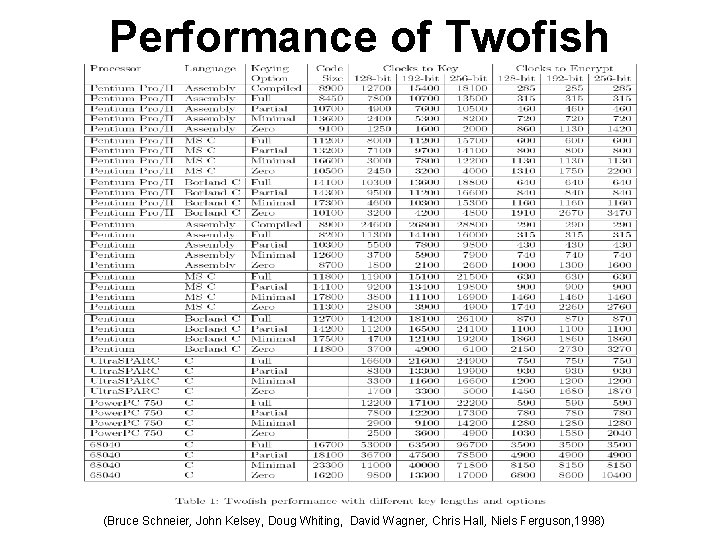
Performance of Twofish (Bruce Schneier, John Kelsey, Doug Whiting, David Wagner, Chris Hall, Niels Ferguson, 1998)
Performance of Twofish Performance on Large Microprocessors : • Full Keying - this option performs the full key precomputations • Partial Keying - for applications where few blocks are encrypted with a single key, it may not make sense to build the complete key schedule • Minimal Keying - for applications where very few blocks are encrypted with a single key, there is a further possible optimization
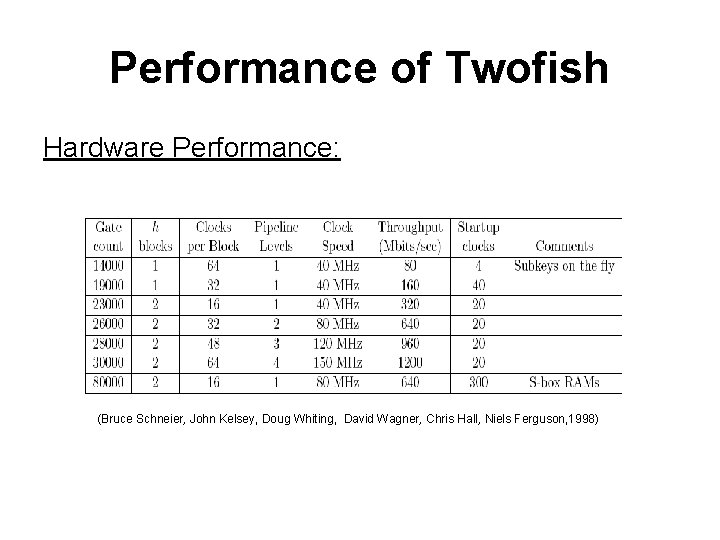
Performance of Twofish Hardware Performance: (Bruce Schneier, John Kelsey, Doug Whiting, David Wagner, Chris Hall, Niels Ferguson, 1998)