
TwoDimensional Phase Unwrapping On FPGAs And GPUs Sherman
- Slides: 21
Two-Dimensional Phase Unwrapping On FPGAs And GPUs Sherman Braganza Prof. Miriam Leeser Re. Configurable Laboratory Northeastern University Boston, MA
Outline � Introduction � Motivation � � Optical Quadrature Microscopy Phase unwrapping � Algorithms � Minimum LP norm phase unwrapping � Platforms � Reconfigurable Hardware and Graphics Processors � Implementation � FPGA and GPU specifics � Verification details � Results � Performance � Power � Cost � Conclusions and Future Work
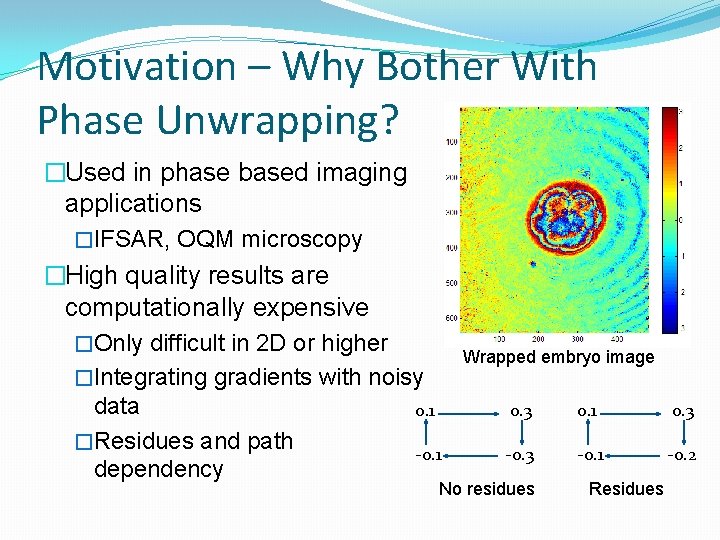
Motivation – Why Bother With Phase Unwrapping? �Used in phase based imaging applications �IFSAR, OQM microscopy �High quality results are computationally expensive �Only difficult in 2 D or higher �Integrating gradients with noisy data 0. 1 �Residues and path -0. 1 dependency Wrapped embryo image 0. 3 0. 1 0. 3 -0. 1 -0. 2 No residues Residues
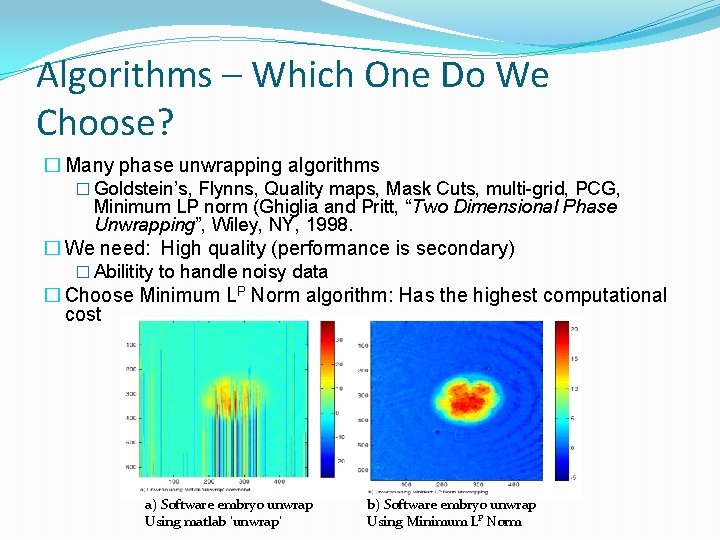
Algorithms – Which One Do We Choose? � Many phase unwrapping algorithms � Goldstein’s, Flynns, Quality maps, Mask Cuts, multi-grid, PCG, Minimum LP norm (Ghiglia and Pritt, “Two Dimensional Phase Unwrapping”, Wiley, NY, 1998. � We need: High quality (performance is secondary) � Abilitity to handle noisy data � Choose Minimum LP Norm algorithm: Has the highest computational cost a) Software embryo unwrap Using matlab ‘unwrap’ b) Software embryo unwrap Using Minimum LP Norm
Breaking Down Minimum LP Norm �Minimizes existence of differences between measured data and calculated data �Iterates Preconditioned Conjugate Gradient (PCG) � 94% of total computation time �Also iterative �Two steps to PCG � Preconditioner (2 D DCT, Poisson calculation and 2 D IDCT) � Conjugate Gradient
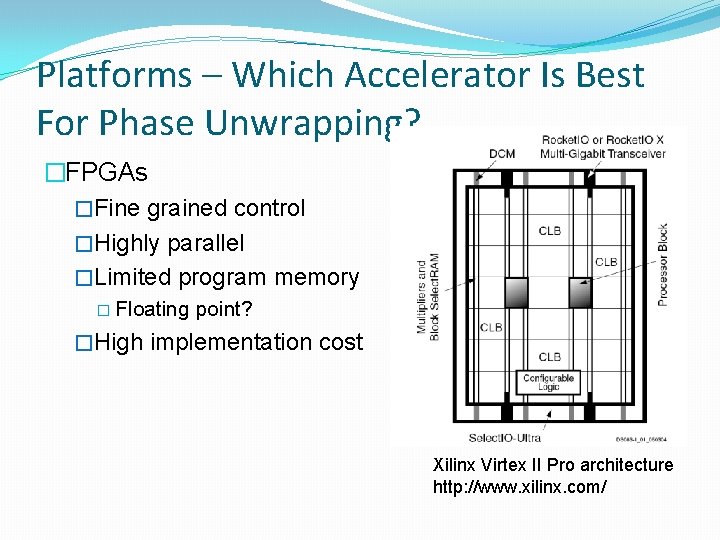
Platforms – Which Accelerator Is Best For Phase Unwrapping? �FPGAs �Fine grained control �Highly parallel �Limited program memory � Floating point? �High implementation cost Xilinx Virtex II Pro architecture http: //www. xilinx. com/
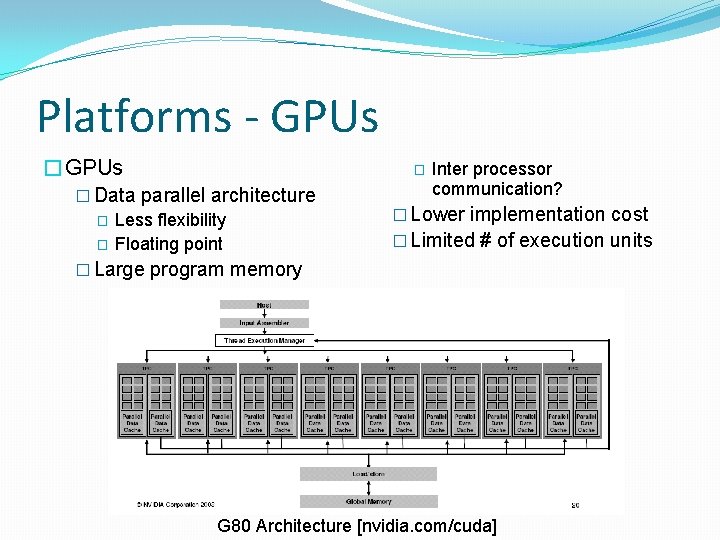
Platforms - GPUs � � Data parallel architecture � Less flexibility � Floating point � Large program memory Inter processor communication? � Lower implementation cost � Limited # of execution units G 80 Architecture [nvidia. com/cuda]
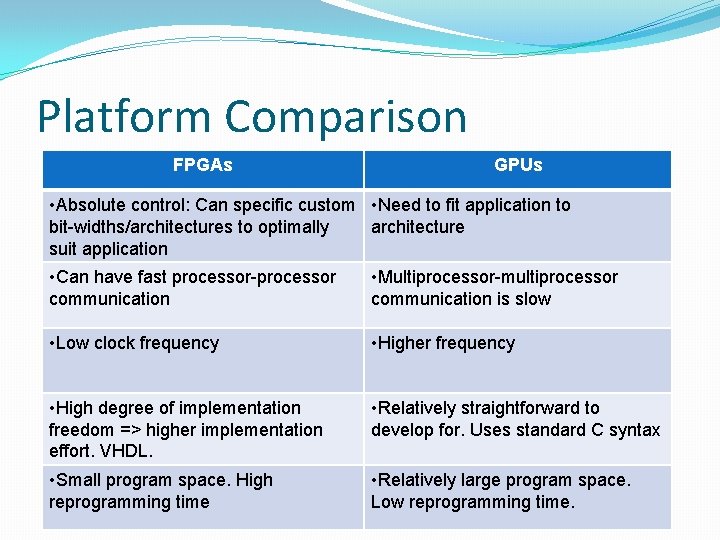
Platform Comparison FPGAs GPUs • Absolute control: Can specific custom • Need to fit application to bit-widths/architectures to optimally architecture suit application • Can have fast processor-processor communication • Multiprocessor-multiprocessor communication is slow • Low clock frequency • Higher frequency • High degree of implementation freedom => higher implementation effort. VHDL. • Relatively straightforward to develop for. Uses standard C syntax • Small program space. High reprogramming time • Relatively large program space. Low reprogramming time.
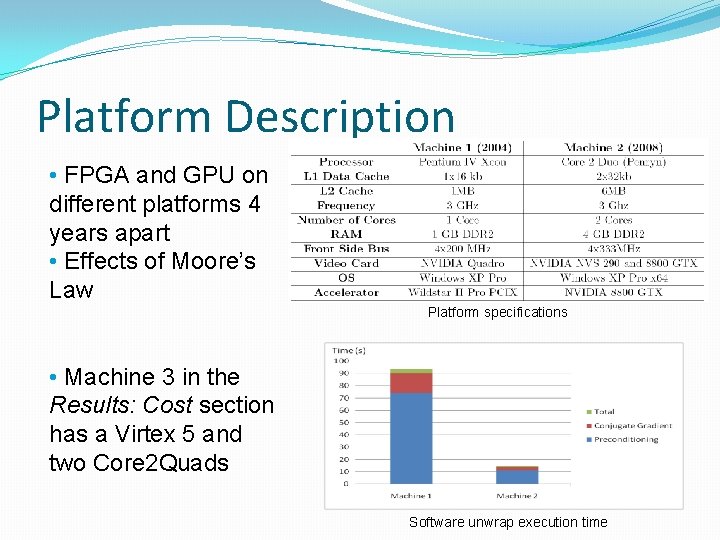
Platform Description • FPGA and GPU on different platforms 4 years apart • Effects of Moore’s Law Platform specifications • Machine 3 in the Results: Cost section has a Virtex 5 and two Core 2 Quads Software unwrap execution time
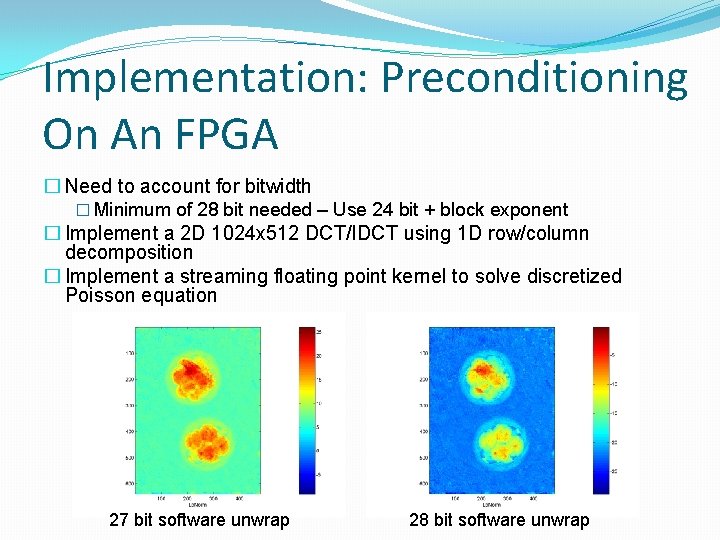
Implementation: Preconditioning On An FPGA � Need to account for bitwidth � Minimum of 28 bit needed – Use 24 bit + block exponent � Implement a 2 D 1024 x 512 DCT/IDCT using 1 D row/column decomposition � Implement a streaming floating point kernel to solve discretized Poisson equation 27 bit software unwrap 28 bit software unwrap
Minimum P L Norm On A GPU �NVIDIA provides 2 D FFT kernel �Use to compute 2 D DCT �Can use CUDA to implement floating point solver �Few accuracy issues �No area constraints on GPU �Why not implement whole algorithm? �Multiple kernels, each computing one CG or LP norm step �One host to accelerator transfer per unwrap
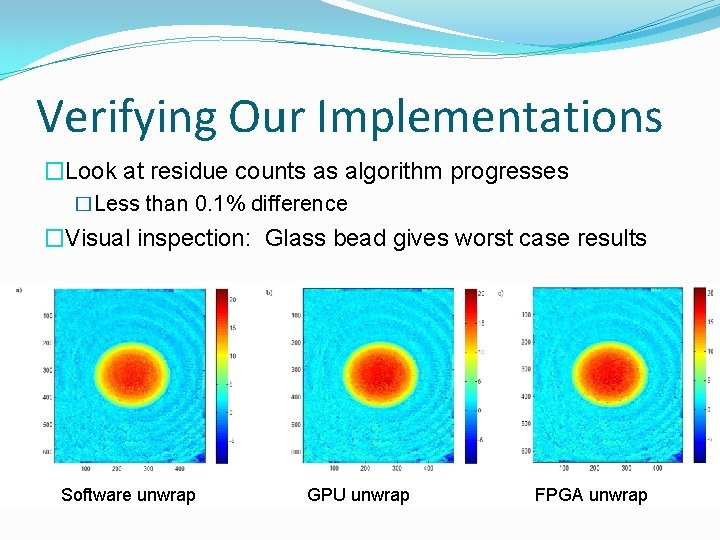
Verifying Our Implementations �Look at residue counts as algorithm progresses �Less than 0. 1% difference �Visual inspection: Glass bead gives worst case results Software unwrap GPU unwrap FPGA unwrap
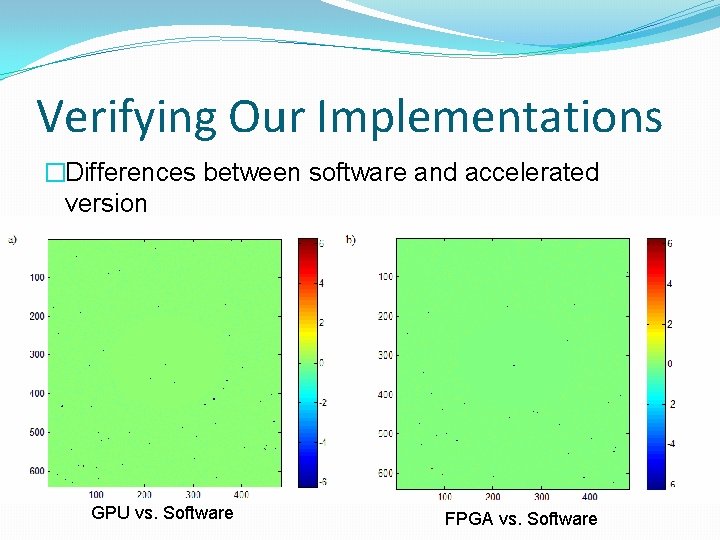
Verifying Our Implementations �Differences between software and accelerated version GPU vs. Software FPGA vs. Software
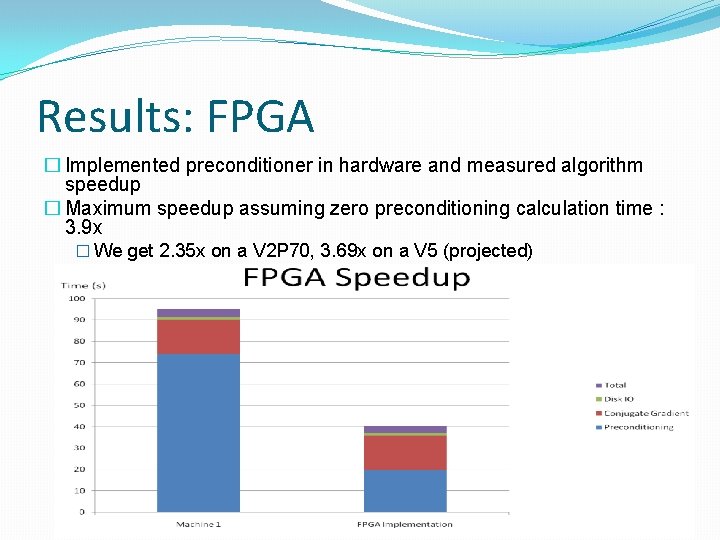
Results: FPGA � Implemented preconditioner in hardware and measured algorithm speedup � Maximum speedup assuming zero preconditioning calculation time : 3. 9 x � We get 2. 35 x on a V 2 P 70, 3. 69 x on a V 5 (projected)
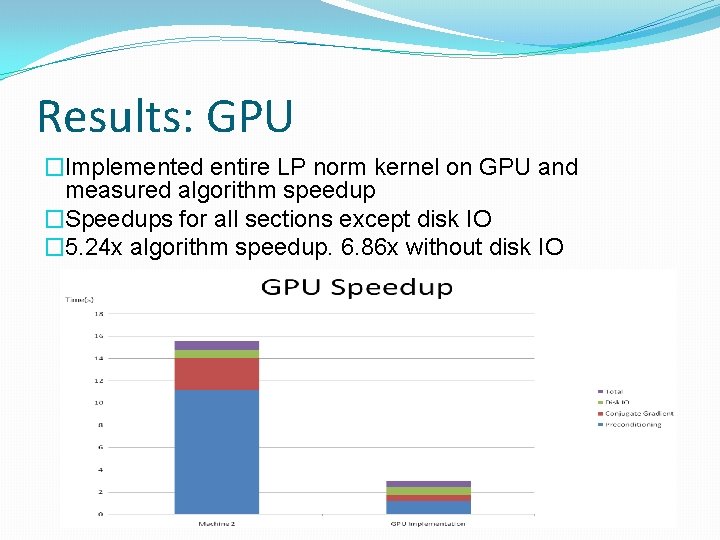
Results: GPU �Implemented entire LP norm kernel on GPU and measured algorithm speedup �Speedups for all sections except disk IO � 5. 24 x algorithm speedup. 6. 86 x without disk IO
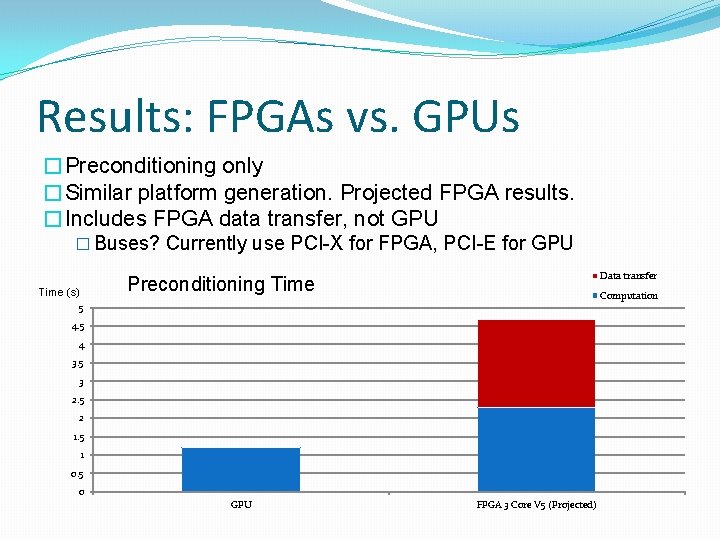
Results: FPGAs vs. GPUs �Preconditioning only �Similar platform generation. Projected FPGA results. �Includes FPGA data transfer, not GPU � Buses? Currently use PCI-X for FPGA, PCI-E for GPU Data transfer Preconditioning Time (s) Computation 5 4 3. 5 3 2. 5 2 1. 5 1 0. 5 0 GPU FPGA 3 Core V 5 (Projected)
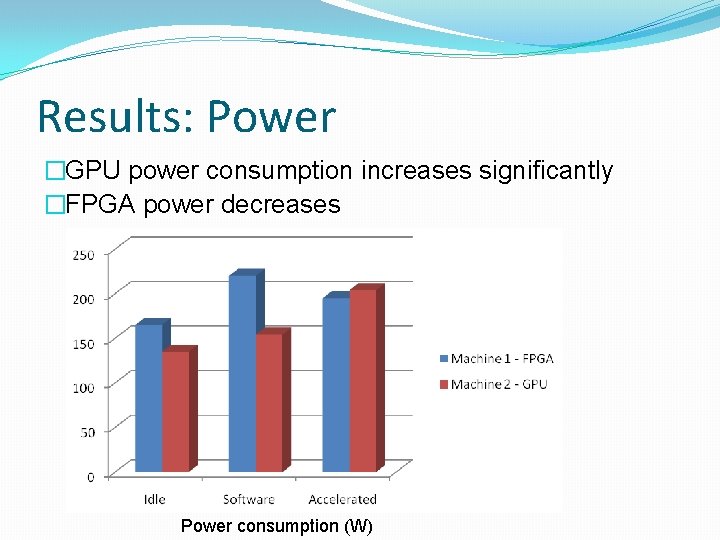
Results: Power �GPU power consumption increases significantly �FPGA power decreases Power consumption (W)
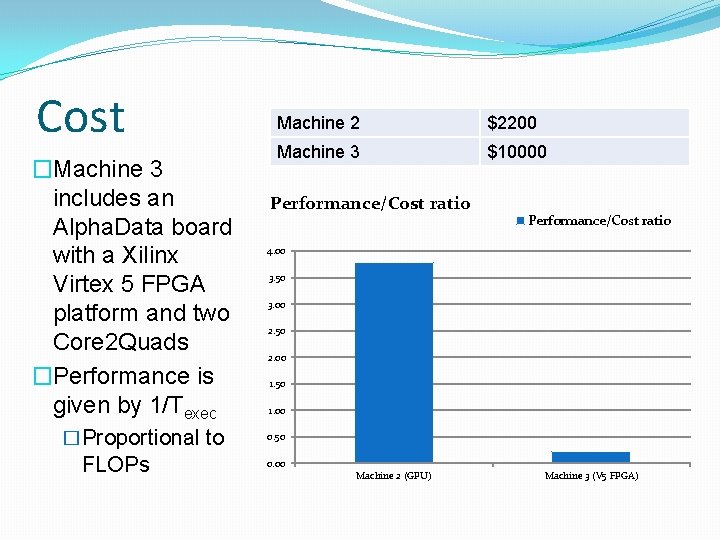
Cost �Machine 3 includes an Alpha. Data board with a Xilinx Virtex 5 FPGA platform and two Core 2 Quads �Performance is given by 1/Texec �Proportional to FLOPs Machine 2 $2200 Machine 3 $10000 Performance/Cost ratio 4. 00 3. 50 3. 00 2. 50 2. 00 1. 50 1. 00 0. 50 0. 00 Machine 2 (GPU) Machine 3 (V 5 FPGA)
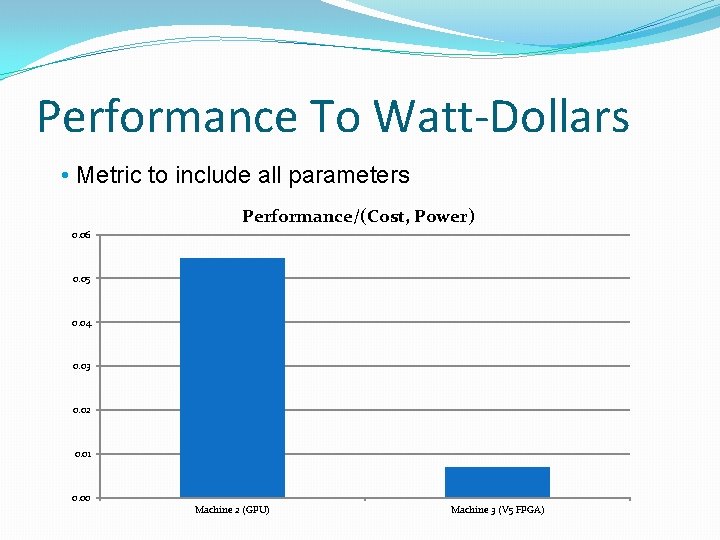
Performance To Watt-Dollars • Metric to include all parameters Performance/(Cost, Power) 0. 06 0. 05 0. 04 0. 03 0. 02 0. 01 0. 00 Machine 2 (GPU) Machine 3 (V 5 FPGA)
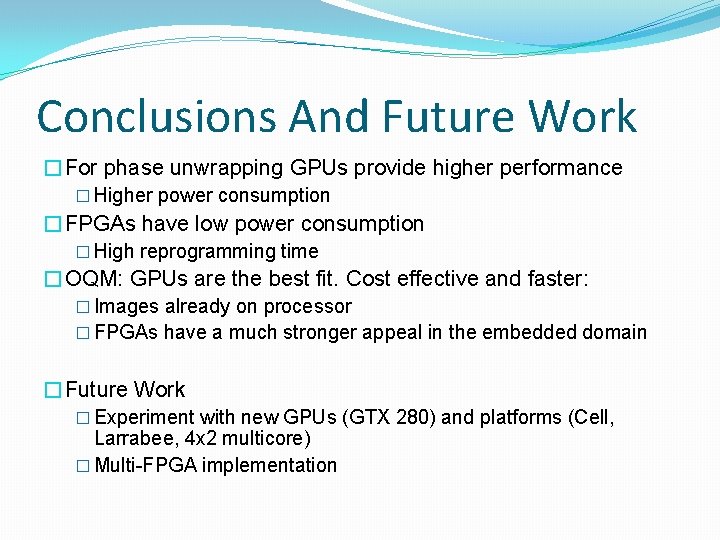
Conclusions And Future Work �For phase unwrapping GPUs provide higher performance � Higher power consumption �FPGAs have low power consumption � High reprogramming time �OQM: GPUs are the best fit. Cost effective and faster: � Images already on processor � FPGAs have a much stronger appeal in the embedded domain �Future Work � Experiment with new GPUs (GTX 280) and platforms (Cell, Larrabee, 4 x 2 multicore) � Multi-FPGA implementation
Thank You! Any Questions? Sherman Braganza (braganza. s@neu. edu) Miriam Leeser (mel@coe. neu. edu) Northeastern University Re. Configurable Laboratory http: //www. ece. neu. edu/groups/rcl