
TwoDimensional Motion and Vectors Preview Section 1 Introduction
- Slides: 11
Two-Dimensional Motion and Vectors Preview Section 1 Introduction to Vectors Section 2 Vector Operations Section 3 Projectile Motion Section 4 Relative Motion Section 1
Two-Dimensional Motion and Vectors Relative Motion Click below to watch the Visual Concept Section 4
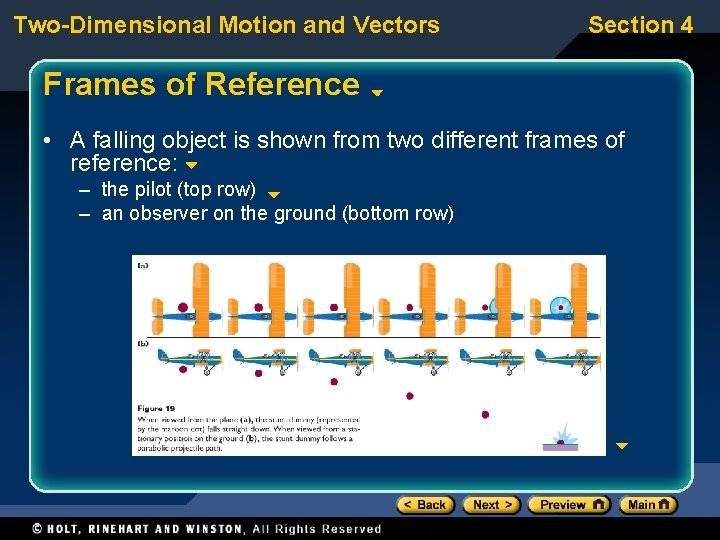
Two-Dimensional Motion and Vectors Section 4 Frames of Reference • A falling object is shown from two different frames of reference: – the pilot (top row) – an observer on the ground (bottom row)
Two-Dimensional Motion and Vectors Section 4 Relative Velocity • vac = vab + vbc – vac means the velocity of object “a” with respect to frame of reference “c” – Note: vac = -vca • When solving relative velocity problems, follow this technique for writing subscripts.
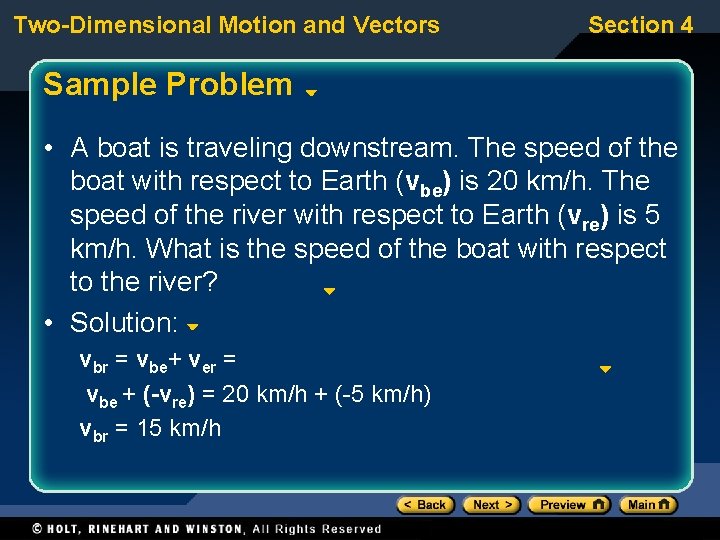
Two-Dimensional Motion and Vectors Section 4 Sample Problem • A boat is traveling downstream. The speed of the boat with respect to Earth (vbe) is 20 km/h. The speed of the river with respect to Earth (vre) is 5 km/h. What is the speed of the boat with respect to the river? • Solution: vbr = vbe+ ver = vbe + (-vre) = 20 km/h + (-5 km/h) vbr = 15 km/h
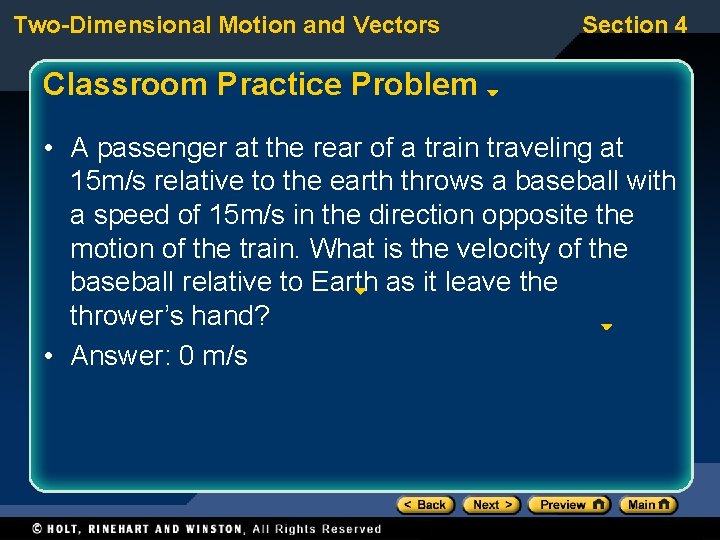
Two-Dimensional Motion and Vectors Section 4 Classroom Practice Problem • A passenger at the rear of a train traveling at 15 m/s relative to the earth throws a baseball with a speed of 15 m/s in the direction opposite the motion of the train. What is the velocity of the baseball relative to Earth as it leave thrower’s hand? • Answer: 0 m/s
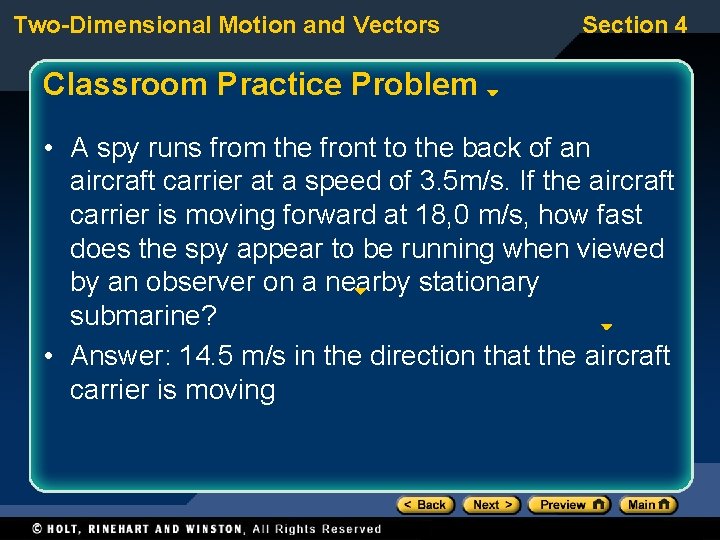
Two-Dimensional Motion and Vectors Section 4 Classroom Practice Problem • A spy runs from the front to the back of an aircraft carrier at a speed of 3. 5 m/s. If the aircraft carrier is moving forward at 18, 0 m/s, how fast does the spy appear to be running when viewed by an observer on a nearby stationary submarine? • Answer: 14. 5 m/s in the direction that the aircraft carrier is moving
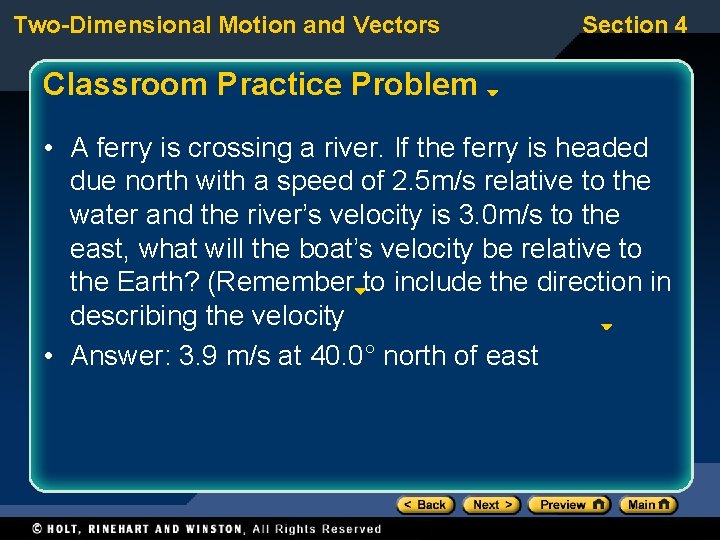
Two-Dimensional Motion and Vectors Section 4 Classroom Practice Problem • A ferry is crossing a river. If the ferry is headed due north with a speed of 2. 5 m/s relative to the water and the river’s velocity is 3. 0 m/s to the east, what will the boat’s velocity be relative to the Earth? (Remember to include the direction in describing the velocity • Answer: 3. 9 m/s at 40. 0° north of east
Two-Dimensional Motion and Vectors Section 4 Classroom Practice Problem • A passenger at the rear of a train traveling at 15 m/s relative to the earth throws a baseball with a peed of 15 m/s in the direction opposite the motion of the train. What is the velocity of the baseball relative to Earth as it leave thrower’s hand? • Answer: 565. 0 km/h at 40. 1° north of east
Two-Dimensional Motion and Vectors Section 4 Classroom Practice Problem • A pet store supply truck moves at 25. 0 m/s north along a highway. Inside, a dog moves at 1. 75 m/s at an angle 35. 0° east of north. What is the velocity of the dog relative to the road? • Answer: 26. 4 m/s at 2. 17° east of north
Two-Dimensional Motion and Vectors Section 4 Now what do you think? • Suppose you are traveling at a constant 80 km/h when a car passes you. This car is traveling at a constant 90 km/h. – How fast is it going, relative to your frame of reference? – How fast is it moving, relative to Earth as a frame of reference? • Does velocity always depend on the frame of reference? • Does acceleration depend on the frame of reference?